Apptronik

Search documents
Humanoid robot startup Apptronik has now raised $935M at a $5B+ valuation
Yahoo Finance· 2026-02-11 14:00
Core Insights - Apptronik, a University of Texas spinout, has reopened its Series A funding round to raise a total of $935 million, indicating strong investor interest in its humanoid robotics technology [1][2] - The company's post-money valuation has reached approximately $5.3 billion, reflecting a significant increase from its initial Series A valuation of around $1.75 billion [2][3] - Apptronik has successfully raised an additional $520 million from existing investors, including Google, Mercedes-Benz, and B Capital, as well as new investors, showcasing robust demand for its shares [2][5] Funding Details - The Series A round was initially set at $350 million but was expanded to $415 million due to high demand, followed by the recent additional funding [2] - The company has not actively sought funding but has responded to inbound interest, which has led to the current funding situation [4] Industry Context - Apptronik's partnership with Google DeepMind and other industry players positions it well in the field of embodied AI, which focuses on robots that can perceive and act in their environments [6] - The company has a long history in humanoid robotics, dating back to 2013, and has maintained a partnership with NASA, indicating its established presence in the industry [7]
Crypto Crashes Rattle Venture Capitalists After $19 Billion Haul
Yahoo Finance· 2026-02-09 14:56
Core Insights - Crypto venture capital funds are facing an identity crisis due to declining digital asset prices and market consolidations, revealing the industry's fragility in building sustainable businesses [1][2] - Retail traders are moving away from digital art and memecoins, with token prices crashing significantly, prompting crypto VCs to adopt a more traditional startup approach focused on product-market fit and long-term user retention [2][3] Market Performance - Bitcoin's price has dropped nearly 50% from its record high in October, while smaller altcoins have seen declines of up to 70% year over year, indicating a significant downturn in retail demand for cryptocurrencies [3] - Despite a crypto-friendly regulatory environment, the demand that previously fueled venture capital investments in tokens has diminished [3] Investment Shifts - Crypto-native funds are shifting their focus towards more stable areas such as stablecoin infrastructure and on-chain prediction markets, while also exploring adjacent sectors like fintech and AI [4][6] - Prominent crypto investment firms are pivoting towards deep tech investments, including robotics, as the focus moves away from traditional crypto sectors like NFTs and gaming [6] Fundraising Landscape - In 2025, venture firms invested $18.9 billion into crypto startups, a figure that, while substantial, is below the speculative highs of 2021 and 2022, and highlights a concentration of capital in a few major deals [7] - Nearly a third of the total VC investment in 2025 was allocated to just four deals, indicating a trend towards concentrated capital deployment in the crypto sector [7]
IDC:2025年全球人形机器人出货量接近1.8万台 同比增长约508%
Zhi Tong Cai Jing· 2026-02-09 05:50
Core Insights - The global humanoid robot market is set to reach a significant scale in 2025, with an expected shipment of nearly 18,000 units, representing a year-on-year growth of approximately 508%, and sales revenue projected at around $440 million [1] - Chinese manufacturers are leading the market with a robust manufacturing system, rapid iteration capabilities, and cost advantages, establishing a dominant position globally [2] - The market is primarily driven by bipedal humanoid robots, which contribute 66.3% of the total sales revenue, with full-sized bipedal robots accounting for 41.6% of the sales [3] Market Dynamics - In 2025, the demand for humanoid robots is mainly driven by applications in entertainment, education, and data collection, emphasizing display effects and interactive experiences [4] - The industry is transitioning from one-time hardware sales to a model that includes Robot as a Service (RaaS), operational services, and a platform ecosystem, creating conditions for scalable applications and sustained revenue [6] Technological Advancements - Humanoid robots are advancing towards engineering and scalable applications, with a focus on enhancing intelligent collaboration capabilities [7] - The integration of upper limb dexterity and the fusion of cognitive models are key breakthroughs that will enhance autonomous operations and human-robot collaboration [7]


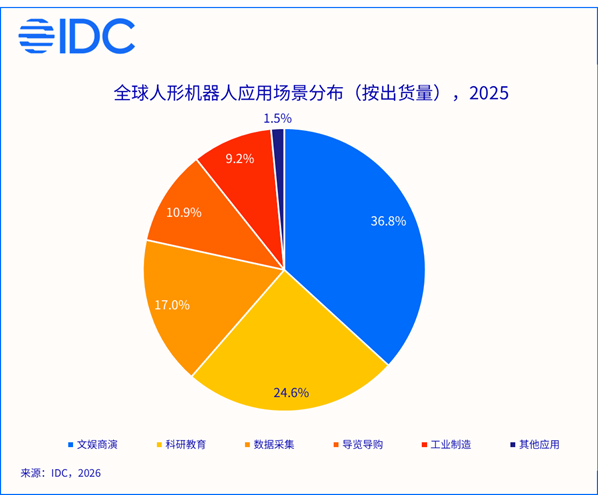
2025年全球人形机器人出货量近1.8万台 智元、宇树等中企产品占据主导
Feng Huang Wang· 2026-02-09 04:50
Core Insights - The global humanoid robot shipment is projected to reach nearly 18,000 units by 2025, representing a year-on-year growth of approximately 508%, with a market size of around $440 million [1] - Cumulative order volume is expected to exceed 35,000 units during the same period [1] Company Landscape - Chinese companies dominate the shipment volume, with Zhiyuan Robotics and Yuzhu Technology each shipping around 5,000 units [1] - Other companies such as Leju Robotics, Accelerated Evolution, and Songyan Power shipped approximately 1,000 units each [1] - Companies like Galaxy General, UBTECH, Zhongqing Robotics, and Stardust Intelligence shipped between 400 to 1,000 units [1] - Emerging companies including Xingdong Jiyuan, Magic Atom, Beijing Humanoid Robot Innovation Center, Xinghai Map, Mojia Zhichuang, and Zhujiji Power achieved shipments of over 100 units [1] - In contrast, international firms like Apptronik and Figure AI are still in pilot testing phases, with shipment volumes in the tens [1] - Tesla's humanoid robot is expected to begin large-scale production in 2026 [1] Product Form Factor - Bipedal robots (including full-size and small-to-medium size) contribute to 66.3% of market sales [1] - Full-size humanoid robots account for the highest sales proportion at 41.6%, with Zhiyuan Robotics leading in this segment [1] Industry Analysis - IDC analysis indicates that Chinese manufacturers hold a first-mover advantage in the current stage of humanoid robot commercialization due to a complete industrial chain, rapid iteration capabilities, and cost advantages [1] - Future industry competition is expected to shift from hardware sales to dimensions such as technical services and ecosystem development [1]

破釜沉舟!特斯拉斥资200亿美元将工厂改建机器人产线,马斯克:80%价值靠他它实现
Zhi Tong Cai Jing· 2026-01-30 03:37
Core Viewpoint - Tesla is shifting its focus from electric vehicles to robotics, planning to invest $20 billion this year to support this transformation, indicating a significant pivot in its business strategy [1][2]. Group 1: Financial Performance and Investment Plans - Tesla's capital expenditure decreased by 24% to $8.6 billion last year, but it is projected to more than double to over $20 billion by 2026 as the company transitions towards artificial intelligence and robotics [1][3]. - The automotive revenue, which constitutes about 70% of Tesla's business, is expected to decline by 10% in 2025 due to the lack of new electric vehicle models and increased competition, particularly from BYD in China and Volkswagen and BMW in Europe [2]. Group 2: Product Development and Future Vision - Tesla plans to end production of the Model S and Model X, which accounted for less than 3% of total deliveries last year, to repurpose the Fremont factory for producing the Optimus robot [2][4]. - Elon Musk envisions that Optimus could eventually make Tesla a $25 trillion company, with 80% of its value derived from robotics [2]. Group 3: Technological Challenges and Competition - The company faces significant competition in both robotics and autonomous driving, with rivals like Waymo and Baidu expanding their services [5]. - Tesla is also planning to establish a large-scale chip manufacturing facility, TeraFab, to ensure it can meet its hardware needs and mitigate geopolitical risks [6]. Group 4: Expansion of Services - Tesla aims to expand its Robotaxi fleet in the U.S. and is testing a fully autonomous ride-hailing service in Austin, Texas, with plans to extend this service to seven additional markets [4].
集邦咨询:预计人形机器人对固态电池的需求有望于2035年超74GWh
智通财经网· 2026-01-28 09:09
Core Insights - The development of humanoid robots is expected to reach a commercialization milestone by 2026, increasing the importance of batteries as an "energy supply" [1] - Solid-state lithium batteries are projected to become the mainstream solution due to their high energy density, with demand from humanoid robots expected to exceed 74 GWh by 2035, growing over a thousand times from 2026 [1] Group 1: Humanoid Robot Battery Market - Global humanoid robot shipments are forecasted to surpass 50,000 units in 2026, representing an annual growth of over 700% [4] - High-nickel ternary lithium batteries (NMC/NCA) are currently the mainstream choice for robot batteries due to their relatively high energy density, while lithium iron phosphate batteries (LFP) are used for lower endurance applications [4] - Most humanoid robots currently have a battery capacity below 2 kWh, with typical endurance ranging from 2 to 4 hours, such as Unitree's H1 with 0.864 kWh and Tesla's Optimus Gen2 with 2.3 kWh [4] Group 2: Challenges and Opportunities - The development of humanoid robot batteries faces two main challenges: the rapid iteration of core technologies affecting battery customization and the current focus on finding scalable commercial applications rather than improving endurance [5] - Despite these challenges, the demand for high energy density, high discharge rate, and high safety batteries in humanoid robots presents an opportunity for solid-state batteries to demonstrate their advantages [5] - Breakthroughs in solid-state battery technology and cost reductions are expected to help humanoid robots overcome power limitations [5]
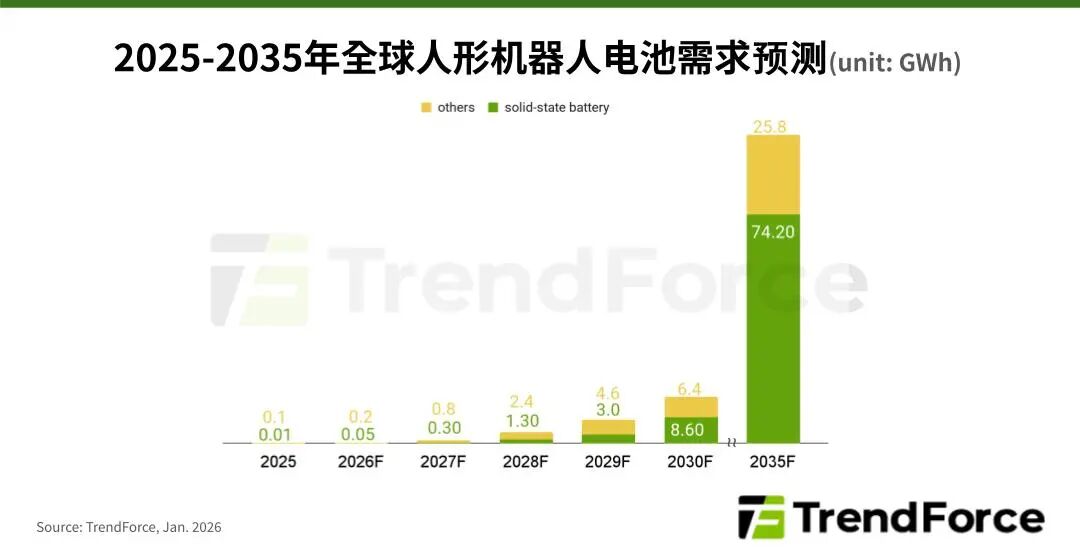
研报 | 人形机器人迈向商用化,固态电池技术将成为突破动力瓶颈的关键
TrendForce集邦· 2026-01-28 09:01
Core Insights - The article highlights the increasing importance of solid-state batteries as humanoid robots approach commercialization in 2026, with a projected demand for solid-state batteries exceeding 74 GWh by 2035, representing a growth of over 1,000 times from 2026 levels [2][5]. Group 1: Current Battery Technology - Currently, humanoid robots primarily use liquid lithium batteries, with most models having a battery capacity below 2 kWh and a runtime of 2 to 4 hours [6][8]. - High-nickel ternary lithium batteries (NMC/NCA) are the mainstream choice for robot batteries due to their relatively high energy density, while lithium iron phosphate batteries (LFP) are used for lower endurance applications [6]. Group 2: Future Developments - To achieve a runtime of 5 to 8 hours, strategies such as battery swapping technology are being explored, allowing for continuous operation without rebooting [7]. - The adoption of high energy density battery technology, such as solid-state batteries, is expected to significantly enhance the runtime of humanoid robots to over 4 hours [7]. Group 3: Challenges in Battery Development - The development of humanoid robot batteries faces two main challenges: the rapid iteration of core technologies affecting battery customization and the current focus on finding scalable commercial applications rather than improving battery life [8]. - Despite these challenges, the demand for high energy density, high discharge rate, and high safety batteries presents an opportunity for solid-state batteries to demonstrate their advantages [8].

超578亿元!2025年人形机器人融资全景回顾
机器人圈· 2026-01-14 09:27
Core Insights - The article highlights a significant increase in financing events and amounts in the humanoid robotics sector, projecting over 215 financing events and a total financing amount exceeding 578 billion RMB by 2025, marking a substantial growth compared to 2024 [3][5]. Financing Overview - The number of financing events in the humanoid robotics industry is expected to rise from 67 in 2024 to 215 in 2025, representing an increase of approximately 221% [5]. - The total financing amount is projected to grow from 110 billion RMB in 2024 to 578 billion RMB in 2025, indicating a growth rate of about 425% [5]. Notable Financing Events - RoboForce (USA) secured 10 million USD in seed funding on January 6, 2025 [6]. - Fourier (China) raised nearly 800 million RMB in an E-round on January 7, 2025 [6]. - Neura (Germany) received 120 million EUR in a B-round on January 15, 2025 [6]. - Apptronik (USA) raised 350 million USD in an A-round on February 13, 2025 [7]. - The financing event list includes various companies from different countries, showcasing a diverse investment landscape in the humanoid robotics sector [6][7].

2025,AI行业发生了什么?
经济观察报· 2026-01-12 11:48
Core Viewpoint - The AI industry has reached a significant milestone in 2025, marked by technological innovations, business model transformations, and global regulatory dynamics [5]. Group 1: Multi-Modal Integration - AI models have rapidly advanced in text and reasoning but have lagged in multi-modal capabilities, limiting their effectiveness [8]. - By 2025, developers shifted from "assembly-style" models to designing "native multi-modal" models that can process text, images, audio, and video simultaneously [9]. - The development of multi-modal models is becoming a primary battleground for leading AI companies, enhancing the practical application and popularization of AI technology [10]. Group 2: Embodied Intelligence - The focus of embodied AI has shifted from experimental demonstrations to market-ready solutions, with companies announcing mass production of robots [12]. - The cost of humanoid robots has significantly decreased, making them more accessible for commercial use [13]. - The rise of embodied intelligence is driven by advancements in multi-modal AI and increasing labor costs, leading to a growing demand for robotic solutions in various sectors [14]. Group 3: Computing Power Competition - The competition for computing power has evolved from a focus on acquiring GPUs to a more complex, efficiency-driven battle [16]. - Companies are beginning to develop their own chips to reduce reliance on dominant suppliers like NVIDIA [16]. - AI infrastructure is being designed specifically for AI workloads, indicating a shift towards a more integrated approach to computing resources [17]. Group 4: Paradigm Controversy - There is a growing debate in the theoretical community regarding the validity of the "scale law" that has dominated AI development, with some experts suggesting that simply increasing model size may not lead to better outcomes [19]. - Opposing views exist, with some researchers arguing that larger models still play a crucial role in advancing AI capabilities [20]. Group 5: Rise of Agents - The emergence of AI agents, capable of understanding tasks and executing operations autonomously, signifies a shift in human-computer interaction [22]. - This new model allows users to focus on goals rather than navigating complex interfaces, reducing the learning curve [22]. - The rise of agents is facilitated by advancements in large models and standardized protocols for tool integration [23]. Group 6: Open Source Renaissance - Open-source models have become a foundational infrastructure for global innovation, increasingly rivaling closed-source systems in performance and adoption [26]. - The rise of open-source is attributed to the need for rapid customization and community collaboration, making it a practical choice for many developers [27]. Group 7: Business Innovation - The AI industry is transitioning from a focus on technology competition to a clearer division of labor within the ecosystem, with companies finding monetization strategies that align with their capabilities [29]. - The commercialization of AI capabilities is evolving, with a shift towards "Outcome-as-a-Service" models that prioritize task completion over mere functionality [30]. Group 8: Regulatory Dynamics - AI governance has become a critical area of focus, balancing innovation with the need for regulatory frameworks that adapt to evolving technologies [33]. - Different regions are adopting varied approaches to governance, reflecting their unique priorities and regulatory philosophies [34]. Group 9: Great Power Competition - The international competition in AI has escalated to a national level, with countries vying for leadership in defining technological paths and standards [36]. - The competition is characterized by interdependence, as nations rely on each other's capabilities while competing for dominance in AI technology and supply chains [37]. Group 10: Youth Leadership - A trend of young scientists taking on leadership roles in major companies is emerging, reflecting a shift in the industry towards innovative thinking and agile decision-making [39]. - This generational change is crucial as the industry navigates the complexities of AI development and seeks to redefine its future [40].
2025,AI行业发生了什么?
Jing Ji Guan Cha Bao· 2026-01-10 09:01
Core Insights - The AI industry experienced significant milestones in 2025, marked by technological innovations, business model transformations, and global regulatory dynamics [2] Group 1: Multi-Modal Integration - AI models have advanced rapidly in text and reasoning but lagged in multi-modal capabilities, limiting their effectiveness [4] - Developers are shifting from "assembled" models to "native multi-modal" models that can process text, images, audio, and video simultaneously [5] - The development of multi-modal models is becoming a primary focus for leading AI companies, enhancing their ability to perform real-world tasks [5][6] Group 2: Embodied Intelligence - The focus of embodied AI has shifted from experimental demonstrations to market-ready solutions, with companies announcing mass production of robots [8] - The cost of humanoid robots has significantly decreased, making them more accessible for commercial use [9] - The rise of embodied intelligence is driven by advancements in multi-modal AI and increasing labor costs, leading to greater demand for robotic solutions [9] Group 3: Computing Power Competition - The competition for computing power has evolved from a focus on acquiring GPUs to a more complex, efficiency-driven battle [10] - Companies are now prioritizing how to effectively utilize limited computing resources rather than just increasing their total computing power [10] - Some developers are moving towards self-developed chips to reduce reliance on dominant suppliers like NVIDIA [10] Group 4: Paradigm Controversy - There is a growing debate in the theoretical community regarding the "scale law" that has traditionally guided AI development [12] - Some experts argue that simply increasing model size does not lead to general intelligence, suggesting a need for new training paradigms and reasoning mechanisms [13] - Despite differing opinions, both sides recognize the need for a reevaluation of existing paradigms to find better development paths [13] Group 5: Rise of Agents - The emergence of AI agents, capable of executing complex tasks autonomously, signifies a shift in human-computer interaction from function-driven to task-driven systems [14][15] - This transition is expected to reshape organizational structures and business models, focusing on task completion rather than capability provision [15] Group 6: Open Source Renaissance - Open-source models have become a foundational infrastructure for global innovation, increasingly rivaling closed-source systems in performance and adoption [16] - The rise of open-source is attributed to changing AI innovation logic, where community collaboration and rapid customization are prioritized [17] Group 7: Business Innovation - The AI industry is moving towards clearer business paths, with different players finding monetization strategies that align with their capabilities [18] - The concept of "Outcome-as-a-Service" is gaining traction, shifting the focus from selling functionalities to delivering task completion [19] Group 8: Regulatory Dynamics - AI governance has become a critical area of focus, balancing innovation with regulatory frameworks to avoid stifling technological development [20] - Different regions are adopting varied approaches to governance, reflecting their priorities and institutional frameworks [21][22] Group 9: International Competition - The competition in AI has escalated from corporate to national levels, with countries vying for leadership in defining technological paths and standards [23] - The U.S. maintains a strong position in core technologies, while China focuses on optimizing existing frameworks for scalable applications [23][24] Group 10: Youth Leadership - A trend of young scientists gaining significant influence in AI companies is emerging, reflecting a shift in the industry's leadership dynamics [25][26] - This generational change is seen as essential for navigating the evolving landscape of AI, where innovative problem definition and evaluation are crucial [26]