
科顺股份

Search documents
科顺股份(300737) - 第四届董事会第十七次会议决议公告
2025-10-24 10:15
证券代码:300737 证券简称:科顺股份 公告编号:2025-055 债券代码:123216 债券简称:科顺转债 科顺防水科技股份有限公司 第四届董事会第十七次会议决议公告 本公司及董事会全体成员保证信息披露的内容真实、准确、完整,没有虚假 记载、误导性陈述或重大遗漏。 一、会议召开情况 科顺防水科技股份有限公司(以下简称"公司")第四届董事会 第十七次会议于 2025 年 10 月 24 日在公司会议室以现场和通讯方式 召开,会议通知已于 2025 年 10 月 20 日发出。本次会议应出席的董 事 7 人,实际出席并参与表决的董事 7 人,会议由董事长陈伟忠先生 主持,公司董事会秘书、高级管理人员列席会议。本次会议的召开符 合《中华人民共和国公司法》和《公司章程》的有关规定。 二、会议表决情况 经参会董事审议,依法表决,本次会议审议通过了以下议案: (一)审议通过《关于公司 2025 年第三季度报告的议案》 表决结果:同意票 7 票,反对票 0 票,弃权票 0 票。 (二)审议通过《关于新增开设募集资金专户并授权签订三方监 管协议的议案》 董事会同意公司新增开设募集资金专项账户,用于部分闲置募集 资金暂 ...
科顺股份(300737) - 2025 Q3 - 季度财报
2025-10-24 10:15
Financial Performance - The company's operating revenue for Q3 2025 was ¥1,483,062,678.37, a decrease of 10.93% compared to ¥1,665,089,100.96 in the same period last year[4] - The net profit attributable to shareholders was a loss of ¥26,867,434.80, compared to a profit of ¥32,331,141.66 in the previous year, marking an 84.08% decline[4] - Total operating revenue for the period was ¥4,703,183,816.72, a decrease of 8.4% from ¥5,136,038,704.94 in the previous period[19] - Net profit for the period was ¥12,017,567.80, a significant decline of 89.9% compared to ¥119,445,756.78 in the previous period[20] - The total comprehensive income for the period was ¥11,138,352.03, down from ¥117,848,055.51 in the previous period[21] - Basic and diluted earnings per share were both ¥0.02, down from ¥0.11 in the previous period[21] Cash Flow - The net cash flow from operating activities improved by 46.03%, reaching -¥823,918,265.17, compared to -¥1,526,535,558.89 in the same period last year[7] - Cash flow from operating activities was ¥4,867,993,131.07, down from ¥5,047,425,383.47 in the previous period[23] - The net cash flow from operating activities was -$823.92 million, an improvement from -$1.53 billion in the previous period, indicating a reduction in cash outflow[24] - Total cash inflow from investment activities was $3.99 billion, compared to $3.05 billion in the prior period, reflecting a significant increase[25] - The net cash flow from financing activities was $35.70 million, a sharp decline from $1.18 billion in the previous period, suggesting reduced financing activities[25] - Cash received from other operating activities was $140.89 million, slightly up from $138.70 million in the previous period[24] Assets and Liabilities - The total assets at the end of the reporting period were ¥15,001,090,022.07, reflecting a 6.06% increase from ¥14,043,623,151.24 at the end of the previous year[4] - The company's total current assets reached CNY 10,656,109,092.13, up from CNY 9,920,020,650.34, indicating a growth of around 7.44%[14] - The company's non-current assets totaled CNY 4,344,980,929.94, compared to CNY 4,224,592,457.46, marking an increase of approximately 2.84%[15] - The company's total liabilities increased to CNY 10,000,000,000, indicating a rise in financial obligations[15] - The total liabilities increased to ¥10,376,888,759.45 from ¥9,077,530,671.29, reflecting a growth of 14.3%[17] - The total equity attributable to shareholders decreased to ¥4,541,061,626.92 from ¥4,982,499,577.27, a decline of 8.8%[17] Shareholder Information - The number of ordinary shareholders at the end of the reporting period was 30,068, with no preferred shareholders[8] - The company reported a total of 223,065,137 shares with restrictions, with no shares released during the period[11] - The company has a significant shareholder structure, with the top 10 shareholders holding a combined 68.15% of the total shares[10] Cost Management - Total operating costs amounted to ¥4,481,630,053.01, down 8.6% from ¥4,905,352,316.82 in the previous period[19] - The company reported a decrease in research and development expenses to ¥198,635,190.15 from ¥190,968,786.07, an increase of 4.4%[19] - The financial expenses decreased significantly to ¥39,558,165.01 from ¥69,842,761.71, a reduction of 43.4%[20] - Cash paid for purchasing goods and services decreased to $4.83 billion from $5.62 billion, showing improved cost management[24] Investment Activities - The company received $3.84 billion in cash from investment recoveries, up from $3.03 billion in the prior period, indicating strong investment recovery performance[24] - The total cash outflow from investment activities was $3.91 billion, compared to $2.87 billion in the previous period, indicating increased investment spending[25] Other Financial Metrics - The weighted average return on equity decreased to -0.58% from 0.64% in the same period last year[4] - The company reported a basic earnings per share of -¥0.02, down from ¥0.03 in the previous year, representing an 81.82% decline[4] - Non-recurring gains and losses totaled ¥17,220,806.37 for the current period, with significant contributions from asset disposal and government subsidies[5] - The company has not identified any items that would be classified as recurring gains or losses under the relevant regulations[6] - Cash and cash equivalents rose to CNY 4,205,364,047.45 from CNY 3,416,078,844.83, an increase of about 23.12%[14] - Short-term borrowings surged to CNY 3,241,122,802.09 from CNY 1,377,572,651.30, reflecting a significant increase of approximately 135.06%[15] - The accounts receivable slightly decreased to CNY 4,070,191,800.41 from CNY 4,072,793,425.11, a marginal decline of about 0.07%[14] - The inventory balance increased to CNY 516,119,148.80 from CNY 501,975,812.22, reflecting a growth of about 2.81%[14] - The company experienced a negative impact of -$1.27 million from foreign exchange fluctuations on cash and cash equivalents[25]
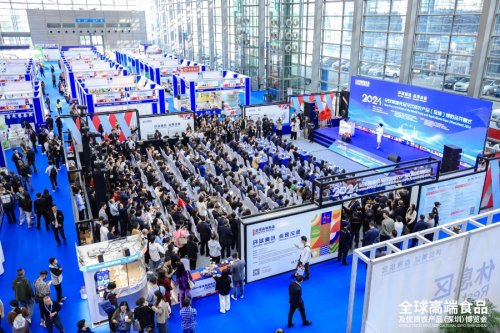
讯推科技2025年赋能食博会,助力品牌营销增长
Zhong Guo Shi Pin Wang· 2025-10-24 07:52
Group 1: Event Overview - The 2025 Global High-end Food and Quality Agricultural Products Expo will be held from October 22 to 24, 2025, at the Shenzhen Convention and Exhibition Center [1] - The expo aims to build a "big food" ecosystem, leveraging the industrial resource advantages of the Greater Bay Area, covering ten specialized exhibition areas [1] Group 2: Company Participation - XunTui Technology Co., Ltd. has become a comprehensive digital operation service provider for brands, participating in the expo to empower enterprises [3] - The company addresses the challenges faced by exhibitors in both domestic and international markets, including unstable international environments and changing domestic consumption structures [3] Group 3: Digital Marketing Solutions - XunTui Technology offers a comprehensive digital operation plan that includes various online marketing strategies such as Douyin operation promotion, WeChat video account promotion, Google SEO optimization, and overseas social media operation [3][6] - The company utilizes big data analysis to understand product characteristics and potential customer needs, providing customized execution plans for exhibitors [4] Group 4: Industry Impact - The marketing strategies implemented by XunTui Technology received recognition from exhibitors, indicating a successful expo that opened new online marketing channels for food enterprises [4] - The company has provided tailored online marketing solutions to over 10,000 enterprises across various industries, including intelligent manufacturing, new materials, and fast-moving consumer goods [6]

资金高切低+格局优化,推荐消费建材板块
CAITONG SECURITIES· 2025-10-19 10:53
Core Insights - The report maintains a positive outlook on the building materials sector, highlighting a shift in capital towards domestic demand-driven segments due to ongoing U.S.-China tariff tensions and a focus on defensive investments [4] - The competitive landscape within the consumer building materials sector is improving, with leading companies expected to gain market share as smaller firms exit the market due to financial strain [4] - The report emphasizes the potential for a recovery cycle in profitability for leading companies in the building materials sector, particularly in coatings and waterproofing segments, as price stabilization is observed [4] Market Performance - The building materials sector has shown a performance of -9% over the last 12 months, compared to the Shanghai Composite Index's -3% and the CSI 300's 4% [2][4] Recommendations - The report recommends prioritizing investments in leading companies within the building materials sector, specifically mentioning Sanke Tree, Oriental Yuhong, Rabbit Baby, and Keshun Co., as they are expected to benefit from the ongoing market consolidation [4] - For the cement sector, the report suggests a wait-and-see approach until supply-side improvements materialize, with a focus on Huaxin Cement and a watch on Shangfeng Cement and Tapai Group [4]


阿克苏诺贝尔、立邦......化工龙头集体押注这一新材料赛道
DT新材料· 2025-10-17 16:07
Core Viewpoint - The article emphasizes that energy conservation and emission reduction are becoming the strongest innovation drivers in the materials industry, particularly highlighting the emerging technology of Radiative Cooling, which allows materials to cool themselves without energy input [2][4]. Group 1: Industry Trends - The Radiative Cooling technology is inspired by natural phenomena, where the Earth's surface radiates heat into space at night, leading to lower temperatures than surrounding air [2]. - This technology is advancing from a "material-based" phase to an "application-oriented, system-driven" engineering transformation phase, integrating passive cooling functions into various applications such as vehicle cooling and electronic device thermal management [4]. Group 2: Company Developments - Nippon Paint has launched a Radiative Cooling exterior wall coating system that can reduce surface temperatures by 5-8°C compared to traditional exterior paints under strong sunlight [6]. - Three Trees has developed a series of Radiative Cooling coatings that outperform traditional insulation paints in reducing air conditioning energy consumption [8]. - Carpoly's innovative nano self-cleaning cooling coating combines self-cleaning and cooling effects, maintaining long-term reflective performance [9]. - AkzoNobel has a mature layout in exterior wall insulation systems, focusing on a reflective and radiative cooling system for energy efficiency [10]. - Meitu's high-reflective non-electric cooling coating can lower surface temperatures by over 7°C in summer compared to conventional white paint [11]. - Yashi Chuangneng focuses on passive energy-saving materials, developing a Radiative Cooling coating that integrates with waterproof and insulation systems [13]. - Fustar emphasizes a non-electric cooling coating that achieves surface cooling of 4-6°C without energy consumption [15]. - Valspar's research in passive cooling focuses on high-reflective resin systems for industrial roofs and energy storage stations [17]. - Moguang New Energy's water-based Radiative Cooling coating balances environmental friendliness and efficient cooling [19]. - Keshun is developing self-cleaning Radiative Cooling coatings suitable for roofs and curtain walls [21]. - Zhongxi Yitu's rare earth Radiative Cooling coating significantly enhances cooling efficiency through high emissivity in the infrared band [24]. - Chuangleng Technology specializes in non-electric cooling paints for vehicles, achieving temperature reductions of 5-10°C [26]. - Weilan Times is developing Radiative Cooling coatings for various applications, including building rooftops and photovoltaic supports [28]. - Yuangjingang New Materials is known for its super-hydrophobic Radiative Cooling coatings that maintain high reflectivity [30]. - Hongleng Technology focuses on passive Radiative Cooling coatings with multi-layer nano-structure designs for various applications [32]. - Zhongjian Photon is developing self-cleaning Radiative Cooling coatings for large buildings and transportation hubs [33]. - Zhongjian Southwest Institute and Zhongnan Building Materials are collaborating on integrated design for energy-saving building materials [35].
国泰海通建材鲍雁辛一周观点:内需避险或是TACO交易都只是价值发现的一个过程-20251015
Haitong Securities· 2025-10-15 13:51
Investment Rating - The report maintains a positive investment outlook on the construction materials industry, highlighting specific companies as key recommendations for investment opportunities [2][6][19]. Core Insights - The report emphasizes that both domestic demand hedging and TACO trading are merely processes of value discovery, suggesting that companies with high economic prospects and room for valuation growth will accelerate price discovery [2][3]. - It identifies a shift in focus towards companies that are expected to show resilience and growth potential, particularly in the context of domestic demand recovery and global demand expectations [4][12]. Summary by Sections Domestic Demand Hedging - Companies recommended under domestic demand hedging include Oriental Yuhong, Hanhigh Group, and Huaxin Cement, which are expected to show positive revenue trends in Q3 [2][4]. - The report highlights the importance of infrastructure projects in regions like Xinjiang, predicting a significant increase in cement demand due to major construction initiatives [7][9]. TACO Trading - The report suggests that the glass fiber and CCL industry chain will benefit from global demand expectations, with price increases observed in electronic fabrics and copper-clad laminates [3][5]. - Key companies in this segment include China Jushi and Zhongcai Technology, which are positioned to capitalize on the ongoing price increase cycle [6][15]. Cement Industry - The cement sector is noted for its potential growth driven by policy execution and governance improvements, with overseas expansion opportunities highlighted for companies like Huaxin Cement [34][38]. - The report indicates that the cement market is entering a phase of price stabilization, with a focus on limiting overproduction and enhancing governance [35][41]. Glass and Fiberglass - The glass sector is experiencing a recovery, particularly in photovoltaic glass, with companies like Fuyao Glass and Xinyi Glass expected to see improved profitability [10][12]. - The report notes that the fiberglass sector is witnessing a strong performance, with significant contributions from price increases in electronic fabrics [10][14]. Consumer Building Materials - The consumer building materials segment is showing signs of recovery, with companies like Sanke Tree and Beixin Building Materials expected to benefit from improved revenue performance in Q3 [19][25]. - The report emphasizes the importance of cost reduction and price stabilization in enhancing profitability for companies in this sector [26][27]. Key Recommendations - The report recommends focusing on companies with strong fundamentals and growth potential, such as China Jushi, Huaxin Cement, and Oriental Yuhong, as they are expected to outperform in the current market environment [6][17][19].



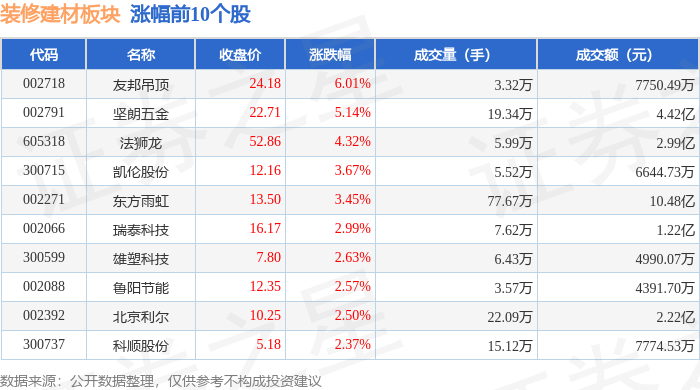
装修建材板块10月15日涨1.11%,友邦吊顶领涨,主力资金净流入9268.84万元


Zheng Xing Xing Ye Ri Bao· 2025-10-15 08:37
Market Performance - The renovation and building materials sector rose by 1.11% on October 15, with Youbang Ceiling leading the gains [1] - The Shanghai Composite Index closed at 3912.21, up 1.22%, while the Shenzhen Component Index closed at 13118.75, up 1.73% [1] Top Gainers in the Sector - Youbang Ceiling (002718) closed at 24.18, up 6.01% with a trading volume of 33,200 lots and a transaction value of approximately 77.50 million yuan [1] - Jianlang Hardware (002791) closed at 22.71, up 5.14% with a trading volume of 193,400 lots [1] - Fashilong (605318) closed at 52.86, up 4.32% with a trading volume of 59,900 lots and a transaction value of approximately 299 million yuan [1] Sector Fund Flow - The renovation and building materials sector saw a net inflow of 92.69 million yuan from institutional investors, while retail investors experienced a net outflow of 129 million yuan [2] - The sector's main funds showed a mixed trend, with some companies attracting significant net inflows while others faced outflows [3] Notable Stocks with Fund Flow - Beixin Building Materials (000786) had a net inflow of approximately 36.81 million yuan from main funds, but a net outflow of 45.10 million yuan from retail investors [3] - Jianlang Hardware (002791) attracted a net inflow of about 30.89 million yuan from main funds, with a net outflow of 33.69 million yuan from retail investors [3] - San Ke Tree (603737) saw a net inflow of 12.85 million yuan from main funds, but also faced a net outflow of 11.04 million yuan from retail investors [3]
2025年上海市建筑防水卷材产品质量监督抽查结果公布
Zhong Guo Zhi Liang Xin Wen Wang· 2025-10-13 09:05
Core Viewpoint - The Shanghai Municipal Market Supervision Administration conducted a quality inspection of building waterproofing materials, revealing that all 15 batches tested were compliant with relevant standards, indicating a strong quality assurance in the local market [1] Group 1: Inspection Results - A total of 15 batches of waterproofing materials were sampled, with no non-compliant products found [1] - The inspection included 14 batches from local Shanghai manufacturers and 1 batch from an external province [1] - The inspection was conducted according to the SHSSXZ0013-2025 guidelines for product quality supervision [1] Group 2: Product Details - Various types of waterproofing materials were tested, including SBS modified asphalt and polymer modified asphalt products [1] - The production dates of the tested samples ranged from March to May 2025, showcasing recent manufacturing activity [1] - Notable manufacturers involved in the inspection included Shanghai Oriental Yuhong Waterproof Technology Co., Ltd. and Shanghai North New Moon New Materials Group Co., Ltd. [1]
反内卷效果逐显,持续重点推荐青鸟消防
HUAXI Securities· 2025-10-13 08:10
Investment Rating - The industry rating is "Recommended" [4] Core Views - The report highlights the benefits of the new national fire safety standards and the commercialization of fire-fighting robots, recommending Qingniao Fire Protection as a leading beneficiary [6] - The cement industry is experiencing self-discipline and price increases under the "anti-involution" initiative, with recommendations for Huaxin Cement and Conch Cement [6] - The photovoltaic glass industry is seeing price increases from a bottoming out, with recommendations for Qibin Group, Fuyao Glass, and Xinyi Solar [6] - The report emphasizes the high demand for specialty electronic fabrics, recommending China Jushi, China National Materials, and International Composites [6] - The report suggests investing in companies with strong operational resilience and high dividends, such as Weixing New Materials and Tubao [6] Summary by Sections Cement Industry - National cement market prices decreased by 0.4% week-on-week, with average shipment rates below 45% in key regions [2][28] - Price adjustments varied by region, with increases in Hebei and Jiangxi, while declines were noted in Beijing, Tianjin, Jiangsu, Zhejiang, and Anhui [2][28] - The report anticipates continued price fluctuations in the cement market due to insufficient demand support [28] Glass Industry - The average price of float glass increased to 1289.81 CNY/ton, a rise of 5.31% from the previous week [2][67] - The industry maintains a production capacity utilization rate of 82.20%, with no significant changes in production lines [67] Real Estate Market - In the 41st week, new home transaction volume in 30 major cities decreased by 46% year-on-year and 33.94% month-on-month [3][23] - The report indicates a slight improvement in second-hand housing transactions in 15 monitored cities, with a year-on-year increase of 15% [3][23] Specialty Electronic Fabrics - China Jushi reported a revenue of 9.109 billion CNY in the first half of 2025, a year-on-year increase of 17.70% [6] - The company is advancing low-dielectric product development, with significant growth in net profit [6] Investment Opportunities - The report identifies investment opportunities in regions like Xinjiang due to increased infrastructure investments related to the 70th anniversary celebrations [7] - Recommendations include companies like Tianshan Shares and Xinjiang Jiaojian, which are expected to benefit from regional investments [7]

东方雨虹20251011
2025-10-13 01:00
Summary of Dongfang Yuhong Conference Call Company Overview - **Company**: Dongfang Yuhong - **Industry**: Waterproofing materials within the construction materials sector Key Points and Arguments Industry Dynamics - The waterproofing industry has experienced a significant supply-side clearing, primarily due to the implementation of new waterproofing regulations and the collective procurement model during the real estate bubble, which led to excessive investments and pressure on balance sheets and cash flows [2][4][5] - The industry is expected to transition into an oligopoly, with leading companies like Dongfang Yuhong, Beixin Building Materials, and Keshun Holdings controlling approximately 40% of the market share [2][6][7] Company Performance - Dongfang Yuhong has increased its market share to 22% as of 2024, positioning itself as a leader in the industry [2][5][8] - The company has implemented price increases since early 2025, which have been followed by other leading firms, contributing to improved profit margins [6][9] - The company is expected to see a recovery in profitability, with projections indicating that operational profits could exceed 2 billion in 2025, and potentially reach between 2.5 billion to 3 billion in 2026 due to overseas expansion [13] Future Growth Potential - Dongfang Yuhong has significant growth potential through optimizing product structure, enhancing service quality, and adjusting pricing strategies [2][8] - The company is focusing on channel transformation, with retail channels accounting for 36% of total sales, and plans to expand its special mortar business, which currently contributes over 15% to total revenue [10][12] - The anticipated recovery in the waterproofing industry is expected to reach a turning point in 2025, similar to trends observed in the cement industry [9] Strategic Initiatives - Future strategies include enhancing the proportion of engineering and retail channels, which currently make up 70%-80% of total sales [11] - The company plans to expand its product categories, including special mortars and construction sealants, and is actively pursuing overseas market opportunities, such as the acquisition of a Chilean building materials retail supermarket [12] Market Outlook - The overall market for waterproofing materials is expected to stabilize and gradually recover over the next two years, with leading companies likely to benefit from collaborative price increases [7][9] Additional Important Insights - The competitive landscape is shifting, making it increasingly difficult for smaller companies to gain market share, thereby solidifying the position of leading firms like Dongfang Yuhong [7][8] - The company’s resilience and strategic adjustments have positioned it favorably to navigate the current market challenges and capitalize on future opportunities [10][13]