
英维克

Search documents
通信行业2026年度投资策略:聚焦AI:算力降本向光而行,应用落地网络先行
Guolian Minsheng Securities· 2026-01-23 12:20
Group 1 - The core viewpoint of the report emphasizes that the demand for AI computing power will continue to grow and diversify in 2026, extending from data centers to network edges and even internal terminals [8][13][27] - The report highlights the significant capital expenditure (Capex) growth driven by business revenue, with major cloud service providers like Google, Microsoft, and Amazon showing consistent revenue growth exceeding 20% year-on-year [27][31][35] - The report identifies the increasing importance of silicon photonics technology, particularly the 1.6T optical module, which is expected to maintain accelerated growth and enhance the global market share of domestic optical chips and devices [7][54][70] Group 2 - The report discusses the emergence of new technologies such as Scale-UP supernodes and their impact on optical link demand, indicating that these technologies will drive additional link requirements in 2026 [7][9][66] - It notes that the AI infrastructure is experiencing a high level of prosperity, with significant investments in data centers and AI capabilities expected to continue, particularly in the U.S. [47][49][53] - The report anticipates that the integration of silicon photonics will significantly increase its market penetration, projecting that by 2026, over half of optical module sales will come from silicon photonics solutions [70][75]


数据复盘丨钙钛矿电池、商业航天等概念走强 191股获主力资金净流入超1亿元




Zheng Quan Shi Bao Wang· 2026-01-23 09:56
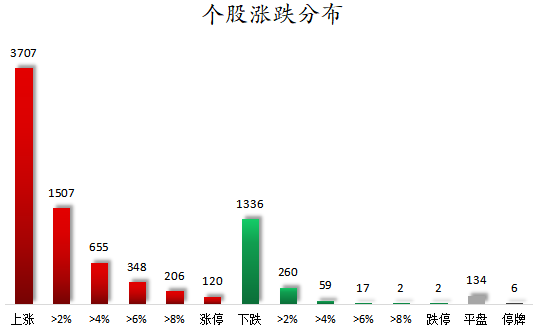
Market Overview - The Shanghai Composite Index closed at 4136.16 points, up 0.33%, with a trading volume of 1.3369 trillion yuan. The Shenzhen Component Index rose 0.79% to 14439.66 points, with a trading volume of 1.7484 trillion yuan. The ChiNext Index increased by 0.63% to 3349.50 points, with a trading volume of 822.63 billion yuan. The STAR Market 50 Index closed at 1553.71 points, up 0.78%, with a trading volume of 110.8 billion yuan. The total trading volume of both markets was 3.0853 trillion yuan, an increase of 393.5 billion yuan compared to the previous trading day [1]. Sector Performance - The market saw more sectors gaining than losing, with notable increases in power equipment, non-ferrous metals, precious metals, defense and military, steel, media, computer, environmental protection, and textile and apparel sectors. Concepts such as perovskite batteries, commercial aerospace, satellite internet, sapphire, lithium mining, cultivated diamonds, small metals, gold, and interactive short dramas were particularly active. In contrast, sectors like communication, insurance, banking, coal, and home appliances experienced declines [1]. Individual Stock Performance - A total of 3707 stocks rose, while 1336 stocks fell, with 134 stocks remaining flat and 6 stocks suspended. Excluding newly listed stocks, there were 120 stocks hitting the daily limit up and 2 stocks hitting the limit down [2]. - Among the stocks that hit the daily limit up, 23 stocks had consecutive limit-up days of 2 or more, with Fenglong Co., Ltd. leading with 18 consecutive limit-ups [3]. Capital Flow - The net capital outflow from the two markets was 4.167 billion yuan, with the ChiNext seeing a net inflow of 1.515 billion yuan. The CSI 300 index experienced a net outflow of 1.005 billion yuan, while the STAR Market saw a net outflow of 3.171 billion yuan. Out of 31 sectors, 13 sectors had net capital inflows, with the power equipment sector leading with a net inflow of 8.977 billion yuan [4][6]. - The top sectors with net inflows included non-ferrous metals (4.552 billion yuan), media (2.173 billion yuan), and defense and military (2.157 billion yuan). Conversely, the communication sector had the highest net outflow of 7.992 billion yuan, followed by electronics (6.350 billion yuan) and machinery (5.077 billion yuan) [4][6]. Notable Stocks - 191 stocks had net capital inflows exceeding 1 billion yuan, with Jin Feng Technology receiving the highest net inflow of 1.861 billion yuan. Other notable stocks included Lens Technology (1.594 billion yuan), Qian Zhao Optoelectronics (1.267 billion yuan), and Xian Dao Intelligent (1.217 billion yuan) [7][8]. - Conversely, 116 stocks experienced net capital outflows exceeding 1 billion yuan, with Xin Yi Sheng leading with a net outflow of 3.471 billion yuan, followed by Zhong Ji Xu Chuang (3.103 billion yuan) and Li Ou Shares (2.604 billion yuan) [10][11]. Institutional Activity - Institutional investors had a net selling of approximately 1.02 billion yuan, with 22 stocks seeing net purchases and 14 stocks net sales. Jin Feng Technology was the most purchased stock by institutions, with a net purchase amount of approximately 266 million yuan [13][14].

建信改革红利股票A:2025年第四季度利润6095.84万元 净值增长率15.51%
Sou Hu Cai Jing· 2026-01-22 12:27
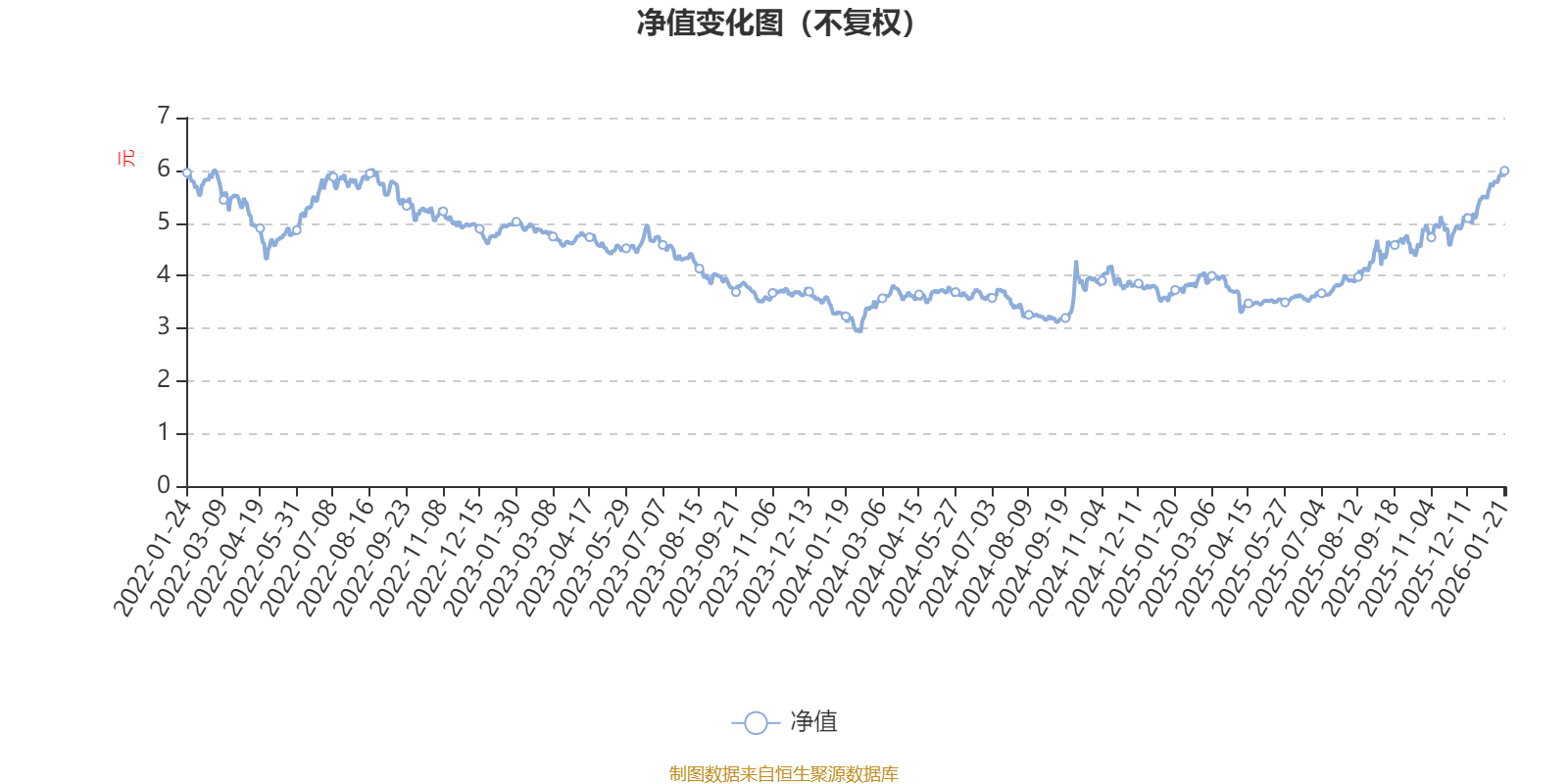
基金管理人在四季报中表示,本基金在四季度,在有色金属、通信上配置较多,在房地产、医药、计算机等板块配置较少,在行业配置上较为契合市场,从 季度运作来看,中观景气筛选是行业配置较为合适的方法。 截至1月21日,建信改革红利股票A近三个月复权单位净值增长率为30.06%,位于同类可比基金1/167;近半年复权单位净值增长率为56.57%,位于同类可比 基金5/167;近一年复权单位净值增长率为58.64%,位于同类可比基金23/165;近三年复权单位净值增长率为19.79%,位于同类可比基金86/156。 通过所选区间该基金净值增长率分位图,可以观察该基金与同类基金业绩比较情况。图为坐标原点到区间内某时点的净值增长率在同类基金中的分位数。 AI基金建信改革红利股票A(000592)披露2025年四季报,第四季度基金利润6095.84万元,加权平均基金份额本期利润0.7098元。报告期内,基金净值增长 率为15.51%,截至四季度末,基金规模为4.34亿元。 该基金属于标准股票型基金。截至1月21日,单位净值为5.992元。基金经理是陶灿,目前管理的4只基金近一年均为正收益。其中,截至1月21日,建信改革 红利股票 ...
5张图看懂“2026年全球视野·下注中国”十大核心ETF
Ge Long Hui· 2026-01-22 08:54
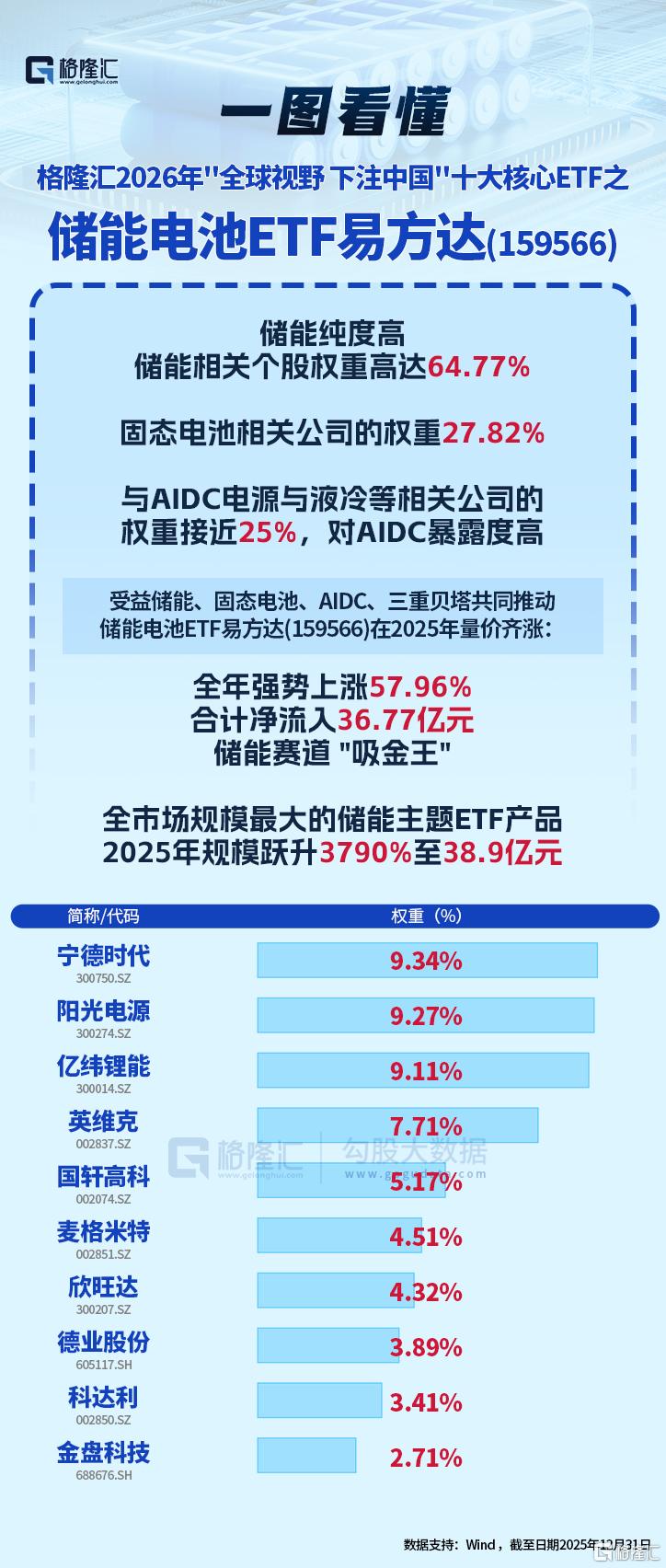
Group 1: Energy Storage Battery ETF - The Energy Storage Battery ETF by E Fund (159566) achieved a strong annual increase of 57.96% in 2025, with its scale rising from 100 million to 3.89 billion, marking a 3790% growth, making it the largest energy storage-related ETF in the market [1] - The ETF tracks the National Securities New Energy Battery Index, focusing on core stocks related to the energy storage battery industry, including leading companies like CATL, Sungrow, EVE Energy, and Inovance [1] - Key characteristics include a high purity of energy storage with 64.77% weight in energy storage-related stocks, benefiting from increased demand for energy storage due to rising data center electricity consumption [1] Group 2: Sci-Tech Chip ETF - The Sci-Tech Chip ETF (588200) tracks the Shanghai Stock Exchange Sci-Tech Board Chip Index, covering the entire chip industry chain, focusing on critical segments, with the top ten holdings accounting for 57% [3][4] - The index consists entirely of companies from the Sci-Tech Board, emphasizing R&D capabilities and technological innovation, representing the "elite force" of the chip industry [4] - The index shows significant growth indicators, with a 39% year-on-year revenue increase and a 94% net profit growth in the first three quarters of 2025 [4] Group 3: Aerospace ETF - The Aerospace ETF (159227) aligns closely with the "space and sky integration" strategy, focusing on military aerospace power, with a high weight of 98.2% in defense and military industries, making it the purest military index in the market [6][7] - The ETF has a significant overlap with commercial aerospace concepts, with a 70.19% correlation, and focuses on key national strategic areas such as military aircraft replacement and satellite internet [6][7] - It recorded a net inflow of 1.329 billion in the period, becoming the leading fund in the aerospace sector [7] Group 4: Hang Seng Technology ETF - The Hang Seng Technology ETF (513010) tracks the Hang Seng Technology Index, selecting 30 leading Hong Kong tech companies, covering sectors like internet platforms, semiconductors, and new energy vehicles [10] - The top ten holdings include major players like Meituan, SMIC, Tencent, and Alibaba, with AI-related companies making up over 60% of the portfolio [10] - The ETF saw a net inflow of 19.047 billion in 2025, with a low comprehensive fee rate of 0.25% per year [10] Group 5: Robotics ETF - The Robotics ETF (562500) focuses on the most competitive leading companies in the industry, with the top ten holdings accounting for 52% of the portfolio, showcasing significant leader effects [12][14] - It includes key component companies like Harmonic Drive and Mingzhi Electric, as well as system integrators like Inovance Technology and iFlytek, providing a balanced exposure to both industrial and humanoid robotics [12][14] - The ETF's latest scale is 26.169 billion, making it the only robotics-themed ETF in the market exceeding 20 billion [12]
中国工业 - 2026 年展望:复苏持续-China Industrials-2026 Outlook – Recovery Continues
2026-01-22 02:44
Summary of China Industrials 2026 Outlook Industry Overview - **Industry**: China Industrials - **Core Themes**: AI technology diffusion, industrial upgrades, and globalization are central to the industrial sector's recovery in 2026. The government is focused on enhancing productivity through equipment upgrades, particularly in high-end equipment [1][4]. Key Insights - **Industrial Cycle**: The industrial cycle is characterized by strong global demand for capital goods, driven by AI technology applications and supply chain security concerns. China's trend of localizing high-end equipment remains strong, with specific sectors like data centers, electronics, and robotics expected to show growth, while processing markets may experience muted demand [3][10]. - **AI Applications**: 2026 is anticipated to mark the beginning of significant capital expenditure on physical AI, which will benefit automation and robotics companies. The government is supporting this through initiatives aimed at increasing the deployment of AI-powered robotics [4][11][12]. - **Localization and Supply Chain**: The localization rates for automation and industrial robots are projected to rise, with expectations of reaching 60-70% by 2030. This trend is expected to benefit companies involved in automation and precision components [21][22][23]. Market Dynamics - **Overseas Expansion**: Equipment exports from China have grown significantly, outpacing overall export growth. Companies are motivated to expand into international markets to capture larger total addressable markets (TAM) and improve margins [24][25]. - **Margin Expansion**: The overall net margin for China's industrials is expected to increase from approximately 13.0% in 2025 to around 14.6% in 2027, driven by overseas growth and advancements in AI technology [26][27]. Stock Recommendations - **Preferred Stocks**: The report highlights several stocks that are expected to benefit from cyclical strength and structural tailwinds, including: - **Geekplus (2590.HK)**: OW - **Sany Heavy (600031.SS)**: OW - **Leaderdrive (688017.SS)**: OW - **Han's Laser (002008.SZ)**: OW - **Inovance (300124.SZ)**: OW - **Hengli (601100.SS)**: OW - **Wuxi Lead (300450.SZ)**: OW - **Envicool (002837.SZ)**: OW - **Underweight Stocks**: Stocks such as **CSCEC (601668.SS)**, **CRRC-H (1766.HK)**, and **Maxwell (300751.SZ)** are rated as underweight due to various market challenges [5][8][46]. Additional Considerations - **Geopolitical Factors**: The geopolitical landscape is influencing supply chain security, which is a critical factor for capital goods demand globally [3]. - **Investment in AI**: The anticipated investment in AI infrastructure is expected to redefine smart manufacturing and create new opportunities within the industrial sector [10][11]. - **Sector Performance**: The report indicates that most industrial stocks are trading at or above their historical five-year average P/E ratios, reflecting a positive outlook for continuous upgrades and AI-related demand [26][38]. This comprehensive analysis provides insights into the expected recovery and growth opportunities within the China Industrials sector for 2026, highlighting key themes, market dynamics, and stock recommendations.





国信证券:26年算力景气度持续上行 关注互联、液冷、供电板块
智通财经网· 2026-01-22 01:58
微软、谷歌、Meta、亚马逊等海外大厂对2026年资本开支指引乐观,该行预计2025年、2026年四家大 厂资本开支总和分别为4065、5964亿美元,分别同比+46%、47%,且用于投资AI算力及基础设施的比 例有望持续提升。目前,海外大厂仍以采购英伟达AI芯片为主,2026年AMD、海外大厂自研芯片有望 快速放量。 互联侧:光摩尔定律,单卡价值量代际增加 1)光模块:一方面,端口速率按"1–2年一代"从10G/40G-100G/400G-800G/1.6T;另一方面,数据中心 网络从"少量跨机柜光互连"走向leaf-spine扁平化、东西向流量主导,叠加AI训练集群由几十卡扩展到数 百卡规模,使得光模块的用量、规格与单点价值量同步抬升。未来,800G将加速规模化部署、1.6T进 入导入期;同时LPO/CPO、硅光、AOC等路线让网络向"更低功耗、更高密度、更高可靠"演进。2) PCB:行业进入AI驱动的新周期,需求结构发生根本性转变。AI服务器集群建设带来算力板卡、交换机 与光模块的同步升级,推动PCB需求量和单价双升。随着算力架构从GPU服务器向正交化、无线缆化演 进,信号链条更短、对材料损耗更敏感,P ...
AI产业链系列报告一:26年算力景气度持续上行,关注互联、液冷、供电板块
Guoxin Securities· 2026-01-21 05:24
Investment Rating - The report maintains an "Outperform" rating for the AI industry [1] Core Insights - The capital expenditure (Capex) guidance from major overseas companies is optimistic, with a continuous upward trend in computing power expected through 2026. The total Capex for Microsoft, Google, Amazon, and Meta is projected to reach $406.5 billion in 2025 and $596.4 billion in 2026, representing year-on-year growth of 46% and 47% respectively [3][5][22] - The demand for AI-related infrastructure is driving significant upgrades in interconnects, cooling, and power supply sectors, indicating a long-term growth cycle distinct from previous technology cycles [3][4] Summary by Sections 1. Overseas Major Companies' Capex Guidance - Major companies like Microsoft, Google, Amazon, and Meta are expected to increase their Capex significantly, with projections of $186.4 billion, $139.5 billion, $162.5 billion, and $108 billion respectively for 2026 [6][7][14][18][21] - The overall Capex for these four companies is expected to account for 62% of the global AI-related Capex, which is projected to reach $960 billion by 2026 [22][23] 2. Interconnect Sector: Optical Modules and PCBs - The interconnect sector is experiencing a fundamental shift in demand due to AI server cluster construction, leading to simultaneous upgrades in computing boards, switches, and optical modules, which will increase both demand and pricing [3][4] - The deployment of 800G technology is expected to accelerate, with 1.6T technology entering the introduction phase [3] 3. Cooling Sector: Liquid Cooling Demand - The power density of AI GPU racks is projected to rise from 130 kW in 2024 to over 1 MW by 2029, making liquid cooling technology essential [3][4] 4. Power Supply Sector: AIDC Power Distribution Evolution - The evolution of AIDC power distribution methods is crucial, with a focus on HVDC and SST technologies to enhance system efficiency and reduce energy losses [3][4] 5. Investment Recommendations - The report suggests focusing on specific companies within various sectors: - Computing power: Haiguang Information - Interconnects - Optical modules: LightSpeed Technology, Huagong Technology - Interconnects - PCBs: Shenghong Technology, Shennan Circuits, and others - Cooling: Invec - Power supply: Magpow [3][4]






国投瑞银新能源混合A:2025年第四季度利润1.38亿元 净值增长率7.14%
Sou Hu Cai Jing· 2026-01-21 03:59
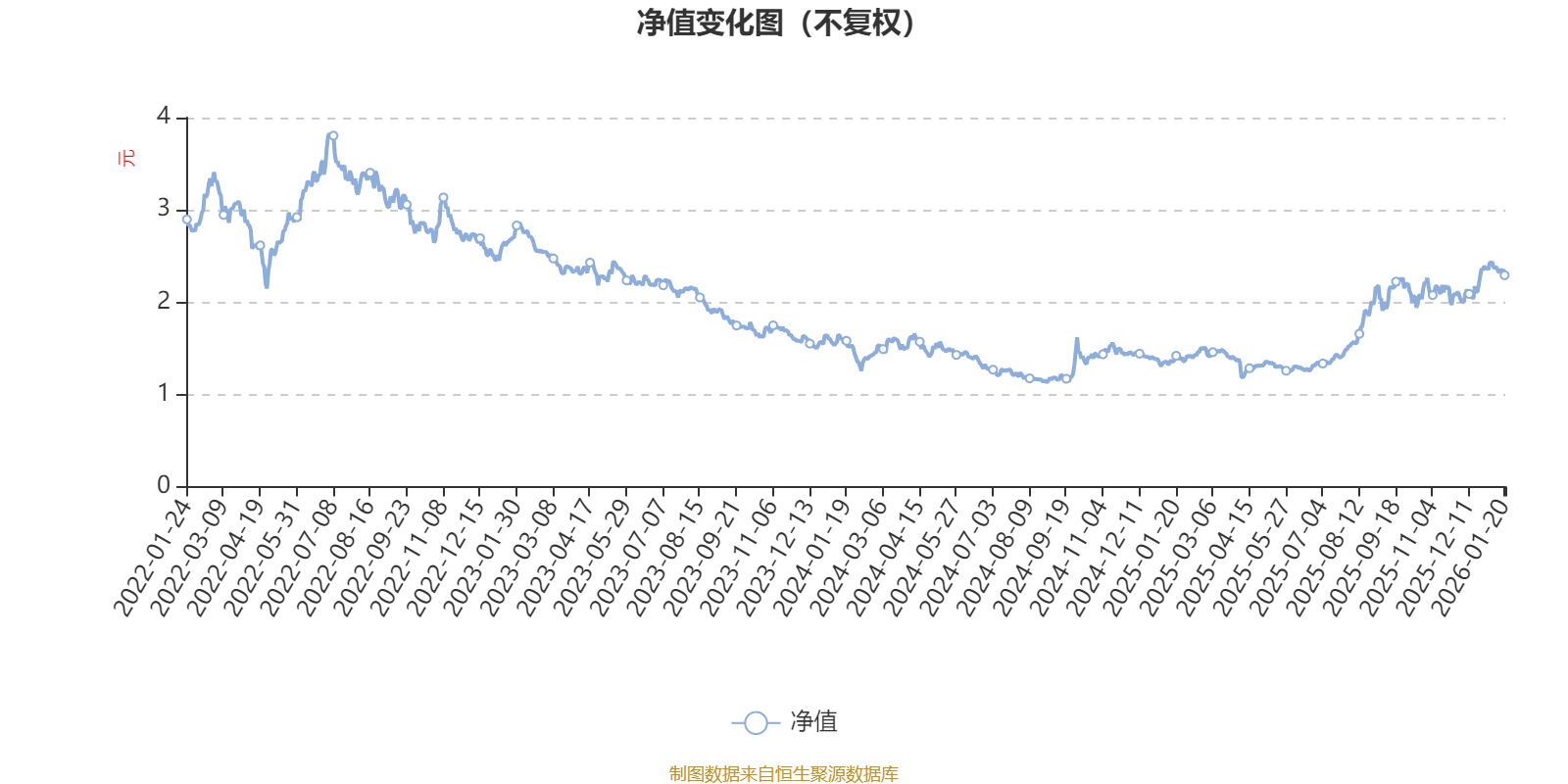
Core Viewpoint - The AI Fund Guotou Ruijin New Energy Mixed A (007689) reported a profit of 138 million yuan in Q4 2025, with a net asset value growth rate of 7.14% and a total fund size of 2.036 billion yuan by the end of Q4 2025 [2]. Fund Performance - As of January 20, the fund's unit net value was 2.291 yuan, with a one-year return of 61.64%, ranking 24 out of 183 comparable funds [3]. - The fund's performance over the last three months showed a growth rate of 15.64%, ranking 28 out of 185 comparable funds, and over the last six months, it achieved a growth rate of 60.10%, ranking 6 out of 185 [3]. - The fund's three-year return was -17.36%, placing it 166 out of 176 comparable funds [3]. Risk and Return Metrics - The fund's Sharpe ratio over the last three years was 0.1951, ranking 157 out of 176 comparable funds [8]. - The maximum drawdown over the last three years was 60.35%, with the largest single-quarter drawdown occurring in Q3 2022 at 26.31% [10]. Investment Strategy and Focus - The fund manager indicated that the future development of AI may lead to significant changes in electrical systems, presenting new investment opportunities, particularly in cooling technologies transitioning from air cooling to liquid cooling [2]. - The report highlighted that the performance growth in the new energy sector is expected to rebound by 2025, with further improvements anticipated in 2026, particularly in sectors like energy storage [2]. Fund Holdings - As of Q4 2025, the fund had a high concentration of holdings, with its top ten stocks including Magpow, Invec, Tianci Materials, Zhongkuang Resources, Duofluo, Cambrian, Tianji Shares, Shenghong Technology, Shengxin Lithium Energy, and Jingwang Electronics [18]. Fund Positioning - The fund maintained an average stock position of 92.03% over the last three years, exceeding the comparable average of 87.64% [13].
未知机构:我们近期在高盛中国AI机器人与电力行业调研中走-20260121
未知机构· 2026-01-21 02:00
Summary of Conference Call Records Company Overview - **Company**: 英维克 (Invec) - **Industry**: Server Cooling and Energy Storage Key Points Sales and Profit Growth - The company expects sales growth in 2026, with profit growth anticipated to outpace revenue growth, marking a critical turning point for large-scale production of server cooling products in 2026 [1][2] - Projected total sales growth for 2026 is 79%, with profit growth of 127% [3] Growth Drivers - Growth is supported by three main pillars: 1. A 2MW level CDU project based on Google's Project Deschutes 5, expected to contribute significantly to revenue in the second half of 2026 [1] 2. Rapid disconnect (QD) component production capacity planned to be achieved by the end of Q1 2026 to meet increasing demand [1] 3. Accelerated overseas market demand for energy storage cooling, with increasing unit value [1] Market Share and Revenue Projections - The company maintains a "Buy" rating with a target price of 121.1 RMB, expecting global server liquid cooling market share to rise from 1% in 2025 to 10% by 2030 [2] - Anticipated compound annual growth rate (CAGR) for server cooling business sales from 2025 to 2030 is 98%, with an average gross margin around 30% [2] Order Visibility and Revenue Trends - Management noted a clear quarter-over-quarter growth trend in order visibility and revenue scale for the server cooling business from Q1 to Q4 [2] - However, there remains uncertainty regarding the specific timing of individual liquid cooling project implementations and client budget allocations [2] Production Capacity Expansion - The company is actively expanding production bases both domestically and overseas: - Domestic expansion includes increasing CDU, piping, and QD capacity, with QD capacity construction starting in November 2025 [3] - Overseas, the company operates two factories in the U.S. for server cooling and energy storage cooling products, and one factory in Thailand focused on server cooling [3] Next-Generation Liquid Cooling Technology - Investment in next-generation liquid cooling technologies, including microchannel liquid cooling plates (MLCP) and immersion cooling, is ongoing, but large-scale commercialization is not expected until 2026-2027 [4] Energy Storage System Cooling - The sales growth for the energy storage system (BESS) cooling segment is expected to accelerate in 2026, driven by strong global energy storage demand [4] - Anticipated sales growth for this segment is 19% in 2025 and 34% in 2026, with potential for unit value to increase 2-3 times for certain overseas clients [4] Gross Margin Trends - The company expects overall gross margin to improve in 2026 due to a higher proportion of overseas sales [4] - Short-term commodity price increases, particularly for copper, may exert some pressure on gross margins, but the impact is expected to be limited [4] - Projected gross margins for 2026 and 2027 are 28.6% and 29.1%, respectively, with net margins of 12.3% and 13.7% [5]

新兴产业行业周报:商业航天发展步入快车道 重视人形机器人产业趋势
Xin Lang Cai Jing· 2026-01-20 06:39
Market Overview - A-share major indices showed a significant rebound this week, with the weekly performance of the indices as follows: CSI 300 at -0.57%, ChiNext 300 at 1.39%, STAR 50 at 2.58%, CSI 500 at 2.18%, CSI 1000 at 1.27%, and the humanoid robot index at 1.48%, with the STAR 50 showing the most notable recovery [1] Recent Events and Highlights - China applied to the International Telecommunication Union (ITU) for frequency resources for over 200,000 satellites, with more than 190,000 satellites coming from the newly established Radio Innovation Institute. Experts are optimistic about the institute's role in integrating industry resources and leveraging China's large market to accelerate its industry to catch up with SpaceX [2] Current Perspectives - The establishment of the humanoid robot and embodied intelligence standardization technical committee by the Ministry of Industry and Information Technology is viewed positively for the humanoid robot industry chain, with related companies including Hengshuai Co., Junpu Intelligent, Anpeilong, Keda Li, Lens Technology, Changying Precision, Sanhua Intelligent Control, Fengmao Co., Top Group, and Wuzhou Xinchun [3] - Guangdong has launched its first provincial-level drone governance system, creating a drone resource pool and a provincial management platform to build a "one network for unified flight" service ecosystem, with related companies including Xindong Link, Wanfeng Aowei, Wolong Electric Drive, and Zongshen Power [3] - The China Academy of Information and Communications Technology's Tair System Laboratory recently issued a liquid cooling capability testing report and certificate to Shenzhen Invech Technology Co., indicating that AI data center construction is expected to drive demand for liquid cooling equipment, with related companies including Invech, Nanfeng Co., Chuanrun Co., and Bojie Co. [3] - China's application to the ITU for over 200,000 satellites coincides with the U.S. Federal Communications Commission granting SpaceX significant authorization to build, deploy, and operate an additional 7,500 second-generation Starlink satellites, with related companies including Superjet Co., Xindong Link, Guoji Precision, and Electric Science Digital [3]


