天弘基金

Search documents
数说公募纯债与混合资产策略基金2025年四季报:固收+规模再创新高,含权敞口小幅下降
SINOLINK SECURITIES· 2026-01-26 15:04
Report Title - "Counting the Public Offering Pure Bond and Hybrid Asset Strategy Funds' 2025 Q4 Reports - The Scale of 'Fixed Income +' Reaches a New High, and the Exposure to Equity Slightly Declines" [1] Report Date - January 26, 2026 [2] Market Overview General Fixed - Income Fund Scale in 2025 Q4 - Among the top 20 fund companies in terms of general fixed - income fund scale, the scale of some companies increased while others decreased. For example, the scale of China Merchants Fund increased by 9.88% to 3512.27 billion yuan, while the scale of E Fund decreased by 4.71% to 3627.05 billion yuan [8]. Hybrid Asset Strategy Fund Scale in 2025 Q4 - In the hybrid asset strategy fund scale ranking, the scale changes also varied. For instance, the scale of Invesco Great Wall Fund increased by 32.11% to 2263.68 billion yuan, while the scale of Fullgoal Fund decreased by 5.85% to 1281.73 billion yuan [8]. Performance Return - Different types of funds had different average returns in 2025 Q4, year - to - date, and in the past 1 - year, 3 - year, and 5 - year annualized periods. For example, the average return of convertible bond funds in 2025 Q4 was 0.84%, and the year - to - date return was 23.10% [15]. Maximum Drawdown - The average maximum drawdowns of various fund types also differed. For example, the average maximum drawdown of convertible bond funds in 2025 Q4 was - 5.26%, and the year - to - date maximum drawdown was - 8.90% [15]. Annualized Sharpe Ratio - The annualized Sharpe ratios of different fund types were distinct. For example, the annualized Sharpe ratio of short - term pure bond funds in 2025 Q4 was 4.28 [15]. Asset Allocation Leverage Ratio - In 2025 Q4, different types of funds had different leverage ratios and their changes compared to Q3. For example, the leverage ratio of short - term pure bond funds was 111.89% in Q4, an increase of 0.40% compared to Q3 [40]. Holding Characteristics Stock Holdings - From 2025 Q1 to Q4, the industry and stock holding ratios of funds changed. For example, the proportion of non - ferrous metals in the stock market value increased from 11.27% in Q1 to 14.65% in Q4 [54][57]. Bond Holdings - The industry and bond holding ratios of funds also changed over the four quarters of 2025. For example, the proportion of bank bonds in the bond market value decreased from 20.75% in Q1 to 14.45% in Q4 [67][68]. Fund Managers' Views Pure Bond Market Views - Different fund managers had different views on the pure bond market in 2026 Q1. For example, Huang Yingjie of Bank of Communications Yulong Pure Bond A believed that the bond market might be in a range - bound market with a steeper curve [74]. Bond and Stock Market Views - Some fund managers had comprehensive views on the bond and stock markets. For example, Deng Xinyu and Zhao Yucheng of China Europe Dingli A were optimistic about the stock market's structural opportunities and adjusted their convertible bond positions [75]. Convertible Bond and Stock Market Views - Fund managers also had different views on the convertible bond and stock markets. For example, Huang Bo of Everbright Tianyi A planned to select high - cost - effective convertible bonds for the fund's fixed - income part [79].
连续3日“吸金”,港股通央企红利ETF天弘(159281)盘中获净申购2200万份,标的指数股息率近6%
2 1 Shi Ji Jing Ji Bao Dao· 2026-01-26 06:52
Group 1 - The Hong Kong stock market experienced a decline, with the Hang Seng Index down by 0.2%, while the Central Enterprises Dividend Index rose by 1.08% [1] - Among the constituents of the Central Enterprises Dividend Index, China Merchants Energy surged over 6%, China Railway increased by over 5%, and China National Offshore Oil, China National Building Material, and China Shenhua all rose by over 4% [1] - The Tianhong Central Enterprises Dividend ETF (159281) recorded a trading volume exceeding 63 million yuan, with a net subscription of 22 million shares during the session [1] Group 2 - CICC indicated that the dividend sector presents phase-specific and structural opportunities amid increasing external uncertainties or a pullback in growth styles, highlighting a "seesaw" effect between dividend and technology growth styles [2] - Demand for capital allocation is expected to support the dividend sector, including the shift of long-term funds from insurance and bank wealth management towards equity assets, as well as the transition of household deposits to dividend assets [2] - The overall dividend payout ratio in the A-share market has increased to 45%, providing fundamental support for the dividend style, alongside continuous encouragement from capital market policies for dividend-oriented strategies [2]





量化指增基金超额呈现边际修复
HTSC· 2026-01-26 03:05
证券研究报告 金工 量化指增基金超额呈现边际修复 2026 年 1 月 24 日│中国内地 量化投资周报 本月以来估值因子偏弱,成长因子相对走强 本月以来估值因子整体偏弱,月初的回撤影响较大;波动率、换手率等防御 性量价因子同样表现不佳,仅在沪深 300 成分股票池取得正收益。成长、 盈利、小市值及反转因子相对走强,在中证 500 以外的成分股票池均呈现 正收益。预期类因子中,超预期因子在沪深 300 以外的股票池呈现正收益; 预期估值因子在沪深 300 和全 A 股股票池取得正收益,在其余股票池回撤; 预期增速因子则呈现普遍回撤。 本月以来小市值因子多空表现靠前,量价因子承压 从平均多空收益来看,本月以来小市值因子表现靠前,平均取得较明显的正 收益,但主要源于在沪深 300 成分股票池中的收益优势;预期增速和超预 期因子紧随其后;成长因子同样呈现正向的平均多空收益。反转、波动率和 换手率等量价因子整体承压,平均呈现较大回撤。 本月以来指增超额呈现边际修复,300 指增超额领先 我们重点跟踪以沪深 300、中证 500、中证 1000 和中证 A500 指数为基准 的量化指数增强基金。基于公募指增基金的复权净 ...
“北京火箭大街”六大平台启动!航空航天ETF天弘(159241)近10日净流入近1.7亿元,机构:中国商业航天开始到达从政策孵化期向工业化爆发期过渡的关键节点
2 1 Shi Ji Jing Ji Bao Dao· 2026-01-26 02:55
Group 1 - The aerospace sector experienced a morning adjustment on January 26, with the Guozheng Aerospace Industry Index falling by 2.14%. Among the constituent stocks, Zhenxin Technology rose over 7%, while China Satellite and Aerospace Development dropped more than 5% [1] - The Tianhong Aerospace ETF (159241) recorded two consecutive days of gains as of last Friday, with a trading volume of 166 million yuan. It has seen a net inflow of over 20 million yuan in the last two trading days, with a cumulative net inflow of over 62 million yuan in the past five trading days and 170 million yuan in the last ten trading days [1] - The Tianhong Aerospace ETF closely tracks the Guozheng Aerospace Industry Index, which covers sub-sectors such as aerospace equipment, military electronics, and satellite internet, with a high weight of 98.7% in the defense and military industry category [1] Group 2 - The third Beijing Commercial Aerospace Industry High-Quality Development Promotion Conference was held on January 23, launching six platforms under "Beijing Rocket Street" aimed at accelerating major project construction and forming a comprehensive "thousand-star production capacity" [2] - According to Guojin Securities, the global aerospace industry is undergoing structural changes similar to the Age of Exploration, driven by the rise of commercial aerospace companies like SpaceX. China's commercial aerospace is transitioning from a policy incubation phase to an industrial explosion phase, with 2026 expected to be a pivotal year for the industry [2]


新规落地!基金直销系统迎来大改造
Zhong Guo Ji Jin Bao· 2026-01-25 13:15
根据新规,今年以来在基金公司直销平台上线的新发基金A类份额已全部实现免认购费,C类份额全部 实现免销售服务费,直接让利于投资者。 在销售新规的推动下,各家基金公司直销系统开年迎来大改造。 公募基金行业机构投资者直销服务平台(以下简称FISP平台)也有了最新进展。据中国基金报记者了 解,根据监管要求,基金公司要在6月底之前接入该平台。 【导读】新规落地!基金直销系统迎来大改造 机构直销服务迈入标准化时代 除了费率改革,基金直销系统另一项关键改造任务也在加速推进,基金公司需在6月底之前完成FISP平 台接入。 谈及销售费用改革的进度,一位基金公司人士表示,目前公司直销平台上线的新发基金A类份额已经根 据监管要求不收取认购费,新发基金C类份额不收取销售服务费的系统改造正在紧锣密鼓进行中,系统 改造完成前,新发基金C类份额不在直销端销售。改造完成后,直销平台上线的新发基金C类份额也不 再收取销售服务费。 除了新发基金立即实施之外,存量基金费率改革有一年的过渡期。据基金公司人士反馈,存量基金费率 改革涉及多家代销机构,因此,基金管理人会与代销机构协商,统一安排直销及代销端的费率改革时间 节点。 创金合信基金认为,基金直 ...
新规落地!基金直销系统迎来大改造
中国基金报· 2026-01-25 13:08
在销售新规的推动下,各家基金公司直销系统开年迎来大改造。 【导读】新规落地!基金直销系统迎来大改造 中国基金报记者 方丽 陆慧婧 根据新规,今年以来在基金公司直销平台上线的新发基金A类份额已全部实现免认购费,C类份额全部实现免销售服务费,直接让利于投资 者。 公募基金行业机构投资者直销服务平台(以下简称FISP平台)也有了最新进展。据中国基金报记者了解,根据监管要求,基金公司要在6月 底之前接入该平台。 多只直销平台上线的新发基金已开启零认购费 今年年初,《公开募集证券投资基金销售费用管理规定》正式实施,基金公司积极响应监管号召,落实直销系统费率改革,直销平台上线 的新发基金A类份额免认购费,C类份额免销售服务费。 以天弘基金正在发行的天弘悦享臻选三个月持有期FOF为例,该基金的招募说明书明确规定,通过基金管理人认(申)购基金份额的,不收 取认(申)购费、销售服务费。 易方达基金正在发行的易方达港股通消费混合基金招募说明书也显示,投资者通过基金管理人或其基金销售子公司认购A类基金份额,不收 取认购费用。目前暂不开通基金管理人及其基金销售子公司销售本基金C类基金份额,若日后开通,将另行公告。 谈及销售费用改革的 ...


今年ETF新品,多点开花
Zhong Guo Ji Jin Bao· 2026-01-25 10:39
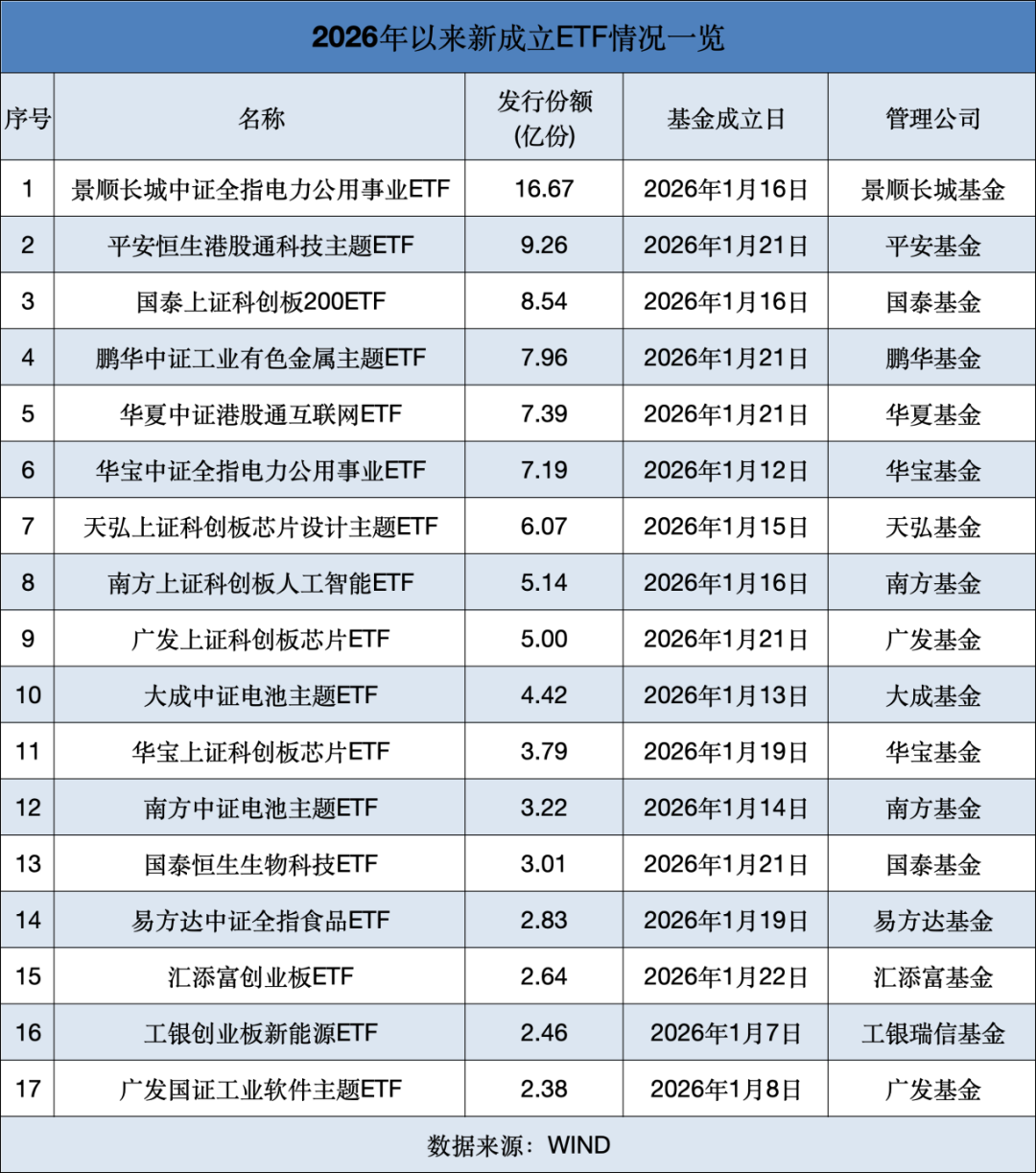
Core Insights - The ETF market in 2026 is experiencing robust growth, with 17 new ETFs launched and a total issuance scale nearing 10 billion yuan, representing 22.37% of new fund issuance quantity and 14.69% of scale [1] - The newly established ETFs cover diverse sectors including non-ferrous metals, chips, artificial intelligence, biotechnology, food, batteries, and public utilities [1] Group 1: Market Growth and Demand - Industry experts are optimistic about the growth potential of the ETF market in 2026, driven by long-term capital inflows and upgraded investor demand [3] - Institutional investors, such as insurance companies, are increasingly seeking long-term allocations in the domestic equity market, while individual investors are becoming more accepting of passive index products due to their low fees and high transparency [3][4] - The diversification of ETF products is creating opportunities for innovation, as there are still many gaps in niche sectors, strategies, commodities, bonds, and overseas assets [4] Group 2: Competitive Landscape and Differentiation - The ETF market is characterized by significant concentration among leading firms, posing challenges for smaller fund companies [5] - Smaller firms are encouraged to focus on differentiated product offerings in niche sectors or thematic areas where larger firms have not established a strong presence [5][6] - There is potential for smaller fund managers to explore non-equity asset ETFs to meet the evolving asset allocation needs of investors [6] Group 3: Challenges and Pain Points - Despite growth opportunities, the ETF market faces challenges such as insufficient investor understanding and operational pressures on certain products [7] - Some individual investors lack a deep understanding of ETFs, leading to impulsive trading behaviors, which can negatively impact their investment outcomes [7] - Certain ETFs are experiencing issues with small scale and high operational costs, which can erode investor returns and affect trading efficiency [7]
黄金相关ETF表现强劲 科技成长类ETF获资金净流入
Sou Hu Cai Jing· 2026-01-25 10:31
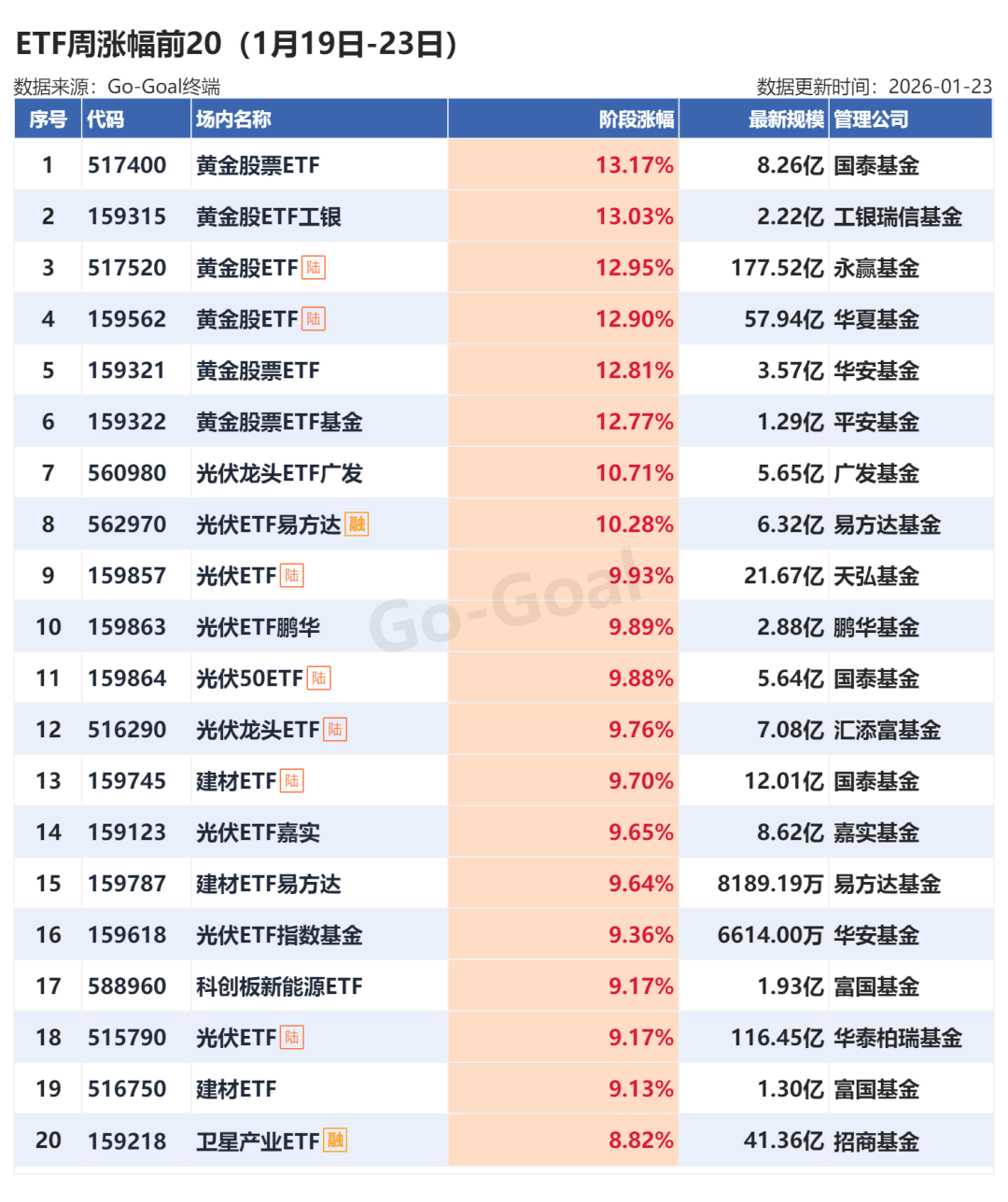
Market Overview - The A-share market exhibited a fluctuating upward trend this week, with major broad-based indices showing mixed performance and significant market style differentiation [1] - International gold prices recently reached a new historical high, leading to strong performance in related ETFs, with gold stock ETFs rising by 13.17%, the highest among all [1][2] - Other sectors such as photovoltaic and building materials ETFs also saw substantial gains, while Hong Kong innovative drug-related ETFs experienced slight adjustments [1] Fund Flow Analysis - Overall, ETF funds experienced a net outflow of 696.39 billion, with broad-based ETFs facing a net outflow of 873.01 billion, while industry ETFs saw a net inflow of 143.04 billion and commodity ETFs a net inflow of 32.91 billion [3] - Funds have not exited the market but have shifted towards more elastic sectors, with significant net inflows into TMT (Technology, Media, Telecommunications) and cyclical sectors like non-ferrous metals, indicating active funds' preference for technology growth themes [2][3] ETF Performance - The top-performing gold stock ETFs included: - 517400 Gold Stock ETF with a 13.17% increase and a latest scale of 826 million [2] - 159315 Gold Stock ETF from ICBC with a 13.03% increase and a scale of 222 million [2] - 517520 Gold Stock ETF from Yongying with a 12.95% increase and a scale of 177.52 billion [2] - Photovoltaic ETFs also performed well, with the top performer being 560980 Photovoltaic Leader ETF from GF with a 10.71% increase and a scale of 565 million [2] Upcoming ETF Listings - Next week, four new ETFs are set to be listed, including: - 589190 Sci-Tech Chip ETF from Huabao, with subscription starting on December 30, 2025 [5] - 159158 Power ETF from Invesco, with subscription starting on January 7, 2026 [5] - 589220 Sci-Tech 200 ETF from Guotai, with subscription starting on January 5, 2026 [5]
今年ETF新品,多点开花
中国基金报· 2026-01-25 10:28
Core Viewpoint - The ETF market in China is experiencing robust growth in 2026, with a diverse range of new products being launched and a steady increase in scale, indicating a strong market potential and competitive landscape [2][4]. Group 1: New ETF Launches - As of January 24, 2026, a total of 17 new ETFs have been established, with an issuance scale nearing 10 billion yuan, accounting for 22.37% of new fund launches and 14.69% of the total issuance scale [2]. - The newly established ETFs cover various sectors including non-ferrous metals, chips, artificial intelligence, biotechnology, food, batteries, and public utilities [2]. Group 2: Market Growth Drivers - Industry experts are optimistic about the growth potential of the ETF market, driven by long-term capital inflows and evolving investor demands [5]. - Institutional investors, such as insurance companies, are increasingly seeking long-term allocations in the domestic equity market, while individual investors are becoming more accepting of passive index products due to their low fees and high transparency [5]. - There remains significant room for innovation in ETF products, particularly in niche sectors and strategies, as the demand for diversified investment portfolios continues to grow [5]. Group 3: Competitive Landscape - The ETF market is characterized by a concentration of leading firms, posing challenges for smaller fund companies. However, differentiation and refined operations are seen as key strategies for smaller firms to carve out a niche [7]. - Smaller fund companies are encouraged to focus on underrepresented sectors and themes where larger firms have not established a strong presence, thereby building expertise and brand influence [7][8]. - There is a need for smaller firms to innovate in product offerings, such as Smart Beta and ESG-focused ETFs, to meet the diverse asset allocation needs of investors [8]. Group 4: Challenges in the ETF Market - Despite growth opportunities, the ETF market faces challenges such as insufficient investor understanding and operational pressures on certain products [9]. - Some individual investors lack a deep understanding of ETFs, leading to impulsive trading behaviors, which can negatively impact their investment outcomes [9]. - Certain ETFs are experiencing issues with small scale and high operational costs, which can erode investor returns and affect trading efficiency due to low liquidity and high bid-ask spreads [9].

投顾周刊:央行行长表示2026年降准降息有空间
Sou Hu Cai Jing· 2026-01-25 00:46
Monetary Policy - The central bank will implement a moderately loose monetary policy in 2026, with room for rate cuts and reserve requirement ratio reductions. The focus will be on maintaining ample liquidity and managing expectations for the RMB exchange rate [1] - The central bank aims to support the stable development of the capital market through specific monetary policy tools [1] Fund Management - Multiple funds have announced fee reductions to lower investment costs for investors. For instance, 华夏基金 reduced the management fee of its financial technology ETF from 0.50% to 0.15% [1] - 天弘基金 also announced a reduction in management and custody fees for its mixed fund from 0.7% and 0.15% to 0.3% and 0.05% respectively [1] Banking Sector - The interest rates on large time deposits from local small and medium-sized banks have fallen below 2% due to ongoing declines in deposit rates [2] - Recent reports from several banks indicate that their wealth management business is experiencing a decline in the scale of funds raised compared to the scale of maturing products [2] Real Estate Market - The second-hand housing market has shown signs of recovery at the beginning of 2026, particularly in first-tier and strong second-tier cities, with a notable decrease in the number of listings in Shanghai [2] Fiscal and Financial Policies - A comprehensive policy package has been introduced to promote domestic demand, including a 500 billion yuan special guarantee plan for private investment and interest subsidies for loans to small and micro enterprises [3] Global Market Trends - Concerns over the Greenland crisis and fiscal pressures have triggered a global bond market sell-off, with significant increases in yields for long-term bonds in Japan and the U.S. [3] - The CEO of NVIDIA highlighted that AI has initiated the largest infrastructure buildout in human history, requiring substantial investments and skilled labor [4]