快手

Search documents
智谱与MiniMax市值双双突破3000亿港元,Kimi新一轮超7亿美元融资将交割,AI大模型赛道持续升温
Jin Rong Jie· 2026-02-20 07:58
Group 1 - The AI large model sector in Hong Kong continues its strong performance post-Spring Festival, with companies like Zhipu (02513.HK) and MINIMAX-WP (00100.HK) seeing their market values exceed 300 billion HKD, collectively surpassing 580 billion HKD, outpacing well-known tech firms like Trip.com, Kuaishou, and JD.com [1][2] - Zhipu and MiniMax went public on January 8 and 9, raising nearly 10 billion HKD, with share prices of 116.20 HKD and 165 HKD respectively, both companies have recorded several-fold increases in their stock prices since listing [2][3] - The primary market remains active, with Kimi, under the Dark Side of the Moon, set to complete a new round of financing exceeding 700 million USD shortly after raising 500 million USD, with a latest valuation surpassing 10 billion USD [3] Group 2 - Recent reports indicate that multiple large models are releasing new features or integrating ecosystems, potentially leading to a new wave of innovation in the sector, shifting the internet value chain from traditional traffic scale to a focus on execution, capability invocation, governance, and result-based business models [4] - The AI application sector is transitioning from being a technology follower to becoming the core narrative of a new technological era, with accelerated commercialization, restructured user behavior, and clearer profit models, indicating a shift in AI investment focus from "computing infrastructure" to "scenario realization" [4]


“聪明钱” 积极布局港股,汇添富港股通科技精选混合发起式C(025545)精准掘金港股科技核心资产
Xin Lang Cai Jing· 2026-02-20 07:16
Group 1 - The core viewpoint of the article highlights the increasing trend of "smart money" in the Hong Kong stock market, with southbound funds showing a pattern of buying more as prices drop, achieving a cumulative net purchase of 136.15 billion yuan year-to-date as of February 13 [1] - Southbound funds have focused on major technology stocks, with Tencent Holdings and Xiaomi Group being the primary targets, net buying 12.88 billion HKD and 12.13 billion HKD respectively, while China Life, China Construction Bank, Pop Mart, and Kuaishou each received over 5 billion HKD in net purchases, continuing the "technology + dividends" strategy [1] - According to Everbright Securities, the overall trend of the Hong Kong stock market is positive due to factors such as profit recovery, improved liquidity, low valuations, and policy support, indicating a market condition of "moderate fundamental recovery, synchronized internal and external liquidity, and neutral to warm sentiment" [1] Group 2 - The "Huitianfu Hong Kong Stock Technology Selection Mixed Fund C" (025545) focuses on high-quality technology theme assets within the Hong Kong Stock Connect range, with a clear investment logic and a minimum of 60% of its assets in stocks, and at least 80% of non-cash assets in Hong Kong Stock Connect stocks [1] - The "Huitianfu Hang Seng Technology ETF Linked Fund C" (013128) aims to balance the allocation of core assets in Hong Kong technology, representing the sector well and capturing the medium to long-term growth momentum of China's new economy [2] - The "Huitianfu Hang Seng Stock Connect China Technology ETF Linked Fund C" (025167) focuses on core assets in the "Hong Kong M7," covering the entire AI industry chain, and is designed to capture the core value of AI by excluding non-technology sectors [2]
美团怎么了?
3 6 Ke· 2026-02-20 05:21
更何况,这一步的战略优先级就是一个字,快。 可能有读者会说了,那当年的淘宝和百度也不是新产品,为什么也要在春晚上砸重金呢? 最近十年的春节档,几乎都是互联网大厂拼实力抓用户的竞技场。 自从微信通过摇一摇红包拉开这场战役之后,每年的春晚似乎都成了互联网春晚。 包括腾讯、阿里、京东、百度、快手、字节在内的公司,几乎都冠名过春晚并成为除夕互动合作平台。 但唯独有一家公司从未出现过,美团。 你可能也会好奇,同为互联网大厂的美团,为什么从来不去争夺春节黄金档? 在我看来,这是战略、业务、产品逻辑之间的差异。 要搞明白美团为什么不在春节撒钱发红包,就得先理解其他互联网大厂春节砸钱的背后逻辑。 就拿今年春节花 10 个亿发红包的腾讯元宝和用 30 亿请客的阿里千问来说吧,他们并不是人傻钱多,而 是精于算计。 元宝和千问都是新产品,尤其在 AI 入口的争夺上,砸钱拉新的速度远快于自然增长。 因为,他们要做渗透。 说白了,就是把自己的业务和产品通过春晚这个超级窗口渗透到中国市场的每一个毛细血管处。 背后的战略优先级,就是围绕更广泛的市场做渗透率。 包括后来的京东,其实也是这个逻辑。 反观美团,它的战略重心和业务增长逻辑和前面提 ...

私有化金科服务、投资星巴克中国、收购SKP 博裕资本在下一盘怎样的棋?
Xin Lang Cai Jing· 2026-02-20 04:44
Core Viewpoint - Kins Services, once valued at over 55 billion HKD, has officially delisted from the Hong Kong stock market after five years of listing, marking a significant shift in its operational strategy and ownership structure [1][4]. Group 1: Company Overview - Kins Services was initially part of Kins Holdings and was listed on the Hong Kong Stock Exchange in October 2020, with an initial share price of 44.8 HKD, reaching a market cap of over 280 billion HKD on its first trading day [2][3]. - The company experienced a peak market valuation exceeding 550 billion HKD during its early years, positioning itself alongside other major property management firms [2]. Group 2: Ownership Changes - The ownership of Kins Services transitioned significantly when its parent company, Kins Holdings, faced a liquidity crisis, leading to the sale of a 22% stake to Boyu Capital for 37.34 billion HKD in December 2021 [3]. - Boyu Capital gradually increased its stake, becoming the largest shareholder by acquiring additional shares through a series of strategic moves, including a partial tender offer in November 2022 and a court-ordered auction in March 2025 [3][4]. Group 3: Delisting and Privatization - The delisting was initiated by Boyu Capital as part of a voluntary privatization process, with a tender offer made at 8.69 HKD per share, resulting in a 95.56% acceptance rate from shareholders [4][5]. - Following the privatization, Kins Services' market cap was approximately 52 billion HKD, reflecting a decline of over 90% from its historical peak [4]. Group 4: Financial Performance - Kins Services reported a total revenue of 2.335 billion CNY for the first half of 2025, a slight decrease of 3.1% year-on-year, while maintaining cash and liquid assets of 2.65 billion CNY [5]. - The company has faced cumulative losses of around 3.4 billion CNY over the past three years, leading to a significant reduction in its market valuation and operational capabilities [5]. Group 5: Industry Context - The delisting of Kins Services reflects broader trends in the real estate and property management sectors, where companies are increasingly opting for privatization due to low public market valuations and financial pressures [9]. - Similar cases of privatization and mergers have been observed in the industry, indicating a shift towards a focus on asset consolidation and operational efficiency in a challenging market environment [9].
港股午评:科指半日跌2.28%,机器人及AI应用概念股逆势走高,互联网科技股表现疲软
Jin Rong Jie· 2026-02-20 04:25
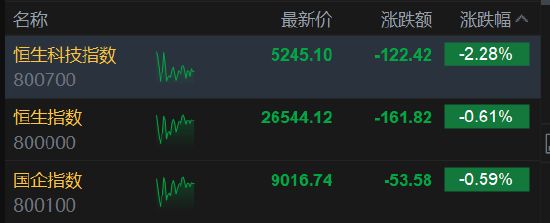
Market Overview - The Hong Kong stock market experienced a decline on the first trading day of the Year of the Rabbit, with the Hang Seng Index down 0.6% to 26,544.62 points, the Hang Seng Tech Index down 2.28% to 5,245.1 points, and the National Enterprises Index down 0.59% to 9,016.99 points [1] - Major technology stocks saw significant declines, including Alibaba down 3.75%, Tencent down 1.97%, and JD Group down 1.42% [1] AI and Robotics Sector - The AI and robotics sectors saw explosive growth, with several stocks reaching historical highs. MINIMAX-WP (00100) surged over 14% to 980 HKD, marking a year-to-date increase of over 450% [2] - The company launched the MiniMax M2.5, a production-grade model designed for Agent scenarios, which has attracted significant developer interest [2] - Zhizhu (02513) opened over 5% higher at 534 HKD, with projections of a 120% compound annual growth rate in revenue from 2025 to 2028 [2] - Aixin Yuanzhi (00600) saw a rise of over 16%, nearing a market capitalization of 20 billion HKD, following the successful testing of its high-end smart driving chip M97 [2] Earnings Disparity - Suton Ju Chuang (02498) reported a significant turnaround, with a forecast of achieving its first quarterly profit of at least 60 million RMB in Q4 2025, indicating a scaling phase for its robotics business [3] - The company Wang Guo Gold Group (03939) anticipates a profit increase of 143%-161% for the 2025 fiscal year, driven by rising gold prices and increased production [3] - Conversely, Shisi Pharmaceutical Group (02005) warned of a profit decline of 45%-60% for 2025 due to factors such as the lack of a major flu outbreak and price reductions in collective procurement [3] Buybacks and Fund Movements - Xiaomi Group-W (01810) repurchased 1.5 million shares for approximately 54.7 million HKD, while NetEase Cloud Music (09899) repurchased 92,400 shares for nearly 15 million HKD [4] - Other companies like Geely Automobile and Meitu also engaged in significant share buybacks [4] - Southbound capital flows showed a mix of cautious sentiment and recovery, with expectations for a rebound in Hong Kong tech stocks amid RMB appreciation [4] Institutional Insights - According to CICC, the recent pullback in Hong Kong stocks is attributed to hawkish expectations from the Federal Reserve and concerns over AI capital expenditures, but there is potential for recovery [6] - Analysts from ING noted that the recent decline in gold prices is a corrective pause, with expectations for strong demand as liquidity in Asian markets improves [6] - Electric equipment stocks rose, with Shanghai Electric up 7.38% and Harbin Electric up 4.45%, as analysts see long-term investment opportunities in the sector due to ongoing electricity shortages in the U.S. [6]

港股午评:恒指跌0.61% 科指跌2.28% 科网股普跌 AI应用、机器人概念股爆发 百度跌超5%
Xin Lang Cai Jing· 2026-02-20 04:12
Market Overview - The Hong Kong stock market indices experienced a collective decline, with the Hang Seng Index down by 0.61% to 26,544.12 points, the Hang Seng Tech Index down by 2.28%, and the National Enterprises Index down by 0.59% [1][2] Sector Performance - Technology stocks faced significant losses, with Baidu and Bilibili dropping over 5%, Alibaba and NetEase down over 3%, and Xiaomi and Kuaishou down over 2% [1] - Conversely, oil stocks showed resilience, with PetroChina rising over 4% amid geopolitical tensions in the Middle East [2] - The robotics sector saw a surge, particularly with Yujian rising over 19% following a strong performance during the Chinese New Year Gala [3][4] AI and Robotics Stocks - AI application stocks also experienced notable gains, with Zhiyu rising over 19% after announcing a "computing power partner" recruitment plan aimed at optimizing their GLM-5 model [4][5] - The sales of robotic products on Douyin e-commerce saw a significant increase, with GMV growing by 1680% and order volume increasing by 655% from February 16 to 18 [3]
春节AI 模型大战,谁是最大赢家?
虎嗅APP· 2026-02-20 03:20
Core Viewpoint - The article discusses the transformation of domestic AI models in China, highlighting a shift from theoretical capabilities to practical applications, particularly during the concentrated product launches around the 2026 Spring Festival, which serve as a testing ground for real-world applications [6][10][22]. Group 1: Practical AI Models - The recent launches of AI models such as Kimi K2.5, Seedance 2.0, and GLM-5 indicate a trend towards more practical and efficient AI solutions capable of handling complex tasks [9][11]. - The focus has shifted from traditional performance metrics to practical evaluation criteria, emphasizing the ability to complete tasks in real-world scenarios rather than just providing standard answers [10][14]. - The Spring Festival provided a unique environment for testing AI capabilities in real-life applications, such as meal planning and travel coordination, which require task decomposition and tool utilization [14][22]. Group 2: Haidian District's Role - Haidian District in Beijing has emerged as a significant hub for AI innovation, characterized by a dense concentration of talent and companies, facilitating rapid technological iteration [18][20]. - The ecosystem in Haidian combines academic research, infrastructure support, and application-driven enterprises, creating a complete chain from research to practical implementation [18][19]. - The local policies and funding initiatives have further strengthened the innovation landscape, allowing for a supportive environment for startups and technology development [19][20]. Group 3: Future Implications - The concentrated release of AI models marks a critical period for validating the industrial value of these technologies, with real user data expected to drive product improvements [22][23]. - The competitive landscape is shifting, with global giants like OpenAI and Google adapting their strategies in response to the advancements made by Chinese companies [22][25]. - The evolution of AI from a tool to a digital employee will necessitate new governance frameworks to accommodate the societal impacts of these technologies [24][25].

智通ADR统计 | 2月20日
智通财经网· 2026-02-19 23:23
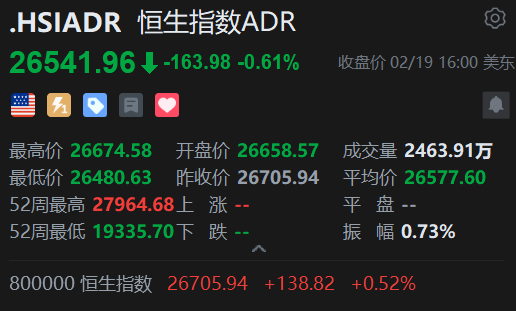
Market Overview - The Hang Seng Index (HSI) closed at 26,541.96, down by 163.98 points or 0.61% on February 19 [1] - The index opened at 26,658.57, reached a high of 26,674.58, and a low of 26,480.63, with a trading volume of 24.6391 million [1] Major Blue-Chip Stocks Performance - HSBC Holdings closed at HKD 135.722, up by 1.13% compared to the previous close [2] - Tencent Holdings closed at HKD 532.399, down by 0.11% compared to the previous close [2] Stock Price Movements - Tencent Holdings (00700) latest price is HKD 533.000, with a slight increase of 1.000 or 0.19% [3] - Alibaba Group (09988) latest price is HKD 154.700, down by 0.700 or 0.45% [3] - HSBC Holdings (00005) latest price is HKD 134.200, down by 1.500 or 1.11% [3] - AIA Group (01299) latest price is HKD 82.350, up by 2.050 or 2.55% [3] - Meituan (03690) latest price is HKD 82.050, down by 0.100 or 0.12% [3] - JD.com (09618) latest price is HKD 105.900, down by 0.500 or 0.47% [3]




春晚广告位争夺战:四十年国民记忆与商业暗流
凤凰网财经· 2026-02-19 10:54
Core Viewpoint - The evolution of the Spring Festival Gala sponsorship reflects the transformation of China's economy and consumer behavior over the past 40 years, showcasing the shift from material scarcity to technological innovation and brand storytelling [4][5]. Group 1: 1980s to Early 1990s - The Era of Material Scarcity - The transition from a planned economy to a market economy in the 1980s led to a scarcity of goods, making items like watches and bicycles symbols of wealth and status [6][7]. - The first brand to sponsor the Spring Festival Gala was Kambas watches in 1984, which used 3,000 quartz watches as payment, marking the beginning of brand sponsorship in the event [7][9]. - Kambas became a household name, with production reaching 1.26 million units by 1987 and over 2 million by 1991, highlighting the impact of the Gala on brand visibility and market demand [9][10]. Group 2: Mid-1990s to Early 2000s - The Rise of Consumerism - The late 1990s saw a surge in consumer spending, with households moving from basic necessities to larger purchases like televisions and refrigerators [12][14]. - In 1995, Shandong Kongfu Banquet Wine became the first "advertising king" of the Spring Festival Gala, paying 30.79 million yuan, initiating a trend among liquor companies [12][14]. - The sales of Qin Pool Wine skyrocketed from 180 million yuan in 1995 to 950 million yuan in 1996 after winning the sponsorship, demonstrating the immediate impact of Gala advertising [17]. Group 3: 2000s to 2010s - The Era of Brand Awareness - The early 2000s marked a shift towards household appliances as the main consumer focus, with Midea becoming a prominent sponsor, securing 16 sponsorships from 2003 to 2019 [18][20]. - The cost of advertising during the Gala increased significantly, with Midea's sponsorship rising from 6.8 million yuan in 2005 to 57.2 million yuan in 2011, reflecting the growing value of the event [20]. - Brands began to focus on storytelling and emotional connections with consumers, as seen with Haier and Gree, indicating a maturation of brand marketing strategies [21]. Group 4: Mid-2010s to Present - The Digital Economy and Technological Innovation - The rise of internet companies has transformed the Spring Festival Gala into a platform for digital engagement, with WeChat's "red envelope war" in 2015 significantly increasing viewer interaction [24][26]. - The Gala has become a battleground for tech giants, with platforms like Douyin and Kuaishou participating in interactive sponsorships, showcasing the shift towards a two-way communication model [29]. - The introduction of robots and AI technologies in recent Galas reflects China's transition from manufacturing to intelligent manufacturing, highlighting the importance of innovation in the economy [31].


春晚广告位争夺战:四十年国民记忆与商业洪流
Xin Lang Cai Jing· 2026-02-19 07:21
Core Insights - The evolution of the CCTV Spring Festival Gala sponsorship reflects the transformation of Chinese society and economy over the past 40 years, showcasing the changing consumer demands and emerging industries [20][21]. Group 1: 1980s to Early 1990s - The Era of Scarcity - In the 1980s, as China transitioned from a planned economy to a market economy, consumer goods were scarce, leading to a high demand for basic commodities [22]. - The first brand to sponsor the Spring Festival Gala was Kambas watches in 1984, which used 3,000 quartz watches as payment, marking the beginning of brand sponsorship in the gala [22][23]. - Kambas became a household name, with production reaching 1.26 million units in 1987 and over 2 million by 1991, despite the high price of its watches relative to average incomes [23][24]. Group 2: Mid-1990s to Early 2000s - The Rise of Consumerism - The mid-1990s saw a shift in consumer spending from basic goods to electronics, with Shandong Kongfu Banquet Wine becoming the first "advertising king" by paying 30.79 million yuan for sponsorship in 1995 [26]. - The competition among liquor brands for sponsorship reflected the rise of "social consumption," where premium liquor became a status symbol for social gatherings [28]. - After winning the Spring Festival sponsorship, Qin Pool Wine's sales skyrocketed from 180 million yuan in 1995 to 950 million yuan in 1996, demonstrating the immediate impact of gala sponsorship [29]. Group 3: 2000s to Early 2010s - The Home Appliance Boom - The early 2000s marked a shift towards home appliances as the primary consumer focus, with Midea becoming the most frequent sponsor, securing 16 sponsorships from 2003 to 2019 [30]. - The cost of advertising during the gala increased significantly, with Midea's sponsorship fee rising from 6.8 million yuan in 2005 to 57.2 million yuan in 2011, an increase of 840% [30]. - Midea's revenue grew from 17.5 billion yuan in 2003 to over 140 billion yuan in 2014, reflecting the effectiveness of its gala sponsorship strategy [12][30]. Group 4: Mid-2010s to Present - The Digital Economy and Technological Innovation - The rise of internet companies has transformed the Spring Festival Gala into a platform for digital engagement, with WeChat's "red envelope war" in 2015 significantly boosting viewer interaction [15][35]. - The gala's advertising has evolved from one-way promotion to interactive engagement, with platforms like Douyin and Kuaishou participating in sponsorships [16][35]. - The presence of technology companies has increased, with innovations such as AI and robotics showcased during the gala, indicating a shift from traditional advertising to technology-driven marketing [19][37].