
上海钢联

Search documents
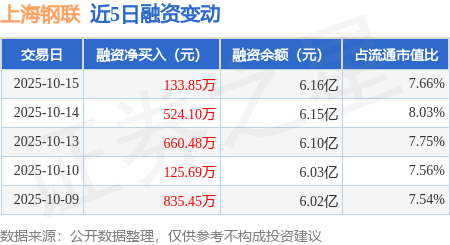
上海钢联:10月15日融资净买入133.85万元,连续3日累计净买入1318.44万元
Sou Hu Cai Jing· 2025-10-16 02:31
Core Insights - Shanghai Steel Union (300226) reported a financing buy of 52.97 million yuan and a financing repayment of 51.64 million yuan on October 15, resulting in a net financing buy of 1.34 million yuan and a financing balance of 616 million yuan, marking a cumulative net buy of 13.18 million yuan over the last three trading days [1] Financing Summary - On October 15, the net financing buy was 1.34 million yuan, with a financing balance of 616 million yuan, representing 7.66% of the circulating market value [2] - The financing balance increased from 610 million yuan on October 13 to 616 million yuan on October 15, indicating a positive trend in market sentiment [4] Margin Trading Summary - On October 15, the margin trading saw a sell of 5,600 shares and a repayment of 23,900 shares, resulting in a net margin buy of 18,300 shares, with a remaining margin of 63,000 shares [3] - Over the past 20 trading days, there were 11 days of net margin selling, suggesting a mixed sentiment in the market [3] Overall Margin Balance - The total margin balance reached 618 million yuan on October 15, reflecting an increase of 960,400 yuan or 0.16% from the previous day [4]


光大期货农产品日报-20251015
Guang Da Qi Huo· 2025-10-15 06:25
Report Industry Investment Ratings - Corn: Oscillatory rebound [1] - Soybean Meal: Oscillatory [1] - Oil: Upward [1] - Eggs: Oscillatory [1] - Pork: Oscillatory [2] Core Views - Corn prices are expected to rebound after a decline due to the release of the pressure of a bumper harvest and the emergence of farmers' reluctance to sell. Soybean meal is affected by uncertainties in US soybean demand and domestic supply, showing an oscillatory weak trend. Oil has short - term pressure but a long - term positive outlook. Egg futures rebounded from the bottom, while the supply pressure of eggs is large. Pork prices continue to be weak [1][2]. Summary by Directory Research Views - **Corn**: On Tuesday, the November corn contract fell and then closed slightly up, breaking through the 2100 - yuan integer mark. The spot price continued to decline, with the domestic average price at 2220 yuan/ton, a decrease of 10 yuan/ton. The price in the Northeast was weak, and the price in North ports and the marketing areas also declined. Technically, the sharp decline of the November contract released the pressure of a bumper harvest. With the cooling weather in the Northeast, farmers' reluctance to sell increased, and the futures price showed a stable performance at a low level [1]. - **Soybean Meal**: On Tuesday, CBOT soybeans closed lower due to uncertainties in US soybean demand. Brazil's soybean exports are expected to increase. Domestically, protein meal declined, and soybean meal fell below 2900 yuan/ton. Macro uncertainties, abundant domestic spot supply, and sufficient soybean arrivals in the fourth quarter suppress the market, with an oscillatory weak strategy [1]. - **Oil**: On Tuesday, BMD palm oil fell for the third consecutive day. High - frequency data showed that the export of Malaysian palm oil increased from October 1 - 10. Domestically, the three major vegetable oils declined. The short - term pressure exists, but the long - term trend is positive, with a strategy of buying on dips [1]. - **Eggs**: On Tuesday, egg futures rebounded from the bottom, with the main 2511 contract rising 1.57% to 2852 yuan/500 kilograms. The supply of eggs is normal, and the digestion speed in most areas is average. There are no new positive factors in the short term, and it is recommended to wait and see [1]. - **Pork**: On Tuesday, pork futures closed slightly up in an oscillatory manner. The spot price continued to decline, with the national average price of ternary live pigs at 10.81 yuan/kg. The daily slaughter volume increased, and the futures price was dragged down by the spot price [2]. Market Information - Malaysia has lowered the reference price of crude palm oil for November to 4262.23 ringgit per ton (1008.1 US dollars), while keeping the export tariff at 10% [2]. - Indonesia may regulate crude palm oil exports to ensure domestic supply for biodiesel production. The plan to increase to B50 in the second half of 2026 may reduce global edible oil supply [3]. - During the "14th Five - Year Plan" period, China's annual grain purchase volume exceeded 400 million tons, with abundant grain reserves and a stable market [3]. - China urges the US to correct wrong practices, show sincerity in negotiations, and promote the healthy development of Sino - US economic and trade relations [4]. Variety Spreads - The report provides charts of contract spreads and contract basis for various agricultural products such as corn, soybean meal, oil, eggs, and pork, including 1 - 5 spreads and basis, with data sourced from Wind and the Everbright Futures Research Institute [5][6][7][11][13][14][15][17][19][23][25] Introduction of the Agricultural Product Research Team - The team includes Wang Na, the director of the agricultural product research at Everbright Futures Research Institute; Hou Xueling, a soybean analyst; and Kong Hailan, a researcher in the egg and pork industries. They have rich experience and many honors [27]
国产EDA软件新品发布,创业板软件ETF华夏(159256)持仓股华大九天大涨超7%
Mei Ri Jing Ji Xin Wen· 2025-10-15 03:45
Group 1 - The A-share market opened with fluctuations, with strong performances in sectors such as building materials, gold, pharmaceuticals, and intelligent vehicles, while rare earth, military, and lithium battery sectors showed significant pullbacks [1] - The domestic software sector has seen continuous hot catalysts recently, with the logic of domestic substitution becoming increasingly clear [1] - The software industry plays a crucial role in the AI industry chain, primarily positioned in the midstream technology layer and downstream application layer, providing essential technical support and facilitating the implementation of AI applications [1] Group 2 - According to Dongfang Securities, the industrial design software sector has the largest potential for market share growth, while the overall scale of basic software is more substantial [2] - Key software includes basic software and industrial software, which are vital for the operation of critical national sectors, ensuring system security, and are difficult to replace, thus holding significant importance for national security, economic development, and social stability [2] - Related products include the ChiNext Software ETF (159256), ChiNext 200 ETF (159573), and AI ETF (515070) [2]

上海钢联股价涨5%,诺德基金旗下1只基金重仓,持有5万股浮盈赚取6.25万元
Xin Lang Cai Jing· 2025-10-15 02:32
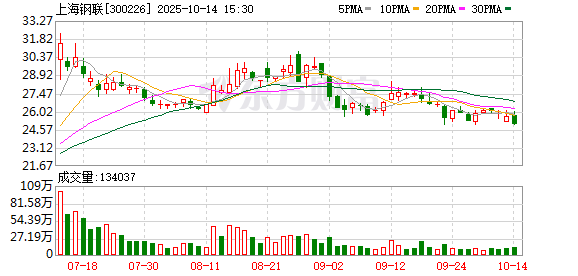
Core Insights - Shanghai Steel Union's stock increased by 5% to 26.25 CNY per share, with a trading volume of 188 million CNY and a turnover rate of 2.39%, resulting in a total market capitalization of 8.366 billion CNY [1] Company Overview - Shanghai Steel Union E-commerce Co., Ltd. was established on April 30, 2000, and went public on June 8, 2011. The company primarily provides B2B e-commerce services based on information services related to the steel, energy, mining, and non-ferrous metals industries [1] - The revenue composition of the company includes: Supply chain services (97.29%), consignment services (1.56%), data subscription services (0.66%), business promotion services (0.19%), conference training services (0.12%), research consulting services (0.07%), and other services (0.11%) [1] Fund Holdings - Nord Fund has a significant holding in Shanghai Steel Union, with the Nord Quantitative Blue Chip A (005082) fund holding 50,000 shares, representing 3.29% of the fund's net value, making it the seventh-largest holding. The estimated floating profit for today is approximately 62,500 CNY [2] - The Nord Quantitative Blue Chip A fund was established on December 29, 2017, with a current size of 289.9 million CNY. Year-to-date returns are 10.92%, ranking 5565 out of 8161 in its category; one-year returns are 16.24%, ranking 4412 out of 8015; and since inception returns are 19.11% [2] Fund Manager Profile - The fund manager of Nord Quantitative Blue Chip A is Zeng Wenhong, who has been in the position for 8 years and 56 days. The total asset size of the fund is 280 million CNY, with the best fund return during his tenure being 26.88% and the worst being 4.8% [3]
上海钢联:2025年半年度权益分派实施公告
Zheng Quan Ri Bao· 2025-10-14 13:07
Core Viewpoint - Shanghai Steel Union announced a cash dividend distribution plan for the first half of 2025, indicating a commitment to returning value to shareholders [2] Summary by Categories Dividend Distribution - The company will distribute a cash dividend of 0.500000 RMB per 10 shares to all shareholders, based on a total share capital of 318,721,422 shares [2] - The record date for the dividend is set for October 21, 2025, while the ex-dividend date is October 22, 2025 [2]
上海钢联(300226) - 2025年半年度权益分派实施公告
2025-10-14 10:46
证券代码:300226 证券简称:上海钢联 公告编号:2025-071 上海钢联电子商务股份有限公司 2025 年半年度权益分派实施公告 二、权益分派方案 本公司 2025 年半年度权益分派方案为:以公司现有总股本 318,721,422 股为 基数,向全体股东每 10 股派 0.500000 元人民币现金(含税;扣税后,通过深股 通持有股份的香港市场投资者、QFII、RQFII 以及持有首发前限售股的个人和证 券投资基金每 10 股派 0.450000 元;持有首发后限售股、股权激励限售股及无限 售流通股的个人股息红利税实行差别化税率征收,本公司暂不扣缴个人所得税, 待个人转让股票时,根据其持股期限计算应纳税额【注】;持有首发后限售股、 股权激励限售股及无限售流通股的证券投资基金所涉红利税,对香港投资者持有 基金份额部分按 10%征收,对内地投资者持有基金份额部分实行差别化税率征 收)。 【注:根据先进先出的原则,以投资者证券账户为单位计算持股期限,持股 1 个月(含 1 个月)以内,每 10 股补缴税款 0.100000 元;持股 1 个月以上至 1 年(含 1 年)的,每 10 股补缴税款 0.0500 ...
猪价跌至年内低位,生猪产能去化成关键
2 1 Shi Ji Jing Ji Bao Dao· 2025-10-13 13:16
Core Viewpoint - The holiday consumption effect on pig prices is weakening, with prices continuing to decline despite the recent National Day and Mid-Autumn Festival [1][3] Price Trends - The average price of live pigs in China was 12.90 yuan/kg in the first week of October, down 2.8% from the previous week and 29.5% year-on-year [1][3] - Prices have dropped over 22% compared to the beginning of the year, reaching a low point for the year [1] - As of October 13, the average price for external three yuan pigs was 10.81 yuan/kg, indicating a slight daily decrease [1][3] Supply and Demand Dynamics - The supply of pigs remains abundant due to previous production capacity releases and ongoing policies to control weight and reduce production [2][4] - Analysts expect a potential increase in demand as the weather cools and seasonal activities begin, which may provide some support for prices [2][4] - The market may see a dual increase in supply and demand in December, but supply growth may outpace demand, leading to further price declines [2] Industry Challenges - The continuous decline in pig prices is impacting breeding profits, with many producers facing losses [6] - As of October 10, self-breeding and pig fattening operations reported average losses of 206.91 yuan and 409.19 yuan per head, respectively [6] - Smaller producers are under significant pressure due to higher costs, while larger enterprises are better positioned to manage risks [6][7] Production Capacity Adjustments - The Ministry of Agriculture has emphasized the need for strict production capacity controls, aiming to reduce the breeding sow population by approximately 1 million [6][7] - Some companies, like Muyuan Foods, have begun to reduce their breeding sow numbers and manage slaughter weights to stabilize the industry [7] - The speed of production capacity reduction will be crucial for future price trends, with expectations of continued supply pressure if adjustments are slow [6][7]

黄金期货 又现新高 !
Zheng Quan Shi Bao Wang· 2025-10-13 09:50
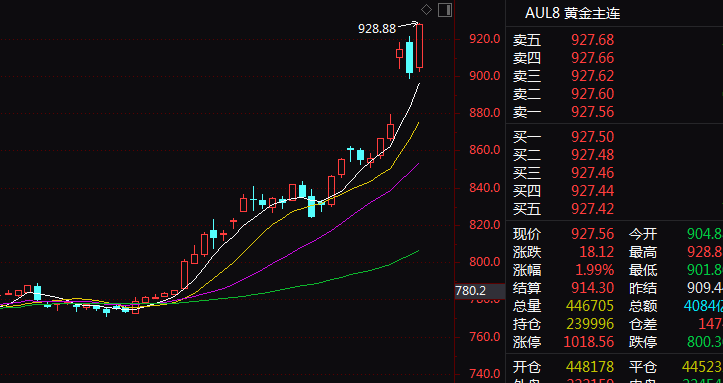
Core Viewpoint - The recent surge in gold and silver prices is driven by geopolitical tensions, macroeconomic uncertainties, and increased demand for safe-haven assets, with gold prices surpassing $4000 per ounce and silver prices reaching historical highs [1][3][4]. Group 1: Gold Market Analysis - On October 13, the domestic futures market saw the Shanghai gold main contract reach a new high of 928.88 yuan per gram, closing up 1.99% [1]. - Internationally, the London spot gold price also rose, breaking the $4070 per ounce mark [1]. - Since late September, international gold prices have increased significantly, with a weekly rise of 3.4% for gold and 4.47% for silver, leading to a gold-silver ratio drop to around 81 [3]. Group 2: Market Positioning and Holdings - As of September 23, the total gold holdings reported by the U.S. CFTC increased by 12,568 contracts to 528,789 contracts, with non-commercial net positions rising by 339 contracts to 266,749 contracts [3]. - Silver holdings also saw an increase, with total holdings up by 2,851 contracts to 165,805 contracts, and non-commercial net positions rising by 738 contracts to 52,276 contracts [3]. Group 3: Geopolitical and Economic Influences - The ongoing U.S. government shutdown is impacting economic stability and diminishing the long-term credit appeal of the U.S. dollar and assets, potentially leading global central banks and investors to increase gold holdings as a hedge against political risks [3]. - The first phase of the ceasefire agreement in Gaza, while initially bearish for gold prices, is overshadowed by ongoing geopolitical tensions from the Russia-Ukraine conflict and other regional issues [4]. Group 4: Silver Market Dynamics - The average weekly price for 1 silver ingots was 10,975 yuan per kilogram, up 670 yuan from the previous week [4]. - COMEX silver futures saw a non-commercial long position increase of 695 contracts to 72,318 contracts, while short positions decreased by 43 contracts to 20,042 contracts [4]. Group 5: Future Outlook - If the U.S. government shutdown persists, it may lead to a lack of clear economic data, increasing the likelihood of the Federal Reserve adopting a more accommodative monetary policy to counteract recession risks [4]. - Despite the recent price increases, potential corrections may occur if budget disagreements in the U.S. are resolved or if Federal Reserve officials issue hawkish statements [5]. - The long-term outlook for precious metals remains strong as they are viewed as valuable safe-haven assets amid ongoing economic uncertainties [6].
上海钢联10月10日获融资买入3050.14万元,融资余额6.03亿元
Xin Lang Zheng Quan· 2025-10-13 01:16
Core Insights - Shanghai Steel Union's stock price decreased by 0.08% on October 10, with a trading volume of 265 million yuan [1] - The company reported a financing buy-in of 30.50 million yuan and a net financing buy of 1.26 million yuan on the same day [1] - As of October 10, the total financing and securities lending balance reached 605 million yuan, indicating a high level of financing activity [1] Financing Summary - On October 10, Shanghai Steel Union had a financing buy-in of 30.50 million yuan, with a current financing balance of 603 million yuan, accounting for 7.27% of its market capitalization [1] - The financing balance is above the 70th percentile of the past year, indicating a relatively high level of leverage [1] Securities Lending Summary - On the same day, the company repaid 5,800 shares in securities lending and sold 7,500 shares, amounting to a selling value of 195,200 yuan [1] - The securities lending balance stood at 183.25 million yuan, exceeding the 60th percentile of the past year, also indicating a high level of activity in this area [1] Business Overview - Shanghai Steel Union, established on April 30, 2000, and listed on June 8, 2011, primarily engages in B2B e-commerce services related to steel, energy, mining, and non-ferrous metals [2] - The company's revenue composition includes 97.29% from supply chain services, 1.56% from consignment services, and smaller percentages from various other services [2] Financial Performance - For the first half of 2025, Shanghai Steel Union reported a revenue of 34.39 billion yuan, a year-on-year decrease of 21.65%, while the net profit attributable to shareholders was 118 million yuan, reflecting a year-on-year increase of 41.07% [2] Shareholder Information - As of June 30, 2025, the number of shareholders increased by 5.62% to 35,900, with an average of 8,523 circulating shares per person, a decrease of 5.32% [2] - Notable changes in institutional holdings include an increase in shares held by Southern CSI 1000 ETF and a decrease in shares held by Hong Kong Central Clearing Limited [3]
生猪市场旺季不旺 周期磨底或将持续
Zheng Quan Shi Bao· 2025-10-12 18:32
Core Viewpoint - The domestic pig market is experiencing a downward trend in prices, with recent data indicating significant declines in both futures and spot markets, leading to losses for pig farming operations [1][2][3]. Price Trends - As of October 10, the futures market price for live pigs has dropped to 11,320 yuan/ton, down over 40% from the peak of 19,010 yuan/ton in August last year [1]. - The average selling price for live pigs has fallen below 12 yuan/kg, marking a near historical low [1]. - In September, major companies reported declines in average selling prices, with TianKang Biological at 12.17 yuan/kg (down 4.85% month-on-month), DaBeiNong at 12.91 yuan/kg (down from 13.67 yuan/kg), and New Hope at 12.89 yuan/kg (down 4.8% month-on-month and 31.47% year-on-year) [2]. Supply and Demand Dynamics - The supply side has seen concentrated pressure release, with forced sales of larger pigs contributing to a "stampede effect" in the market [3]. - Despite some supply-side capacity reduction efforts, the market remains imbalanced, with excess supply continuing to suppress prices [7][8]. - The average price for lean meat pigs has dropped to 11.69 yuan/kg, down 34.72% year-on-year [2]. Industry Losses - The pig farming industry is entering a phase of increased volume but declining prices, leading to micro-profit or loss situations [4]. - Current losses per head for self-breeding operations are approximately 135.62 yuan, while losses for purchased piglet operations reach 295.65 yuan [4]. - The theoretical profit for self-breeding and piglet fattening has shown a downward trend since mid-August, with losses reported at 206.91 yuan/head and 409.19 yuan/head, respectively [4]. Capacity Reduction Efforts - The effectiveness of capacity reduction measures has been limited, with the number of breeding sows only slightly decreasing while still remaining at normal levels [7][8]. - Despite some large enterprises reducing production, many smaller farms have not yet begun to cut back, contributing to ongoing supply excess [7]. Seasonal Demand - The recent National Day and Mid-Autumn Festival, typically a peak demand period, did not meet expectations due to adverse weather conditions affecting consumption [9]. - Analysts predict that the market will remain in a bottoming phase, with potential for slight recovery in November as seasonal demand increases [9][10].
