中国星网

Search documents
关于国产星座,我说几句真心话
3 6 Ke· 2025-08-27 11:52
Core Viewpoint - The recent surge in interest surrounding satellite internet in China is driven by two main events: the rapid deployment of satellites by China Star Network and the anticipated issuance of satellite internet licenses to major telecom operators [1][19]. Group 1: Satellite Internet Development - China Star Network has accelerated its deployment of satellites, launching 38 satellites in 21 days, indicating a significant increase in the pace of its GW constellation deployment [1]. - The anticipated issuance of satellite internet licenses could include major players such as the three major telecom operators, China Star Network, and Shanghai Yuxin [1][26]. - The current landscape for satellite internet is challenging, with a low probability of success due to high costs and technical difficulties associated with low Earth orbit (LEO) satellite constellations [3][10]. Group 2: Historical Context and Technological Challenges - The development of satellite communication in China began in earnest after the Wenchuan earthquake, leading to increased investment in satellite communication technologies [4]. - China's first high-throughput satellite, Zhongxing 16, was launched in 2017, with subsequent satellites achieving higher capacities, such as Zhongxing 26, which has a capacity exceeding 100 Gbps [5]. - The operational logic and technology of LEO constellations differ significantly from medium and high orbit satellites, requiring a large number of satellites for global coverage [8][9]. Group 3: Economic and Strategic Considerations - The cost of maintaining a LEO constellation is substantial, and commercial viability is crucial for sustaining operations, especially given the need for continuous satellite replenishment [10][18]. - The establishment of China Star Network is partly driven by the need for a domestic satellite constellation, similar to the Beidou system, to enhance national capabilities in satellite communication [17]. - The demand for satellite communication is increasing due to the digital transformation of society and the need for coverage in remote areas, as well as for emergency and defense applications [14][15][16]. Group 4: Regulatory and Market Dynamics - The upcoming satellite internet licenses are linked to the first-class basic telecommunications business, indicating a move towards commercial operations in satellite internet [25]. - The three major telecom operators are unlikely to develop large-scale LEO constellations but may focus on specific services using medium and high orbit satellites [26]. - The success of domestic satellite constellations will depend on technological advancements, funding, and support from the national level and the industry chain [26].


2025中国商业航天行业发展研究报告
3 6 Ke· 2025-08-27 10:06
Core Viewpoint - The rapid rise of China's commercial space industry is marked by significant advancements in key technologies, particularly in reusable rockets and satellite manufacturing, positioning it as a competitive player against global leaders like SpaceX [1][2][4]. Group 1: Industry Development - China's commercial space sector is experiencing a milestone moment with the successful launch of 10 low-orbit satellites by China Star Network, marking the sixth launch in a month [1]. - The collaboration between state-owned enterprises and private companies in China is creating a complementary industrial ecosystem, with state entities focusing on strategic planning and private firms driving technological innovation and commercialization [1][2]. - The report from "Jiazi Guangnian Think Tank" provides a comprehensive overview of the current state and future prospects of China's commercial space industry, highlighting its transition from catching up to running alongside global competitors [2]. Group 2: Technological Breakthroughs - Continuous breakthroughs in key technology areas, such as reusable rockets and satellite mass production, are essential for the stable and efficient deployment of large low-orbit internet constellations in China [2][4]. - The establishment of advanced smart manufacturing bases, like the G60 satellite digital factory in Shanghai, has significantly improved satellite production efficiency through the use of digital twin and flexible intelligent manufacturing technologies [2]. - The integration of artificial intelligence and satellite internet is expanding the application boundaries of the aerospace industry, accelerating the development of commercial markets [4][37]. Group 3: Market Dynamics - The commercial space industry's core logic is based on a virtuous cycle of technological breakthroughs reducing costs, which in turn expands the market and drives innovation [4][37]. - The global commercial space market is heavily concentrated among a few key players, with SpaceX leading in launch frequency and payload capacity, while China's space capabilities are rapidly advancing [10][12]. - In 2024, the global space economy is projected to reach $415 billion, with commercial satellite services dominating the market, reflecting a growing trend towards cost reduction and efficiency improvements [33][25]. Group 4: Policy and Investment - National policies are crucial in shaping and promoting the development of China's commercial space industry, with recent government reports emphasizing the sector's strategic importance as a new growth engine [15][19]. - Local governments are actively implementing specialized policies and action plans to foster regional industrial clusters and application demonstrations in commercial space [16][18]. - The influx of diverse capital investments is a significant driver of growth in China's commercial space sector, with a notable increase in financing activities since 2015 [22][24].
2025中国商业航天行业发展研究报告 | 甲子光年智库
Sou Hu Cai Jing· 2025-08-27 08:16
Core Insights - China's commercial space industry is experiencing a milestone development moment, highlighted by the successful launch of 10 low-orbit satellites by China Star Network, marking the sixth launch in a month [2] - The industry is rapidly catching up to global leader SpaceX, which maintains a significant advantage with its reusable Falcon 9 rocket and is projected to conduct more launches in 2024 than all other providers combined [2][12] - The collaboration between state-owned enterprises and private companies in China is creating a complementary industrial ecosystem, with state enterprises focusing on strategic layout and private firms driving technological innovation and commercialization [2][3] Industry Development Background - The global commercial space industry is growing rapidly, with satellite internet revenues expanding and satellite applications and services remaining the largest segment of the market [4][27] - The core logic of commercial space development is a virtuous cycle of "technological breakthroughs reducing costs → cost reductions expanding markets → market demand driving innovation" [4][38] - Key technological breakthroughs in satellite mass manufacturing, reusable rockets, and laser communication links are enabling the transition of low-orbit mega-constellations from concept to large-scale deployment [4][41] Key Trends and Challenges - The commercial space sector is transitioning from a government-dominated model to one driven by market forces, with increasing participation from private enterprises [8][11] - The rise of private companies in the space industry is significant, with their share of the market growing rapidly [9][12] - The Chinese government is playing a crucial role in shaping and promoting the commercial space industry through supportive policies and strategic initiatives [19][22] Market Potential and Investment - The market for commercial space is showing significant potential, with policies gradually loosening and companies pursuing commercial profit [8][24] - Investment activities in China's commercial space sector have remained highly active since 2015, indicating optimistic market expectations [29][25] - The core technology teams, competitive barriers, and feasibility of business models are critical considerations for investors in the commercial space sector [29] Technological Advancements - The development of reusable rocket technology is pivotal for reducing launch costs and enhancing operational efficiency, which is essential for the commercialization of the space industry [43][39] - Laser communication is emerging as the best communication method for future integrated space-ground-sea networks, significantly improving operational efficiency [45][46] - The integration of artificial intelligence and new information technologies with satellite internet is expanding the application boundaries of the space industry and accelerating the development of the civilian market [4][38]

第一创业晨会纪要-20250826
First Capital Securities· 2025-08-26 03:57
Industry Overview - The Ministry of Industry and Information Technology is set to issue satellite internet licenses to three major telecom operators, which will likely accelerate the launch of satellite networks and ground facilities, presenting investment opportunities in satellite manufacturing and related companies [2] - Shanghai has announced adjustments to its real estate purchase restrictions, including lifting limits for single individuals and equalizing loan rates for first and second homes, which may boost confidence in the real estate sector and consumer spending, particularly in the liquor industry [3] - The Chinese government aims to increase the self-sufficiency rate of semiconductors for data centers to 70% by 2027, with plans for Beijing to reach 100%, indicating a growing market for domestic AI servers and computing chips [3] Advanced Manufacturing - Desay Battery reported a revenue of 9.762 billion yuan for the first half of the year, a year-on-year increase of 9.32%, while net profit decreased by 9.36% to 98 million yuan. The company is undergoing a strategic transformation, with traditional consumer electronics battery business performing well, but significant losses in its energy storage segment [6] - Jiangsu province has clarified the "discharge pricing mechanism" for vehicle-grid interaction, allowing electric vehicles to act as distributed energy storage units, which could incentivize the operation of energy storage fleets and charging stations [7] Consumer Sector - Maiqiuer's total revenue for the first half of 2025 was 294 million yuan, a decrease of 4.49%, but net profit turned positive at 1.5466 million yuan, a significant turnaround after three years of losses. The company's gross margin improved to 25.32% [9] - Guibao Pet reported a revenue of 3.221 billion yuan, a year-on-year increase of 32.72%, with net profit rising by 22.55% to 378 million yuan. The company saw strong growth in its core pet food segment, particularly in staple food, while online sales channels have become a significant growth driver [10]



卫星互联网牌照倒计时!太空万亿赛道正式启程
Sou Hu Cai Jing· 2025-08-26 03:07
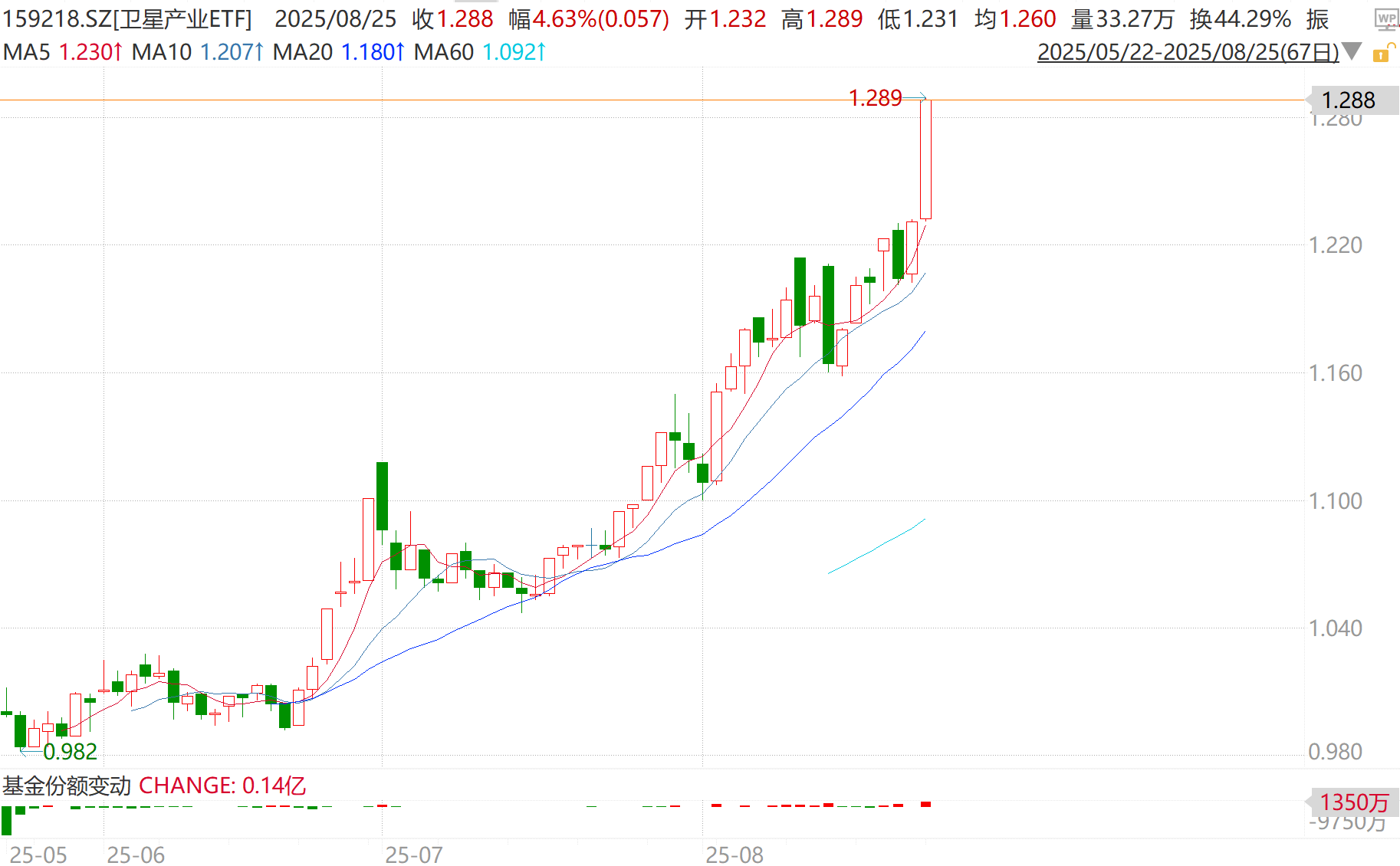
Core Viewpoint - The satellite industry ETF (159218) has shown significant growth, with a 28% year-to-date increase and a recent daily surge of 4.63%, indicating strong investor interest and potential in the satellite sector [2][1]. Group 1: ETF Performance - The satellite industry ETF (159218) has recorded a 28% increase in its value since its establishment just over three months ago [2]. - On August 25, the ETF experienced a daily increase of 4.63%, attracting 17 million in capital [1]. - Key constituent stocks such as China Satellite and Changjiang Communication have shown strong performance, with China Satellite hitting the daily limit up [1][3]. Group 2: Industry Developments - The Ministry of Industry and Information Technology is expected to issue satellite internet licenses to major operators, marking a significant step towards commercializing satellite communication services [5]. - The rapid launch of satellites by China Star Network, with five batches in 22 days, signals an acceleration in the development of low-orbit satellite internet [5][6]. - The industry is under pressure to launch approximately 1,300 satellites by September 2029 to secure frequency and orbital resources [6]. Group 3: Future Outlook - The satellite internet sector is viewed as a long-term strategic initiative rather than a quick profit opportunity, with implications for 6G development and space resource competition [7]. - The current focus is on high-throughput satellites serving niche markets, while consumer-level services will require further development of low-orbit satellite constellations [6][8]. - The issuance of licenses is seen as the starting point for a competitive landscape in satellite internet, with the efficiency of future satellite launches being crucial for China's position in this field [8].




相关部门近期将会发放卫星互联网牌照,专家:迈出商业运营第一步
Xin Lang Cai Jing· 2025-08-25 08:26
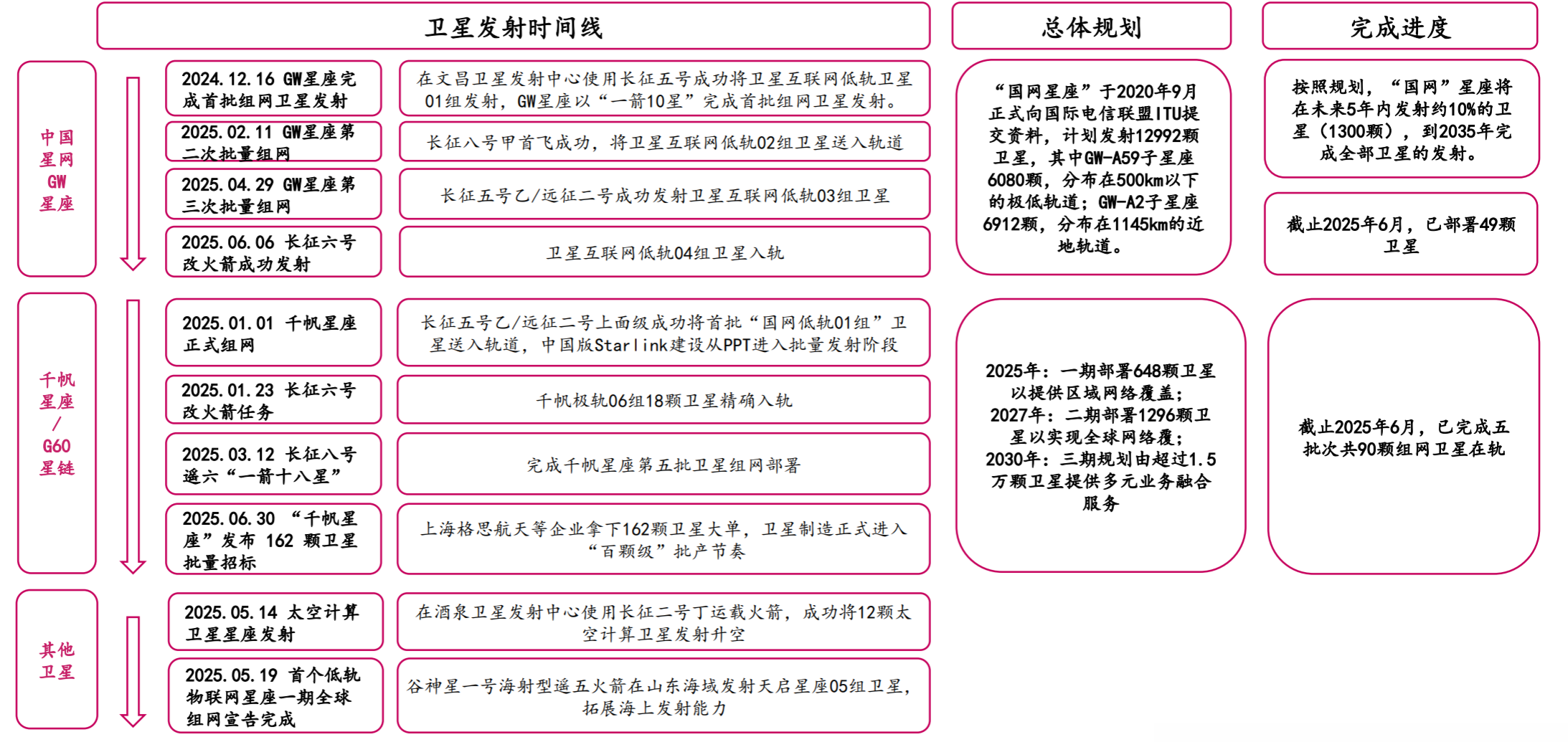
Group 1 - The issuance of satellite internet licenses in China is imminent, marking a significant step towards commercial operations in the satellite internet sector [1][5][6] - The rapid acceleration in satellite launches by China SatNet, with five batches of low Earth orbit satellites successfully launched between July 27 and August 17, indicates a shift towards a more aggressive deployment strategy [1][2][3] - The long-term plan includes the deployment of 13,000 satellites for the GW constellation and 15,000 for the Qianfan constellation, highlighting the ambitious scale of China's satellite internet initiative [1][3] Group 2 - The need to comply with the International Telecommunication Union (ITU) regulations is driving the accelerated launch schedule, as China SatNet must launch 10% of its planned satellites by September 2029 to avoid project cancellation [3][5] - The first generation of satellites, consisting of over 100 satellites, is expected to be completed this year to meet urgent communication needs, while the second generation's technology is still under development [3][6] - Major telecommunications operators in China, including China Telecom and China Mobile, are preparing to expand their satellite internet services, with China Telecom already having launched satellite communication services [5][6] Group 3 - Current satellite internet services in China rely on high-throughput satellites, such as APSTAR 6D and Zhongxing 26, which provide connectivity for specific industries rather than general consumers [9] - The transition to low Earth orbit satellite internet services is anticipated to take an additional 2-3 years before it can meet widespread consumer demand [6][8]


我国卫星互联网牌照发放倒计时,追赶马斯克星链
3 6 Ke· 2025-08-25 08:10
Group 1: Satellite Internet Development in China - Since late July, China's satellite internet construction has significantly accelerated, with the GW constellation successfully launching five low Earth orbit satellites between July 27 and August 17, reducing the launch interval from 1-2 months to 3-5 days, increasing the total number of satellites from 34 to 72 [1] - The GW and Qianfan constellations are part of China's plan to deploy a total of 1.3 billion and 1.5 billion satellites respectively, with the goal of achieving a comprehensive satellite internet network [1] - The issuance of satellite internet licenses is expected to occur within the year, marking a significant step towards commercial operation in the satellite internet sector [6][8] Group 2: Launch Frequency and Compliance - The launch frequency of satellites has increased, with an average of one group of satellites launched every 39 days prior to July, but accelerating to five batches in just 22 days in July and August [4][5] - Compliance with the International Telecommunication Union (ITU) regulations is a driving factor for the increased launch frequency, as China must launch 10% of its planned satellites by September 2029 to avoid project cancellation [5] Group 3: Future Prospects and Challenges - Despite the rapid progress, experts indicate that it may take an additional 2-3 years to provide satellite internet services comparable to SpaceX's Starlink, as the current infrastructure and satellite numbers are insufficient for full commercialization [6][11] - High-throughput satellites are currently being utilized to provide satellite internet services, but they are not designed for widespread consumer use, focusing instead on specific scenarios such as outdoor activities [12][13]
商业航天再迎重磅节点,卫星互联网牌照有望下发,还有SpaceX+华为潜在催化
Xuan Gu Bao· 2025-08-25 07:46
Group 1 - The issuance of satellite internet licenses marks a significant step towards commercial operations in China's satellite internet sector, although full commercial service similar to SpaceX's Starlink may take an additional 2-3 years [1] - Currently, the number of low Earth orbit satellites and application terminals in China is insufficient for comprehensive commercial use, indicating that the license issuance is just the beginning [1] - China Star Network has accelerated its satellite launch schedule, completing five batches of satellite launches within 22 days from July 27 to August 17, 2023, in response to international requirements [2][4] Group 2 - The first generation of the satellite constellation, consisting of over 100 satellites, is expected to be completed this year, prioritizing core needs such as diplomatic communications [4] - The Ministry of Industry and Information Technology is set to issue satellite internet licenses to three major telecom operators and China Star Network, which is a key state-owned enterprise in satellite internet design and operation [5] - Huawei's Mate 60 Pro, launched on August 29, 2023, is the world's first mass-market smartphone supporting satellite calls, reflecting the growing interest in satellite communication technology [7] Group 3 - The satellite internet sector is witnessing significant stock performance, with leading companies like Huali Chuantong experiencing over 200% increase in stock price from August 29 to October 11, 2023 [7] - Key companies in the satellite industry include Xinke Mobile, Zhenyou Technology, and Shanghai Hantong, while the rocket industry features companies like Chaojie Co. and Aerospace Power [9] - The ground infrastructure and terminal segment includes companies such as Tongyu Communication and Xinwei Communication, indicating a broad ecosystem supporting satellite internet development [9]
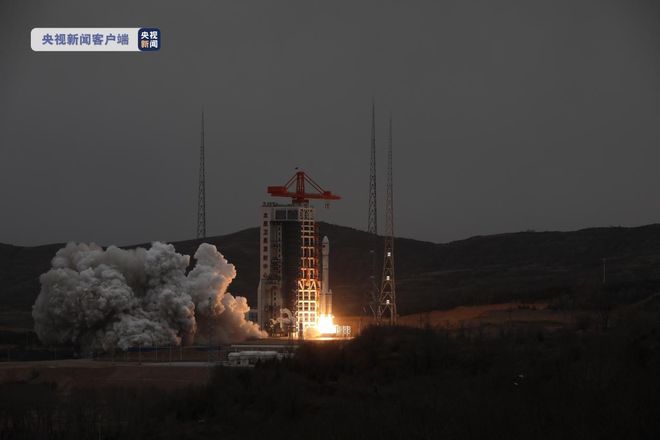
21天5次发射,中国星网为什么这么急?
Guan Cha Zhe Wang· 2025-08-20 00:20
Core Viewpoint - China's Starlink program is racing against time to deploy a massive constellation of satellites, with a goal of launching approximately 13,000 satellites by 2034, driven by international regulatory deadlines set by the International Telecommunication Union (ITU) [1][3][5] Group 1: Launch Strategy and Goals - China has executed five satellite launches in just 21 days, marking an unprecedented pace in its satellite deployment efforts [1][10] - The ITU has established strict timelines for satellite deployment, requiring at least one satellite in orbit within seven years, 10% of the total by the ninth year, 50% by the twelfth year, and 100% by the fourteenth year [3][5][6] - By 2029, China needs to have approximately 1,300 satellites in orbit, with a significant ramp-up in launch frequency required to meet these targets [11][12] Group 2: Competitive Landscape - SpaceX's Starlink has set a high bar with its rapid deployment of thousands of satellites, creating pressure on other competitors like China's Starlink and Amazon's Project Kuiper [6][9] - Amazon's Kuiper project, aiming to deploy 3,200 satellites, is also under time constraints, having launched over 100 satellites recently [7][9] - The competitive environment is characterized by a race to secure frequency and orbital resources, with the potential for significant consequences for those who fail to meet deployment milestones [6][18] Group 3: Challenges and Solutions - China's current strategy involves multiple rocket types being launched in parallel to meet immediate deployment needs, but this approach may not be sustainable long-term due to complexity and cost pressures [11][15] - To meet future demands, China must increase the payload capacity of its rockets and establish a more efficient launch cadence, potentially moving towards reusable rocket technology [12][14][15] - The development of the Long March 12 rocket, which may evolve into a reusable platform, is seen as a critical step in enhancing China's launch capabilities [14][15] Group 4: Regulatory Environment and Implications - The ITU's deadlines are not just formalities; failure to meet them could result in reduced frequency allocations or even project termination [18][19] - The case of Rivada, which received a waiver despite not launching any satellites, illustrates that demonstrating credible progress can provide some leeway in regulatory compliance [18][19] - For China, the focus must be on consistent satellite launches and production capabilities to avoid reliance on potential regulatory leniency [19]
组网与技术日益清晰,卫星互联预计将密集发射
Tebon Securities· 2025-08-19 05:36
Investment Strategy - The report indicates that China's satellite internet is entering a phase of intensive launches, with multiple satellite constellation plans advancing. The recent successful launches by China Star Network and the procurement announcement by Yuanxin Satellite are expected to drive demand in the industry [5][12][17] - The trend of laser networking has emerged, with computational satellites expected to enhance adaptive routing algorithms. China's technology reserves are not lagging behind, and the development of adaptive routing algorithms using machine learning and AI is seen as a key area for improving network performance [5][13][20] - Infrastructure for commercial launches is becoming increasingly robust, with reusable rockets set to be tested soon. The payload capacity of some Chinese rockets is approaching that of SpaceX's Falcon 9, which may lead to a synergistic development with accelerated satellite launches [5][14][15] Industry News - China successfully launched the low Earth orbit 08 group of satellites on August 13, marking the eighth batch of the China Star Network's GW constellation. This launch demonstrates China's capability for high-frequency launches, with a nine-day interval since the last launch [5][16] - The three major telecom operators in China reported stable performance in the first half of 2025, with China Telecom's revenue reaching 271.5 billion yuan, China Unicom's at 200.2 billion yuan, and China Mobile's at 543.8 billion yuan. The growth in their second curve businesses is expected to provide ongoing growth momentum for the companies and the downstream industry [5][17] - Kyivstar, Ukraine's largest telecom operator, completed a direct device connection test with Starlink, planning to commercialize the service in Q4. This test validates the feasibility of satellite mobile connectivity services in overseas markets [5][18][19] - Major AI companies are increasing their token consumption, with OpenAI's GPT-5 and xAI's Grok 4 being made available for free to users. This trend is expected to accelerate the demand for computational power in the AI sector [5][20] Weekly Review and Focus - The communication sector saw a 7.11% increase this week, outperforming major indices. Key areas of growth included IDC and optical modules, with respective increases of 12.90% and 10.04% [5][21] - The report suggests focusing on investment opportunities in the satellite internet and commercial aerospace sectors, highlighting companies such as Aerospace Universe, Mengsheng Electronics, and others [5][25]