太空资源争夺

Search documents
王强:警惕“星链”的国际垄断风险
Xin Lang Cai Jing· 2026-01-27 23:08
Core Viewpoint - Elon Musk's SpaceX has announced free access to its Starlink satellite internet service for Iranian users amid political turmoil, raising international concerns about the implications of commercial satellite constellations on global security and governance [1] Group 1: Impact of Starlink on Warfare - The Starlink system, initially designed for commercial satellite internet, has evolved into a quasi-military tool for the U.S., significantly influencing modern warfare dynamics, as evidenced by its rapid deployment to support Ukrainian forces during the Russia-Ukraine conflict [1] - The U.S. military has integrated Starlink with various operational units, enhancing its combat capabilities and creating a closed-loop information system for military operations [2] Group 2: Strategic Dependency and National Security - The reliance on Starlink technology by smaller nations creates a strategic dependency, posing risks to national sovereignty and security, as seen in past instances where the U.S. leveraged Starlink to exert pressure on countries like Ukraine [3] - The trend of countries, particularly in Europe and Japan, developing their own low-Earth orbit satellite constellations reflects a response to the vulnerabilities associated with dependency on foreign technology [3] Group 3: Challenges of Space Resource Management - Starlink's rapid expansion, with over 10,000 satellites in orbit, has led to monopolistic control over near-Earth orbital resources, increasing the risk of satellite collisions and space debris [4] - The lack of regulatory frameworks allows entities like Starlink to operate with impunity, potentially leading to a new arms race in outer space, as existing international laws struggle to address these emerging challenges [4] Group 4: Call for International Cooperation - There is a pressing need for the international community to establish binding guidelines for space activities to prevent militarization and ensure that space technology serves humanity's welfare [5] - Developing countries are encouraged to pursue autonomous technological paths and strengthen collaboration to build a secure space community [5]
东吴证券:商业航天市场空间广阔 全球频轨资源争夺加剧
Zhi Tong Cai Jing· 2026-01-27 01:41
Group 1 - The core viewpoint is that the competition for space resources is accelerating, leading to rapid development in China's commercial space sector, with over 250,000 satellite applications submitted and a projected global space market exceeding $800 billion by 2030 [1][3] Group 2 - The deployment of satellites in the U.S. is significantly ahead, with SpaceX leading the way; by the end of 2025, SpaceX is expected to have deployed over 9,000 satellites, accounting for about 60% of the global total [2] - China's actual satellite deployment is notably lower than that of the U.S., with a strong demand for satellite launches; policies are being implemented to support the acceleration of space development [2] - The global commercial space market is projected to reach $6.13 trillion by 2024, with commercial space accounting for approximately $4.8 trillion; by 2030, the market is expected to grow to $8 trillion, with a CAGR of about 10% from 2025 to 2030 [3]

美国卫星互联网竞争加剧:技术赛道与太空资源的博弈
Sou Hu Cai Jing· 2026-01-24 03:15
Core Viewpoint - Blue Origin has announced the launch of its multi-orbit satellite communication network plan named "TeraWave," marking a new phase in the competition among U.S. companies in the satellite internet sector [1] Group 1: Industry Overview - The rapid development of satellite internet is attributed to advancements in communication technology since the 1990s, transitioning from a sci-fi concept to real-world applications [3] - The demand for network coverage in remote and geographically complex areas represents the largest market potential for satellite internet [3] - The competition in the satellite internet market has intensified with the entry of major tech companies, indicating a shift from early technological exploration to substantial global competition [3] Group 2: Key Players and Strategies - SpaceX's "Starlink" is currently the largest satellite internet system, with over 9,000 satellites in orbit and more than 9 million users, focusing on providing services to households and small businesses in remote areas [3] - Amazon's "Low Earth Orbit Satellite Plan" aims to serve enterprise markets and government agencies, deploying over 3,000 satellites and emphasizing synergy with its cloud computing services [4] - Blue Origin's TeraWave project utilizes a combination of low and medium Earth orbit satellites to create a multi-orbit architecture, targeting enterprise users and government clients with high throughput and network redundancy [6] Group 3: Market Opportunities and Challenges - The global digital divide presents unprecedented market opportunities for satellite internet, with approximately 2.6 billion people lacking adequate internet access, primarily in rural and low-income areas [7] - The rapid growth of satellite numbers in low Earth orbit (LEO) and medium Earth orbit (MEO) has led to increasing congestion and risks associated with space debris, posing challenges for sustainable development in satellite communications [9] - The competition among companies for orbital and frequency resources is becoming a critical issue, with the need for coordination to avoid collisions and manage space debris [9] Group 4: Future Implications - The competition in satellite internet is not just about market share but also impacts global communication infrastructure, national security, and international cooperation [10] - As global internet demand grows, satellite internet is expected to integrate further with terrestrial networks, creating a more diversified global communication system [10] - The ability to balance commercial interests with international cooperation and address space resource allocation will be essential for the future of satellite internet [10]


20万颗卫星锁位,火箭从海上“回家”!争夺太空资源,中国选择“双道”出击
Sou Hu Cai Jing· 2026-01-21 10:32
Core Viewpoint - The commercial space industry is experiencing significant investment and competition, with China planning to launch 250,000 satellites over the next 14 years, which is five times the scale of SpaceX's Starlink project [1][2]. Group 1: Investment and Scale - The cost of launching a single rocket ranges from 110 million to 180 million yuan [1]. - China's satellite launch plan includes 20.3 million satellites from the government and 51,300 from various companies, totaling 250,000 satellites [2][4]. - This initiative is seen as a strategic move to secure communication sovereignty and space resources [5]. Group 2: Rocket Launch and Cost Efficiency - The high cost of traditional rocket launches, with 60% of expenses attributed to the first stage, necessitates the development of reusable rockets [6]. - SpaceX has successfully reduced launch costs from 50 million USD to 15 million USD through rocket recovery technology [6]. - China is rapidly advancing in rocket launch capabilities, with a growth rate of 30%, positioning itself as the second-largest player globally by 2025 [7]. Group 3: Technological Innovations - Multiple Chinese companies are developing reusable rocket technologies, with significant advancements in recovery methods [8]. - Two distinct recovery methods have been developed: a "sea net capture" system and a "precision landing" system for rockets [9]. - The establishment of a domestic production base for reusable rockets indicates a complete industrial chain from production to recovery [9][10]. Group 4: Future Prospects - The rapid development in China's commercial space sector, supported by policy and technological advancements, is expected to significantly reduce launch costs in the near future [11].
这是硬刚,不是试探!中国刚申请20万颗卫星,美国当天就急跳脚加塞7500颗,连马斯克都得调轨道让出空间。太空频轨早就被美国卡住喉咙,现在中国开始反压,对撞的是系统性封锁。天上的战争已经开打,只是没人听得见枪响。就在我们低头刷手机的时候,头顶几百公里外正在上演一场关于未来半个世纪的生...
Sou Hu Cai Jing· 2026-01-17 02:09
Core Viewpoint - The article discusses China's recent application for 203,000 satellite positions, signaling a strategic move to reclaim control over low Earth orbit resources and challenge U.S. dominance in space [1][10][28]. Group 1: China's Satellite Application - China has submitted a significant application for 203,000 satellite positions, with over 190,000 satellites led by its "national team," aiming to assert control over low Earth orbit resources [1][10]. - This application is seen as a declaration that no single entity can monopolize these orbital positions, challenging the existing power dynamics in space [11][22]. Group 2: U.S. Response - The U.S. responded swiftly by approving SpaceX to launch an additional 7,500 Starlink satellites on the same day the Chinese application was announced, indicating a sense of urgency [3][4]. - The rapid approval process reflects the U.S. government's concern over China's ambitions in space [4]. Group 3: Strategic Implications - The competition for orbital positions is likened to a game where the first to occupy a position becomes the dominant player, with limited available frequencies and orbital slots [8][19]. - The article emphasizes that the U.S. is attempting to fill valuable orbital slots before the seven-year deadline imposed by the International Telecommunication Union on China's satellite deployment [12][19]. Group 4: Challenges Ahead - China faces significant challenges in ramping up rocket production and reducing launch costs to meet the ambitious goals set by its satellite application [25]. - The article warns that failure to act decisively could result in long-term disadvantages in communication and navigation systems, potentially leaving China reliant on U.S. technology [22][25]. Group 5: Future Outlook - The article concludes that the satellite application represents a critical move in a high-stakes positioning war in space, with the potential to reshape future resource allocation and technological independence [28][30].
这是硬刚,不是试探!中国刚申请20万颗卫星,美国当天就急跳脚加塞7500颗,连马斯克都得调轨道让出空间。太空频轨早就被美国卡住喉咙,现在中国开始反压,对撞的是系统性封锁。夜空看着安静,实际上早就成了角斗场,一场抢地盘的硬仗已经打响。1月11日,中国向国际电信联盟递交了一份申请,涉及...
Sou Hu Cai Jing· 2026-01-17 02:09
Core Viewpoint - The competition for satellite resources has intensified, with China applying for 200,000 satellites, prompting a swift response from the U.S. to deploy an additional 7,500 satellites, indicating a strategic battle for control over space resources [1][2][3]. Group 1: China's Satellite Application - On January 11, China submitted an application to the International Telecommunication Union for 200,000 satellites, aiming to secure frequency and orbital resources for the future [2]. - This move is likened to preemptively claiming undeveloped land, ensuring that China locks in its position in the space resource competition [2][3]. - The application is seen as a strategic maneuver to counteract U.S. dominance in low Earth orbit, where the U.S. has been aggressively deploying its Starlink satellites [3][4]. Group 2: U.S. Response - The U.S. Federal Communications Commission quickly approved SpaceX's deployment of 7,500 new satellites on the same day as China's application, showcasing an unusually rapid response [2][3]. - Elon Musk's SpaceX is adjusting the orbits of existing satellites to optimize communication layers, effectively blocking new entrants from accessing prime orbital positions [2][4]. - The U.S. has historically maintained a monopolistic approach to low Earth orbit resources, promoting its own satellite launches while imposing barriers on foreign applications [3][4]. Group 3: Strategic Implications - The competition for satellite resources is not merely commercial but represents a redefinition of access to the highest domains of human exploration [6]. - China's application signifies a challenge to the U.S.'s attempt to monopolize low Earth orbit resources, emphasizing the need for fair resource distribution [6]. - The ongoing struggle reflects deeper concerns over information sovereignty, as satellite internet is crucial for global data flow and communication infrastructure [3][6].
基金经理紧急喊话:注意风险!!卫星产业ETF(159218)炸板再封板,信科移动-U、国博电子、华力创通多股涨超10%
Jin Rong Jie· 2026-01-12 06:56
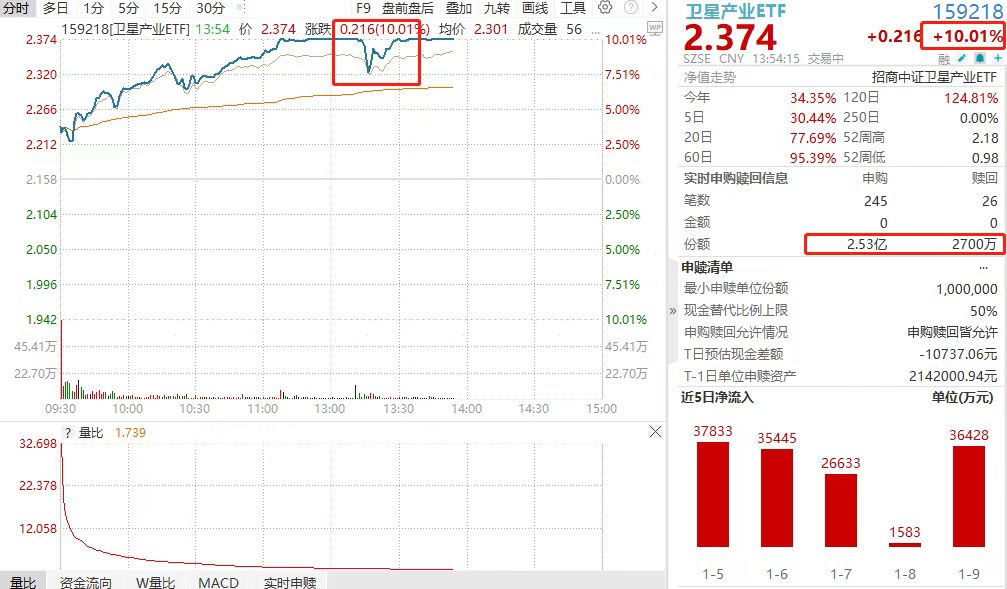
Core Viewpoint - The commercial aerospace sector is experiencing significant market activity, highlighted by the strong performance of the Satellite Industry ETF (159218), which saw substantial trading volume and price fluctuations [1][3]. Group 1: Market Activity - The Satellite Industry ETF attracted over 500 million yuan in single-day inflows, with a total trading volume reaching 1.4 billion yuan, indicating a highly active trading environment [3]. - Key constituent stocks such as Xinke Mobile-U, Guobo Electronics, Huali Chuantong, and Bolite surged over 10%, reflecting the market's enthusiasm [1]. Group 2: Industry Developments - The competitive landscape in the international space resource arena is intensifying, with China announcing the addition of 203,000 satellite frequency resources and SpaceX receiving approval for deploying 7,500 second-generation Starlink satellites [3]. - Domestically, the construction of the first offshore rocket recovery and reuse super factory has commenced, aiming to address the core bottleneck in rocket capacity [3]. Group 3: Investment Insights - Despite the current market exuberance, caution is advised regarding potential short-term corrections, as highlighted by the fund manager of the ETF, who noted the significant absolute and relative price increases [3][4]. - The long-term outlook for the satellite industry remains positive, driven by factors such as the frequent launches of reusable rockets, the upcoming IPO wave of commercial rocket companies, and the growing adoption of satellite connectivity in mobile devices [3][4]. Group 4: ETF Structure - The Satellite Industry ETF closely tracks the CSI Satellite Industry Index, with a strict requirement that the combined weight of "satellite manufacturing and launching" in the index must be no less than 50%, aligning with national strategic priorities in space infrastructure [4]. - Market analysts suggest that while short-term sentiment may lead to volatility, the fundamental growth logic of the industry remains intact, presenting potential opportunities for long-term investors during market corrections [4].

SpaceX 宣布卫星降轨行动,太空资源日趋紧张
Changjiang Securities· 2026-01-05 15:26
Investment Rating - The industry investment rating is "Positive" and maintained [7] Core Viewpoints - SpaceX announced a reduction in the orbital altitude of thousands of Starlink satellites to mitigate collision risks, highlighting the increasing competition for limited space resources [2][5] - The adjustment will involve approximately 4,400 Starlink satellites moving from an altitude of 550 kilometers to about 480 kilometers, aiming to reduce space debris and enhance safety [10] - The report emphasizes that the competition for low Earth orbit resources is intensifying, which may accelerate the development of China's commercial space industry, particularly with advancements in reusable rocket technology [10] Summary by Relevant Sections - **Event Description**: SpaceX's decision to lower the altitude of its Starlink satellites is a response to the growing congestion in low Earth orbit, which has become a focal point for international discussions on space resource allocation [5][10] - **Market Dynamics**: The report notes that the number of low Earth orbit satellites is expected to increase by 190% over the next decade, further complicating resource distribution [10] - **China's Commercial Space Development**: China's commercial space sector is projected to enter a rapid growth phase, driven by the competition for orbital resources and advancements in technology, with a focus on key suppliers in the industry [10]
下一片“新大陆”:马斯克用万颗卫星占轨道,中国如何后发制人?
Sou Hu Cai Jing· 2025-12-19 13:13
Core Insights - The competition for low Earth orbit (LEO) resources is intensifying, with the U.S. and China racing to deploy satellites at an unprecedented rate [1][5][10] - SpaceX's Starlink program has established a significant lead in satellite deployment, with over 8,000 satellites launched, while China's satellite count remains significantly lower at approximately 951 [2][4][6] Group 1: Satellite Deployment and Market Dynamics - As of July 2025, there are over 12,000 active satellites in orbit globally, with the U.S. dominating with about 10,490 satellites [2] - SpaceX's industrialized approach has allowed it to reduce satellite manufacturing costs to below $500,000 and launch costs to approximately $62 million per Falcon 9 rocket [5][7] - China's space program is transitioning from custom satellite production to a more industrialized model, with plans to deploy around 13,000 satellites under the National Star Network (GW) initiative and over 15,000 under the Shanghai Yanjin Satellite's "Thousand Sails Constellation" [8][9] Group 2: Strategic Implications and Future Outlook - The competition for satellite resources is not just about quantity but also involves communication sovereignty, digital economy, and national security [10] - The global satellite industry is projected to reach revenues of $293.3 billion by 2024, with significant growth in satellite manufacturing and launch sectors, providing opportunities for latecomers like China [10] - China aims to complete a portion of its satellite launches by 2027-2030 to secure its position in the competitive landscape, driven by regulatory pressures from the International Telecommunication Union [10]


卫星互联网牌照倒计时!太空万亿赛道正式启程
Sou Hu Cai Jing· 2025-08-26 03:07
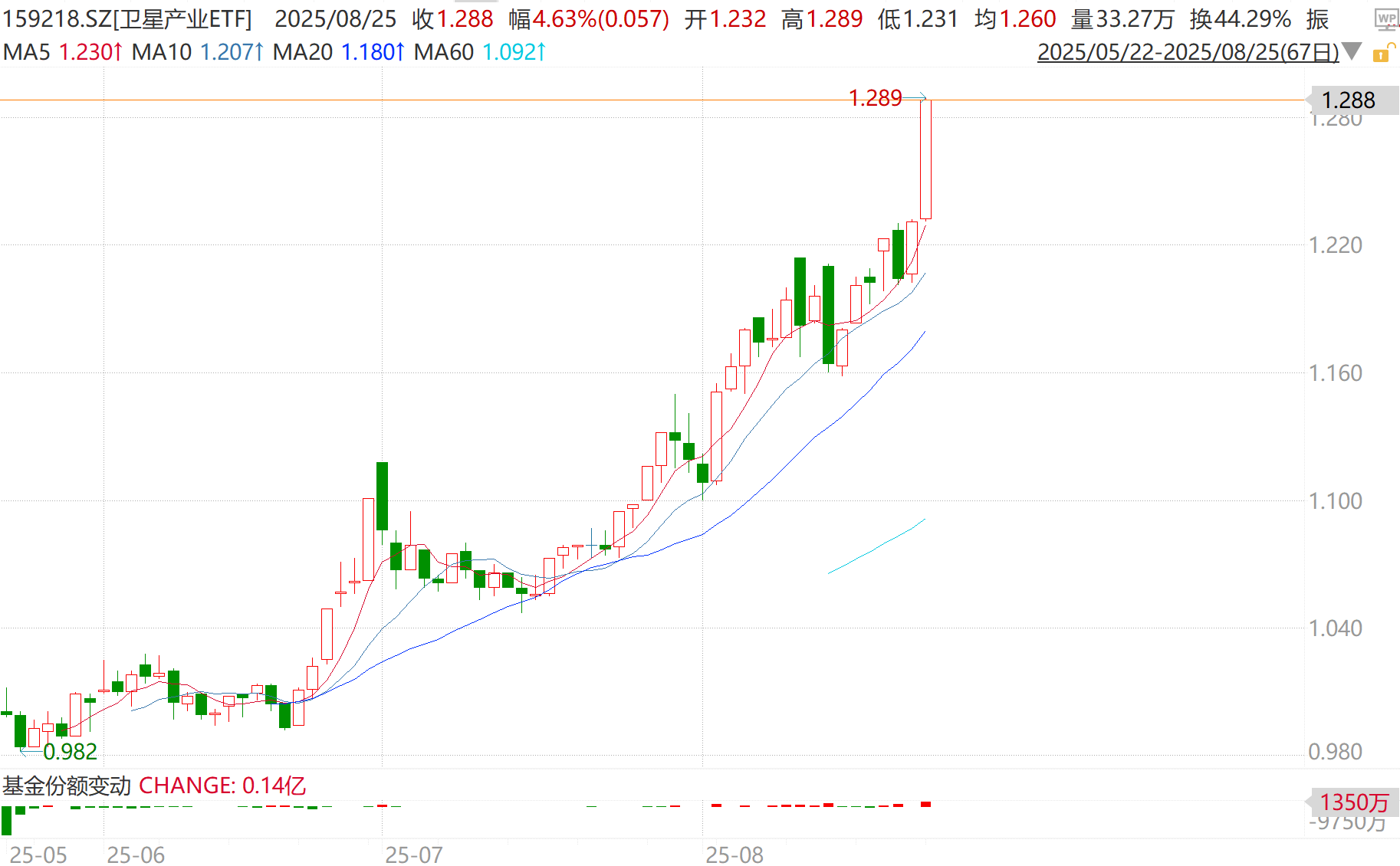
Core Viewpoint - The satellite industry ETF (159218) has shown significant growth, with a 28% year-to-date increase and a recent daily surge of 4.63%, indicating strong investor interest and potential in the satellite sector [2][1]. Group 1: ETF Performance - The satellite industry ETF (159218) has recorded a 28% increase in its value since its establishment just over three months ago [2]. - On August 25, the ETF experienced a daily increase of 4.63%, attracting 17 million in capital [1]. - Key constituent stocks such as China Satellite and Changjiang Communication have shown strong performance, with China Satellite hitting the daily limit up [1][3]. Group 2: Industry Developments - The Ministry of Industry and Information Technology is expected to issue satellite internet licenses to major operators, marking a significant step towards commercializing satellite communication services [5]. - The rapid launch of satellites by China Star Network, with five batches in 22 days, signals an acceleration in the development of low-orbit satellite internet [5][6]. - The industry is under pressure to launch approximately 1,300 satellites by September 2029 to secure frequency and orbital resources [6]. Group 3: Future Outlook - The satellite internet sector is viewed as a long-term strategic initiative rather than a quick profit opportunity, with implications for 6G development and space resource competition [7]. - The current focus is on high-throughput satellites serving niche markets, while consumer-level services will require further development of low-orbit satellite constellations [6][8]. - The issuance of licenses is seen as the starting point for a competitive landscape in satellite internet, with the efficiency of future satellite launches being crucial for China's position in this field [8].