信达证券

Search documents
信达期货,因合规问题又被“点名”!
Shen Zhen Shang Bao· 2026-01-03 03:26
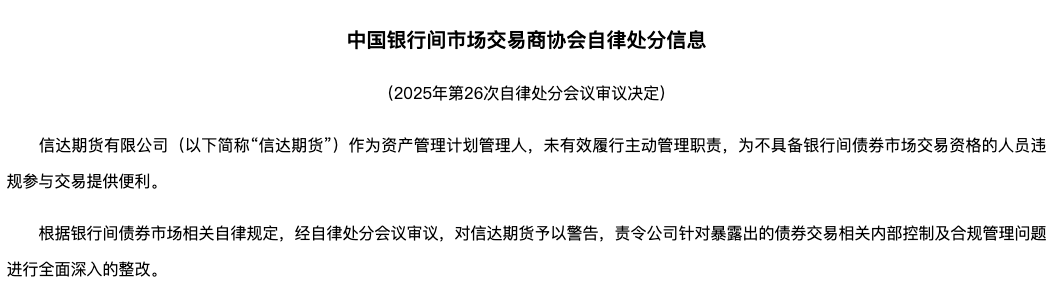
Group 1 - The China Interbank Market Dealers Association announced that Cinda Futures Co., Ltd. failed to effectively fulfill its active management responsibilities, facilitating unauthorized trading by individuals not qualified for interbank bond market transactions [1] - Cinda Futures has been named for compliance issues for the second time in 2025, with a previous incident in September regarding its app's privacy policy violations, which did not adequately disclose the purposes, methods, and scope of personal information collection [3] - Cinda Futures was established in October 1995 and is wholly owned by Cinda Securities Co., Ltd., with a registered capital of 600 million RMB, and is recognized as a large, reputable futures company in China [3] Group 2 - Cinda Futures is a member of several major exchanges, including the China Financial Futures Exchange and the Shanghai Futures Exchange, and holds various memberships in industry associations [3] - In June 2025, the China Securities Regulatory Commission officially approved Central Huijin Investment Ltd. as the actual controller of Cinda Securities, changing the controlling shareholder from the Ministry of Finance to Central Huijin [3]


券商行业2025年十大事件:行业首例“三合一” 券商纷纷“换帅”
Nan Fang Du Shi Bao· 2026-01-01 23:10
Core Viewpoint - In 2025, the Chinese securities industry underwent profound changes under the strategy of "cultivating first-class investment banks," marked by resource integration, technological empowerment, and ecological restructuring, signaling a new chapter for the industry. Group 1: Major Events - The merger of Guotai Junan and Haitong Securities in 2025 established a new "dual leader" pattern in the industry, with the combined entity "Guotai Haitong" reporting a net profit of 22.074 billion yuan, closely following CITIC Securities' 23.159 billion yuan, both surpassing the 20 billion yuan mark [4] - The first "three-in-one" integration in the industry is being planned by CICC, Dongxing Securities, and Xinda Securities, which, if completed, will create a new model for industry integration with total assets exceeding 1 trillion yuan [5] - The margin trading balance reached a historical high of 2.551734 trillion yuan by December 29, 2025, accounting for 2.59% of the A-share market's circulating market value, with a 288% year-on-year increase in new accounts opened in September 2025 [6] Group 2: Regulatory and Structural Changes - The China Securities Regulatory Commission revised and renamed the "Securities Company Classification Evaluation Regulations" in 2025, focusing on guiding the industry to serve national strategies and enhancing professional capabilities [7] - AI applications in securities firms accelerated, with leading institutions showcasing advancements at the 2025 World Artificial Intelligence Conference, enhancing capabilities in investment research and risk control [8] Group 3: Leadership and Talent Dynamics - Over 10 chief economists in the securities industry changed positions in 2025, primarily due to the merger wave, indicating a significant reshuffling of talent [9] - More than 50 securities firms experienced changes in leadership roles, with approximately one-third of firms undergoing a "leadership change," driven by factors such as retirement and shareholder changes due to mergers [10] Group 4: Market Competition and Trends - Despite the rising trend of "anti-involution," a price war among securities firms intensified, with commission rates dropping to as low as 0.01% and financing rates falling below 4%, highlighting the need for the industry to return to its core financial services [11] - Securities firms were first included as issuers of Sci-Tech Innovation Bonds in May 2025, with total issuance exceeding 80 billion yuan since then, enhancing their competitive edge [12] - The wave of public fund business that began in 2022 receded in 2025, with several institutions withdrawing their applications for public fund qualifications, indicating a shift in business models [14]



945亿元盘活4524亿元资产,中国信达房地产“造血”模式如何持续?
Xin Hua Wang· 2025-12-31 13:05
Core Viewpoint - The article discusses the role of China Cinda Asset Management in addressing real estate risks during the "14th Five-Year Plan" period, highlighting its involvement in various projects across multiple cities and its strategies for risk resolution in the real estate sector [1][2][3]. Group 1: Company Involvement in Real Estate Projects - China Cinda has participated in 43 cities' projects to ensure the delivery of homes and buildings, completing its tasks during the "14th Five-Year Plan" [1]. - The company has invested 12 billion yuan in the Xi'an project, which has successfully sold 1,006 units, demonstrating its effective management and development capabilities [2][3]. Group 2: Risk Resolution Strategies - The company employs a dual approach of "blood transfusion" and "blood production" to support troubled real estate projects, focusing on both funding and sustainable development [4][5]. - China Cinda has initiated 191 real estate risk resolution projects from 2022 to September 2025, ensuring the delivery of approximately 130,000 homes [2][4]. Group 3: Financial Performance and Growth - As of June 2025, China Cinda's total assets reached 1.68 trillion yuan, reflecting a 2.62% increase from the end of 2024 [2]. - The company reported a net profit of 2.281 billion yuan for the first half of 2025, marking a 5.8% year-on-year growth, indicating a recovery in profitability [6]. Group 4: Future Outlook - Looking ahead to 2026, China Cinda aims to focus on high-quality urban renewal, revitalizing troubled real estate projects, and exploring opportunities in non-residential sectors and restructuring [7].

券商财富强监管信号:166份罚单曝光六乱象
2 1 Shi Ji Jing Ji Bao Dao· 2025-12-31 12:49
Core Insights - The wealth management industry is undergoing a significant transformation driven by stringent regulations, which are reshaping the industry order and increasing the cost of violations [2][16]. Regulatory Trends - The regulatory landscape is characterized by three major trends: penetrating accountability, multi-faceted penalties, and full-cycle supervision [16]. - There is a clear signal of "zero tolerance" towards violations, with a notable increase in the number of penalties issued [2][16]. Violations and Penalties - As of December 26, 2025, at least 166 penalties have been issued against 57 brokerage firms for violations related to wealth management business, highlighting issues such as mismanagement of personnel and inadequate compliance [2][3]. - Over one-third of brokerages have faced administrative measures due to violations in wealth management since 2025, primarily involving branch offices [3]. Common Violations - Six prevalent types of violations have been identified: 1. Inadequate compliance management of personnel, with examples including unauthorized trading and improper account handling [3][4]. 2. Failure to effectively implement investor suitability management, with instances of providing incorrect answers to knowledge assessments [4]. 3. Unauthorized promises of returns during financial product sales, indicating a focus on quantity over quality in brokerage practices [5]. 4. Illegal solicitation of clients, with several firms found to be assigning marketing tasks to non-marketing personnel [6][7]. 5. Failure to report significant events that could impact management and client rights in a timely manner [8]. 6. Multiple issues often exist within the same brokerage, leading to severe operational impacts [9]. Impact of Violations - The consequences of violations extend beyond warnings, with some branches facing business suspensions for serious infractions [9][10]. - Increased internal compliance checks and regulatory discussions have been mandated for firms with identified issues [10][11]. Employee Accountability - Nearly 97 penalties have been issued to individual employees for violations related to wealth management, with a concentration on sales promotion and internal controls [13][14]. - The regulatory focus on employee misconduct reflects the ongoing challenges in transitioning to a "buy-side advisory" model [14][15]. Compliance Management Risks - The rise of online channels for business has introduced new compliance risks, with several penalties issued for violations related to online marketing practices [15].
【新华财经调查】945亿元盘活4524亿元资产,中国信达房地产“造血”模式如何持续?
Xin Hua Cai Jing· 2025-12-31 12:25
Core Viewpoint - During the "14th Five-Year Plan" period, China Cinda has successfully completed its tasks related to ensuring the delivery of housing and projects, actively participating in risk resolution in the real estate sector across 43 cities in China [2][3]. Group 1: Financial Performance and Strategy - As of June 2025, China Cinda's total assets reached 1.68 trillion yuan, reflecting a 2.62% increase from the end of 2024 [3]. - The company aims to be a problem solver for distressed real estate and a value investor in operational real estate, adapting to market changes and policy directions [3][8]. - China Cinda has invested 945 billion yuan to facilitate the resumption of projects valued at approximately 4.524 trillion yuan, achieving a leverage ratio of 1:5 [5]. Group 2: Project Management and Risk Resolution - The company has engaged in 191 real estate risk resolution projects from 2022 to September 2025, ensuring the delivery of around 130,000 housing units [2][3]. - China Cinda employs a multi-faceted approach to project management, involving collaboration with various stakeholders, including government departments and financial institutions, to address issues across the entire business chain [4][5]. - The company has successfully restructured projects like the Henan Kangqiao project, injecting funds and management expertise, resulting in the delivery of over 6,400 housing units and resolving 2 billion yuan in construction payments [3][5]. Group 3: Future Outlook and Development - Looking ahead to 2026, China Cinda plans to focus on high-quality urban renewal, revitalizing distressed real estate projects, and exploring opportunities in non-residential sectors and restructuring [8]. - The company is transitioning from merely providing financial support to offering comprehensive solutions that include substantial restructuring and operational management [8].
东兴证券2026年新年致辞
Xin Lang Cai Jing· 2025-12-31 09:37
Core Viewpoint - The company expresses confidence in entering 2026, highlighting the achievements of 2025 as a pivotal year for reform and efficiency enhancement, while emphasizing the importance of aligning with national strategies and improving financial services [1][4]. Group 1: Achievements in 2025 - 2025 marked the successful completion of the "14th Five-Year Plan" and was a year of significant reform and efficiency improvements for the company [1][4]. - The company witnessed the deepening of comprehensive reforms and the continuous improvement of the capital market's foundational systems [4][5]. - There was a notable enhancement in the effectiveness of financial services to the real economy, reflecting the company's active participation in this process [4][5]. Group 2: Strategic Initiatives and Developments - The company focused on deepening the implementation of the Party's innovative theories and aligning with the spirit of the 20th National Congress and subsequent meetings [2][5]. - A strategic transformation was promoted, leading to the development of a "Investment Banking +" ecosystem and the establishment of a new competitive landscape [2][5]. - The company improved its risk management framework, reinforcing risk prevention in key areas, thereby solidifying its foundation for safe development [5]. Group 3: Vision for 2026 - 2026 is identified as a crucial year for advancing the construction of a modern socialist country and deepening the financial power strategy [2][5]. - The company aims to enhance its research and investment capabilities while focusing on a comprehensive financial service system that integrates research, investment banking, and investment [5]. - The company plans to adapt to market changes with innovative products and maintain stable operations to address risks, thereby demonstrating value in national strategy services and industry development [5].

中国资本市场2025:十大“最”时刻
Xin Lang Cai Jing· 2025-12-31 08:18
Core Insights - The year 2025 marked significant transformations in China's capital market, characterized by index breakthroughs and ecological restructuring, including the Shanghai Composite Index surpassing 4000 points and the handling of the Dongxu Group's 600 billion yuan fraud case [1][10] Group 1: Major Transformations - The most important ideological shift was from "heavy financing" to "coordinated investment and financing," emphasizing a balanced ecosystem and investor returns through improved systems for dividends, buybacks, and mergers [2][12] - A strong consensus emerged around market value management, transitioning from a niche practice to a standard across the market, with 1001 A-share companies disclosing value management systems by November, a fivefold increase from earlier in the year [2][12] Group 2: Key Market Trends - The hottest sectors were AI and hard technology, with the launch of DeepSeek-R1 in January triggering a massive influx of capital into the AI industry chain, leading to a significant revaluation of related stocks [2][13] - A major shift in funding structures occurred, with insurance and social security funds increasing equity asset allocations, and a "deposit migration" trend among residents as savings rates fell below 1% [2][14] Group 3: Regulatory Environment - 2025 was marked by stringent regulatory enforcement, highlighted by the forced delisting of major companies like Dongxu Group for significant fraud, with over 60 companies delisted throughout the year [3][5] - The year also saw a focus on mergers and acquisitions as a strategic solution for asset revaluation, with notable transactions including Guotai Junan's acquisition of Haitong Securities [3][15] Group 4: Notable Reforms - The launch of the "1+6" reform series for the Sci-Tech Innovation Board aimed to enhance the inclusivity and adaptability of the capital market, facilitating the listing of unprofitable companies [5][16] Group 5: Market Performance - The Shanghai Composite Index reached a ten-year high, crossing the 4000-point mark for the first time since August 2015, reflecting a significant recovery in market confidence [6][16] - The total trading volume of A-shares reached a record 29.92 trillion shares, with a total transaction value exceeding 419.86 trillion yuan, marking a 63% increase from 2024 [6][16] Group 6: Unexpected Developments - Hong Kong's stock market made a remarkable comeback, becoming the world's best-performing market with IPO fundraising returning to the top globally and the Hang Seng Index achieving its best annual performance since 2017 [7][17] - The most profitable new stocks were the domestic GPU companies, Moer Thread and Muxi Co., with record profits from initial public offerings, indicating strong market support for domestic GPU alternatives [8][18]


又见首席跳槽 于明明加盟东吴证券
Xin Lang Cai Jing· 2025-12-31 08:01
Group 1 - The core viewpoint of the article highlights the frequent talent movement within the brokerage research industry in 2025, with significant changes in personnel across various firms [1][5] - Yu Mingming, the former deputy director of the research institute at Xinda Securities, has joined Dongwu Securities as the head of quantitative investment, indicating a trend of high-profile analysts changing firms [1][5] - By the end of 2025, over 300 analysts changed their professional institutions, involving more than 60 brokerages, with 220 analysts transferring in the first half of the year alone [4][8] Group 2 - The total number of registered analysts in the industry surpassed 6,162 by September 2025, marking a historical high, which contrasts with the ongoing talent flow [4][8] - Notable changes in core talent include at least 14 chief economists from various brokerages, such as the transfer of Xun Yugen from Guotai Junan to Guoxin Securities, reflecting significant shifts in leadership roles [4][9] - The movement of analysts is driven by factors such as brokerage mergers leading to job overlaps, adjustments in business positioning, differences in compensation mechanisms, and career development opportunities [3][4] Group 3 - The phenomenon of "team migration" is prevalent, with over 25 top analysts from popular sectors like consumption, new energy, and TMT changing platforms, indicating a trend of collective movement within teams [9] - The overall analysis of 2025 suggests that the talent flow is a manifestation of the "Matthew effect" due to declining commission rates, as well as a necessary transition from traditional sell-side services to integrated research and comprehensive financial services [4][9] - Xinda Securities has established a three-tier research system covering 25 core industries, focusing on key sectors aligned with national industrial upgrading trends, and is advancing the integration of research and investment [3][7]


破局与重构:2025年中国金融业十大事件
2 1 Shi Ji Jing Ji Bao Dao· 2025-12-31 06:09
"却顾所来径,苍苍横翠微。" 2025年这一年,全球经济复苏乏力与地缘博弈交织的外部环境,同国内高质量发展与金融强国建设的内在要求相互碰撞,共同推动中国金融体 系加速告别规模扩张的旧范式,迈入以质量提升、结构优化、风险可控为核心的新周期。 2025年10月28日,《中共中央关于制定国民经济和社会发展第十五个五年规划的建议》(以下简称"十五五"规划建议)正式公布,为未来五年 中国经济社会发展擘画了宏伟蓝图。这份纲领性文件将金融提升到前所未有的战略高度,"金融"一词被提及17次,并首次将"加快建设金融强 国"确立为核心目标,标志着金融发展从"大"到"强"的历史性跨越。 "十五五"规划建议为金融强国建设明确了清晰的实施路径与核心任务。在对内改革层面,明确提出完善中央银行制度、货币政策与宏观审慎管 理体系"双支柱"框架;将科技金融、绿色金融、普惠金融、养老金融、数字金融这"五篇大文章"确立为金融服务实体经济的核心抓手;并致力 于提高资本市场制度的包容性与适应性。 在对外开放与监管层面,规划强调"稳"与"进"的平衡:一方面要求全面加强金融监管,强化央地协同,丰富风险处置工具,构建坚实的风险防 范化解体系;另一方面则明确 ...
并购重组风起云涌,2025券商十大事件,万亿赛道谁执牛耳
Nan Fang Du Shi Bao· 2025-12-31 03:48
Core Insights - The Chinese capital market is at a historical intersection of deepening reform and high-quality development in 2025, with significant transformations in the brokerage industry driven by resource integration, technological empowerment, and ecological restructuring [2] - The brokerage industry is experiencing a year of both challenges and breakthroughs, marked by major events that symbolize the ongoing transformation and the journey towards becoming a first-class investment bank [2] Group 1: Major Mergers and Acquisitions - The merger of Guotai Junan and Haitong Securities marks the largest A+H dual-market merger in China's capital market history, establishing a new "giant" in the brokerage industry, Guotai Haitong [2][3] - In 2025, both CITIC Securities and Guotai Haitong achieved over 20 billion yuan in net profit, solidifying a "dual leader" position in the industry [3] Group 2: Innovative Integrations - The planned merger of China International Capital Corporation (CICC) with Dongxing Securities and Xinda Securities represents the first "three-in-one" integration in the brokerage industry, potentially creating a new "trillion-yuan brokerage" [5] - The combined assets of the three firms reached 1,009.58 billion yuan, positioning them among the top in the industry [5] Group 3: Market Developments - The margin trading market reached a historical high of 25,517.34 billion yuan by December 29, 2025, accounting for 2.59% of the A-share market's circulating value [7] - The number of new margin trading accounts surged by 288% year-on-year in September, indicating increased investor activity [7] Group 4: Regulatory Changes - The China Securities Regulatory Commission revised the classification regulations for securities companies, emphasizing the need for firms to enhance their professional capabilities and better serve the real economy [9] - The new regulations focus on improving return on equity (ROE) and reducing the emphasis on total revenue rankings [9] Group 5: Technological Advancements - The brokerage industry is rapidly adopting AI technologies, with significant advancements showcased at the 2025 World Artificial Intelligence Conference [11] - CITIC Securities introduced a "digital employee" system to enhance operational efficiency, reflecting a broader trend of digital transformation in the industry [11] Group 6: Leadership Changes - Over 50 brokerages experienced changes in their core management teams in 2025, indicating a significant reshuffling of leadership within the industry [15] - The changes are driven by factors such as retirement and the impact of mergers, with a notable shift towards younger leadership [15] Group 7: Competitive Landscape - A price war has emerged in the brokerage industry, with commission rates dropping significantly, reflecting the competitive pressures and the industry's response to market conditions [17] - The average commission rate in Shanghai decreased by 8.2% year-on-year, with some firms offering financing rates below 4% [17] Group 8: New Financial Instruments - Securities companies were included as issuers of sci-tech bonds for the first time in 2025, with over 80 billion yuan in bonds issued since May [19] - This expansion aims to enhance the industry's ability to support technological innovation and align with national strategies [19] Group 9: Market Trends - The enthusiasm for public fund business among brokerages has waned, with several firms withdrawing their applications for public fund licenses [21] - The industry is shifting towards alternative models such as equity participation in public funds, indicating a strategic pivot in business operations [21] Conclusion - The brokerage industry in China is navigating a transformative landscape characterized by mergers, technological advancements, regulatory changes, and evolving market dynamics, all while striving to enhance its competitive edge and service capabilities [23]