华润微

Search documents
PCB、存储、被动元件...这些芯片大厂都在涨价!
芯世相· 2025-12-08 06:30
Core Viewpoint - The article discusses the ongoing price increases across the semiconductor supply chain, driven by rising raw material costs and surging demand from AI applications, leading to a widespread tightening of supply and price hikes across various components [3][4][6]. Group 1: Price Increases in PCB and Wafer Manufacturing - The price increase trend has spread to the PCB industry, with major players like 建滔 and 南亚 raising prices by 5% to 10% and 8% respectively due to rising raw material costs [8][9]. - TSMC has announced price hikes for advanced process nodes, with increases expected to be in the range of 8% to 10% starting in 2026, and potentially up to 50% for 2nm wafers [12][11]. Group 2: Storage Market Dynamics - The storage market is experiencing significant price increases, with DRAM and NAND prices rising by 20% to 30% due to AI demand and supply constraints [15][19]. - Major manufacturers like 三星 and SK海力士 have suspended pricing for certain products, indicating a tightening supply situation [17][18]. - Flash memory prices have surged, with companies like 闪迪 announcing a 50% increase in NAND flash contract prices [21]. Group 3: Passive Components Price Adjustments - Passive component manufacturers are also raising prices, with increases driven by raw material costs and heightened demand from AI applications [32][33]. - Companies like 国巨 and 风华高科 have issued price hikes for various components, with increases ranging from 5% to 30% [35][36]. Group 4: Power Devices and Other Components - The power semiconductor market is seeing price increases, particularly following the 安世事件, which has led to a surge in demand for alternative products [42][44]. - 华润微 has confirmed price increases for certain IGBT products, citing rising raw material costs and strong order performance as key factors [45]. Group 5: Market Sentiment and Future Outlook - The overall sentiment in the semiconductor market remains optimistic, with expectations of continued price increases and strong demand driven by AI and other emerging technologies [26][27][28]. - The storage market is anticipated to maintain a tight supply situation, with companies like 兆易创新 predicting further price increases in the coming quarters [23].




14份料单更新!出售安世、ST、TI等芯片
芯世相· 2025-12-08 06:30
Core Insights - The article discusses the challenges of managing excess inventory in the semiconductor industry, highlighting the financial burden of storage and capital costs associated with unsold materials [1] - It emphasizes the services provided by Chip Superman, which has served 21,000 users and offers rapid inventory clearance solutions [8] Group 1: Inventory Management - A significant amount of obsolete materials is causing financial strain, with monthly storage and capital costs estimated at least 5,000, leading to a potential loss of 30,000 over six months [1] - The article suggests that companies struggling to sell their inventory can utilize Chip Superman's services for better pricing and faster transactions [1][9] Group 2: Chip Superman's Offerings - Chip Superman operates a 1,600 square meter smart warehouse with over 1,000 stock models and 50 million chips, valued at over 100 million [7] - The company has an independent laboratory in Shenzhen for quality control, ensuring that each item undergoes inspection [7] - The platform offers discounts for inventory clearance, with transactions completed in as little as half a day [8] Group 3: Demand for Specific Components - The article lists specific components that are in demand, indicating a market need for various semiconductor products [6] - It highlights the importance of understanding market trends and customer needs in the semiconductor sector [6]


研判2025!中国高纯铟行业政策、产业链上下游、市场规模及发展趋势分析:短期承压后回暖,高纯铟行业迎稳健增长新阶段[图]
Chan Ye Xin Xi Wang· 2025-12-08 01:04
Core Insights - The high-purity indium industry in China has experienced rapid growth, becoming a crucial support for semiconductor materials, photovoltaic industries, and electronic device manufacturing. However, in 2023, the market faced a significant downturn due to a deep destocking cycle in the semiconductor market and a persistent slump in the consumer electronics market, leading to a 25% year-on-year decline in market size. A recovery is expected in 2024, with the market size projected to reach 2 billion yuan, a 6% increase year-on-year. The industry is anticipated to continue growing, driven by high-end manufacturing and the expansion of the new energy sector, particularly in semiconductor materials as reliance on high-purity indium increases with advancements in 5G communication, artificial intelligence, and data center construction [1][6]. Industry Overview - High-purity indium is a silver-white metal material purified through processes such as electrolysis, chemical cleaning, and vacuum distillation, achieving purity levels from 5N (99.999%) to 7N8 (99.999998%). It is primarily used in the preparation of III-V semiconductor compounds like indium phosphide (InP) and indium antimonide (InSb), as well as in ITO targets and high-purity alloys. The main production methods include electrolysis, vacuum distillation, zone melting, metal-organic compound methods, and low-halogen compound methods [2][3]. Industry Chain - The upstream raw materials for the high-purity indium industry include primary indium and recycled indium. Primary indium is mostly a byproduct of zinc mining, with China being rich in zinc reserves, particularly in Yunnan, Guangxi, and Hunan. Recycled indium is becoming increasingly important due to stricter environmental policies and tight primary indium supply, with secondary resources like waste ITO targets and liquid crystal panel dismantling waste becoming key supplements. The midstream refers to the high-purity indium industry, while the downstream includes applications in semiconductors, electronics, and new energy sectors [4][5]. Market Size and Trends - China is the largest producer of primary indium, holding 72% of the global reserves. In 2024, the production of primary indium in China is expected to reach 688 tons, a 6.5% year-on-year increase. This growth in primary indium production will ensure a stable supply of raw materials for high-purity indium production. The semiconductor industry, which has strict purity requirements, is projected to grow significantly, with the Chinese semiconductor market expected to reach $630.5 billion in 2024, a 43% increase from $440.4 billion in 2020 [5][6]. Competitive Landscape - The competitive landscape shows that overseas markets for high-purity indium and its oxides have advanced technology and established companies like Dowa and Rasa. In contrast, China's high-purity indium industry has been developing rapidly in recent years, with companies like Zhuzhou Keno New Materials Co., Ltd., Yunnan Tin Company Limited, and Henan Yuguang Gold and Lead Co., Ltd. making significant strides [6][7]. Development Trends 1. Recycled indium is becoming a critical support for supply, with the domestic recycled indium production accounting for about 30% of the total. The market share of recycled indium is expected to continue increasing, with companies focusing on improving recovery technologies for waste materials [10]. 2. The industry concentration is expected to rise, with smaller companies facing challenges due to outdated technology and increasing environmental costs. Leading companies are expanding capacity and securing stable raw material supplies through investments in overseas mines and long-term supply agreements [11][12]. 3. Domestic companies are advancing in high-purity indium production, particularly in the 7N grade, which has historically been dominated by Japanese and Korean firms. With government support and increased R&D investment, companies are expected to overcome key technological barriers and promote green processes to enhance purity stability while reducing energy consumption and emissions [13].




趋势研判!2025年中国开关电源行业发展历程、产业链、市场规模、竞争格局及前景展望:5G基建加速与新能源发展,拉动开关电源市场规模提升[图]
Chan Ye Xin Xi Wang· 2025-12-08 01:04
Core Insights - The switch power supply is a crucial component in power supply systems, widely used in various electronic devices, converting power voltage into stable voltage required by devices, with advantages such as miniaturization, lightweight, and high conversion efficiency [1][12] - The market for switch power supplies in China is projected to grow from 114.98 billion yuan in 2015 to 253.2 billion yuan by 2025, with a compound annual growth rate (CAGR) of 8.55% [1][14] - The demand for high-performance power supplies is driven by the construction of 5G networks, the proliferation of the Internet of Things (IoT), and the expansion of data centers, particularly in servers, edge devices, and smart terminals [1][13] Industry Overview - Switch power supplies, also known as switched-mode power supplies (SMPS), are high-frequency power conversion devices that convert voltage from AC or DC sources to the required DC voltage for devices [4][9] - The industry has a well-established supply chain, with upstream suppliers controlling the manufacturing technology of power supply IC chips, midstream manufacturers providing various power products, and downstream applications spanning multiple sectors including industrial automation, medical devices, and consumer electronics [11][12] Market Dynamics - The application of switch power supplies is concentrated in the industrial sector (53.94%) and consumer electronics (33.05%), indicating a high industry concentration [15] - The rapid development of new energy industries such as photovoltaics and wind power has significantly increased the demand for related power supply equipment [1][13] Competitive Landscape - The switch power supply industry in China features both international and domestic players, with global leaders like TDK-Lambda and Mean Well dominating the high-end market, while domestic companies like Oulutong and Maoshuo Power are rapidly emerging through technological innovation and cost advantages [16][17] Development Trends - The industry is expected to see advancements in high frequency, modularization, low noise, and enhanced stability, driven by new semiconductor materials and innovative circuit designs [18][19][20][21]




中国功率半导体,逆袭
3 6 Ke· 2025-12-08 00:07
Core Viewpoint - The collaboration between global semiconductor giants and Chinese technology leaders signifies a profound industrial transformation, with Chinese companies rapidly advancing in the power semiconductor sector, moving from the periphery to the center of the global stage [1][2][3] Group 1: Collaborations and Partnerships - Onsemi and Innoscience have formed a deep collaboration to develop next-generation efficient power devices based on Innoscience's 8-inch silicon-based GaN technology, targeting markets such as industrial, automotive, telecommunications, consumer electronics, and AI data centers [1][3] - STMicroelectronics and Sanan Optoelectronics are jointly building a silicon carbide (SiC) manufacturing plant in Chongqing, with an expected annual capacity of hundreds of thousands of wafers, marking a significant investment of approximately 230 billion RMB [4][5] - Infineon has established long-term supply agreements with domestic companies for high-quality SiC substrates, ensuring a stable supply of materials for SiC semiconductor production [6][7] Group 2: Market Dynamics and Growth - The global power semiconductor market is projected to see GaN technology capture approximately $2.9 billion (11%) by 2030, with a compound annual growth rate of 42% from 2024 to 2030 [3] - China's power semiconductor industry is expected to reach a market size of 105.775 billion RMB in 2024, maintaining its position as the largest consumer market globally, with a domestic production rate exceeding 80% for low-end power devices [10][11] - Innoscience has achieved a global market share of over 42.4% in 2024, with cumulative shipments exceeding 2 billion chips, highlighting its significant position in the global semiconductor landscape [11] Group 3: Industry Trends and Future Outlook - The shift from passive following to active selection by international giants indicates a recognition of China's capabilities in core technology breakthroughs and market potential [8][9] - The rise of domestic companies in the power semiconductor sector is characterized by a combination of integrated device manufacturing (IDM) and specialized divisions, enhancing self-sufficiency and competitiveness [9][10] - The future landscape will require Chinese companies to focus on technological innovation, global expansion, and collaborative industry chain development to maintain their competitive edge [14][15]


中国功率半导体,逆袭!
半导体行业观察· 2025-12-07 02:33
Core Viewpoint - The article highlights the significant transformation in the global semiconductor industry, particularly in the power semiconductor sector, where Chinese companies are rapidly advancing from a position of dependency to becoming key players in the global market [1][2][3]. Group 1: Industry Dynamics - Onsemi and Innoscience have formed a deep collaboration to develop next-generation efficient power devices based on Innoscience's 8-inch silicon-based GaN technology, indicating a shift in global partnerships towards Chinese technology leaders [1][3]. - The global power semiconductor giants are increasingly engaging in comprehensive collaborations with Chinese firms, including joint R&D and supply chain integration, reflecting a recognition of China's industrial strength [2][8]. - The power semiconductor sector is identified as a leading area for China's semiconductor industry to achieve breakthroughs, supported by a growing number of domestic companies emerging in this field [2][9]. Group 2: Market Opportunities - The global market for GaN power semiconductors is projected to reach approximately $2.9 billion by 2030, with a compound annual growth rate of 42% from 2024 to 2030, highlighting the growth potential in this segment [3][12]. - The Chinese power semiconductor market is expected to reach 105.775 billion yuan in 2024, maintaining its position as the largest consumer market globally, with a significant increase in domestic production rates [11][12]. - The domestic market for low-end power devices has surpassed 80% in localization, with expectations for SiC manufacturers' market share to increase by 10-15 percentage points this year [11][12]. Group 3: Technological Advancements - Innoscience has become the first global company to achieve mass production of 8-inch GaN wafers, with a market share exceeding 42.4% in 2024, showcasing its technological and production capabilities [12]. - Chinese companies have made significant advancements in SiC substrate and epitaxial wafer technologies, with Tianyu Semiconductor leading in market share for carbon silicon epitaxial wafers [11][12]. - The collaboration between international firms and Chinese manufacturers is evolving from technology licensing to joint R&D and supply chain binding, indicating a deeper integration of Chinese firms into the global semiconductor ecosystem [8][9]. Group 4: Strategic Collaborations - STMicroelectronics and Sanan Optoelectronics are collaborating to build a SiC manufacturing facility in Chongqing, with an expected investment of approximately 23 billion yuan, marking a significant step in localizing SiC production [5][6]. - Infineon has established long-term supply agreements with domestic SiC substrate manufacturers to secure competitive materials for its semiconductor production, further integrating Chinese suppliers into its supply chain [6][7]. - Other international companies, such as ROHM and Panasonic, are also forming strategic partnerships with Chinese firms to enhance their product offerings and market reach in the power semiconductor sector [7][8]. Group 5: Future Outlook - The article emphasizes that the rise of China's power semiconductor industry is not coincidental but a result of multiple factors, including strong market demand, strategic opportunities in third-generation semiconductors, and supportive policies [12][13][14]. - The industry is transitioning from a focus on domestic market replacement to actively participating in global competition, with Chinese firms expanding their international presence and capabilities [14][15]. - The future competition in the power semiconductor sector will hinge on technological endurance, ecosystem development, and global operational capabilities, as Chinese companies aim to lead in key areas like SiC and GaN [15][16].


中科科化上交所科创板IPO已受理 拟募资5.98亿元
智通财经网· 2025-12-05 11:47
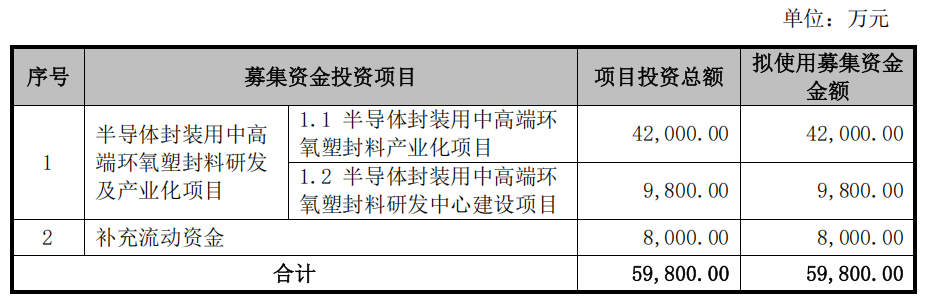
智通财经APP获悉,12月5日,江苏中科科化新材料股份有限公司(简称:中科科化)上交所科创板IPO已受理。招商证券为保荐机构,拟募资5.98亿元。 招股书显示,中科科化专注于半导体封装材料的研发、生产和销售,主要产品为环氧塑封料,是半导体封装环节的关键主材料,广泛应用于消费电子、汽 车电子、工业控制、通信、计算机等终端应用领域。公司聚焦中高端市场,报告期内中高端环氧塑封料产品销售收入快速增长,且占比不断提升。 目前我国半导体封装材料的国产化率仍然较低,公司是少数具备中高端环氧塑封料产品自主研发和规模化生产能力的内资厂商。报告期内,公司环氧塑封 料业务规模在内资厂商中的排名稳步提升至第二,部分中高端产品已实现对日系竞品的替代。 截至本招股说明书签署日,公司已与华润微(688396.SH)、蓝箭电子(301348.SZ)、捷捷微电(300623.SZ)、银河微电(688689.SH)、通富微电(002156.SZ)、华天 科技(002185.SZ)、富满微(300671.SZ)、气派科技(688216.SH)、日月新集团、KEC 集团等下游知名厂商建立了长期、稳定的合作关系。 本次公开发行新股的募集资金扣除发行费 ...
40只中证A500基金全线上涨,易方达增强ETF领涨丨A500ETF观察
2 1 Shi Ji Jing Ji Bao Dao· 2025-12-05 10:52
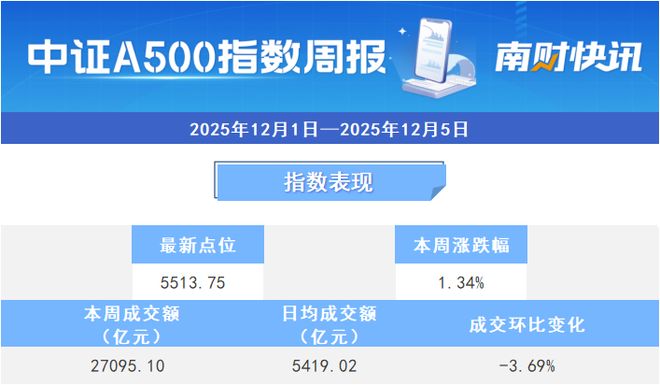
Index Performance - The China Securities A500 Index rose by 1.34% this week, closing at 5513.75 points as of December 5 [7] - The average daily trading volume for the week was 5419.02 billion yuan, with a week-on-week decrease of 3.69% [3][7] Component Stocks Performance - The top ten gainers this week included Aerospace Development (52.26%), Jereh Petroleum (26.40%), and Tianfu Communication (25.79%) [4] - The top ten losers included BlueFocus Communication (down 13.98%), Hunan YN Energy (down 10.59%), and Duofuduo (down 10.39%) [4] Fund Performance - All 40 China Securities A500 funds reported gains this week, with the exception of two funds [7] - The total scale of the A500 funds remained below 200 billion yuan, recorded at 1954.68 billion yuan as of December 4 [7] - The top three funds by scale were Huatai-PB A500 ETF (256.97 billion yuan), E Fund A500 ETF (226.45 billion yuan), and Guotai Junan A500 ETF (212.14 billion yuan) [7] Market Outlook - Bohai Securities indicated that the A-share market is currently in a consolidation phase, awaiting policy developments [8] - The focus is on potential investment opportunities in the TMT sector and robotics due to ongoing AI capital expansion and domestic substitution processes [8] - There is also attention on the power equipment and non-ferrous metals industries due to high global energy storage demand and the advancement of solid-state battery industrialization [8]
40只中证A500基金全线上涨,易方达增强ETF领涨
2 1 Shi Ji Jing Ji Bao Dao· 2025-12-05 10:48
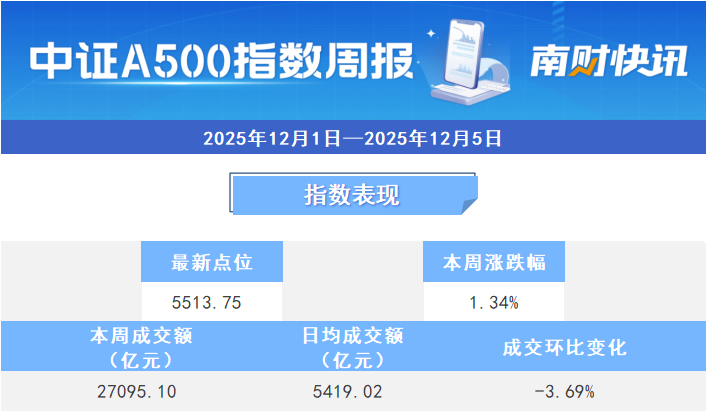
Index Performance - The China Securities A500 Index increased by 1.34%, closing at 5513.75 points on December 5 [5] - The average daily trading volume for the week was 5419.02 billion yuan, with a week-on-week decrease of 3.69% [5] Top Performing Stocks - The top ten stocks with the highest gains included: 1. Aerospace Development (000547 SZ) with a gain of 52.26% 2. Jerry Holdings (002353 SZ) with a gain of 26.40% 3. Tianfu Communication (300394 SZ) with a gain of 25.79% 4. Jiangxi Copper (600362 SH) with a gain of 15.74% 5. Aerospace Electronics (600879 SH) with a gain of 15.68% [3] Underperforming Stocks - The top ten stocks with the largest declines included: 1. BlueFocus Communication Group (300058 SZ) with a loss of 13.98% 2. Hunan YN Energy (301358 SZ) with a loss of 10.59% 3. Dofluorid (002407 SZ) with a loss of 10.39% 4. Zhonggong Education (002607 SZ) with a loss of 9.02% 5. 360 Security Technology (601360 SH) with a loss of 8.88% [3] Fund Performance - All 40 China Securities A500 funds reported gains, with the exception of two funds. The A500 Enhanced ETF from E Fund was the only product with a gain exceeding 2% [6] - The total scale of the A500 funds remained below 200 billion yuan, recorded at 1954.68 billion yuan as of December 4 [6] Market Outlook - Bohai Securities indicated that the A-share market is currently in a consolidation phase, awaiting policy developments. The upcoming important meetings may catalyze market movements if policies exceed expectations [8] - Investment opportunities are suggested in the TMT sector and robotics due to ongoing AI capital expansion and domestic substitution processes [8]
龙腾半导体赴港“借壳”的背后:失去军品红利后再陷亏损 行业上行期却打“价格战”竞争力何存?
Xin Lang Cai Jing· 2025-12-05 10:29
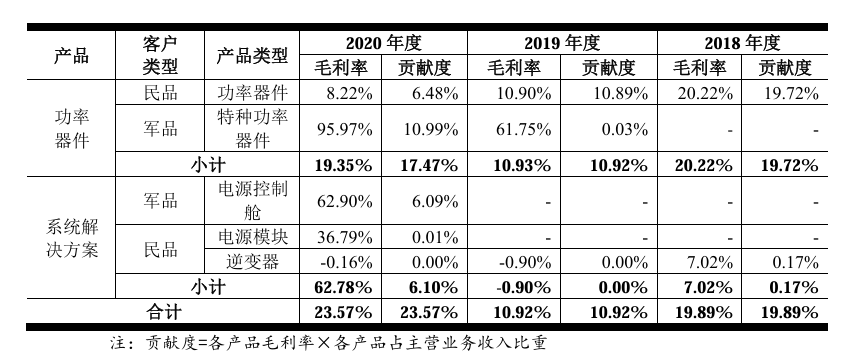
Core Viewpoint - Zhonglian Development Holdings plans to acquire up to 100% of Longteng Semiconductor for a price between HKD 4.5 billion and HKD 9 billion, marking a reverse takeover (RTO) transaction [1][17] Group 1: Acquisition Details - The acquisition is characterized as a reverse takeover, where an unlisted company gains control over a listed company by injecting assets [1][17] - Longteng Semiconductor previously attempted to go public on the STAR Market in June 2021 but withdrew its application in December 2021 after two rounds of inquiries, primarily due to concerns over its small scale and weak financial data [1][17] Group 2: Market Reaction - Prior to the announcement, Zhonglian Development's stock price increased from HKD 2.05 to HKD 2.53, a 23% rise over 14 trading days [1][17] - The market's reaction to the acquisition has been relatively muted, possibly due to concerns regarding Longteng Semiconductor's fundamentals [2][18] Group 3: Longteng Semiconductor's Financial Performance - Longteng Semiconductor's revenue from military products was minimal from 2018 to 2020, but the company shifted focus to military markets due to changes in international trade policies [3][19] - In 2020, the company's gross profit reached HKD 40.69 million, a nearly 300% increase from the previous year, with military clients contributing over 70% of this profit [4][20] - The gross margin for military power devices was significantly higher at 95.97% compared to 8.22% for civilian products in 2020 [4][20] Group 4: Accounts Receivable and Profitability - Longteng Semiconductor's accounts receivable grew to HKD 71.96 million in 2020, a nearly 150% increase year-on-year, indicating longer payment cycles from military clients [7][22] - The company transitioned from a low-profit, fast-turnover model to a high-profit, slow-turnover model, which introduces liquidity risks but also potential for better profit growth [7][22] - The net profit for Longteng Semiconductor improved from a loss of HKD 13.2 million in 2019 to a profit of HKD 24.53 million in 2020, but the company faced significant challenges in subsequent years [8][23] Group 5: Industry Context and Challenges - The military electronics sector entered a downturn after reaching a peak in 2022, with many companies facing declining revenues and profits [8][24] - Longteng Semiconductor reported revenues of HKD 614 million in the first three quarters of 2025, but incurred a net loss of HKD 58.69 million, highlighting ongoing profitability issues despite revenue growth [8][24] - The company’s R&D expenditures were significantly lower than its peers, raising concerns about its competitive position in the market [9][25] Group 6: Future Prospects - Longteng Semiconductor's planned investment in an 8-inch power semiconductor manufacturing project is underway, with the first phase already in production [16][29] - The company faces ongoing pressure from operational costs and depreciation associated with its manufacturing facilities, which could impact profitability [16][29] - The collaboration between Zhonglian Development and Longteng Semiconductor is currently based on a non-binding memorandum of understanding, indicating that the restructuring process is still in its early stages [16][29]