小红书

Search documents
独家|小红书内测长文付费功能,进军付费网文市场
Xin Lang Cai Jing· 2026-01-05 09:19
Core Insights - Xiaohongshu has launched an internal test for its "paid notes" feature, targeting photographers, illustrators, and long-form story creators, indicating its intention to enter the paid online literature market after testing a novel reading section in 2024 [1][2][3] Group 1: Paid Notes Feature - The "paid notes" feature includes three payment models: 1. High-definition original image downloads for visual creators, allowing users to pay for high-quality, watermark-free files [2][3] 2. A model for long-form authors and story creators that allows users to preview part of the content and pay to unlock the full article [2][3] 3. A paid unlock for note collections, aimed at serialized novels and series columns, where users can preview chapters and pay to access all content, facilitating ongoing monetization for creators [2][3] Group 2: Market Context - Xiaohongshu's paid notes feature is currently invitation-only and not available to all users, with plans for gradual expansion of invitations [2][3] - In 2024, Xiaohongshu introduced a novel reading section featuring numerous novels from third-party platforms, all available for free, although access requires users to search for a specific mini-program [2][3] - Competitively, ByteDance is set to launch a standalone paid reading app called "Hongzhu Xiaoshuo" in December 2025, which will clearly differentiate between free and premium content, indicating an intensifying competition in the online literature market [2][3]
做电商10年,小红书从“广告位”变“生意场”?
Sou Hu Cai Jing· 2026-01-04 12:45
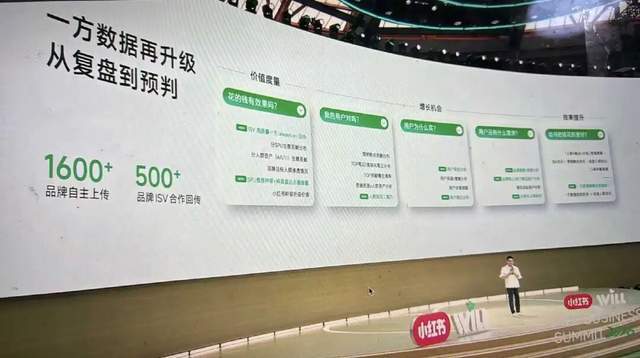
Core Insights - Xiaohongshu is striving to transform from an advertising platform to a genuine business platform by enhancing brand conversion rates through data analysis and closing the advertising and e-commerce loop [1][3][21] - Despite its strong brand-building capabilities, Xiaohongshu faces challenges in converting user engagement into direct sales, as many users still prefer traditional e-commerce platforms for purchases [2][6][13] Group 1: Brand Relationships - Brands view Xiaohongshu as a double-edged sword, effective for brand image and consumer engagement but struggling with sales conversion [2][3] - Many brands still rely on platforms like Douyin and Tmall for actual transactions, indicating Xiaohongshu's sales loop is not fully effective [3][6] - Xiaohongshu's marketing strategy has shifted to focus on being the most efficient "grass-planting" entry point rather than forcing a sales loop [3][12] Group 2: Data Utilization - Xiaohongshu has improved its data analysis capabilities, helping brands understand their target audiences better and optimize marketing strategies [4][10] - The platform has begun requiring data feedback from external e-commerce partners like Tmall and JD to enhance its data-driven approach [4][10] - Brands that utilize Xiaohongshu's insights have seen significant improvements in customer acquisition costs and user loyalty metrics [4][10] Group 3: E-commerce Infrastructure - Xiaohongshu's e-commerce infrastructure remains underdeveloped compared to specialized platforms, affecting its ability to create a seamless transaction experience [8][20] - The platform has made adjustments to its marketplace features to enhance user discovery and engagement with merchants [15][17] - Xiaohongshu's ambition to become a transaction endpoint is challenged by its reliance on B-end investments and the need to cultivate C-end user habits [13][14] Group 4: Strategic Shifts - The company has restructured its commercial operations to unify advertising and e-commerce efforts, aiming to streamline the entire consumer journey from awareness to purchase [9][21] - Xiaohongshu is focusing on creating a "decision-making brain" for brands, moving away from merely providing advertising space to offering actionable consumer insights [12][21] - The acquisition of a payment license indicates Xiaohongshu's commitment to enhancing its commercial ecosystem while balancing external linkages with internal transactions [20][21]

从“流量高地”到“巨头环伺” 百度健康如何突围?
Xi Niu Cai Jing· 2026-01-04 06:45
近期,百度健康密集推进业务迭代,连续两次发布新版服务,创新节奏明显加快。与此同时,有报道称,百度大搜索算法策略部T10级技术专家王俊峰已调 任百度健康,出任策略研发部负责人。这一人事变动被业内解读为百度加码健康业务底层算法支撑、强化核心技术布局的重要信号。 曾几何时,"身体不适先百度"是不少中国人的固有习惯。依托百度搜索的流量红利,百度健康通过竞价排名、内容分发及医生问答等模式,逐步搭建起规模 庞大的医疗健康商业体系。 但随着各大互联网巨头纷纷加速布局医疗健康领域,百度健康在流量获取上遭遇明显瓶颈。其中,抖音、快手等短视频平台分流了大量医疗科普流量,不少 医生大V通过直播间实时解答患者疑问,并引导用户转入私域流量池完成转化;小红书则成为年轻女性群体的"医疗参考阵地",从医美攻略到养生话题,均 有大量用户分享笔记。 除流量压力外,竞争对手在服务体系的深度布局,更让百度健康的发展之路布满荆棘。随着互联网医疗行业迈向智能化、精准化发展新阶段,各平台纷纷依 托自身核心优势抢占市场。例如,蚂蚁阿福借助支付宝的实名认证体系及芝麻信用机制,有效化解了医患之间的信任痛点;腾讯健康则依托微信的社交生态 链条和电子健康卡功能,牢 ...


喜茶掉队、DeepSeek被它打败,2025年好品牌之争谁赢了
3 6 Ke· 2026-01-04 02:24
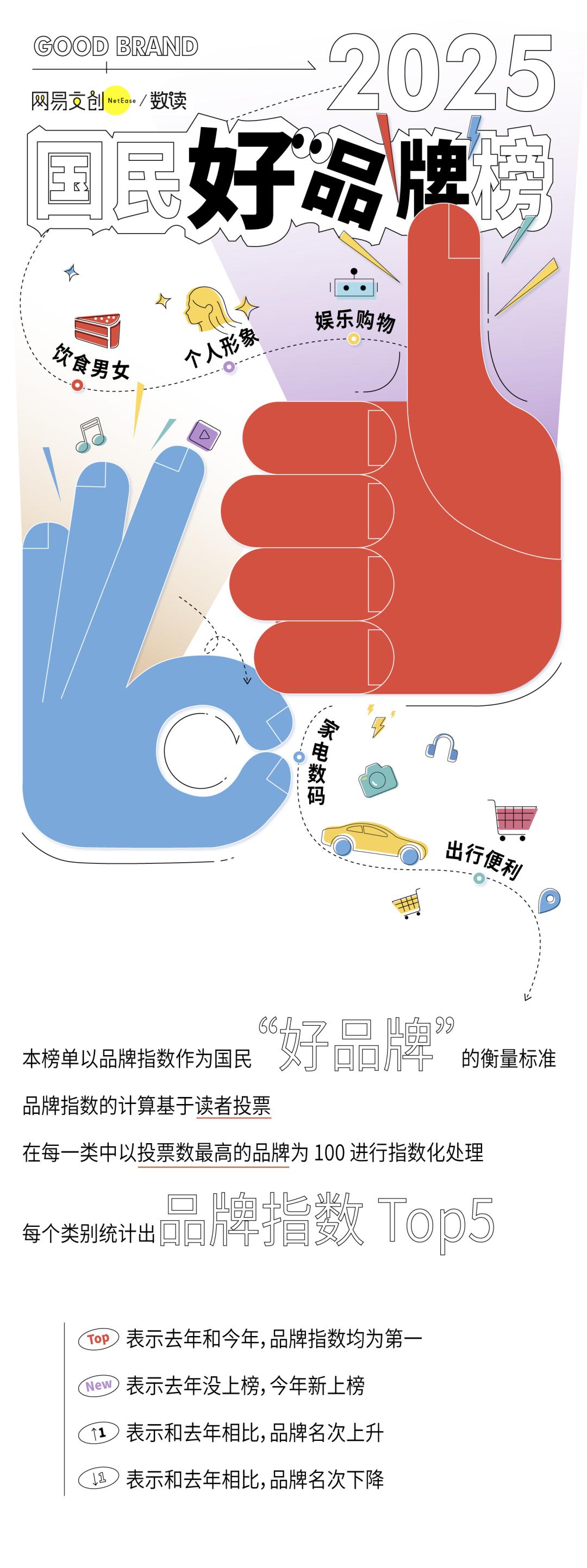
Group 1 - The brand index is used as a measurement standard for the public, calculated based on reader votes, with the highest voted brand in each category set to 100 for index processing [2] - The top five brands in various categories have been identified, with changes in rankings noted, including new entries and shifts in positions compared to the previous year [4][9] - The overall consumer sentiment indicates a cautious approach to spending, with a significant portion of respondents prioritizing product quality and reliability over brand loyalty [123][124] Group 2 - Heytea has fallen behind, with Guming Tea replacing it in the top five, and Guming Tea's store count reaching 11,179 with a net profit of 1.625 billion yuan, surpassing its total profit from the previous year [9] - Haidilao remains the top brand in the hot pot category, while KFC and McDonald's have swapped positions, with KFC slightly ahead [12] - The beverage market sees a return of Nongfu Spring to the top ranks, while Wahaha faces management turmoil, impacting its brand perception [15][17] Group 3 - In the beauty and personal care sector, Estee Lauder and L'Oreal dominate, with significant changes in rankings and the absence of local brands in the top positions [41] - Anta and Li Ning lead the sportswear category, with Li Ning rising to first place from fourth last year, while Adidas has returned to the rankings [45] - Douyin has surpassed Bilibili in the short video sector, with Douyin's daily active users reaching 600 million, while Bilibili has improved its profitability [55] Group 4 - The e-commerce landscape is evolving, with traditional platforms like JD, Meituan, and Taobao entering the instant retail competition, leading to significant financial investments in subsidies [73] - The AI app market is witnessing explosive growth, with ByteDance's products leading in active user numbers, indicating a shift towards AI-driven applications [80] - The adult product market is quietly rising, with brands like Durex and Okamoto leading the category [82] Group 5 - The home appliance market is characterized by intense competition, with Midea focusing on diversified business strategies, while Haier emphasizes high-end and localized operations [92] - Huawei continues to focus on the high-end market, with significant developments in its HarmonyOS ecosystem, while Apple faces challenges with its latest iPhone series [94][95] - The hotel industry is shifting towards new chain hotels, with traditional five-star hotels losing appeal as consumers seek more modern accommodations [116]

4家消费公司拿到新钱;火山引擎与春晚达成合作;喜茶与星星人联名又上新|创投大视野
36氪未来消费· 2026-01-03 12:00
Group 1 - The core viewpoint of the article highlights significant investments in various consumer sectors, particularly in the toy and pet industries, indicating a growing interest in innovative products and market expansion strategies [3][5][7][8]. Group 2 - The潮玩 brand "黑玩" has completed over 100 million RMB in Series A financing, led by Jinding Capital, with plans to enhance online and offline channel integration and expand into key overseas markets [3][4]. - "杰森娱乐" has secured several hundred million RMB in strategic financing, focusing on product innovation and market expansion, with a portfolio of over 500 IPs [5][6]. - The pet service platform "宠乐Go" has raised over 40 million RMB in angel round financing, aiming to integrate AI technology into its product offerings and supply chain management [7]. - "深庭纪智能," a Chinese robotics company, has completed a 100 million RMB angel round financing, focusing on outdoor AI companion robots with advanced environmental perception capabilities [8]. Group 3 - ByteDance's AI assistant application "Dola" has surpassed 10 million daily active users in overseas markets, indicating strong growth and user engagement [9][11]. - The company has also announced its partnership with the Central Broadcasting Television Station as the exclusive AI cloud partner for the Spring Festival Gala, showcasing its technological capabilities [12]. Group 4 - The film "疯狂动物城2" has become the box office champion for imported films in 2025, grossing 4.022 billion RMB [20]. - The domestic film box office in 2025 reached 51.832 billion RMB, reflecting a year-on-year growth of 21.95% [21]. Group 5 - The Chinese government has introduced a subsidy policy for consumers purchasing certain home appliances and digital products, aiming to stimulate consumption [22]. - During the New Year holiday, Hainan's duty-free sales saw a significant increase, with sales amounting to 251 million RMB, a year-on-year growth of 93.8% [23].

让模型自己找关键帧、视觉线索,小红书Video-Thinker破解视频推理困局
机器之心· 2026-01-02 03:12
Core Insights - The article discusses the revolutionary advancements in video reasoning through the introduction of the "Thinking with Videos" paradigm, specifically the Video-Thinker model, which enhances the model's ability to autonomously navigate and understand temporal sequences in videos [2][6][10]. Group 1: Model Development and Methodology - Video-Thinker integrates "temporal grounding" and "visual captioning" into the model's cognitive chain, eliminating reliance on external tools and enabling the model to autonomously identify key frames and extract visual cues [2][10]. - The research team constructed the Video-Thinker-10K dataset, consisting of 10,000 high-quality samples, and employed a two-phase training strategy of "supervised fine-tuning + reinforcement learning" to enhance the model's self-exploration and self-correction capabilities [3][10]. - The model achieved state-of-the-art (SOTA) performance in various challenging video reasoning benchmarks, significantly surpassing existing baselines with its 7 billion parameters [3][22]. Group 2: Data Quality and Training Process - The construction of high-quality training data is crucial for developing complex reasoning capabilities, leading to the integration of six major datasets into Video-Thinker-10K, which combines precise temporal annotations with detailed visual descriptions [12][13]. - The training process involved a structured thinking paradigm where the model learns to output specific labels such as <time> and <caption>, ensuring a rigorous "locate - perceive - reason" sequence [16][18]. - The reinforcement learning phase, utilizing Group Relative Policy Optimization (GRPO), allowed the model to explore and optimize its reasoning strategies, leading to emergent cognitive behaviors akin to human metacognition [19][22]. Group 3: Performance Evaluation - Video-Thinker-7B demonstrated significant advantages across various video reasoning benchmarks, establishing a new SOTA for models with 7 billion parameters [25][29]. - The model's performance was evaluated through both in-domain and out-of-domain assessments, showcasing its ability to generalize effectively to unseen scenarios [24][29]. - The model achieved an accuracy of 43.22% on the Video-Holmes benchmark and 80.69% on the VRBench, outperforming previous models by notable margins [29][30]. Group 4: Key Findings and Implications - The model's success is attributed to its internal capabilities of grounding and captioning, which were quantitatively assessed and found to be superior to those of baseline models [32][36]. - The findings indicate that relying on external tools can hinder performance, as demonstrated by experiments showing that simple plug-and-play tools did not enhance, but rather degraded, the model's reasoning capabilities [34][35]. - The article concludes that Video-Thinker's approach of integrating core internal capabilities rather than depending on large parameters and datasets represents a new paradigm in video reasoning, with potential applications across various industries [39].

Kimi账上100亿,不着急上市
盐财经· 2026-01-01 09:42
Core Viewpoint - The article highlights the significant funding achievement of "Moon's Dark Side" (Kimi), which completed a $500 million Series C financing round, leading to a post-money valuation of $4.3 billion (approximately 30 billion RMB) and a substantial cash reserve exceeding 10 billion RMB, positioning the company favorably in the competitive AI landscape [4][5][8]. Financing and Valuation - "Moon's Dark Side" successfully raised $500 million in its Series C round, with notable participation from existing investors such as Alibaba, Tencent, and Wang Huiwen, resulting in a post-money valuation of $4.3 billion (approximately 30 billion RMB) [7][8]. - The company has demonstrated rapid financing growth, previously surpassing a $3 billion valuation, and has attracted investments from prominent funds and tech giants [7][8]. Technological Advancements - The Kimi K2 model has gained international recognition, being described by Nature magazine as a "second DeepSeek moment," and has achieved state-of-the-art (SOTA) performance in key benchmarks, surpassing OpenAI [7][8]. - The launch of the Agent feature, OK Computer, has been pivotal for commercialization, allowing users to perform various tasks such as website development and data analysis [7][8]. Commercialization and Growth Metrics - The commercialization index for the consumer side has seen a month-over-month growth of over 170% in paid users from September to November, with API revenue increasing fourfold during the same period [8]. - The company aims to focus on enhancing the K3 model's capabilities and integrating product offerings to create unique user experiences, targeting significant revenue growth [9]. IPO Landscape - The article discusses the upcoming IPO wave in the domestic AI sector, with companies like Zhizhu AI and MiniMax preparing for listings, highlighting the competitive environment [12][13]. - "Moon's Dark Side" is in a strong position with over 10 billion RMB in cash reserves, significantly more than its competitors, allowing it to adopt a patient approach towards its IPO strategy [13][14]. - The company plans to leverage its strong financial position to accelerate its AGI strategy rather than rushing into the public market [13][14].

12月数字零售:抖音电商陷高退货率困境 贾乃亮售假事件反转
Sou Hu Cai Jing· 2026-01-01 00:30
Group 1 - The digital retail sector is experiencing significant changes, with various platforms facing challenges and opportunities in 2025 [1] - Douyin e-commerce is seeing an alarming daily return volume of millions of packages, indicating a shift in the dynamics between e-commerce and logistics industries [6] - Alibaba's anti-counterfeiting alliance reported a 58.5% decrease in counterfeit complaints on the Taotian platform compared to the previous year [8] Group 2 - The second-hand mobile phone recycling platforms are under scrutiny for practices like "high price estimation and low price upon receipt," raising user concerns about fairness and privacy [3] - The "old for new" service on Taobao reportedly saw a 32.7% reduction in the recycling price for an iPhone 15 Pro Max, highlighting issues of price manipulation [11] - A well-known women's clothing store with over 10 million followers announced its closure due to continuous losses, despite significant sales figures [12] Group 3 - Pinduoduo is tightening regulations on promotional language related to free gifts, requiring merchants to use official tools for compliance [15] - Pinduoduo has launched a special governance initiative to combat the use of pre-recorded videos masquerading as live streams, aiming to protect consumer rights [16] - Pinduoduo's new "delivery to village" service aims to enhance competitiveness in rural markets by facilitating logistics for merchants [17] Group 4 - Douyin e-commerce has introduced a new intelligent marketing product, "Qianchuan Chengfang," which integrates AI technology to optimize marketing strategies [30] - Douyin's nine support policies have reportedly saved merchants nearly 29 billion yuan in operating costs from January to November 2025 [32] - Douyin e-commerce's "treasure shop" report indicates a 165% year-on-year increase in GMV for participating merchants [29] Group 5 - The online retail sector in China saw a total online retail sales figure of 144.582 billion yuan from January to November 2025, reflecting a 9.1% year-on-year growth [67] - The Ministry of Commerce reported that online service consumption grew significantly, with a notable increase of 21.7% [77] - The National Development and Reform Commission has issued new rules prohibiting platforms from selling products below cost to prevent market disruption [68]

2026年电商们打响全面战争
21世纪经济报道· 2025-12-31 12:50
Core Viewpoint - The essence of the e-commerce business is "traffic," and the competition in the industry has evolved into a complex and multi-dimensional landscape, driven by various factors such as technology, consumer habits, and supply chain dynamics [1][2]. Group 1: E-commerce Competition Dynamics - In February 2025, Liu Qiangdong initiated a fierce competition in the food delivery sector, disrupting the market with substantial subsidies, leading to increased spending on sales and marketing by major players like Meituan, Alibaba, and JD.com, which collectively spent an additional 614 billion yuan in the third quarter [1]. - The competition is characterized by a shift from traditional e-commerce to instant retail, with platforms like JD.com, Meituan, and Alibaba engaging in a "comprehensive war" rather than a zero-sum game [2][6]. - The integration of AI in consumer decision-making and the transition of supply chains from a focus on scale to efficiency and resilience are reshaping the industry's development logic [2]. Group 2: Strategic Moves and Financial Implications - JD.com launched a recruitment initiative for quality dining merchants, offering zero commission for early entrants, marking the beginning of the food delivery war [4]. - Alibaba's recent performance indicates a significant growth in its instant retail business, with revenues reaching 229.06 billion yuan, a 60% year-on-year increase, despite a 53% drop in net profit for the second quarter of fiscal year 2026 [6][7]. - The competitive landscape is intensifying, with platforms reflecting on their strategies, as evidenced by Meituan's CEO acknowledging the unsustainable nature of past competitive practices [9]. Group 3: Market Trends and Future Outlook - The ongoing battle for market share in instant retail is not just about creating new consumption scenarios but also about capturing traditional e-commerce users and offline market shares [7][10]. - The industry is entering a phase of refined and localized operations, moving away from "barbaric growth" towards a more sophisticated approach [2][12]. - The exploration of local life and instant retail by platforms like Xiaohongshu and Douyin continues, despite challenges, indicating that the competition will remain dynamic and multifaceted [10].




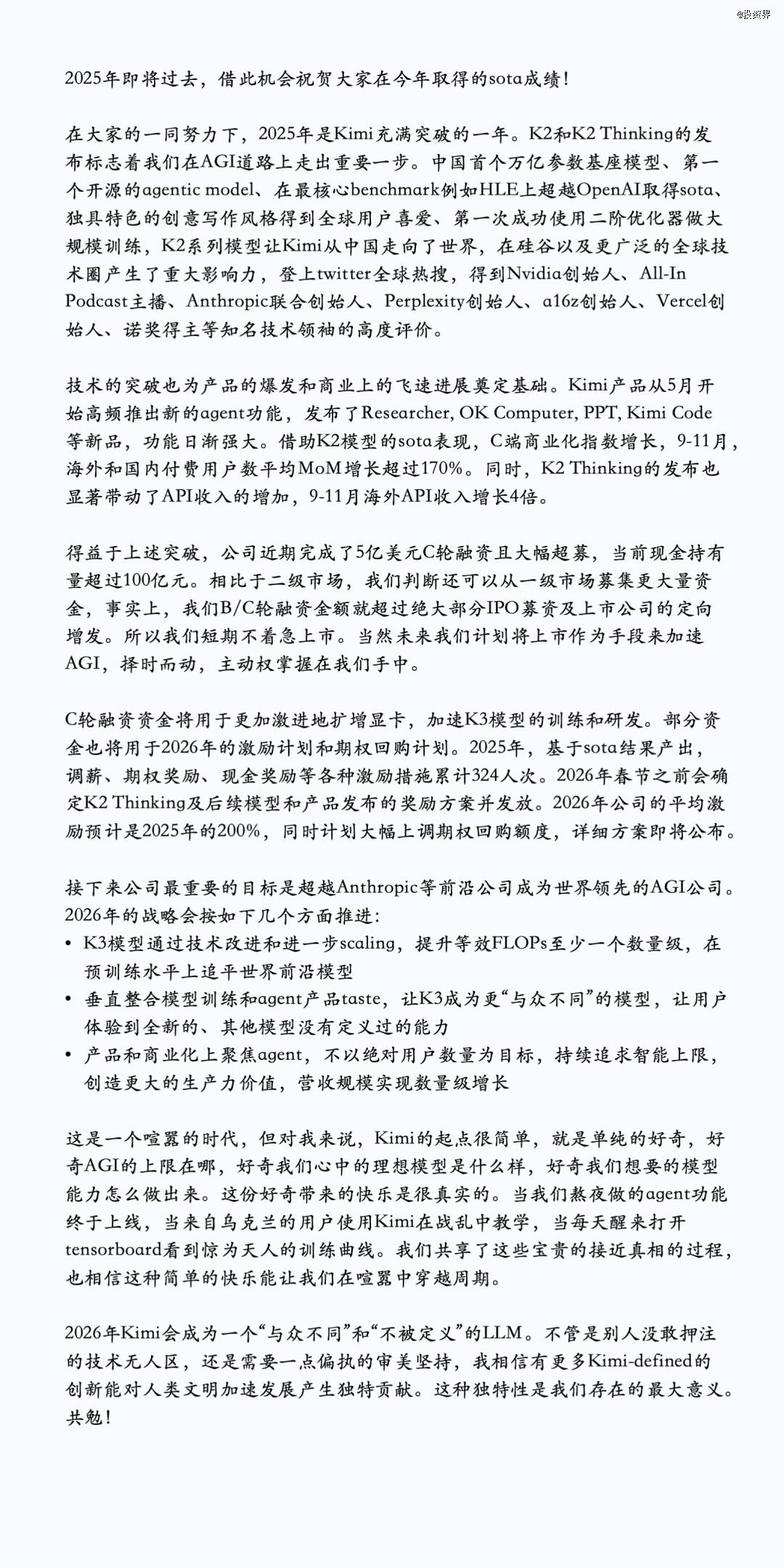
Kimi账上100亿,杨植麟:我们不着急上市
Sou Hu Cai Jing· 2025-12-31 12:03
Core Insights - The company "月之暗面" (Kimi) has successfully completed a $500 million Series C funding round, significantly oversubscribed by existing investors including Alibaba, Tencent, and Wang Huiwen [2][4] - Following this funding round, the post-money valuation of Kimi has surged to $4.3 billion (approximately 30 billion RMB) [3][4] - Kimi's current cash reserves exceed 10 billion RMB, which is nearly equivalent to the combined cash reserves of its competitors, 智谱 (Zhiyu) and MiniMax [3][11] Funding and Valuation - The Series C funding round was notable for its scale, with Kimi's valuation having previously crossed the $3 billion mark [4] - The company has attracted significant interest from top-tier venture capital firms and major tech companies, indicating strong market confidence [4][6] - Kimi's funding success is attributed to its strong performance in the large model market, particularly with its K2 model, which has received critical acclaim [5][6] Product and Technology Development - Kimi's K2 model has achieved state-of-the-art (SOTA) results in key benchmarks, surpassing competitors like OpenAI [5][16] - The company has introduced new features such as the "OK Computer" agent, which enhances its commercial offerings by enabling users to perform various tasks [4][16] - The company plans to further develop its K3 model, aiming to improve its performance significantly and integrate more advanced capabilities [7][17] Commercialization and User Growth - Kimi has reported a substantial increase in its commercial metrics, with a month-over-month growth of over 170% in paid users from September to November [5][16] - The release of K2 Thinking has also led to a fourfold increase in overseas API revenue during the same period [5][16] - The company is focusing on enhancing its agent products rather than solely increasing user numbers, aiming for greater productivity and revenue growth [7][17] Strategic Outlook - Kimi's CEO has indicated that the company is not in a rush to go public, preferring to leverage its strong cash position to fund further growth and development [11][12] - The company plans to use part of the Series C funding for employee incentives and stock buyback programs, aiming to attract and retain top talent [17] - Kimi's long-term goal is to surpass leading companies in the AGI space, positioning itself as a world leader in artificial general intelligence [7][17]