石头科技

Search documents
国泰海通消费机遇混合发起A:2025年第四季度利润7.86万元 净值增长率0.93%
Sou Hu Cai Jing· 2026-01-24 15:43
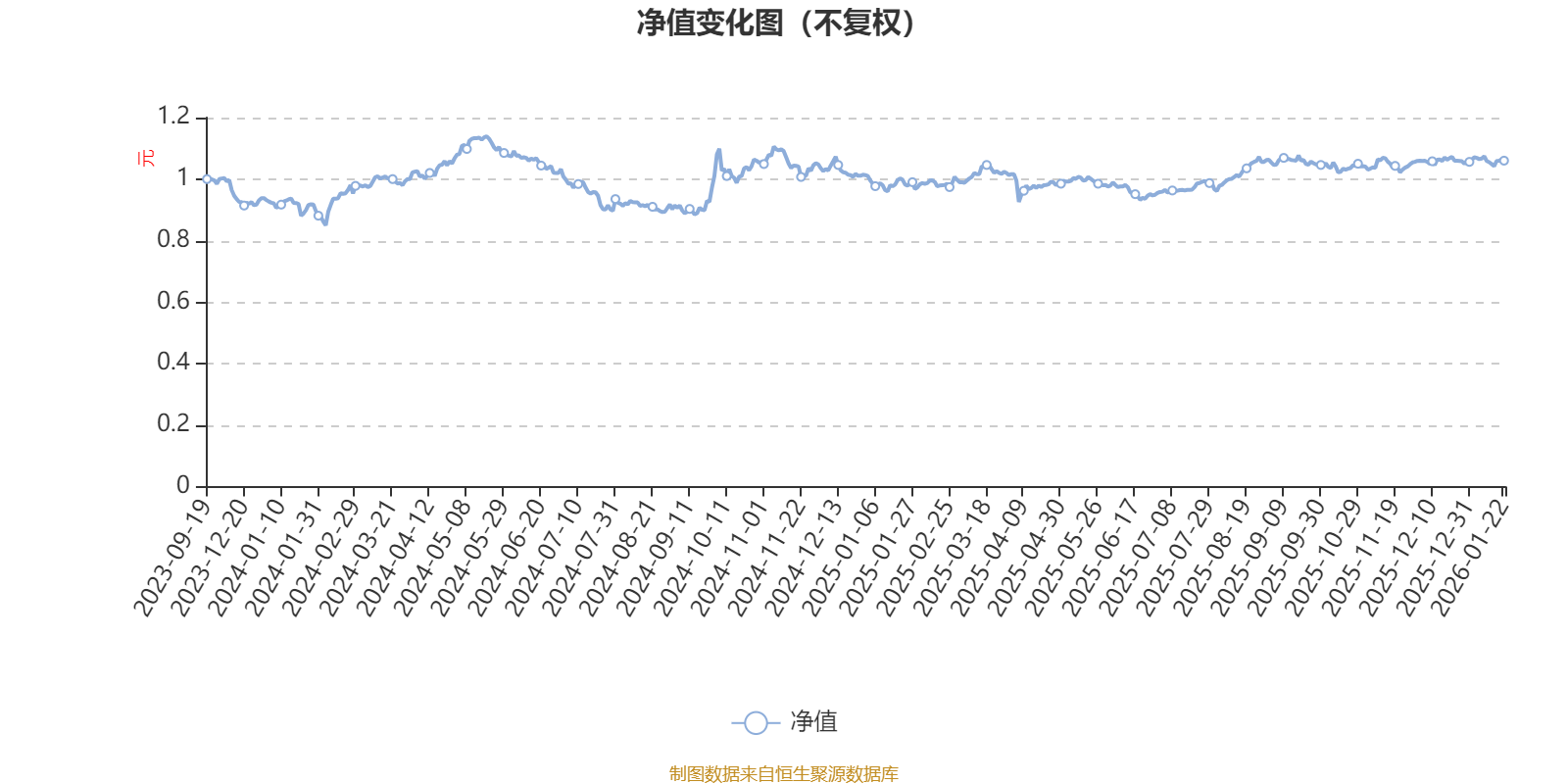
Core Viewpoint - The Guotai Haitong Consumption Opportunity Mixed Fund A (019433) reported a profit of 78,600 yuan in Q4 2025, with a weighted average profit per fund share of 0.0097 yuan. The fund's net value growth rate for the reporting period was 0.93%, and the fund size reached 8.61 million yuan by the end of Q4 2025 [3][17]. Fund Performance - As of January 22, the fund's unit net value was 1.06 yuan. The fund manager, Fan Yang, oversees four funds, all of which have positive returns over the past year. The highest one-year cumulative net value growth rate among these funds was 54.86% for Guotai Haitong Jun Dexin 2-Year Holding Mixed A, while the lowest was 7.78% for Guotai Haitong Consumption Opportunity Mixed Fund A [3]. - The fund's performance over different time frames includes a three-month net value growth rate of 2.81%, a six-month growth rate of 7.54%, and a one-year growth rate of 7.78%, ranking 15th out of 85, 14th out of 85, and 44th out of 83 among comparable funds, respectively [4]. Risk and Return Metrics - The fund has a Sharpe ratio of 0.3595 since inception, indicating a moderate level of risk-adjusted return [9]. - The maximum drawdown since inception is 22.31%, with the largest quarterly drawdown occurring in Q3 2024 at 14.32% [13]. Investment Strategy - The fund maintains a high average stock position of 85.98% since inception, with a peak of 92.07% at the end of 2025 and a low of 70.31% at the end of 2024 [16]. - The fund's portfolio is highly concentrated, with the top ten holdings including Sailun Tire, Hisense Visual Technology, Senki Lin, Muyuan Foods, Tiankang Biology, Great Wall Motors, Stone Technology, Youran Agriculture, Baiya Shares, and Xingyu Shares [20]. Future Outlook - The fund management anticipates continued investment in service consumption, focusing on new consumption led by younger demographics and elder consumption driven by the aging population. They aim to achieve better investment returns by leveraging structural changes in consumer demographics and validating corporate competitiveness amid trade tensions [3].


整个社会都在喊没钱了,为什么这些公司反而年赚百亿?
创业家· 2026-01-24 10:18
Core Insights - The article discusses how certain industries are thriving despite a general perception of economic downturn, highlighting eight key sectors that present significant business opportunities [3][4]. Group 1: Key Industries - **Second-Hand Economy**: The second-hand luxury market in Japan, represented by companies like Daikokuya, has seen a surge in revenue. In China, platforms like Hongbulin and Panghu are experiencing similar growth [6][7][8]. - **Pet Economy**: With a decline in birth rates, spending on pets has increased, with brands like Inaba in Japan and Guobao (Zhongchong) in China seeing strong stock performance [12][13][14]. - **Adult Care**: The adult diaper market in Japan has surpassed $10 billion, indicating that aging populations can drive significant economic opportunities [17][18][19]. - **Health Food and Beverages**: Changes in population structure and rising health awareness have led to the growth of sugar-free products and functional beverages in both Japan and China [21][22]. - **Beauty Economy**: The demand for beauty products, such as collagen supplements and home beauty devices, remains strong, with brands like Weimei and U like achieving significant sales [23][24][25][26]. - **Outdoor Recreation**: Companies in the outdoor equipment sector, like Snow Peak in Japan, are capitalizing on the trend of outdoor activities, with Chinese brands also seeing rapid sales growth [29][31][32]. - **Convenience Economy**: The rise of frozen foods and smart home appliances reflects a shift towards convenience, with brands like Anjijia and Stone achieving steady growth [39][40]. - **Lazy Economy**: The trend of reduced cooking time among younger generations has led to increased demand for time-saving products, emphasizing the value of time over money in a low-desire economy [42][43]. Group 2: Market Trends - The article emphasizes that even in a low-desire society, there are substantial opportunities for those willing to invest in counter-cyclical sectors [44]. - The narrative suggests that the current economic climate should not deter investment but rather encourage a focus on emerging trends and consumer needs [44].

经济越来越差,这八大行业越赚爆!
创业家· 2026-01-23 10:27
Core Insights - The article discusses how certain industries are thriving despite a general perception of economic downturn, highlighting eight key sectors that present significant business opportunities in a low-desire society [3][4]. Group 1: Key Industries - **Second-Hand Economy**: The second-hand luxury market in Japan, represented by companies like Daikokuya, has seen a surge in revenue. In China, platforms like Hongbulin and Panghu are experiencing similar growth, indicating a shift in consumer spending towards second-hand goods [6][7][8][9]. - **Pet Economy**: With declining birth rates, young people are investing more in pets, leading to a boom in pet food and healthcare products. Companies like Inaba in Japan and Guobao in China are capitalizing on this trend [11][12][14][15]. - **Adult Care Products**: The adult diaper market in Japan has surpassed $10 billion, indicating a growing demand for adult care products in China, with companies like Kexin showing potential for growth [16][17][18]. - **Health Food and Beverages**: The rise in health consciousness has led to increased sales of sugar-free beverages and functional drinks in both Japan and China, with brands like Suntory and Dongpeng gaining traction [21][22]. - **Beauty Economy**: The demand for beauty products, including collagen supplements and at-home beauty devices, remains strong, with companies like Jinbo Biological achieving significant market valuations [23][25]. - **Outdoor Recreation**: The outdoor equipment market is thriving, with brands like Snow Peak in Japan and various Chinese brands experiencing rapid sales growth, as consumers seek leisure activities despite economic constraints [25][26][27]. - **Emotional Economy**: Brands that provide emotional comfort, such as Labubu and Rio, are gaining popularity, reflecting a consumer willingness to spend on small pleasures even in tough times [28][29][30]. - **Convenience Economy**: The demand for convenience products, such as frozen foods and smart home appliances, is increasing as younger generations prioritize time-saving solutions [33][35][36]. Group 2: Market Trends - The article emphasizes that the current low-desire economic environment does not equate to a lack of opportunities. Instead, it suggests that businesses that can identify and invest in counter-cyclical sectors will emerge as winners [39].

小家电板块1月23日涨0.65%,ST德豪领涨,主力资金净流出4504.04万元
Zheng Xing Xing Ye Ri Bao· 2026-01-23 09:04
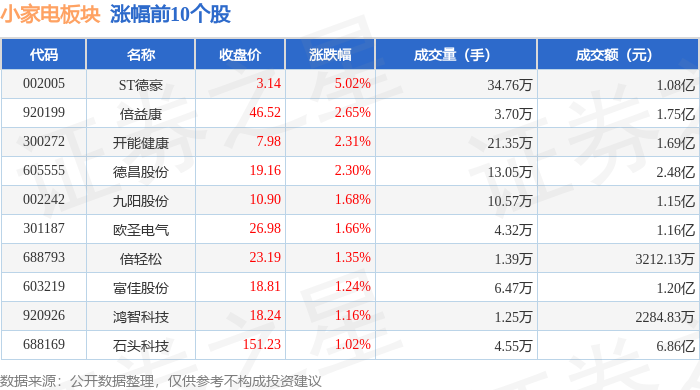
Market Performance - The small home appliance sector increased by 0.65% on January 23, with ST Dehao leading the gains [1] - The Shanghai Composite Index closed at 4136.16, up 0.33%, while the Shenzhen Component Index closed at 14439.66, up 0.79% [1] Stock Performance - ST Dehao (002005) closed at 3.14, up 5.02% with a trading volume of 347,600 shares and a transaction value of 108 million yuan [1] - Other notable performers include: - Beiyikang (6610Z6) at 46.52, up 2.65% [1] - Kaineng Health (300272) at 7.98, up 2.31% [1] - Dechang Co. (605555) at 19.16, up 2.30% [1] - Joyoung (002242) at 10.90, up 1.68% [1] Capital Flow - The small home appliance sector experienced a net outflow of 45.04 million yuan from institutional investors, while retail investors saw a net inflow of 82.44 million yuan [2] - The overall capital flow indicates a mixed sentiment among different investor types [2] Individual Stock Capital Flow - Lek Electric (603355) had a net inflow of 23.46 million yuan from institutional investors but a net outflow of 10.31 million yuan from retail investors [3] - ST Dehao (002005) saw a net inflow of 19.80 million yuan from institutional investors, with retail investors also showing a net outflow [3] - Other stocks like Dechang Co. (605555) and Kaineng Health (300272) also reflected similar trends in capital flow [3]



马斯克:计划明年面向公众销售人形机器人,机器人ETF(159770)标的指数盘中涨超1%,近5日日均成交额超4.3亿元居深市同标的第一
2 1 Shi Ji Jing Ji Bao Dao· 2026-01-23 03:10
Group 1 - The A-share market saw all three major indices open higher, with the CSI Robot Index rising by 0.06% and briefly exceeding 1.3% during trading. Notable stocks included Fengli Intelligent, Zhongdali De, and Haozhi Electromechanical, each increasing by over 2% [1] - The Robot ETF (159770) opened high with a trading volume exceeding 84 million yuan, showing active trading at the beginning of the session and a premium rate of 0.06% [1] - The Robot ETF (159770) experienced a net inflow of 5.2 million yuan yesterday, with an average daily trading volume of 430 million yuan over the past five days, ranking first among similar products in the Shenzhen market. The latest circulating shares amount to 9.118 billion, with a total market size of 10.492 billion yuan [1] Group 2 - According to Shenwan Hongyuan, the rapid advancement in the robot sector is driven by four key factors: capital investment, enhanced R&D, industrialization, and scenario development. These factors are expected to accelerate the realization of commercial viability in multiple previously uncommercialized areas by 2026 [2]

特斯拉将开始向公众销售人形机器人,机器人ETF(562500)近1周涨幅排名可比基金首位
Mei Ri Jing Ji Xin Wen· 2026-01-23 02:44
Core Viewpoint - The Robot ETF has shown significant performance and growth, with notable increases in both stock prices and trading volume, driven by positive market sentiment and developments in robotics technology [1][2]. Group 1: ETF Performance - As of January 22, 2026, the Robot ETF has increased by 0.72%, with constituent stocks such as Haozhi Electromechanical rising by 4.86% and Weichuang Electric by 3.96% [1]. - Over the past week, the Robot ETF has accumulated a total increase of 2.86%, ranking 1st among comparable funds [1]. - The ETF's trading volume has been robust, with an average daily transaction of 1.634 billion yuan over the past month, leading the comparable funds [1]. Group 2: Fund Flows and Leverage - The net financing amount for the Robot ETF reached 27.8652 million yuan in the previous trading day, with the latest financing balance at 1.107 billion yuan [1]. - The ETF has seen a significant growth in scale, with an increase of 248 million yuan over the past week, ranking 1st among comparable funds [1]. - The number of shares for the Robot ETF has grown by 91.5 million shares in the past week, also ranking 1st among comparable funds [1]. Group 3: Risk and Recovery - The maximum drawdown for the Robot ETF this year is 1.25%, with a relative benchmark drawdown of 0.04%, indicating a strong recovery capability with a repair time of just 1 day, the fastest among comparable funds [2]. Group 4: Fee Structure and Tracking Accuracy - The management fee for the Robot ETF is 0.50%, and the custody fee is 0.10%, both of which are the lowest among comparable funds [3]. - The tracking error for the Robot ETF over the past three years is 0.024%, indicating the highest tracking precision among comparable funds [3]. Group 5: Index Composition - The Robot ETF closely tracks the CSI Robot Index, which includes companies involved in system solutions, digital workshops, automation equipment manufacturing, and other robotics-related sectors [3]. - As of December 31, 2025, the top ten weighted stocks in the CSI Robot Index account for 52.83% of the index, including companies like iFlytek, Huichuan Technology, and Top Group [3].

OpenAI人形机器人实验室扩容,机器人ETF鹏华(159278)开盘上涨
Xin Lang Cai Jing· 2026-01-23 02:06
Group 1 - OpenAI has established a humanoid robot laboratory that has expanded over four times since its launch in February 2025, employing around 100 data collectors to train robotic arms for household tasks [1] - The laboratory employs a combination of teleoperation and simulation training, utilizing low-cost 3D printed controllers to gather real-world interaction data, which is a more pragmatic approach compared to Tesla's end-to-end training [2] - OpenAI aims to inject sensor data from robots directly into multimodal models like the GPT architecture to enhance AI's understanding of physical concepts, with experimental data showing a 47% reduction in task error rates when tactile feedback is included [2] Group 2 - The focus of OpenAI's laboratory is on household chores, indicating a target market in the trillion-dollar home service sector, where the demand for environmental adaptability is higher than for industrial robots [2] - The industry anticipates that 2027 will be a critical year for the large-scale deployment of humanoid robots, coinciding with Tesla's plan to produce 50,000 to 100,000 units of its Optimus robot by 2026 [2] - As of January 23, 2026, the National Securities Robot Industry Index has seen a slight increase of 0.29%, with notable gains in constituent stocks such as CITIC Heavy Industries and Aerospace Zhizhuang [3]
苹果计划将Siri重塑为内置聊天机器人,科创综指ETF天弘(589860)录得两连阳,机构:AI大模型正推动多行业应用加速商业落地
2 1 Shi Ji Jing Ji Bao Dao· 2026-01-23 01:29
Group 1 - The A-share market saw all three major indices rise collectively, with the Shanghai Stock Exchange Science and Technology Innovation Board Composite Index increasing by 0.14% [1] - The Tianhong ETF tracking the Science and Technology Innovation Board Index recorded a slight increase, achieving two consecutive days of gains, with a trading volume of nearly 30 million yuan [1] - Key stocks in the Tianhong ETF included Tengjing Technology, Mingwei Electronics, and Qingyun Technology, all reaching the daily limit, while other stocks like Godewei and Aotwei saw significant increases of nearly 20% and over 14%, respectively [1] Group 2 - The Robot ETF closely tracks the China Securities Robot Index, with a focus on manufacturing and information transmission, software, and IT services [2] - Major holdings in the Robot ETF include Huichuan Technology, iFlytek, and Stone Technology, and it is supported by two off-market connection funds [2] - The AI industry is experiencing rapid commercialization, with applications in various sectors such as AI search, marketing, office work, and education, indicating a significant technological impact on industry development [2]

佳音科技由董事长鲁定尧夫妻控制87%表决权,中专学历陈芝波任总助
Sou Hu Cai Jing· 2026-01-23 00:42
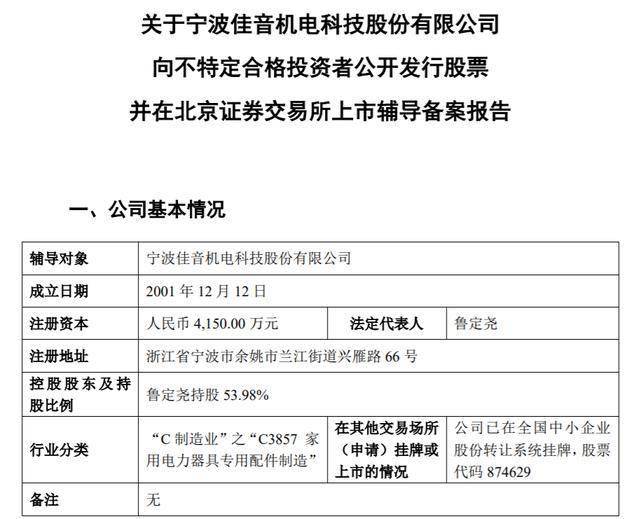
Core Viewpoint - Ningbo Jiayin Electromechanical Technology Co., Ltd. (hereinafter referred to as "Jiayin Technology") is initiating an IPO process to list on the Beijing Stock Exchange, with guidance from GF Securities. The company specializes in the research, manufacturing, and sales of core components for fluid control systems, applicable in various industries such as smart home appliances, automotive, medical, and new energy [1][4]. Company Overview - Jiayin Technology was established on December 12, 2001, with a registered capital of RMB 415 million. The legal representative is Lu Dingyao, who holds a 53.98% stake in the company [1]. - The company is classified under the manufacturing industry, specifically in the production of specialized components for household electric appliances [1]. Business Performance - In 2024, Jiayin Technology reported an operating income of RMB 808 million, representing a year-on-year increase of 51.16%. The net profit attributable to shareholders was RMB 60.94 million, up 23.64% compared to the previous year [3][4]. - For the first half of 2025, the company achieved an operating income of RMB 48.7 million, reflecting a year-on-year growth of 46.93%. However, the net profit attributable to shareholders decreased by 9.23% to RMB 29.53 million [4]. Shareholding Structure - Lu Dingyao directly holds 22.4 million shares (53.98%), while Chen Zhibo holds 10.88 million shares (26.22%). Together, they control 87.03% of the voting rights in the company [4]. - Lu Dingyao serves as the Chairman and General Manager, while Chen Zhibo is the Assistant General Manager [4][5].
富国消费主题混合C基金近3年单位净值下跌23.03% 长期重仓白酒股
Xi Niu Cai Jing· 2026-01-22 14:45
Core Insights - The performance of the Fuqua Consumer Theme Mixed Fund has attracted market attention, particularly since the establishment of its C-class shares, which has seen a decline in net asset value [2][4] Fund Performance - The C-class shares of the Fuqua Consumer Theme Mixed Fund have experienced a 29.9% decline in net asset value since their inception on January 18, 2021, with a 23.03% drop over the past three years and a modest 1.03% increase over the last year [2][3] - As of January 19, 2026, the fund's net asset value stood at 2.1520, with a recent monthly performance of -0.55% and a three-month decline of 6.19% [3] Fund Management - The fund is managed by Wang Yuanyuan, who has been with Fuqua Fund since April 2015 and has held various positions, including industry researcher and senior equity fund manager [3][4] - As of the end of Q3 2025, the fund's net asset value was approximately 4.241 billion, with 91.4% of its assets allocated to stocks and no bonds held [3] Investment Strategy - The fund has historically maintained a heavy allocation to liquor stocks, particularly Kweichow Moutai, which saw a 6.47% decline in stock price in 2025 [4] - Wang Yuanyuan indicated in the fund's Q3 report that the fund is looking to increase its allocation to the liquor sector based on low valuation levels and potential stabilization in 2026, while also screening for opportunities in the new consumption sector [4] - The fund aims to focus on high-quality growth companies in the domestic consumer sector, emphasizing brand concentration and international expansion as key growth drivers [4]