
LVMH

Search documents
美国经济的三期叠加
SINOLINK SECURITIES· 2025-11-12 13:47
Group 1: Economic Downturn - The U.S. economy is currently experiencing a negative feedback loop characterized by declining income, shrinking consumption, and weak employment[2] - Since the beginning of the year, a noticeable cyclical downturn has emerged, with key indicators such as employment, consumption, and services showing continuous decline[3] - The consumer confidence index has dropped to its lowest level since June 2022, with the Michigan consumer sentiment index at 50.3[27] Group 2: Government Shutdown Impact - The ongoing U.S. government shutdown has lasted 43 days, surpassing the previous record of 35 days in December 2018[28] - The shutdown has led to approximately $24 billion in federal spending being paused, with the Congressional Budget Office estimating a 2% decline in U.S. economic growth for Q4[4] - The shutdown has also caused liquidity tightening in financial markets, contributing to a significant drop in risk assets such as gold, Bitcoin, and U.S. stocks[32] Group 3: Structural Distortions from AI Investment - There is a clear "K-shaped" divergence in U.S. exports, with AI-related sectors performing exceptionally well while traditional consumer goods exports continue to weaken[36] - AI investments have led to a surge in demand for semiconductors and related infrastructure, with Taiwan's exports to the U.S. increasing by 144.3% in October[36] - The reliance on AI has created a structural dependency that may increase long-term financial system vulnerabilities, as any fluctuations in AI could trigger broader economic disruptions[45]
最新,全球美妆十强排名又变了
3 6 Ke· 2025-11-12 02:29
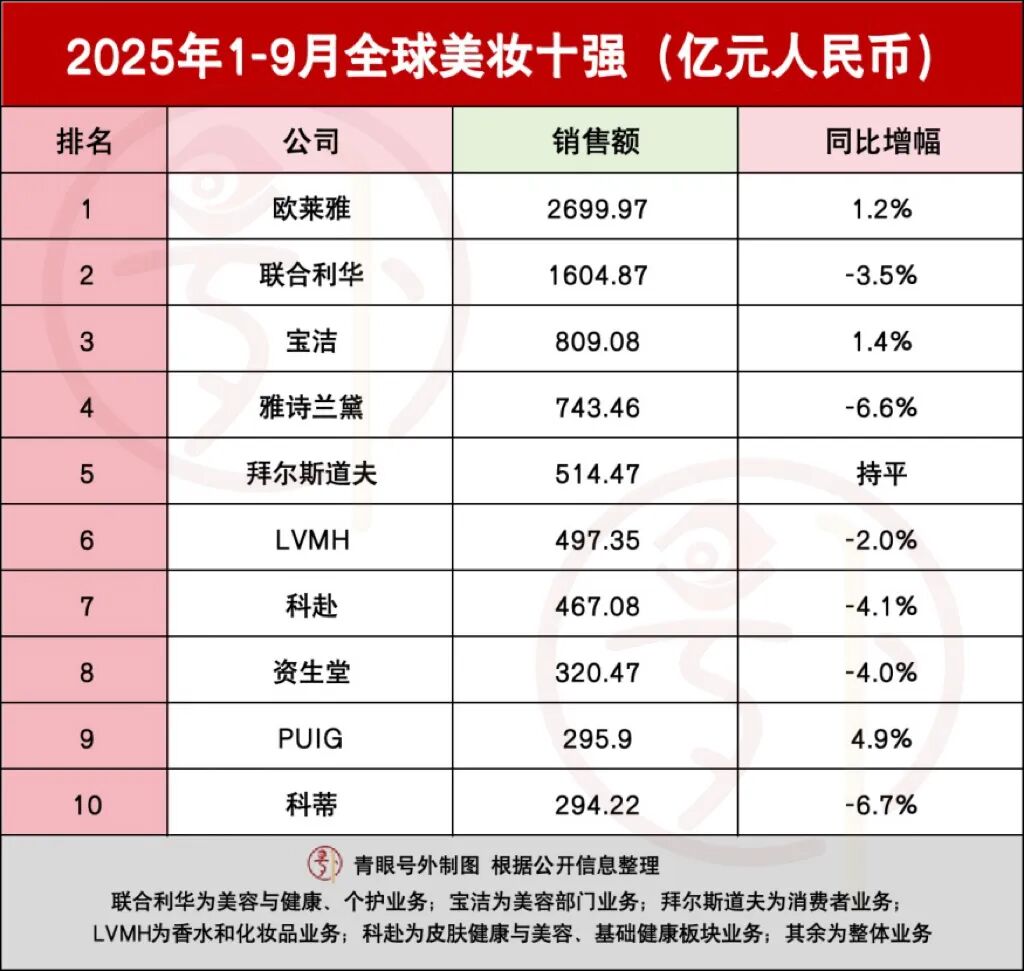
Core Insights - The global beauty market is undergoing transformation amidst resilience, with the top ten beauty companies showing mixed performance in sales and growth [1][10] - The overall sales of the top ten beauty companies reached 824.69 billion RMB in the first three quarters of 2023, a 5.3% increase from 783.42 billion RMB in the same period last year [1][2] Sales Performance - L'Oréal leads the ranking with a sales figure of 269.99 billion RMB, marking a 1.2% increase [2] - Unilever follows with 160.49 billion RMB, but experienced a decline of 3.5% [2] - Procter & Gamble and Estée Lauder reported sales of 80.91 billion RMB and 74.35 billion RMB, respectively, with growth rates of 1.4% and a decline of 6.6% [2][3] - Only L'Oréal, Procter & Gamble, and Puig showed sales growth among the top ten companies, while Coty experienced the largest decline at 6.7% [3] Strategic Adjustments - Companies like Unilever and Coty are undergoing significant strategic changes, including layoffs and asset divestitures, to adapt to market conditions [4] - Estée Lauder has initiated a "Reinventing Beauty" plan to restructure its operations and brand management [4] High-End Beauty Market - The high-end beauty market is showing signs of recovery, with Estée Lauder reporting a 4% increase in net sales in Q3 2023 [7][8] - L'Oréal's growth in the high-end skincare segment in China has been a significant driver of its performance [8][10] China Market Dynamics - The Chinese market is emerging as a new growth engine for international beauty companies, with Coty reporting a 15% increase in high-end beauty sales in China [10][11] - Procter & Gamble's sales in the Greater China region grew by 5%, indicating a positive trend [10][11] - Estée Lauder has begun to treat the Chinese mainland as a separate reporting region, highlighting its importance [11] Future Outlook - The global beauty market is in a phase of adjustment, with high-end beauty recovery and the Chinese market's resurgence being key factors for future growth [10][11] - Companies that can adapt to changing consumer demands and leverage digital transformation are likely to succeed in the evolving competitive landscape [11]





中信证券:短期关注经营拐点机会 长期配置强调重视消费结构变化
智通财经网· 2025-11-12 00:56
Core Viewpoint - The report from CITIC Securities indicates that "low expectations and low valuations" combined with the resilience of consumer spending are expected to enhance the funding preference for consumer allocations, with a focus on the potential recovery of consumption as the economic fundamentals begin to improve [1] Group 1: Current Market Analysis - The overall consumption sector is currently weak, with structural differentiation and company performance facing downward pressure, leading to a "bottoming out" phase for earnings and valuations [2] - Retail sales growth in the first half of 2025 showed signs of recovery due to government policies like "trade-in for new," but the growth rate fell to 3% in September as the effectiveness of these policies diminished [1][2] - High-end consumption is stabilizing, with luxury brands like LVMH and Kering reporting positive growth in Asia, and Macau's gaming revenue reaching over 91% of 2019 levels in October [1] Group 2: Future Outlook - The historical performance of the consumer sector during previous bull markets suggests that significant increases typically occur when economic fundamentals improve, with the current cycle expected to show structural recovery rather than rapid growth [3] - The report emphasizes the importance of monitoring high-end consumption recovery driven by capital market wealth effects and operational turning points due to supply-side optimization [3] Group 3: Long-term Structural Opportunities - The report stresses the importance of focusing on structural changes in consumer demand, which reflect a long-term trend from goods to services and from survival to experience [4] - Key areas for long-term investment include new products related to emotional and health needs, advancements in technology (AI and biotechnology), changes in distribution channels, and expansion into new markets [4]

部分海外龙头中国业务持续回暖
HTSC· 2025-11-11 08:48
Investment Rating - The report maintains an "Overweight" rating for the consumer discretionary and commercial trade sectors [7]. Core Insights - Several leading overseas beauty and luxury brands are experiencing a recovery in their business in China, with notable growth in Q3 2025 [1][2]. - The overall consumption in mainland China is expected to continue its gradual recovery, supported by positive macroeconomic signals [1]. Summary by Sections Company Performance - LVMH's revenue in the Asia-Pacific region, excluding Japan, returned to positive growth after six consecutive quarters of decline, with Q3 2025 showing a recovery [1]. - L'Oréal's revenue in mainland China grew by approximately 3% year-on-year in Q3 2025, driven by a 4.7% increase in North Asia [2]. - Hermès reported strong growth in the Greater China region, while Estée Lauder achieved a 9% year-on-year increase in its China business [1][2]. - Unilever's business segments in China, excluding ice cream, also showed signs of recovery [1]. Channel Insights - Online channels have seen significant growth, with L'Oréal and Beiersdorf reporting year-on-year increases of 12% and 19.2% respectively in Q3 [3]. - Travel retail remains under pressure but has shown marginal improvements, with L'Oréal and Kering noting slight revenue recovery [3]. Category Insights - The medical aesthetics segment, particularly high-demand products like Sculptra, has seen a year-on-year revenue increase of 11.8% in Q3 2025 [4]. - Skin science skincare products, including brands like Cetaphil and Alastin, reported double-digit growth, contributing to a 9.3% year-on-year increase in the skincare segment [4]. - Fragrance categories also performed well, benefiting from new product launches by L'Oréal and LVMH [4]. Performance Guidance - Galderma has raised its full-year revenue growth guidance for FY25 to 17.0%-17.7%, up from a previous estimate of 10%-12% [5]. - Procter & Gamble expects a revenue growth rate of 1%-5% for FY26, maintaining its guidance for Q4 2025 [5]. - Unilever anticipates a potential sales growth rate of 3%-5% for FY25, with Q2 revenue growth expected to exceed that of H1 2025 [5].
China Luxury Rebound: LVMH Is Set to Open Major Stores in Beijing
Youtube· 2025-11-11 08:20
Group 1 - The new wave of store openings by LVMH in China is significant, particularly in the context of a weak consumer housing market and deflation concerns [1] - Four major LVMH brands, including Louis Vuitton, Dior, Tiffany, and Loro Piana, are opening large multi-storey stores in Beijing next month, a scale rarely seen in recent years [2] - LVMH is also in discussions to open a new Dior store in Shanghai by 2027, highlighting the strategy of creating massive shopping destinations that offer unique experiences [3] Group 2 - Chinese consumer behavior is shifting from a focus on brand names to seeking personal wellness and experiences, prompting luxury brands to build personal connections with consumers [4] - The latest Louis Vuitton flagship store in Shanghai has significantly increased visitor numbers, contributing to a doubling of sales in the shopping mall where it is located [5] - The performance of stock markets in mainland China and Hong Kong this year may have contributed to increased spending in the luxury sector [5]


X @Bloomberg
Bloomberg· 2025-11-11 06:10
LVMH is set to open major stores in China in December and is considering further expansion there https://t.co/RKbSL5QZR5 ...
上海汇正财经:财政政策情况报告,继续提振消费行动
Sou Hu Cai Jing· 2025-11-10 12:12
Core Viewpoint - The Chinese Ministry of Finance released a report on the execution of fiscal policy for the first half of 2025, outlining six key areas of focus for future fiscal policy implementation [1]. Group 1: Fiscal Policy Implementation - The report emphasizes the need for a more proactive fiscal policy, including actions to boost consumer spending through targeted financial subsidies for personal loans in key sectors [3]. - Support for employment and foreign trade is prioritized, with measures to promote job creation and assist businesses in maintaining operations and expanding markets [4]. - The report highlights the importance of fostering new growth drivers by advancing core technologies and promoting emerging industries, while ensuring equal treatment for all business entities [4]. Group 2: Consumer Trends - High-end consumption is showing signs of recovery, with notable improvements in sectors such as Macau gaming and luxury goods, driven by wealth effects and supply optimization [6]. - The luxury market is experiencing growth, with companies like LVMH and Hermès reporting improved sales in China, indicating a positive trend in consumer sentiment [6]. - New consumption sectors, particularly in the tea beverage industry, are expected to see significant profit growth, with leading brands benefiting from strong market positions [8]. Group 3: Policy Support for Consumption - The government is taking steps to enhance service consumption by relaxing entry barriers and removing unreasonable restrictions, which is expected to boost consumer willingness to spend [7]. - Recent policy changes in the duty-free sector aim to improve shopping experiences and increase consumer engagement in duty-free shopping [7].
除了政府关门和数据真空,大跌反映了美国经济什么问题?
2025-11-10 03:34
Summary of Conference Call Records Industry Overview - The U.S. economy is facing stagflation risks, with both soft and hard data indicating weakness, particularly in employment and consumer spending [1][2][3] - The sales of corrugated boxes have hit a ten-year low, reflecting sluggish consumer demand, with early Christmas stocking up in July peaking and then declining in August and September [1][2] - The U.S. U6 unemployment rate reached 8.1% in August, with youth unemployment at 9.2%, compounded by student loan repayment pressures, limiting consumer capacity [1][2][3] Key Points and Arguments - The government shutdown has led to 750,000 federal employees being furloughed or working without pay, with a suspension of $24 billion in federal spending, impacting GDP by approximately 0.1% weekly [1][3][4] - If the shutdown continues, the GDP could decline by more than 2% in Q4 [1][3] - The Federal Reserve's interest rate cut expectations have dropped sharply from 90% to 60% due to comments from Chairman Powell, exacerbating liquidity tightening and negatively affecting stocks and risk assets [1][4] - The reduction of food stamp amounts in November by half affects about 1/8 of the U.S. population, leading to an expected additional decline in consumer growth by about 0.5% [1][4][6] Economic Challenges - The U.S. economy is experiencing a K-shaped recovery, where AI-related investments are driving demand for chips, storage, and power equipment, while demand for ordinary consumer goods remains weak [2][5][9] - Exports of graphics cards from Taiwan to the U.S. increased by 138.2%, and South Korea's semiconductor exports grew by 25.4%, while traditional manufacturing countries like Vietnam and Mexico are facing weaker exports [2][5][8] Consumer Behavior and Market Impact - Chipotle and McDonald's Q3 earnings reports indicate a significant decline in spending among their primary consumers—young people and low-income groups [3][4] - The Michigan Consumer Sentiment Index fell to 50.3 in November, the lowest since June 2020, indicating severe consumer confidence issues [3] - The K-shaped recovery is evident in consumer behavior, with luxury goods remaining strong while middle and low-income groups shift to cheaper shopping options [9][10] Future Monetary Policy - Given the complex economic environment, the Federal Reserve may adopt a more accommodative monetary policy, with expectations for interest rate cuts in December [11] - The Fed may have no choice but to implement easing measures to support overall economic stability amid reduced fiscal spending and rising unemployment [11]
Ferrari Stock Looks Expensive -- or Does It?
The Motley Fool· 2025-11-08 18:05
Core Viewpoint - Ferrari's high valuation may seem excessive at first, but its unique business model and financial performance justify the premium, positioning it more like a luxury brand than a traditional automaker [1][2][12]. Financial Metrics - Ferrari's P/E ratio stands at 41, with an EV/EBITDA multiple near 29 and a price-to-sales ratio above 11, which are significantly higher than traditional automakers [2][3]. - The company boasts an adjusted EBITDA margin of 38.3%, an operating margin of 28.3%, and a gross margin close to 50% for 2024, aligning it more with luxury brands like LVMH and Hermès [3][4]. Revenue Streams - Approximately 15% of Ferrari's revenue is derived from sponsorships, licensing, financial services, and after-sales, contributing to predictable cash flow and stability [6][7]. - The return on invested capital (ROIC) is around 24%, which is double that of LVMH, indicating strong financial health [8]. Business Model - Ferrari operates on a scarcity-driven model, producing fewer cars than demand, which maintains multiyear waiting lists and rising resale values, thus preserving pricing power [9]. - The company focuses on reinvesting in innovation and returning capital to shareholders without pursuing scale, allowing it to maintain its luxury status [9][12]. Market Position - Despite being valued at 42 times earnings, Ferrari's unique characteristics and brand durability suggest that it is not a conventional company, and its premium may be justified [10][12]. - The brand's emotional appeal insulates it from economic downturns, keeping demand stable even during weaker macroeconomic conditions [6][12]. Future Outlook - If Ferrari successfully blends scarcity with innovation, its elevated valuation could remain sustainable over the long term [13].

Coty(COTY) - 2026 Q1 - Earnings Call Transcript
2025-11-06 15:30
Financial Data and Key Metrics Changes - Coty reported strong growth in several key brands over the past five years, with Burberry growing by 140%, Hugo Boss by 33%, Chloé by 70%, and Marc Jacobs by 50% [6][7] - The company emphasized that it remains in the top three for total global fragrances and for prestige fragrances, even without the Gucci license [6][7] Business Line Data and Key Metrics Changes - The exit from the Gucci license will allow Coty to focus on brands with the biggest long-term growth potential and optimize the remaining term of the Gucci brand [4][5] - Coty has seen significant growth in its ultra-premium brands, which currently represent only 1% of its business but are growing at 17% [41][42] Market Data and Key Metrics Changes - The U.S. fragrance market is experiencing mid-single-digit growth, with Coty expecting a good holiday season [23][30] - In EMEA, the prestige fragrance market is growing at low single digits, with the French market being less dynamic compared to the U.K. and Spain [58][59] Company Strategy and Development Direction - Coty plans to amplify new licenses and brands recently added to its portfolio while optimizing existing brands [4][5] - The company is committed to solidifying its position as a prestige beauty company with a focus on fragrance and scenting across various price points [7][8] Management's Comments on Operating Environment and Future Outlook - Management expressed confidence in returning to growth in the second half of the fiscal year, driven by strong innovation and market dynamics [30][31] - The company is actively managing risks in its portfolio, ensuring no single brand accounts for more than 10% of sales [9][18] Other Important Information - Coty is focused on maintaining a strong licensing model, with 85% of its portfolio being owned brands or long-term licenses [9][8] - The company is seeing a trend of consumers stacking scents, which is influencing product development and marketing strategies [49] Q&A Session Summary Question: Impact of exiting the Gucci license on Coty's portfolio - Management stated that exiting the Gucci license will allow for a more focused growth strategy on other brands with long-term potential [4][5] Question: Financial impact of the Gucci license transition to L'Oréal - Management acknowledged that losing the Gucci brand will have a profit impact but emphasized the focus on driving growth in other areas [17][18] Question: Performance expectations for Q2 - Management indicated that the fragrance market dynamics are strong, contributing to a favorable outlook for Q2 [23][30] Question: E-commerce impact on sell-in and sell-out dynamics - Management noted that e-commerce is growing rapidly, with no major difference in de-stocking between online and brick-and-mortar retailers [55][56] Question: Trends in the prestige fragrance market for the holiday season - Management expressed confidence in the resilience of the prestige fragrance category, expecting strong performance during the holiday season [64][65] Question: Strategic review outcomes and options - Management is assessing various options for the Brazilian business and color cosmetics, focusing on profitability and growth potential [75][76]