丝塔芙

Search documents
高德美营收50亿美元,全球美妆十强要重排座次?
FBeauty未来迹· 2026-03-07 13:13
Core Viewpoint - In a slowing global beauty industry, Galderma, a skin-focused company, has achieved significant growth, with net sales surpassing $5 billion for the first time, reaching $5.207 billion (approximately 358.92 billion RMB), a year-on-year increase of 17.7% [3][4]. Financial Performance - Galderma's record financial performance in 2025 includes growth across all product categories and major regional markets, driven by a clear strategic positioning and a science-based innovation approach [4]. - The company projects a net sales growth of 17%-20% for 2026 at constant exchange rates, with core EBITDA margin expected to reach approximately 26% [4]. Market Position - Galderma ranks 11th among global beauty groups with a revenue of $5.207 billion, closing the gap with the 10th place Coty, which is only about $500 million ahead [7]. - The company's growth is attributed to the success of its three main business segments, which complement each other in revenue contribution, profit margins, innovation potential, and resilience [7]. Business Segments - The Injectable Aesthetics segment is the largest revenue source, with net sales of $2.572 billion, showing a year-on-year growth of 11.5% [8]. - The Dermatological Skincare segment generated net sales of $1.449 billion, with a year-on-year increase of 9.3%, driven by strong performances from brands like Cetaphil and Alastin [8]. - The Therapeutic Dermatology segment experienced the fastest growth, with net sales of $1.185 billion, a remarkable year-on-year increase of 50.2%, largely due to the performance of the Nemluvio brand [8]. Strategic Execution in China - China has become a key testing ground for Galderma's strategic execution, with a focus on integrating global products, cross-segment collaboration, and local research to build a comprehensive health management system [9]. - The brand Cetaphil has been a significant driver of growth in China, particularly during promotional events like Double Eleven, outperforming the overall skincare market [9]. Product Innovations - In 2025, Galderma introduced several key products to the Chinese market, including the globally recognized regenerative aesthetic product Sculptra, marking a strategic move into the Chinese regenerative aesthetic market [11]. - The launch of the innovative perioperative skincare brand Alastin further extends the company's offerings from treatment to pre- and post-procedure care, creating a complete "injection + care" loop [11]. Research and Development - Galderma is advancing its R&D investments in China, with a clinical study focusing on the biological impacts of lifestyle and environmental factors on sensitive skin populations [13]. - The company has established a robust R&D network with over 650 personnel across 33 global research bases, emphasizing clinical validation and efficacy in product development [20]. Competitive Landscape - The global beauty industry is witnessing a shift towards medical aesthetics, with major players like L'Oréal and Estée Lauder increasing their focus on this high-growth segment [14][15]. - Galderma's unique vertical integration model allows it to meet diverse consumer needs across different skin conditions and life stages, creating a competitive moat that traditional beauty brands find hard to replicate [21].

前雀巢CEO兼董事长包必达:董事会一次都没征询过我意见,食品工业世纪范式早已到头
Xin Lang Cai Jing· 2025-12-29 23:15
Group 1 - The former CEO and Chairman of Nestlé, Peter Brabeck-Letmathe, expressed that the traditional paradigm of the food industry has reached its end, emphasizing a shift from merely producing calories to focusing on overall nutrition and well-being [10][31] - Brabeck-Letmathe criticized the "Minder Initiative," which mandates annual re-elections for board members, arguing that it leads to a short-term focus on quarterly performance rather than long-term strategy [3][25] - He highlighted that the excessive regulation in Switzerland has deterred multinational companies from investing, leading to a decline in new investments, particularly in the pharmaceutical sector [7][28] Group 2 - The former CEO noted that the board of directors at Nestlé has not consulted him since he stepped down as Chairman in 2017, indicating a disconnect between the current leadership and his vision for the company [11][32] - Brabeck-Letmathe expressed disappointment over Nestlé's return to a focus on food and beverage, which he believes undermines the progress made towards a more holistic approach to nutrition [10][31] - He mentioned that the financial policies adopted by the current management, including significant debt accumulation for stock buybacks, are detrimental to the company's long-term health [11][32] Group 3 - Brabeck-Letmathe's departure from the World Economic Forum was influenced by a conflict regarding the handling of serious allegations against Klaus Schwab, indicating governance challenges within the organization [14][37] - He believes that the World Economic Forum still has the potential to contribute to a rules-based multilateral world by serving as a platform for consensus-building [39] - The former CEO plans to participate in the Dakar Rally, marking a personal achievement after years of involvement in corporate leadership [18][39]


——化妆品医美行业周报20251214:11月化妆品淘系略承压,胶原医美赛道再添两员-20251214
Shenwan Hongyuan Securities· 2025-12-14 11:20
Investment Rating - The report indicates a weak performance in the cosmetics and medical beauty sector, with the Shenwan Beauty Care Index declining by 1.6% from December 5 to December 12, 2025, underperforming the market [3][4]. Core Insights - The cosmetics sector faced pressure in November, with overall GMV in the Taobao system showing weakness due to the pre-promotion of the Double 11 sales event and the rise of Douyin as a sales channel. Brands like Han Shu and Lin Qingxuan maintained stable GMV, while others like Feicui continued to grow significantly [3][9]. - The collagen medical beauty segment is expanding, with two new animal-derived collagen products approved for market entry, expected to drive growth in this area [3][9]. - The report highlights the leading market share of Minoxidil products from Mandi International in the hair loss treatment market, with a steady revenue growth from 982 million yuan in 2022 to approximately 1.455 billion yuan in 2024, reflecting a CAGR of 21.7% from 2022 to 2024 [10][11]. - L'Oréal's acquisition of an additional 10% stake in Galderma, raising its total ownership to 20%, signifies a strategic shift towards the medical beauty and skin health sectors, aiming to adapt to the slowing growth in the Chinese beauty market [3][18]. Summary by Sections Industry Performance - The Shenwan Beauty Care Index and its sub-indices for cosmetics and personal care products have shown declines of 1.2% and 1.7%, respectively, indicating underperformance compared to the Shenwan A Index [4][6]. Key Market Developments - The overall GMV for cosmetics in November was weak, influenced by earlier sales spikes in October and competition from Douyin [9]. - The approval of new collagen products is expected to enhance the supply side of the medical beauty market, with projections for continued expansion in 2026 [9][22]. Company Highlights - Mandi International has maintained a dominant position in the Minoxidil market, with its products accounting for approximately 57% and 71% of the market share in the hair loss treatment and Minoxidil categories, respectively, as of 2024 [11][13]. - The report notes that the Chinese consumer healthcare market is projected to grow from 931.3 billion yuan in 2018 to 16.42 trillion yuan by 2024, with significant growth in hair health and skin health segments [12][13].
化妆品医美行业周报:11月化妆品淘系略承压,胶原医美赛道再添两员-20251214
Shenwan Hongyuan Securities· 2025-12-14 09:49
Investment Rating - The report maintains a "Positive" outlook on the cosmetics and medical beauty industry, despite recent underperformance compared to the market [3][4]. Core Insights - The cosmetics and medical beauty sector has shown weaker performance, with the Shenwan Beauty Care Index declining by 1.6% from December 5 to December 12, 2025, underperforming the market [4][5]. - The report highlights that the November sales in the cosmetics sector were impacted by pre-Double 11 promotions and the rise of Douyin as a sales channel, leading to a weaker overall GMV [4][10]. - The collagen medical beauty segment is expanding, with two new animal-sourced collagen products approved for market, indicating growth potential in this area [4][10]. - The report emphasizes the strong market position of Mandi International in the minoxidil hair growth market, with a revenue increase from 982 million yuan in 2022 to approximately 1.455 billion yuan in 2024, reflecting a CAGR of 21.7% [4][11][12]. - L'Oréal's recent acquisition of an additional 10% stake in Galderma signifies a strategic shift towards medical aesthetics and skin health, aiming to adapt to the slowing growth in the Chinese beauty market [4][21]. Summary by Sections Industry Performance - The Shenwan Beauty Care Index decreased by 1.6%, with the Shenwan Cosmetics Index down by 1.2% and the Shenwan Personal Care Index down by 1.7% during the specified period [4][5]. - Notable stock performances included Water Sheep Co. (+5.9%) and Jinsong New Materials (+4.3%), while Hongmian Co. (-10.6%) and Juzhi Biological (-8.4%) faced significant declines [7]. Market Trends - The overall GMV for cosmetics in November was weak, influenced by the earlier sales surge in October and the emergence of Douyin as a competitive sales platform [4][10]. - The report notes that brands like Han Shu and Lin Qingxuan maintained stable GMV, while brands like Feicui continued to experience high growth [4][10]. Company Highlights - Mandi International has established a leading position in the minoxidil market, with a market share of approximately 57% in the hair loss treatment sector and 71% in the minoxidil product market as of 2024 [4][15]. - The company has shown consistent revenue growth, with a net profit increase from 2022 to the first half of 2025, indicating a robust business model [4][12][15]. Investment Recommendations - The report recommends focusing on companies with strong product lines and high profitability in the medical beauty sector, such as Ai Meike, while also suggesting attention to companies like Langzi Co. and Ru Yi Chen [4][10].
两大美妆巨头同时出手,一边狂买一边狂卖
21世纪经济报道· 2025-12-10 12:19
Core Views - The article discusses the contrasting strategies of two major beauty groups, L'Oréal and Unilever, highlighting L'Oréal's aggressive acquisition approach and Unilever's focus on divesting non-core assets [2][8]. Group 1: L'Oréal's Acquisition Strategy - L'Oréal announced the acquisition of an additional 10% stake in Galderma, increasing its ownership from 10% to 20%, with plans to explore further scientific research collaborations [1][6]. - The acquisition is part of L'Oréal's ambition to penetrate the rapidly growing medical aesthetics market, alongside its investments in high-end and clean beauty segments [6][8]. - In October, L'Oréal made a significant investment of €4 billion to acquire beauty licenses from Kering Group, indicating a strong recovery in its performance, particularly in the North Asia region [6][7]. Group 2: Unilever's Divestment Strategy - Unilever is undergoing a restructuring process, focusing on core businesses by divesting over 20 non-core beauty and personal care brands, including the planned spin-off of its ice cream business [1][7]. - The CEO of Unilever emphasized that the spin-off aims to create a more streamlined company focused on higher profit margins in beauty and personal care sectors [7][8]. - Unilever's recent quarterly results showed improvement in sales growth after excluding the ice cream business, indicating a positive trend in its core operations [7][8]. Group 3: Industry Trends and Brand Matrix - The contrasting strategies of L'Oréal and Unilever reflect a broader industry trend where companies are either expanding their brand portfolios or optimizing them by shedding non-core assets [8][9]. - The ideal brand matrix should exhibit strategic synergy, growth gradient, and profit orientation, allowing companies to withstand market fluctuations [10]. - Other beauty brands, including Estée Lauder, are also reviewing their brand portfolios, indicating a shift towards optimizing brand performance and profitability [9].

“买买买”vs“断舍离”:欧莱雅、联合利华再变阵?丨美妆变局
2 1 Shi Ji Jing Ji Bao Dao· 2025-12-10 09:25
Core Insights - The two major beauty groups, L'Oréal and Unilever, are pursuing different strategies, with L'Oréal focusing on acquisitions while Unilever is divesting non-core assets [2][4]. Group 1: L'Oréal's Acquisition Strategy - L'Oréal announced the acquisition of an additional 10% stake in Galderma, increasing its ownership from 10% to 20%, with plans to explore further scientific research projects together [1][2]. - The acquisition is part of L'Oréal's ambition to enter the rapidly growing medical aesthetics market, alongside its investments in high-end and clean beauty segments [2][3]. - In October, L'Oréal spent €4 billion to acquire beauty licenses from Kering Group, indicating a strong partnership and capability to enhance luxury brands [3]. - L'Oréal's investments in China include a stake in Naturgy and further investments in local skincare brands, reflecting its strategy to accelerate brand innovation and consumer attraction [3]. Group 2: Unilever's Divestment Strategy - Unilever is undergoing a restructuring process to focus on core businesses, highlighted by the planned spin-off of its ice cream division, expected to be completed by Q4 2025 [1][5]. - The CEO of Unilever emphasized that the spin-off will create a more streamlined company, concentrating on beauty, health, and personal care sectors for higher profit margins [5]. - Unilever's recent quarterly performance showed improvement after excluding the ice cream business, indicating a positive trend in its core operations [5]. Group 3: Industry Trends and Brand Matrix - The contrasting strategies of L'Oréal and Unilever reflect a broader industry trend where companies are either expanding their brand portfolios or optimizing them by shedding non-core assets [6][7]. - The ideal brand matrix should exhibit strategic synergy, growth gradient, and profit orientation, allowing companies to withstand market fluctuations [7].
部分海外龙头中国业务持续回暖
HTSC· 2025-11-11 08:48
Investment Rating - The report maintains an "Overweight" rating for the consumer discretionary and commercial trade sectors [7]. Core Insights - Several leading overseas beauty and luxury brands are experiencing a recovery in their business in China, with notable growth in Q3 2025 [1][2]. - The overall consumption in mainland China is expected to continue its gradual recovery, supported by positive macroeconomic signals [1]. Summary by Sections Company Performance - LVMH's revenue in the Asia-Pacific region, excluding Japan, returned to positive growth after six consecutive quarters of decline, with Q3 2025 showing a recovery [1]. - L'Oréal's revenue in mainland China grew by approximately 3% year-on-year in Q3 2025, driven by a 4.7% increase in North Asia [2]. - Hermès reported strong growth in the Greater China region, while Estée Lauder achieved a 9% year-on-year increase in its China business [1][2]. - Unilever's business segments in China, excluding ice cream, also showed signs of recovery [1]. Channel Insights - Online channels have seen significant growth, with L'Oréal and Beiersdorf reporting year-on-year increases of 12% and 19.2% respectively in Q3 [3]. - Travel retail remains under pressure but has shown marginal improvements, with L'Oréal and Kering noting slight revenue recovery [3]. Category Insights - The medical aesthetics segment, particularly high-demand products like Sculptra, has seen a year-on-year revenue increase of 11.8% in Q3 2025 [4]. - Skin science skincare products, including brands like Cetaphil and Alastin, reported double-digit growth, contributing to a 9.3% year-on-year increase in the skincare segment [4]. - Fragrance categories also performed well, benefiting from new product launches by L'Oréal and LVMH [4]. Performance Guidance - Galderma has raised its full-year revenue growth guidance for FY25 to 17.0%-17.7%, up from a previous estimate of 10%-12% [5]. - Procter & Gamble expects a revenue growth rate of 1%-5% for FY26, maintaining its guidance for Q4 2025 [5]. - Unilever anticipates a potential sales growth rate of 3%-5% for FY25, with Q2 revenue growth expected to exceed that of H1 2025 [5].
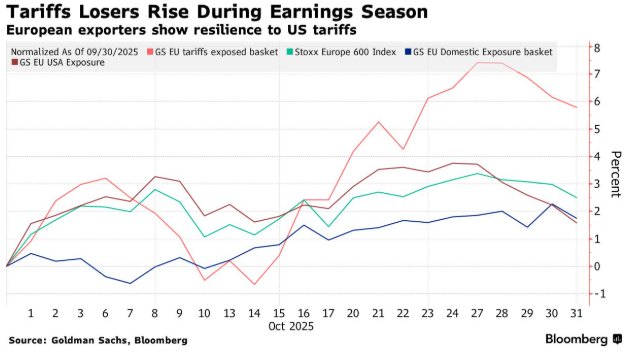
展现韧性!欧洲公司对美关税“免疫”,明年有望实现两位数利润增长
智通财经网· 2025-11-03 07:05
Core Viewpoint - European companies have performed better than expected in response to U.S. tariffs, indicating a positive outlook for profit growth in the coming year, with market expectations of double-digit profit increases [1][3]. Group 1: Performance of European Companies - A basket of European stocks most affected by tariffs, compiled by Goldman Sachs, outperformed the market in October, rising approximately 6%, which is double the increase of the European Stoxx 600 index and three times that of domestic stocks [1]. - Companies like Hermès, Unilever, and Galderma have reported significant sales growth in the Americas, with Hermès seeing a 14.1% increase in sales in the region [3][6]. - The frequency of mentions of tariffs in European earnings calls has been declining, indicating a growing optimism among EU companies regarding their outlook [10]. Group 2: Strategic Adjustments and Cost Management - Companies are adapting to tariffs by cutting costs to avoid raising prices, which could push consumers towards cheaper brands, as seen with Unilever's strategy [6]. - Pharmaceutical companies in Europe are negotiating with the U.S. government to lower drug prices and are committing billions in investments to mitigate the impact of upcoming sector tariffs [6][11]. - Some companies, like Stellantis, reported a 13% increase in net income due to recovery in North American business, while also committing to significant investments in the U.S. [11]. Group 3: Market Sentiment and Future Outlook - Analysts suggest that the gap between profit growth in the U.S. and Europe is expected to narrow, with a general market expectation of a 12% increase in earnings per share for Stoxx 600 constituents next year [3][6]. - There is a growing belief that tariffs are manageable and will not cause significant damage, although some caution remains regarding the long-term effects and currency impacts on earnings [12].
国泰海通:国际美护品牌二季度增速回暖 中国区市场全面增长
智通财经网· 2025-08-03 05:59
Group 1: Market Overview - Recent financial reports from international beauty leaders like L'Oréal and Procter & Gamble indicate a sequential improvement in growth rates for overseas brands in the Chinese market, particularly in functional skincare and medical aesthetics [1] - The beauty sector is experiencing significant changes, with a notable rise in domestic brands, highlighting a clear growth trend and increasing brand differentiation [1] Group 2: L'Oréal Performance - L'Oréal reported a sales figure of €22.47 billion for 1H25, reflecting a year-on-year growth of 3.0%, with Q1 and Q2 growth rates of 2.6% and 3.7% respectively [2] - The net profit for L'Oréal reached €3.783 billion, showing a 1.0% year-on-year increase [2] - The professional hair division led growth with a 6.5% increase, while mass skincare, premium cosmetics, and skin science segments grew by 2.8%, 2.0%, and 3.1% respectively [2] - The Chinese market showed a 3% year-on-year growth in Q2, with skin science and professional hair products performing particularly well [2] Group 3: Procter & Gamble Performance - Procter & Gamble's Q2 sales amounted to $20.889 billion, a 2% year-on-year increase, with net profit rising by 15% to $3.626 billion [3] - The beauty segment saw a slight increase of 0.2% year-on-year, while net profit in this division grew by 4% [3] - The skincare business in China continued to grow, although this was offset by a decline in North America, resulting in flat overall sales for the skincare segment [3] Group 4: Galderma Performance - Galderma reported a net sales figure of $2.448 billion for 1H25, marking a 12.2% year-on-year increase, with Q2 growth at 15.8% [4] - The company raised its full-year sales guidance to 12-14%, up from the previous 10-12% [4] - The injection aesthetics, daily skincare, and skin treatment segments grew by 9.8%, 7.7%, and 26.9% respectively, with botulinum toxin sales increasing by 14.7% [4] - Strong performance was noted in key markets such as Brazil, Canada, and mainland China, particularly in the injection aesthetics business [4]


商贸零售行业周报:国新办3/17召开提振消费发布会关注新消费&顺周期 爱美客拟控股收购REGEN BIOTECH
Xin Lang Cai Jing· 2025-03-19 06:36
Group 1: Consumption Policy and Market Trends - The government is expected to implement policies to promote childbirth, with significant subsidies announced in Hohhot, which may catalyze demand in the maternal and infant sector, benefiting companies like Aiyingshi and Haiziwang [6][8] - The retail sector is seeing a shift towards quality supermarkets, driven by consumer demand for better product quality, with companies like Yonghui Supermarket and Chongqing Department Store expected to expand [7][8] - The "AI + Consumption" initiative is being emphasized, with potential growth in sectors like AI-integrated eyewear and e-commerce, highlighting companies such as Mingyue Optical and Ruoyuchen [2] Group 2: Company-Specific Developments - Aimeike plans to acquire REGEN Biotech, which could enhance its market position and valuation, as the acquisition is expected to provide significant growth opportunities in both domestic and international markets [3] - The 3.8 promotion event on platforms like Tmall and Douyin showed strong performance, with brands like Juzi and Marubi exceeding expectations, indicating a robust recovery in the beauty sector [4][5] - Gaode Beauty reported a 9.3% increase in net sales for 2024, with significant growth in its aesthetic injection segment, particularly in China, where new products are expected to drive further growth [6]