中国太平

Search documents
保险行业2026年策略:资负两端全面改善,估值修复正当其时
SINOLINK SECURITIES· 2025-12-31 15:27
Investment Rating - The report indicates a positive outlook for the insurance industry, with expectations of double-digit growth in new premiums and net profit value (NBV) driven by the migration of deposits and improved margins [2][22]. Core Insights - The insurance sector is expected to benefit from strong household savings demand, with insurance products becoming increasingly attractive as low-risk savings options amid declining bank deposit rates [2][22]. - The transition towards participating insurance products is anticipated to enhance market share for leading insurance companies, as they leverage their stronger investment capabilities and distribution channels [2][3]. - The report highlights a favorable market environment for insurance stocks, driven by high demand for new policies and a stable investment return outlook, which is expected to support valuation recovery [4][8]. Summary by Sections Liability Side Outlook - New business and NBV are projected to grow at double-digit rates, supported by strong household savings and a shift towards insurance products due to declining bank deposit rates [2][22]. - The insurance sector is expected to maintain stable margins despite the downward adjustment of preset interest rates and the transition to participating insurance [2][22]. Asset Side Outlook - Insurance funds are expected to actively enter the market, with a significant portion of new premiums allocated to equities, particularly in A-shares [3][16]. - The report anticipates a diversified approach to asset allocation, with a focus on high-dividend stocks and sectors such as technology and advanced manufacturing [3][19]. Market Performance Review - The insurance sector has outperformed the broader market, with significant gains in both A-shares and H-shares, indicating strong investor confidence [8][4]. - The report notes that the insurance index has increased by 27.0%, outperforming the CSI 300 index, which rose by 18.2% [8]. Premium Income and Profitability - New premium income is expected to achieve double-digit growth, with specific companies like China Life and Ping An showing substantial increases in their new business premiums [14][32]. - The report highlights the importance of maintaining a favorable cost structure and investment returns to support profitability in the insurance sector [4][11].



太平财险换将:70后女将彭云苹拟任总经理 朱捷不再兼任
Nan Fang Du Shi Bao· 2025-12-31 05:22
此次卸任的朱捷自2022年1月起兼任太平财险总经理,任职期间推动公司实现高质量发展。据太平财险 披露,2025年1至11月,该公司实现原保险保费收入302亿元,同比增长3.7%,其中科技保险、绿色保 险、普惠保险等战略性新兴领域保费均实现两位数快速增长。 作为中国太平保险集团旗下核心财险子公司,太平财险目前注册资本61.7亿元,股权结构清晰:中国太 平保险控股有限公司持股99.99%,龙壁工业区管理(深圳)有限公司持股0.01%。公司曾公告拟增资10 亿元,增资后注册资本将达71.7亿元,股权比例保持不变,旨在进一步充实资本实力。2025年三季度 末,太平财险交出亮眼成绩单。得益于承保与投资两端协同发力,公司新准则下前三季度净利润9.74亿 元,同比增幅82.3%;其中三季度单季净利润3.42亿元,同比增长73.2%。与此同时,综合成本率优化至 98.18%,同比改善1.43个百分点,保险业务收入258.65亿元,实现4.24%的同比增长。 南都·湾财社记者从太平财险获悉,12月26日,该公司召开干部大会,宣布重要人事任免决定:彭云苹 出任公司党委书记、临时负责人,待监管批复后将正式出任总经理;与此同时,中国 ...

保险证券ETF(515630)红盘向上,保险资管行业数据分类分级指南发布
Xin Lang Cai Jing· 2025-12-31 02:43
Group 1: Market Performance - The China Securities Insurance Index (399966) increased by 0.41% as of December 31, 2025, with notable gains from Huayin Securities (002945) up 5.02%, GF Securities (000776) up 2.00%, and Guosen Securities (002736) up 1.68% [1] - The Insurance Securities ETF (515630) also rose by 0.41%, with the latest price reported at 1.46 yuan [1] Group 2: Regulatory Developments - The China Banking and Insurance Asset Management Association released the "Data Classification and Grading Guidelines" (T/BIAMAC 001—2025), which will be implemented starting January 1, 2026 [1] - The guidelines aim to provide a scientific and practical method for data classification and grading, enhancing the standardization of data security management within the insurance asset management sector [1] Group 3: Industry Trends - Dongwu Securities anticipates an increase in the proportion of participating insurance products in 2026, driven by their lower cost structure and reduced impact from new accounting standards [2] - The transition towards participating insurance began in 2025, with over 50% of new policies from most insurers being participating insurance, and China Taiping leading with over 90% [2] - The relative advantages of participating insurance are expected to become more pronounced in 2026, further boosting its share in new policies [2] Group 4: Key Holdings - As of November 28, 2025, the top ten weighted stocks in the China Securities Insurance Index accounted for 63.12% of the index, including major companies like Ping An Insurance (601318) and CITIC Securities (600030) [3]
申万宏源证券晨会报告-20251231
Shenwan Hongyuan Securities· 2025-12-31 00:45
Group 1: China Ping An (601318) - The insurance sector is expected to undergo a value reassessment, with China Ping An demonstrating significant advantages in managing liability costs and outperforming peers in interest spread performance. The stabilization of long-term interest rates and the ongoing entry of insurance funds into the market indicate a clear trend of asset improvement, suggesting that the insurance sector will benefit from this reassessment [3][13]. - Investment analysis suggests an upward revision of profit forecasts, maintaining a "buy" rating. The projected net profit for 2025-2027 is adjusted to 146.8 billion, 161.2 billion, and 188 billion RMB, respectively, with a target price of 93.8 RMB per share, corresponding to a P/EV of 0.99x for 2026 [3][13]. - The company has a high dividend yield, with a focus on shareholder returns, and is expected to see a recovery in OPAT growth in 2026. The public fund's holding in China Ping An is below the weight of the CSI 300, indicating potential for increased capital inflow [3][13]. Group 2: 37 Interactive Entertainment (002555) - The company has demonstrated strong operational capabilities through strategic transformations over the years, maintaining a stable management team and timely adjustments to its systems. The gaming pipeline is expected to validate its product offerings in 2025 [12][15]. - The revenue forecast for 2025-2027 is adjusted to 16.2 billion, 18.6 billion, and 20.9 billion RMB, with net profit estimates of 3.22 billion, 3.54 billion, and 3.81 billion RMB, respectively. The current price corresponds to a PE of 15/14x for 2026-2027 [12][15]. - The company is actively integrating AI into its production and content innovation, with a focus on expanding its product pipeline in the gaming sector, particularly in the SLG and casual gaming markets [12][15]. Group 3: Baidu Group (09888) - Baidu is advancing its AI stack, with significant growth in its intelligent cloud business. The company has released new AI chips and models, positioning itself as a leader in the AI large model solution market [14][15]. - Revenue projections for Baidu from 2025 to 2027 are set at 128.5 billion, 133.1 billion, and 141 billion RMB, with corresponding growth rates of -3%, 4%, and 6%. The target valuation for the group is 430.2 billion RMB, with a target price of 172.54 HKD per share [14][15]. - The company is also seeing substantial growth in its autonomous driving segment, with a significant increase in order volume and profitability, indicating a strong market position in the next-generation mobility space [14][15]. Group 4: Real Estate Industry - The real estate sector has experienced significant adjustments, with a focus on repairing household balance sheets as a key to recovery. The government is expected to introduce further supportive policies to stabilize the market [18][22]. - The recent reduction in the value-added tax for housing sales is aimed at lowering transaction costs for sellers, which may help restore the transaction chain, although the overall impact on demand remains limited [18][20]. - Investment recommendations include focusing on commercial real estate and high-quality housing companies, with expectations of value reassessment in the sector as supportive policies are anticipated [18][22]. Group 5: Electric Vehicle Industry - The continuation of subsidies for electric vehicles in 2026 is expected to enhance the penetration rate of electric vehicles, with specific measures aimed at promoting the replacement of old vehicles and supporting the electrification of public transport [24][25]. - The policy changes reflect a commitment to boosting consumer demand for electric vehicles, with expectations of strong sales growth in the coming year [24][25]. - Investment opportunities are highlighted in battery manufacturers and material suppliers, with a focus on the long-term growth potential of the electric vehicle market [24][25].


太平财险换将:70后女将彭云苹拟任总经理,朱捷不再兼任
Nan Fang Du Shi Bao· 2025-12-30 10:40
作为中国太平保险集团旗下核心财险子公司,太平财险目前注册资本61.7亿元,股权结构清晰:中国太 平保险控股有限公司持股99.99%,龙壁工业区管理(深圳)有限公司持股0.01%。公司曾公告拟增资10 亿元,增资后注册资本将达71.7亿元,股权比例保持不变,旨在进一步充实资本实力。2025年三季度 末,太平财险交出亮眼成绩单。得益于承保与投资两端协同发力,公司新准则下前三季度净利润9.74亿 元,同比增幅82.3%;其中三季度单季净利润3.42亿元,同比增长73.2%。与此同时,综合成本率优化至 98.18%,同比改善1.43个百分点,保险业务收入258.65亿元,实现4.24%的同比增长。 此次管理层平稳交接,标志着太平财险进入新的发展阶段。在保险行业持续深化转型、聚焦主责主业, 奋力书写"五篇大文章"的背景下,如何巩固传统业务优势,同时在新兴战略领域打开更大局面,将是摆 在以彭云苹为首的新管理层面前的核心课题。 采写:南都·湾财社记者 罗曼瑜 南都·湾财社记者从太平财险获悉,12月26日,该公司召开干部大会,宣布重要人事任免决定:彭云苹 出任公司党委书记、临时负责人,待监管批复后将正式出任总经理;与此同时, ...
中国分红险发展的前世今生:低利率时代的重逢
Soochow Securities· 2025-12-30 10:06
Investment Rating - The report maintains an "Accumulate" rating for the insurance sector [1]. Core Insights - The report discusses the evolution of participating insurance in China, highlighting its significance in a low-interest-rate environment and the shift towards floating yield products, which are gaining traction among domestic investors [2][6]. Summary by Sections 1. What is Participating Insurance? - Participating insurance is a type of insurance that combines protection and investment, allowing policyholders to share in the insurer's surplus [12]. - The operational mechanism involves sharing profits derived from better-than-expected performance, with a minimum of 70% of the surplus distributed to policyholders [6][15]. 2. Historical Development of Participating Insurance in Mainland China - The development of participating insurance has seen significant fluctuations influenced by policy and market factors, with its market share peaking at 75% in 2010 before declining due to market reforms [6][45]. - Since 2024, regulatory policies have encouraged the development of floating yield products, marking a consensus in the industry towards transitioning to participating insurance [6][45]. 3. Current Transition of Participating Insurance - The report anticipates that the proportion of participating insurance will continue to rise, with over 50% of new policies in the first half of 2025 being participating insurance [6][45]. - The transition is expected to alleviate pressure from interest rate losses and enhance the reliability of the insurance sector's embedded value (EV) [6][45]. 4. International Experience - In mature markets, floating yield products dominate, with Hong Kong's participating insurance being a core component, accounting for 85% of new premiums in 2024 [2][6]. - The report suggests that the characteristics of participating insurance in Hong Kong, such as multi-currency support and a design of low guarantees with high floating returns, could serve as a model for the mainland market [2][6]. 5. Key Metrics for Evaluating Participating Insurance - The report outlines four key indicators for assessing the performance of participating insurance: 1. **Guaranteed Rate**: Currently set at 1.75%, which is lower than traditional insurance [23]. 2. **Demonstration Rate**: Reflects expected returns, with current rates around 3.5% to 4% [24]. 3. **Actual Yield**: The industry average is capped at 3.2%, with some companies exceeding this limit [27]. 4. **Dividend Realization Rate**: Increased by 11 percentage points to 62% in 2024, indicating improved management and expectation guidance [29].

《保险公司资产负债管理办法(征求意见稿)》点评:资负管理的战略定位进一步提级
Shenwan Hongyuan Securities· 2025-12-30 09:33
Investment Rating - The report maintains an "Overweight" rating for the insurance industry, indicating a positive outlook for the sector's performance relative to the overall market [3]. Core Insights - The strategic positioning of asset-liability management for insurance companies has been elevated, with the introduction of the "Insurance Company Asset-Liability Management Measures (Draft for Comments)" by the Financial Supervisory Authority [2]. - The draft emphasizes three main goals for asset-liability management: matching the term structure, cost-benefit matching, and liquidity matching, with insurance companies bearing primary responsibility and the authority overseeing compliance [2]. - The governance structure requires clear delineation of responsibilities for the board of directors and senior management, establishing an asset-liability management committee and department within insurance companies [2]. - The report highlights the importance of asset-liability management in mitigating interest spread risks, especially in a declining interest rate environment, and aims to enhance the risk warning mechanism for insurance operations [2]. Summary by Sections Regulatory and Monitoring Indicators - For property and casualty insurance companies, there are three regulatory indicators focusing on income-cost coverage and liquidity, all of which must not fall below 100% [5]. - For life insurance companies, four regulatory indicators are established, including effective duration gap and comprehensive investment income coverage, also requiring a minimum of 100% [5]. Valuation of Key Companies - The report provides a valuation table for key non-bank financial companies, including China Life, Ping An, and China Pacific Insurance, with metrics such as market capitalization and price-to-earnings ratios [6]. - For instance, China Life has a market capitalization of 115.02 billion RMB and a PE ratio of 7.66, while Ping An has a market capitalization of 119.24 billion RMB and a PE ratio of 9.02 [6]. Investment Recommendations - The report continues to recommend several major insurance companies, including China Life (H), Ping An (A/H), China Pacific Insurance, China People’s Insurance, New China Life, and China Property Insurance, while suggesting to pay attention to China Taiping [3].


华创证券:预定利率调整影响消减 2026年分红险转型或超预期
智通财经网· 2025-12-30 07:43
Group 1: Industry Overview - The insurance industry achieved original premium income of 57,629 billion yuan from January to November 2025, with a year-on-year growth of 7.6% and a month-on-month decrease of 0.4 percentage points [2] - Life insurance premiums totaled 33,874 billion yuan, with a year-on-year increase of 11.5% and a month-on-month decrease of 0.5 percentage points [2] - The overall premium growth rate for both life and non-life insurance has declined [2] Group 2: Life Insurance Sector - Life insurance companies reported original premium income of 41,472 billion yuan from January to November 2025, reflecting a year-on-year growth of 9.1% [3] - The growth rate for life insurance premiums has been narrowing, with a year-on-year decrease of 2.3% in November, although the month-on-month growth improved by 2.9 percentage points [3] - The focus of life insurance companies is expected to shift towards the launch of new products for 2026, starting in early December [3] Group 3: Non-Life Insurance Sector - Non-life insurance companies achieved original premium income of 16,157 billion yuan from January to November 2025, with a year-on-year growth of 3.9% [4] - The growth rate for various non-life insurance products has shown a decline, while health insurance continues to see an increase with a year-on-year growth of 11.4% [4] - The auto insurance segment accounted for 52% of total premiums, with a year-on-year growth of 3.1% [4] Group 4: Asset Changes - As of the end of November 2025, the total assets of the insurance industry reached 40.6 trillion yuan, an increase of 13.2% compared to the end of the previous year [5] - Life insurance companies held assets of 35.75 trillion yuan, reflecting a year-on-year increase of 13.3% [5] - The net assets of the insurance industry reached 3.68 trillion yuan, up by 10.7% from the previous year [5] Group 5: Recommendations - The recommended order for investment is China Life Insurance, China Pacific Insurance, China Property Insurance, and China Taiping [6]
中国太平产寿险子公司齐换将 “70后”高管走上关键岗位
Zhong Guo Jing Ying Bao· 2025-12-29 14:54
Core Viewpoint - The recent leadership changes at China Taiping Insurance Group's subsidiaries, Taiping Life and Taiping General Insurance, reflect a shift in governance, with new leaders being promoted from within rather than appointed from the group's senior management [2][5]. Group 1: Leadership Changes - Wang Xuze has been appointed as the Party Secretary and proposed General Manager of Taiping Life, while Peng Yunping has been appointed as the Party Secretary and proposed General Manager of Taiping General Insurance [2]. - Both Wang and Peng are internal promotions, indicating a move away from the previous practice of having senior executives from the group serve in these roles [2][5]. - The changes are pending regulatory approval before the new leaders officially assume their positions [2]. Group 2: Background of New Leaders - Peng Yunping has over 20 years of experience in the property insurance industry, with a background in sales, management, governance, and compliance [3]. - She has held various positions within China Taiping Insurance Group, including Vice General Manager of the Comprehensive Development Department and Secretary of the Discipline Inspection Commission at Taiping General Insurance [3]. - Wang Xuze has extensive frontline experience, having worked in various branches of Taiping Life and served as the Market Director before becoming the temporary head of the company [4]. Group 3: Recent Performance Metrics - From January to November 2025, Taiping General Insurance achieved original insurance premium income of 30.2 billion yuan, a year-on-year increase of 3.7% [6]. - Taiping Life reported insurance business income of 158.04 billion yuan for the first three quarters of 2025, a 6.6% increase year-on-year, with net profit rising by 61.2% to 18.13 billion yuan [6]. - As of the end of the third quarter, Taiping Life's net asset scale reached 87.068 billion yuan, a 31.18% increase from the beginning of the year, and total assets amounted to 1.4 trillion yuan, up 10.19% [6].
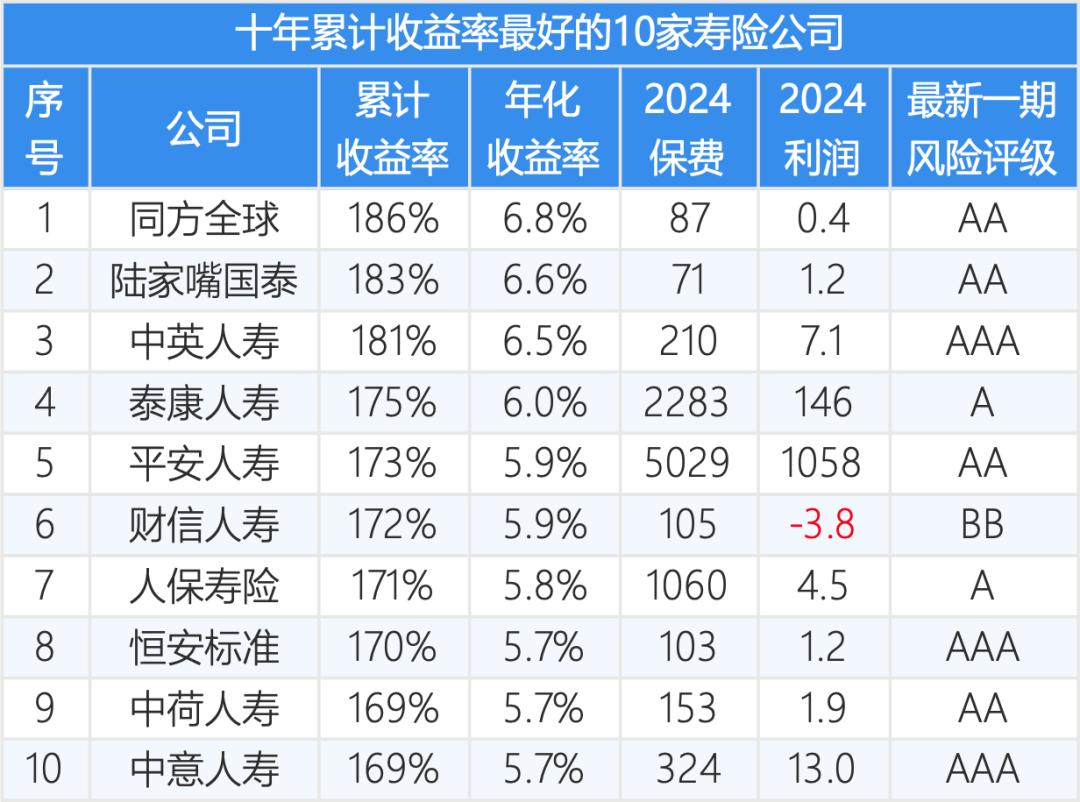
40家寿险公司投资收益率比拼,前三强都是合资公司,泰康平安人保跻身前7
Xin Lang Cai Jing· 2025-12-29 13:46
Core Insights - The article compares the investment returns of various life insurance companies over the past decade, highlighting the top performers and the bottom performers in terms of annualized returns. Group 1: Top Performers - The top three companies in terms of annualized returns are joint ventures: Tongfang Global (6.8%), Lujiazui Guotai (6.6%), and Zhongying Life (6.5%) [1][14] - The fourth and fifth positions are held by Taikang Life (6.0%) and Ping An Life (5.9%), respectively [14] - Other notable companies in the top ten include PICC Life, Caixin Life, Heng'an Standard, Zhonghe Life, and Zhongyi Life, with Caixin Life also having the smallest volatility among the top ten [1][14] Group 2: Bottom Performers - The company with the lowest ten-year cumulative return is Great Wall Life, which has a 40 percentage point difference compared to the top performer, Tongfang Global [2][15] - Junlong Life not only has a low return but also exhibits high volatility, while China Life's poor investment returns may be attributed to its large scale [2][15] Group 3: Historical Performance - Eight companies have previously held the top position, with Tongfang Global and Hongkang Life achieving first place twice [3][15] - The article notes that Tongfang Global has also secured second place three times and ninth place once, indicating consistent strong performance [3][15] Group 4: Risk Ratings - The bottom five companies generally have lower risk ratings, with most rated as B, except for China Life, which holds an AAA rating [3][15]