江苏银行

Search documents
银行行业:主动基金重仓比例微升,北向资金和被动基金有所减持
Dongxing Securities· 2026-01-28 08:09
Investment Rating - The industry investment rating is "Positive" [5] Core Insights - As of the end of Q4 2025, the market value of actively managed equity funds holding A-shares reached 1.61 trillion, with the banking sector accounting for 30.367 billion, representing 1.89% of the total, which is below the 5-year and 10-year averages of 3.02% and 3.89% respectively [1] - The report indicates a slight increase in the proportion of active funds in the banking sector, while passive funds and northbound capital have seen reductions in their holdings [2][3] - The report anticipates that in 2026, macro policies will be proactive, with the central bank lowering various structural monetary policy tool rates, which will help improve banks' funding costs and encourage lending in key areas [3] Summary by Sections Active Funds - The market value of active funds in the banking sector increased slightly to 30.367 billion, with a proportion of 1.89%, up 0.07 percentage points from Q3 2025 [1] - The concentration of holdings among the top five banks decreased to 57.6%, with notable increases in holdings for Ningbo Bank, China Merchants Bank, and others [2] Passive Funds - The overall holdings of passive funds remained stable in Q4 2025, but there has been a significant reduction since January 2026 [2] - By the end of Q4 2025, the market value of banks held by sample ETFs accounted for 6.73% of the net value of stock ETFs, a decrease of 0.99% compared to the end of 2024 [2][27] Northbound Capital - Northbound capital saw a net reduction in bank stocks, with holdings decreasing to 160.27 billion shares, down 13.75 billion shares from the previous quarter [3] - The market value held by northbound capital in bank stocks was 177.26 billion, representing 5.86% of the free float market value, a decrease of 0.21 percentage points from the previous quarter [3] Investment Recommendations - The report suggests that the banking sector's fundamentals are expected to remain stable, supported by improved net interest margins and stable asset quality [3]




一文纵览全国分省份财政社融特征
GF SECURITIES· 2026-01-28 07:49
Investment Rating - The industry investment rating is "Buy" [2] Core Insights - The average narrow deficit ratio for all provinces in 2024 is 16.4%, and the average broad deficit ratio is 20.0%, both at relatively low levels since 2010. The average debt ratio stands at 357.0%, which has been on the rise since 2016 [5] Summary by Sections Regional Finance - The average tax revenue ratio across provinces is 67.2% in 2024, showing a year-on-year decline of 2.7%. The overall trend indicates a decrease in tax revenue reliance [20][26] - The average fiscal self-sufficiency rate for all provinces is 43.9% in 2024, reflecting a continuous decline since 2013 [17][19] - The government fund budget, which accounts for 20% of fiscal revenue, has seen a revenue decline of 14.2% year-on-year in 2024, primarily due to the downturn in the real estate market [27][28] Regional Social Financing - The new social financing has shown significant differentiation, with a notable concentration in economically developed eastern regions. Approximately 60% of the new social financing increment from 2020 to 2024 has been directed towards eastern regions, although this percentage has been gradually declining [5] - In 2024, the marginal contribution of government financing has increased, while corporate financing has decreased. The contribution of government departments to new loans is 69.1%, while corporate and household contributions are 34.7% and 24.8%, respectively [5][19]



「苏超」没有泡沫
3 6 Ke· 2026-01-28 05:22
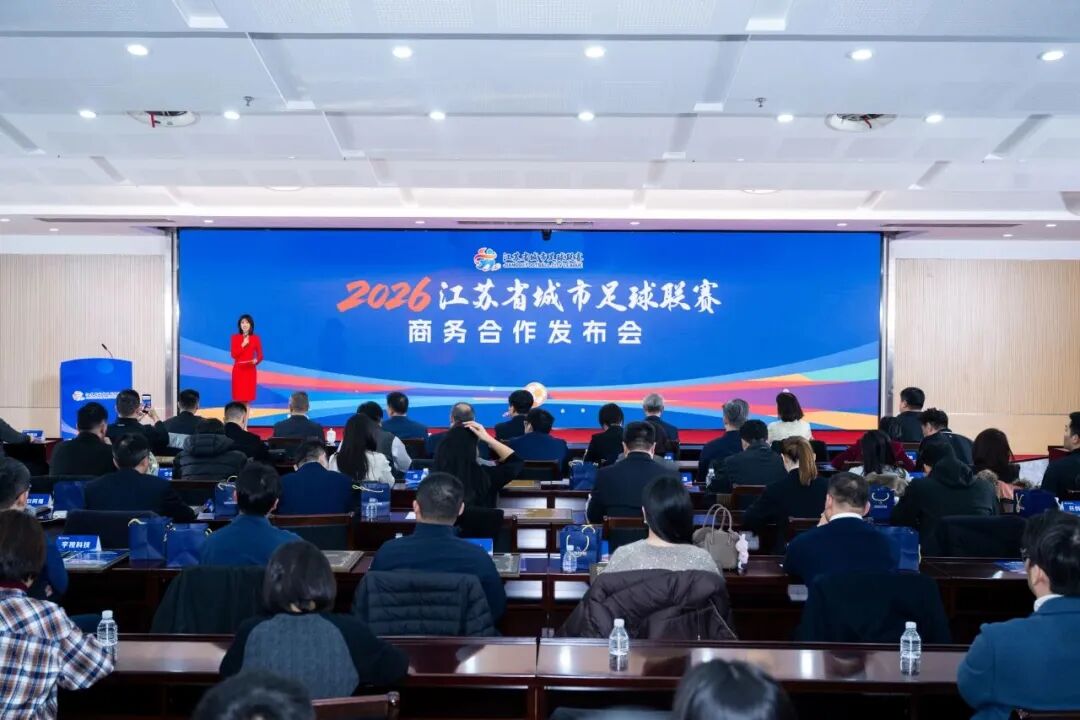
Core Insights - The article highlights the growing popularity and commercial viability of the Jiangsu Provincial Urban Football League (Su Super League), especially following the U23 national team's success in the Asian Cup [1][3]. Sponsorship and Financial Aspects - The 2026 season of Su Super League will be co-sponsored by "Jiangsu Bank · Suhao Holdings," with 24 sponsors including Adidas, Ant Financial, and Coca-Cola [3][5]. - Adidas will replace Karamay as the official apparel sponsor, providing 8 million yuan in cash support and 1 million yuan worth of apparel for each participating team, indicating a significant increase in sponsorship expectations for a provincial amateur league [3][5]. - The total sponsorship amount from Adidas for the league is reported to be 21 million yuan, which is comparable to the sponsorship amounts in top-tier leagues like the Chinese Super League [5][9]. Market Dynamics and Growth - The Su Super League has become a competitive platform for brands, with 15 new sponsors added, reflecting its attractiveness to advertisers [5][6]. - The league's sponsorship landscape has evolved, with local enterprises and internet platforms actively seeking exposure, leading to a total sponsorship amount of 15.41 million yuan in the Nanjing division alone [5][6]. - The league has driven significant consumer spending, with over 38 billion yuan generated from various consumption scenarios, including a 26.48% year-on-year increase in tourism-related spending [6][13]. Brand Strategy and Engagement - Adidas' involvement in the Su Super League aligns with its strategy to enhance its presence in grassroots football, focusing on youth training and community engagement [10][12]. - The league's structure allows brands to engage with a larger audience, providing a platform for consistent interaction with fans and consumers [15][19]. - The introduction of a sponsorship scheme for small and micro enterprises aims to integrate local businesses into the league's ecosystem, enhancing community involvement [16][19]. Broader Implications for Chinese Football - The Su Super League represents a shift in the relationship between football and urban development, integrating sports into cultural and economic frameworks [13][22]. - The league's success is indicative of a broader trend where local leagues are becoming essential components of China's football landscape, contributing to social and economic growth [19][22]. - The evolving structure of Chinese football now includes a multi-tiered system, with grassroots leagues playing a crucial role in the overall ecosystem [22][23].

【独家发布】2025年中国中小银行行业政策梳理及上下游产业链全景分析
Xin Lang Cai Jing· 2026-01-28 04:49
Core Insights - The article emphasizes the positive role of small and medium-sized banks in supporting China's long-term economic development, particularly in fostering private enterprises and local economies while advancing financial market reforms [2][16] - It highlights the significant growth in total assets and liabilities of small and medium-sized banks, indicating their expanding market presence and competitiveness [16] Summary by Sections Overview of the Small and Medium-Sized Banking Industry - Small and medium-sized banks are defined as those excluding the six major state-owned banks, encompassing various types such as national joint-stock banks, urban commercial banks, rural commercial banks, and private banks [3][17] - These banks play a crucial role in providing diverse financial services, including cash management, online banking, investment banking, and microfinance [5][19] Industry Policies - The Chinese government has shown strong support for the development of small and medium-sized banks, with policies aimed at enhancing their operational environment and promoting rural revitalization [7][21] - Key policies include the "Opinions on Further Deepening Rural Reform" and measures to support micro-enterprise financing, which guide these banks to leverage their local advantages [21][23] Industry Chain - The upstream of the small and medium-sized banking industry includes IT service providers, payment platforms, and financial market participants, which support banks in digital transformation and service innovation [10][24] - The midstream consists of the banks themselves, which provide essential financial services to meet the diverse needs of consumers and businesses [10][24] - The downstream includes consumers and enterprises that utilize banking services for consumption, investment, and financing, reflecting a growing demand for financial services [11][25] Financial Performance - In 2024, the total assets of small and medium-sized banks reached 192.25 trillion yuan, a year-on-year increase of 6.39%, while total liabilities were 177.36 trillion yuan, up 6.27% [16] - By November 2025, total assets are projected to grow to 201.6 trillion yuan, with liabilities increasing to 186.07 trillion yuan, indicating a continued upward trend in the sector [16]





金价大涨,银行黄金挂钩结构性存款火了
Sou Hu Cai Jing· 2026-01-28 02:46
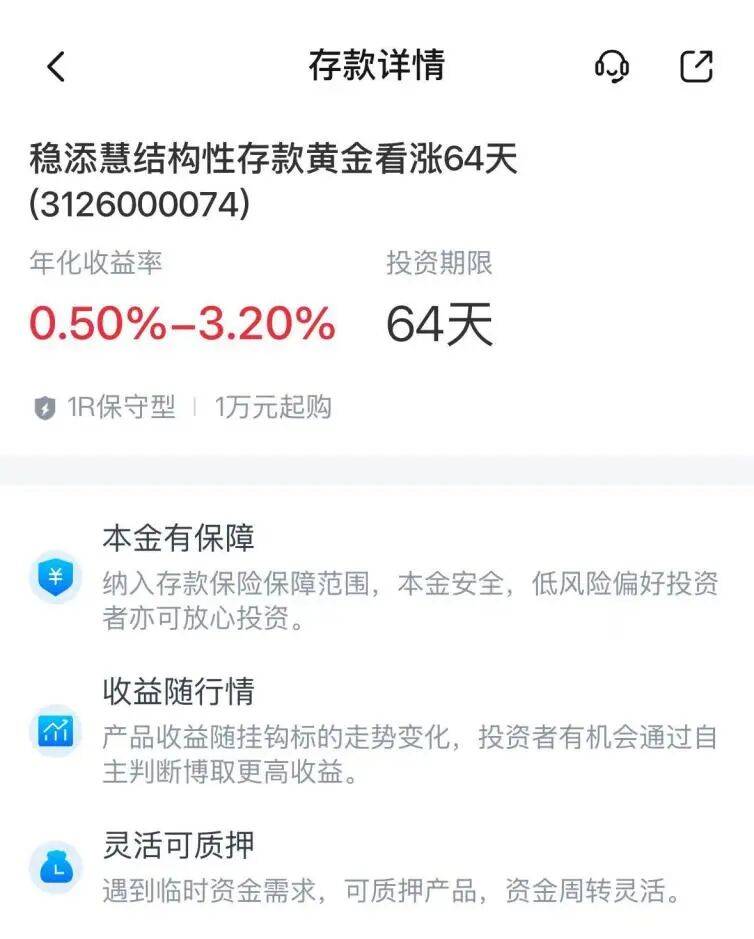
Core Viewpoint - The demand for gold-linked structured deposits is surging among banks and companies in China, driven by rising international gold prices, with many products selling out quickly [1][6]. Group 1: Bank Offerings - Multiple banks, including China Construction Bank, China Merchants Bank, and others, have launched gold-linked structured deposit products, with some experiencing high sales rates [1][6]. - The typical investment threshold for these products is around 10,000 yuan, with some popular offerings starting at 50,000 yuan, and most have a maturity of less than one year [6]. - Expected annualized returns for these products generally range from 1% to 4%, with some banks offering higher rates for foreign bank products [6][7]. Group 2: Company Participation - Numerous listed companies have begun investing in gold-linked structured deposits, with a total subscription amount reaching 1.728 billion yuan, significantly higher than the same period last year [8]. - For instance, Sujiao Technology announced a purchase of 90 million yuan in structured deposits linked to gold prices, with a maturity of 364 days and an expected annualized return of 0.30% to 2.35% [8]. Group 3: Market Analysis - Analysts suggest that the surge in gold-linked structured deposits is a response to increasing investor interest in gold as a safe-haven asset amid rising geopolitical uncertainties and economic fluctuations [9]. - The expectation is that gold prices may challenge the $6,000 mark by 2026, driven by ongoing market conditions and investor sentiment [9]. - The current market environment is characterized by high prices and volatility, prompting recommendations for investors to adopt strategies like dollar-cost averaging [10].

【立方早知道】61岁女富豪被留置!手握三家上市公司/两大半导体龙头宣布涨价/A股多家公司将赞助“苏超”
Sou Hu Cai Jing· 2026-01-28 02:35
Group 1: Currency and Economic Indicators - The US dollar index experienced a significant drop, reaching a low of 95.5542, the lowest since February 2022, following comments from Trump expressing indifference towards the dollar's decline [1] - The People's Bank of China reported that by the end of Q4 2025, the total balance of RMB loans was 271.91 trillion yuan, a year-on-year increase of 6.4%, with a total increase of 16.27 trillion yuan for the year [5] Group 2: Corporate Developments - The actual controller of Dongcai Technology, Yichang Technology, and Gaomeng New Materials, Xiong Haitao, is under investigation by the Sichuan Provincial Supervisory Committee [3] - Multiple semiconductor companies announced price increases, with prices for certain products rising by 15% to 50% for Zhongwei Semiconductor and up to 80% for Guokewi [3] - A number of A-share companies reported their 2025 earnings forecasts, with Shijia Photon expecting a revenue increase of approximately 98.13% and a net profit increase of about 425.95% [20] - Vanke A announced that its largest shareholder, Shenzhen Metro Group, will provide a loan of up to 2.36 billion yuan to repay bond principal and interest [25] - Di'er Laser is planning to issue H-shares and apply for listing on the Hong Kong Stock Exchange to enhance its international strategy [29] Group 3: Regulatory and Policy Changes - The Ministry of Natural Resources, the Ministry of Civil Affairs, and the National Health Commission jointly issued 18 measures to support the development of elderly care services, including encouraging mixed-use land development [7] - The revised Drug Administration Law will take effect on May 15, emphasizing the importance of clinical value in drug research and introducing exclusive market periods for pediatric and rare disease drugs [12] - The Ministry of Human Resources and Social Security announced plans to implement employment support measures in response to the impact of artificial intelligence [9]

【行业深度】一文洞察2026年中国中小银行行业发展前景及投资趋势研究报告
Sou Hu Cai Jing· 2026-01-28 02:35
Core Insights - The article emphasizes the significant role of small and medium-sized banks in supporting China's long-term economic development through flexible market mechanisms and high service efficiency [2] - It highlights the ongoing transformation and competitive pressures faced by these banks, leading to strategies aimed at enhancing market competitiveness and expanding their asset base [2][8] Group 1: Industry Overview - Small and medium-sized banks are defined as all banks excluding the six major state-owned banks, and they include various types such as national joint-stock banks, urban commercial banks, rural commercial banks, and private banks [4] - These banks have become a crucial part of China's financial ecosystem, holding a substantial share of total assets in the banking sector [2] Group 2: Financial Performance - In 2024, the total assets of China's small and medium-sized banks reached 192.25 trillion yuan, marking a year-on-year growth of 6.39%, while total liabilities were 177.36 trillion yuan, up 6.27% [2] - By November 2025, total assets increased to 201.6 trillion yuan, reflecting a growth of 6.49%, with total liabilities at 186.07 trillion yuan, a rise of 6.66% [2] Group 3: Policy Environment - The Chinese government has shown strong support for the development of small and medium-sized banks, with policies aimed at enhancing their role in financing small and micro enterprises and promoting rural revitalization [8] - Key policies include the "Opinions on Further Deepening Rural Reform" and measures to support small and micro enterprise financing, which guide these banks to leverage their local advantages [8][10] Group 4: Industry Chain - The upstream of the small and medium-sized banking industry chain includes IT service providers, payment platforms, and financial market participants, which support banks in innovation and service delivery [11] - The midstream consists of the banks themselves, which provide essential financial services to meet diverse consumer and business needs [11][12] Group 5: Competitive Landscape - As competition intensifies, small and medium-sized banks are adopting strategies such as capital supplementation, attracting strategic investors, and differentiated operations to enhance their market position [2][8] - The focus on small and micro enterprise financing has led to significant achievements in expanding the industry’s total assets [2]
中国银河证券:低配比例继续扩大 大行、股份行持续受关注
智通财经网· 2026-01-28 01:29
Core Viewpoint - The report from China Galaxy Securities indicates that the public fund's heavy stockholding data for Q4 2025 shows a continued low preference for the banking sector, despite ongoing interest in state-owned and joint-stock banks [1] Group 1: Active Fund Holdings - The proportion of active funds underweight in the banking sector has increased, with a current underweight ratio of 8.88%, up by 0.5 percentage points [1] - The total market value of active fund holdings in banks is 30.545 billion yuan, reflecting a 1.52% increase quarter-on-quarter, with a holding ratio of 1.88%, up by 0.07 percentage points, remaining at a near five-year low [1] - The rankings of bank holdings among active funds show state-owned banks at 0.31%, joint-stock banks at 0.61%, city commercial banks at 0.77%, and rural commercial banks at 0.19%, with state-owned banks seeing a notable increase of 0.08 percentage points [1][2] Group 2: Passive Fund Holdings - The total market value of passive fund holdings in banks is 110.423 billion yuan, with a holding ratio of 7%, up by 1.56 percentage points, ranking 6th among the Shenwan first-level industries [3] - The holding ratios for state-owned banks, joint-stock banks, city commercial banks, and rural commercial banks are 0.88%, 5.63%, 0.42%, and 0.08%, respectively, all showing increases, particularly joint-stock banks which rose by 1.37 percentage points [3] Group 3: Northbound Capital Flows - Northbound capital has seen a slight net outflow from the banking sector, with total holdings amounting to 177.26 billion yuan, up by 2.06%, and a holding ratio of 6.85%, increasing by 0.12 percentage points [4] - The net outflow from the banking sector was 5.08 billion yuan, with notable net purchases in banks such as China Merchants Bank, Industrial and Commercial Bank of China, and Ningbo Bank, amounting to 4.356 billion, 1.419 billion, and 1.344 billion yuan, respectively [4]

江北新区浦口康居集团 开展“腊八甜粥暖寒冬 党员敬老见真情”活动
Xin Lang Cai Jing· 2026-01-27 22:08
(来源:南京晨报) 一碗腊八粥,浓浓党群情。为了让老人们尝到地道的腊八滋味,党员志愿者们提前精心挑选糯米、红 豆、红枣、莲子等多种杂粮,耗时数小时慢火熬制,熬出的腊八粥软糯香甜、暖意浓浓。活动现场,将 温热的粥品小心翼翼盛入碗中,逐一向老人们递去,一句句"大爷慢点喝""阿姨注意保暖"的贴心叮嘱, 搭配着粥香,驱散了冬日的严寒。老人们捧着温热的粥碗,眉眼间满是笑意,直言"这碗粥,熬的是心 意,暖的是我们老百姓的心"。 义剪送温情,新风暖人心。针对养老中心老人出行不便、理发困难的实际需求,活动特意增设"志愿义 剪"服务环节,邀请专业志愿者现场"坐镇"。志愿者们耐心倾听每位老人的发型诉求,细致梳理、精准 修剪,一边娴熟操作,一边与老人们拉家常、话年俗,倾听老人们的心声,缓解老人们的孤独感。 此次活动结合腊八节时令,以志愿服务为抓手,将党建引领的责任与温度具象化,既传承了中华优秀传 统文化,又切实解决老人们的急难愁盼问题,进一步筑牢了党群"连心桥"。下一步,南京江北新区浦口 康居集团党总支将持续深化"党建+志愿服务"模式,聚焦老年群体等重点对象,推出更多有温度、有特 色、有实效的民生服务,以点滴行动书写为民初心。 转 ...
银行股配置重构系列九:从主动基金 Q4 持仓看配置思路
Changjiang Securities· 2026-01-27 15:25
Investment Rating - The investment rating for the banking sector is "Positive" and is maintained [12] Core Insights - In Q4 2025, active funds did not significantly reduce their holdings in bank stocks, with a stable allocation ratio of 1.86% compared to the previous quarter. This reflects a general decline in market risk appetite. However, it is anticipated that the allocation ratio may decrease further in Q1 2026 due to a significant rebound in risk appetite and the relative underperformance of bank stocks at the beginning of the year [2][6] - The selection of individual stocks has shifted towards a focus on fundamental trends, with Ningbo Bank seeing the most significant increase in allocation due to improved asset quality and performance expectations. The bank has established a turning point in retail asset quality and is expected to lead the sector in performance [7][8] - The report suggests that the core investment strategy for 2026 should prioritize high-performing regional banks, particularly city commercial banks, as they are expected to maintain superior growth rates amid a stable credit structure [9] Summary by Sections Active Fund Holdings - As of Q4 2025, the allocation ratio of active public funds to bank stocks remained stable at 1.86%, indicating a recovery in market risk appetite. The allocation ratio is expected to hit a new low in Q1 2026 due to a resurgence in risk appetite and the underperformance of bank stocks [6][8] - City commercial banks experienced a reduction of approximately 1.7 billion in total holdings, but Ningbo Bank was notably increased by 860 million, reflecting a shift towards stocks with improving fundamentals [7][8] Stock Selection Trends - The focus on stock selection has shifted from high dividend yields to fundamental trends, with Ningbo Bank being the most significantly increased stock in Q4 2025. The bank's asset quality indicators have shown continuous improvement, and it is expected to see a growth in performance in 2026 [7][8] - Conversely, stocks like Chengdu Bank have been reduced significantly, reflecting concerns over performance volatility and ongoing adjustments in business structure [7] Market Dynamics - The banking sector has faced downward pressure due to capital outflows from active funds and index funds, leading to undervaluation in bank stocks. The report recommends seizing opportunities in quality city commercial banks at lower price levels [9][33] - The report highlights that the allocation strategy for 2026 should focus on high-quality city commercial banks, as they are expected to outperform in terms of earnings growth amid a stable credit environment [9]