德赛西威

Search documents
德赛西威(002920) - 关于公司股东减持股份预披露公告
2026-01-07 12:30
惠州市德赛西威汽车电子股份有限公司 证券代码:002920 证券简称:德赛西威 公告编号:2026-002 惠州市德赛西威汽车电子股份有限公司 关于公司股东减持股份预披露公告 股东广东德赛集团有限公司保证向公司提供的信息披露内容真实、准确、完 整,没有虚假记载、误导性陈述或重大遗漏。 本公司及全体董事会成员保证公告内容与信息披露义务人提供的信息一致。 特别提示:持有惠州市德赛西威汽车电子股份有限公司(以下简称"公司") 157,106,250 股(占公司当前总股本比例 26.32%)的股东广东德赛集团有限公司(以 下简称"德赛集团")计划在本公告之日起 15 个交易日后的 3 个月内以集中竞价或 大宗交易方式减持公司股份不超过 7,106,250 股,不超过公司当前总股本的 1.1906% (不超过剔除公司回购专户中的股份数量的总股本的 1.1964%)。 公司于近日收到第一大股东、持股 5%以上股东德赛集团出具的《关于公司股 份减持计划的告知函》,现将本次股东减持股份计划的有关情况公告如下: 一、德赛集团的基本情况 1、股东的名称:广东德赛集团有限公司 2、股东持有的股份数量:截至本公告日,德赛集团持有公司 ...
德赛西威:德赛集团拟减持公司不超1.19%股份
Zheng Quan Shi Bao Wang· 2026-01-07 12:28
人民财讯1月7日电,德赛西威(002920)1月7日公告,持股26.32%的公司第一大股东德赛集团拟减持公司 不超过710.625万股,减持比例不超过公司当前总股本的1.1906%(不超过剔除公司回购专户中的股份数 量的总股本的1.1964%)。 转自:证券时报 ...
德赛西威:持股26.32%股东拟减持不超1.1906%股份
Xin Lang Cai Jing· 2026-01-07 12:17
Core Viewpoint - Desay Group, a major shareholder of Desay SV, plans to reduce its stake by up to 7,106,250 shares, representing approximately 1.1906% of the company's total share capital, due to its own funding needs [1] Group 1 - Desay Group currently holds 26.32% of Desay SV, equating to 157,106,250 shares [1] - The reduction will occur within three months starting from 15 trading days after the announcement date [1] - The shares will be sold at market price through centralized bidding or block trading [1] Group 2 - There are no restrictions preventing Desay Group from reducing its holdings [1] - The plan to reduce shares carries a degree of uncertainty [1]
英伟达发布自动驾驶开源模型,将促进相关软硬件及Robo-X渗透率提升
Orient Securities· 2026-01-07 11:11
Investment Rating - The industry investment rating is Neutral (maintained) [5] Core Insights - NVIDIA has launched an open-source autonomous driving model, Alpamayo, which is expected to enhance the penetration rates of high-level autonomous driving and Robo-X. This development is anticipated to benefit related vehicle manufacturers, component suppliers, and mobility service providers [3][9] - The Robo-X scale is expected to accelerate, with leading companies like LoBot and Pony.ai achieving or nearing single-vehicle breakeven points for their Robotaxi services. The deployment of Robovans is also increasing, with significant cost reductions in unmanned logistics vehicles [8] - NVIDIA is building a comprehensive autonomous driving ecosystem, which is likely to create growth opportunities for suppliers of autonomous driving hardware and software as demand for advanced components rises [8] Summary by Sections Investment Recommendations and Targets - Recommended stocks in the component sector include: - Jingwei Hirain (688326, Buy) - Bertel (603596, Buy) - Desay SV (002920, Buy) - Huayang Group (002906, Buy) - Coboda (603786, Buy) - Horizon Robotics (09660, Not Rated) - Hesai (02525, Not Rated) - Nexperia (01316, Not Rated) - Recommended stocks in the vehicle and mobility service sector include: - Xpeng Motors (09868, Not Rated) - Seres (601127, Not Rated) - Pony.ai (02026, Not Rated) [3][9]

骁龙数字底盘强势领跑,高通智能体 AI 重塑未来驾乘生态
Huan Qiu Wang· 2026-01-07 11:05
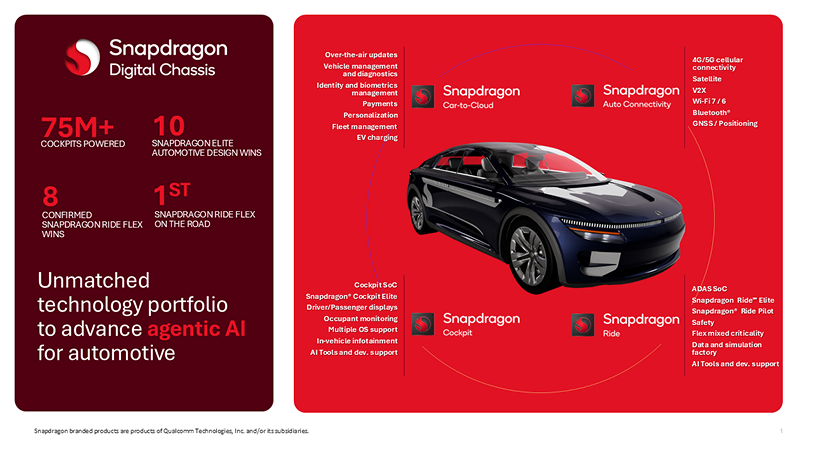
Core Insights - Qualcomm solidified its industry leadership at CES 2026 with the global adoption of its Snapdragon digital chassis solutions, integrating AI and high-performance computing into the automotive sector, thus accelerating the transition to software-defined vehicles [1][3] Group 1: Partnerships and Collaborations - Qualcomm announced a deepened long-term collaboration with Google to integrate Snapdragon digital chassis solutions with Google automotive software, facilitating faster market deployment of new AI features for automakers [3] - The company has established new or expanded collaborations with several automotive manufacturers, including Li Auto, Leap Motor, Geely, Great Wall Motors, NIO, and Chery, achieving a total of 10 model designations [4] - Qualcomm is collaborating with leading driving assistance software providers such as Yuanrong Qixing, Momenta, and others to create a diverse competitive ecosystem for AI technologies [5] Group 2: Product Innovations - Qualcomm's Snapdragon cockpit platform and Snapdragon Ride platform have gained widespread recognition among global automakers for their high-performance computing capabilities and AI acceleration [4] - The Snapdragon Ride Flex chip, which supports both digital cockpit and advanced driver assistance system workloads, has been successfully deployed in eight production vehicle projects globally [4] - The Snapdragon Ride platform has secured 20 model designations, becoming one of the most trusted and efficient driving assistance platforms in the industry [5] Group 3: AI Integration and User Experience - Qualcomm's integration of AI technology into its cockpit platform has enhanced the in-car experience, supporting over 75 million vehicles globally by mid-2025 [6] - The new generation Snapdragon cockpit platform will be featured in Toyota's RAV4 model, utilizing AI to anticipate driver and passenger needs for real-time adjustments [6] - Qualcomm introduced the A10 5G modem, designed for automotive applications, which offers low power consumption and cost advantages while supporting critical vehicle services [6]


汽车行业点评报告:英伟达发布推理智驾模型Alpamayo,智驾功能有望加速“平权”
KAIYUAN SECURITIES· 2026-01-07 07:42
Investment Rating - The industry investment rating is "Overweight" (maintained) [1] Core Insights - The report highlights the significant advantages of robotics in enhancing the growth potential of automotive companies, particularly in the context of the ongoing transition to electric vehicles and autonomous driving technologies [3][6] - The introduction of Nvidia's Alpamayo model and its open-source tools is expected to accelerate the maturity and deployment of autonomous driving technologies, making it easier for developers to create and implement advanced driving algorithms [5][6] - The demand for intelligent driving features is becoming a critical factor for consumers when choosing vehicles, with expectations for these features to penetrate mid- to high-end models [7] Summary by Sections Industry Overview - The intelligent driving sector is poised for continued growth in 2026, driven by both supply and demand factors [7] - Nvidia's advancements in AI and autonomous driving are expected to lower development barriers and enhance the ecosystem for autonomous vehicle deployment [6] Key Opportunities - The report suggests focusing on companies within the intelligent driving supply chain, including Desay SV, Huayang Group, and XPeng Motors, among others, which are likely to benefit from the growth in this sector [8] - Specific beneficiaries identified include companies like Cobot, Bertel, and Horizon Robotics, which are positioned to capitalize on the advancements in intelligent driving technologies [8]
中金:英伟达(NVDA.US)扩大智驾软硬件生态圈 国内头部智驾供应商迎来出海机遇
智通财经网· 2026-01-07 06:43
风险因素 智驾技术发展不如预期,行业竞争加剧风险,存在政策变化风险。 在CES展会上,英伟达推出Alpamayo开源VLA人工智能算法,并规划于2027年推出L4级Robotaxi。特斯 拉已在2025 年下半年启动Robotaxi在奥斯汀等城市商业化运营,并计划在2026年量产Cybercab。小马智 行已部署超千辆Robotaxi车队,文远知行发力中东市场,并在阿布扎比逐步迈向单车盈亏平衡。随着海 外英伟达、特斯拉(TSLA.US),国内小马智行-W(02026)、文远知行-W(00800)、小鹏汽车-W(09868)等 加速布局自动驾驶,全球智驾有望进一步打开成长空间。 国内高阶智驾已跨过渗透率拐点,看好国内智能驾驶各环节龙头领跑全球市场 中金认为,高阶智驾渗透率持续提升,推动智驾产业链发展,预计随着L3、L4级别智驾渗透率提升, 智驾软硬件单车配套价值量有望提升,叠加头部供应商加速切入海外市场,国内智能驾驶各环节龙头公 司有望迎来量价齐升周期。 智通财经APP获悉,中金发布研报称,在本周CES展会上,英伟达(NVDA.US)宣布全球DRIVE Hyperion 生态系统正在扩张,纳入了包括博世、禾赛- ...
中国Robotaxi产业链深度梳理
2026-01-07 03:05
Summary of Key Points from the Conference Call on the Robotaxi Industry Industry Overview - The Robotaxi industry in China is experiencing accelerated commercialization driven by three main factors: technology (multi-sensor fusion and VOA autonomous driving software), policy (supportive domestic and international regulations), and cost (LiDAR prices dropping to around $200) [1][7][25]. Market Projections - The Chinese Robotaxi market is expected to reach a scale of 80 billion yuan by 2030, with an estimated fleet of 500,000 vehicles, and surpass 700 billion yuan by 2035, indicating significant market potential and a substitution effect on private car ownership [1][8][12]. Valuation and Revenue Model - The valuation of Robotaxi entities is based on their revenue-generating capabilities, which include the number of vehicles and their capability levels (from L1 to L5). The complexity of tasks completed by these entities is a critical evaluation factor in the AI era [1][9]. Changes in Value Per Kilometer - In the Robotaxi era, the value per kilometer is expected to increase due to the standardization of driving experiences with the maturity of L4 autonomous driving technology. The value will rise for algorithm suppliers, operational platforms, and car rental companies compared to the ride-hailing era [1][10][11]. Key Players and Investment Opportunities - In the H-share market, notable companies include XPeng Motors and Horizon Robotics, which are transitioning from L2+ to L4 Robotaxi capabilities, as well as early technology providers like Pony.ai and WeRide. In the A-share market, key recommendations include companies involved in the L4 operational chain and those focusing on international expansion [3][5]. Market Dynamics - The ride-hailing market is characterized by a "one strong, many strong" structure, with Didi dominating but aggregation platforms rising from 7% market share in 2019 to 25%-30% currently, providing growth opportunities for second-tier ride-hailing platforms like Cao Cao Mobility [1][21][23]. Future Trends and Challenges - The Robotaxi market is anticipated to reach a significant turning point in 2027, driven by advancements in software, hardware, and ecosystem maturity. The decline in hardware costs, such as the BOM cost of the sixth-generation model of a leading company dropping to around 200,000 yuan, is crucial for profitability [4][26]. Regulatory Environment - The regulatory landscape is becoming increasingly favorable for Robotaxi development, with both domestic and international policies gradually relaxing to support the industry [25]. Conclusion - The Robotaxi industry presents a promising investment opportunity, with a robust growth trajectory expected due to technological advancements, favorable policies, and decreasing costs. The market dynamics indicate a shift in value distribution among various stakeholders, enhancing the overall profitability potential of the sector [1][26].
英伟达加速进军智驾业务-继续重点推荐智能汽车板块
2026-01-07 03:05
Summary of Conference Call on NVIDIA and the Smart Automotive Sector Industry Overview - The conference call focuses on the smart automotive sector, particularly the advancements in autonomous driving technology led by NVIDIA in collaboration with Mercedes-Benz [1][2]. Key Points and Arguments - **NVIDIA and Mercedes-Benz Collaboration**: This partnership signifies a major advancement in the autonomous driving field, with a clear production timeline set for 2026. Testing will begin in the U.S. in Q1 2026, followed by deployment in Europe in Q2, and expansion into Asia later in the year. By the end of 2026, the vehicles are expected to have urban operational vehicle (OV) capabilities, positioning NVIDIA as a potential third-party leader in the global autonomous driving market [1][2]. - **Impact on Competition**: The collaboration is expected to have a significant demonstration effect in overseas markets, potentially attracting more automotive companies to accelerate their efforts to catch up with Tesla. This will intensify competition in the Chinese market and promote the development of Robotaxi services, which is particularly crucial for non-Chinese markets where competition is currently limited [1][3]. - **Investment Recommendations**: - For H-shares, the focus should be on XPeng (closest to Tesla's model) and Horizon Robotics (best mapping). Additionally, companies like Pony.ai and WeRide, which are purely focused on L4 Robotaxi, are highlighted for their potential. - For A-shares, Desay SV Automotive is noted as the best mapping object, while Qianli Technology is recognized as the only company actively engaged in Robotaxi-related business. Other small to mid-cap stocks like Beijing Junzheng and Dazhongnan are also recommended for investment [1][4]. Future Catalysts - Key future catalysts that may influence the smart automotive sector include: - The introduction of L3/L4 national standards - Full domestic rollout of Tesla's Full Self-Driving (FSD) technology - Launch of new models by XPeng and iterations of the second-generation Vehicle Operating Architecture (VOA) - Doubling of sales targets by companies like Pony.ai, LoBot, and WeRide - Continued progress by third-party players like Horizon Robotics and Momenta in L4 development - The implementation of electrification policies, which will alleviate overall concerns and shift the focus of autonomous driving to B-end applications [1][5]. Market Outlook for 2026 - The outlook for the smart automotive sector in 2026 is increasingly centered on L4 autonomous vehicle scenarios, particularly the Robotaxi market, which is expected to be the largest and most accommodating for various players. Since September, numerous catalysts, including Tesla's record highs and new model launches from XPeng, indicate that the industry is in a phase of positive development. Investors are advised to closely monitor NVIDIA, Tesla, and related mapping stocks like XPeng, Horizon Robotics, Pony.ai, and WeRide, while keeping an eye on upcoming policies and technological advancements to seize investment opportunities [1][6][7].

加快海外业务拓展,德赛西威拟港股上市
Ju Chao Zi Xun· 2026-01-07 02:35
Group 1 - The company is planning to issue H-shares and list on the Hong Kong Stock Exchange to enhance its international strategy and brand influence, while not affecting its control [2] - The company aims to maintain its domestic market share by leveraging unique advantages to create superior products and investing in R&D to sustain its first-mover advantage [2] - The company possesses full-stack capabilities in smart cockpits and smart driving, enabling faster and more cost-effective product launches through collaboration with industry leaders [2] Group 2 - The trend of integrated cockpit and driving systems is expected to become more pronounced, with the company's 8775 integrated solution anticipated to offer significant cost optimization and performance improvements [3] - The company has developed a new in-car acoustic solution in collaboration with XPERI, featuring a leading 9.3.4 audio system designed for balanced sound across frequencies [3] - The acoustic solution employs a dual external amplifier system to ensure stable output, with plans for ongoing innovation in cabin acoustic technology to enhance user experience [4]