
亚钾国际

Search documents
亨斯迈MDI装置意外停车,己内酰胺减产逐步落地价格拉涨 | 投研报告
Zhong Guo Neng Yuan Wang· 2025-12-04 02:03
Industry Overview - The chemical sector's overall performance ranked 13th this week (2025/11/24-2025/11/28) with a change of 2.98%, positioned in the upper-middle of the market. The Shanghai Composite Index rose by 1.40%, while the ChiNext Index increased by 4.54%. The Shenwan Chemical sector outperformed the Shanghai Composite by 1.58 percentage points but underperformed the ChiNext by 1.56 percentage points [1]. Key Insights - The chemical industry is expected to continue its trend of divergence in 2025, with recommendations to focus on synthetic biology, pesticides, chromatography media, sweeteners, vitamins, light hydrocarbon chemicals, COC polymers, and MDI [1]. Synthetic Biology - A pivotal moment for synthetic biology is anticipated, driven by energy structure adjustments. Traditional chemical companies will face competition based on energy consumption and carbon tax costs. Companies that adopt green energy alternatives and leverage integrated and scaled advantages are likely to reduce energy costs and expand into larger overseas markets. The demand for bio-based materials is expected to surge, leading to potential profitability and valuation increases. Key companies to watch include Kasei Bio and Huaheng Bio [1]. Refrigerants - The implementation of quota policies is expected to usher in a high-growth cycle for third-generation refrigerants. Starting in 2024, the supply of these refrigerants will enter a "quota + continuous reduction" phase, while second-generation refrigerants will be phased out more rapidly. The demand for refrigerants is projected to grow steadily due to the development of heat pumps, cold chain markets, and the expansion of the air conditioning market in Southeast Asia. Companies with high quota shares, such as Juhua Co., Sanmei Co., Haohua Technology, and Yonghe Co., are expected to benefit significantly [2]. Electronic Specialty Gases - Electronic specialty gases are critical to the electronics industry and represent a core component of domestic industrialization. The domestic market is experiencing rapid upgrades in wafer manufacturing, but there is a mismatch with the fragmented and insufficient capacity of high-end electronic specialty gases. Companies that establish high-end capacity and possess substantial technical reserves are likely to seize opportunities for growth. Demand is driven by integrated circuits, displays, and photovoltaics. Key players include Jinhong Gas, Huate Gas, and China Shipbuilding Gas [3]. Light Hydrocarbon Chemicals - The trend towards light raw materials in the global olefin industry has been significant over the past decade, with a shift from heavy naphtha to lighter low-carbon alkanes like ethane and propane. This transition is characterized by shorter processes, higher yields, and lower costs. Light hydrocarbon chemicals also align with global low-carbon and energy-saving initiatives. Companies in this sector, such as Satellite Chemical, are expected to see their values reassessed [4]. COC Polymers - The industrialization of COC/COP (cyclic olefin copolymer) is accelerating in China, driven by domestic companies achieving breakthroughs after years of R&D. The shift of downstream industries, such as consumer electronics and new energy vehicles, to domestic sources is increasing the demand for these materials. The market is currently constrained by high prices, but domestic companies are expected to break through and expand market space. Key company to watch is Acolyte [5]. Potash Fertilizers - Potash fertilizer prices are expected to rebound as the industry enters a destocking cycle. Canpotex has withdrawn new quotes, and Nutrien has announced production cuts, leading to a short-term decline in supply. The termination of the Black Sea Grain Export Agreement has increased the prices of wheat and corn, boosting the demand for potash fertilizers. Companies like Yara International, Salt Lake Potash, and Zangge Mining are positioned to benefit from this trend [6]. MDI Market - The MDI market is characterized by oligopoly, with demand steadily improving due to the expansion of polyurethane applications. The global MDI production capacity is concentrated among five major chemical giants, which account for 90.85% of total capacity. Despite current price fluctuations, MDI remains a high-margin product. Companies like Wanhua Chemical are expected to benefit from a favorable supply structure as demand recovers [7]. Price Tracking - The top five price increases this week included methanol (East China) at 6.27%, NYMEX natural gas (futures) at 5.90%, and caprolactam (East China CPL) at 5.49%. The top five price decreases included liquid chlorine (East China) at -7.82% and propylene oxide (East China) at -5.85% [8]. Supply Side Tracking - This week, 168 chemical enterprises had their production capacities affected, with 9 new repairs and 3 restarts reported [9].
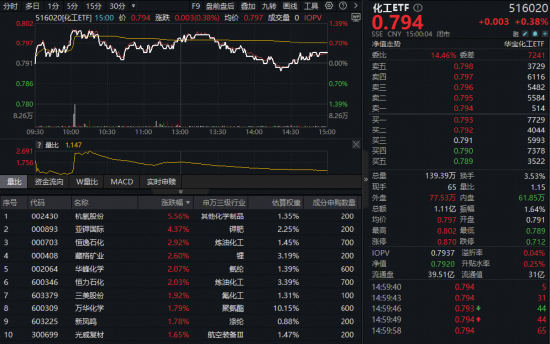
化工股逆市崛起!化工ETF(516020)盘中上探1.39%!板块近5日吸金189亿元,机构高呼行业景气或边际回暖
Xin Lang Ji Jin· 2025-12-03 12:01
Group 1 - The chemical sector experienced a counter-market rise on December 3, with the chemical ETF (516020) showing a maximum intraday increase of 1.39% and closing up 0.38% [1] - Key stocks in the sector included Hangyang Co., which surged by 5.56%, and Yara International, which rose by 4.37%, along with several others gaining over 2% [1] - The basic chemical sector attracted significant capital inflow, with a net inflow of 1.877 billion yuan on the day, ranking third among 30 major industries [3] Group 2 - The chemical ETF (516020) has shown a year-to-date increase of 28.13%, outperforming major indices such as the Shanghai Composite Index (15.7%) and the CSI 300 Index (15.15%) [4] - The basic chemical sector has seen a cumulative net inflow of 18.977 billion yuan over the past five days, ranking second among the 30 major industries [3][5] Group 3 - The chemical industry is expected to benefit from ongoing "anti-involution" policies, which may strengthen supply-side constraints and gradually reverse the overcapacity situation [6] - The overall profitability of the chemical sector is anticipated to recover from its bottom due to a slowdown in fixed asset investment and demand recovery [6] - The current price-to-book ratio of the chemical ETF (516020) is 2.33, indicating a relatively low valuation compared to the past decade, suggesting good long-term investment potential [6] Group 4 - Looking ahead, the chemical industry is projected to experience a cyclical upturn starting in 2026, driven by a combination of supply-side contraction and increased demand [7] - The demand recovery in downstream sectors such as automotive, home appliances, and textiles is expected to continue, supported by macroeconomic improvements and consumption stimulus policies [7] - The chemical ETF (516020) provides a diversified investment opportunity across various sub-sectors, with nearly 50% of its holdings in large-cap leading stocks [7]




供销社概念涨0.69%,主力资金净流入这些股
Zheng Quan Shi Bao Wang· 2025-12-03 09:10
Group 1 - The supply and marketing cooperative concept index rose by 0.69%, ranking fourth among concept sectors, with eight stocks increasing in value [1] - Leading gainers in the supply and marketing cooperative sector included New Power Financial, Yaqi International, and Zhongnong United, which rose by 5.59%, 4.37%, and 2.93% respectively [1] - The stocks with the largest declines in this sector were Gongxiao Daji, Huangshan Gujie, and Hunan Development, which fell by 2.72%, 1.40%, and 1.04% respectively [1] Group 2 - The supply and marketing cooperative sector experienced a net outflow of 160 million yuan in main funds today, with five stocks seeing net inflows [2] - New Power Financial led the net inflow of main funds with 64.04 million yuan, followed by Zhongnong United and Yaqi International with net inflows of 10.83 million yuan and 6.52 million yuan respectively [2] - The net inflow ratios for New Power Financial, Zhongnong United, and Zhongnong Lihua were 15.54%, 3.93%, and 3.14% respectively [3] Group 3 - The trading volume and turnover rates for the leading stocks in the supply and marketing cooperative sector were notable, with New Power Financial having a turnover rate of 8.92% and Zhongnong United at 11.99% [3] - Stocks such as Gongxiao Daji and Hunan Development had significant negative main fund flows, with Gongxiao Daji experiencing a net outflow of 183.31 million yuan, representing a 25.14% decline [4] - The overall performance of the supply and marketing cooperative sector reflects a mixed sentiment among investors, with some stocks showing resilience while others faced significant selling pressure [2][4]



技术突破引领绿色转型,估值低位或是布局良机?石化ETF(159731)逆市上涨,份额创新高
Sou Hu Cai Jing· 2025-12-03 03:37
Core Viewpoint - The petrochemical ETF (159731) has seen a 0.48% increase, with significant inflows and a record high in shares, indicating strong investor interest in the sector [1] Group 1: ETF Performance - The petrochemical ETF has gained 0.48% as of December 3, with leading stocks such as Hangzhou Oxygen Plant, Yara International, Wanhua Chemical, and Zangge Mining showing notable increases [1] - Over the past eight days, the petrochemical ETF has experienced continuous net inflows totaling 22.15 million yuan [1] - The latest share count for the petrochemical ETF reached 238 million, marking a one-year high [1] Group 2: Industry Developments - On December 1, China Petroleum announced the successful operation of the country's first 100 kW oil and gas associated wastewater electrolysis hydrogen production system at the Longqing Sulige gas field, representing a significant breakthrough in resource utilization in the oil and gas wastewater sector [1] - The successful implementation of the hydrogen production system exemplifies the integration of the petrochemical industry with new energy technologies [1] Group 3: Market Insights - Zhongyin Securities highlights that the chemical sector is currently valued at historical lows, suggesting a focus on undervalued leading companies in December [1] - The report emphasizes the impact of "anti-involution" on the supply side of related sub-industries and the increasing importance of self-sufficiency in electronic materials companies, alongside price increases in certain new energy materials [1] - The petrochemical ETF closely tracks the CSI Petrochemical Industry Index, with the basic chemical industry accounting for 60.39% and the oil and petrochemical industry for 32.71%, indicating that the "anti-involution" policy is a core theme for the petrochemical industry, with expectations for continued improvement in supply-demand dynamics and profitability [1]

“反内卷”政策托底+商品价格走强,板块热度升温,石化ETF(159731)连续8日获资金净买入
Mei Ri Jing Ji Xin Wen· 2025-12-03 02:59
Group 1 - The core viewpoint of the news highlights the positive performance of the petrochemical ETF (159731), which has seen a 0.24% increase and significant net inflow of funds totaling 22.15 million yuan over the past eight days, reaching a new high of 238 million shares [1][2] - The petrochemical sector is experiencing active performance in the commodity market, with significant price increases in synthetic rubber and other chemical products due to geopolitical tensions and fundamental rumors, while crude oil prices are strengthening due to production pauses and geopolitical issues [1] - Huatai Securities notes that the market's risk appetite has continued to decline, but high-dividend sectors, particularly oil and petrochemicals, have performed relatively well, suggesting a potential recovery in risk appetite in December [1] Group 2 - The petrochemical ETF (159731) and its linked funds (017855/017856) closely track the CSI Petrochemical Industry Index, with the basic chemical industry accounting for 60.39% and the oil and petrochemical industry for 32.71% of the index [2] - The release of the "Stabilizing Growth Work Plan" is expected to support the industry's scale over the next two years, highlighting the long-term value of the industry under the "anti-involution" policy [2]
化工行业盈利边际回暖趋势已逐步显现,化工ETF嘉实(159129)备受市场关注
Xin Lang Cai Jing· 2025-12-03 02:53
Core Viewpoint - The chemical industry is currently experiencing a dual bottom in valuation and profitability, with signs of recovery in profit margins and a potential upward trend in the economic cycle driven by demand recovery and resource supply contraction [1][2]. Group 1: Industry Performance - As of December 3, 2025, the chemical sector index rose by 0.87%, with notable gains from stocks such as Hangzhou Oxygen Plant (up 4.48%) and Yara International (up 4.42%) [1]. - The basic chemical sector's net profit increased by 7.45% year-on-year for the first three quarters of 2025, indicating a recovery trend despite mixed performance across sub-sectors [1]. - The overall chemical industry remains at a low level of prosperity, but a gradual improvement in profit margins is becoming evident [1]. Group 2: Market Dynamics - The industry is expected to benefit from reduced supply-side pressures and a global monetary easing environment, particularly with the anticipated interest rate cuts by the Federal Reserve, which could stimulate downstream demand [1]. - The focus on "anti-involution" policies is crucial as multiple sub-industries face competitive pressures, and the industry is likely to accelerate the release of high-performance new materials driven by AI demand [1][2]. Group 3: Investment Opportunities - Investors can track the chemical sector through the Jia Shi Chemical ETF (159129), which closely follows the China Securities Index for the chemical industry [2]. - There are also opportunities for off-market investors to engage with the chemical sector via the Chemical ETF Connect Fund (013527) [3].


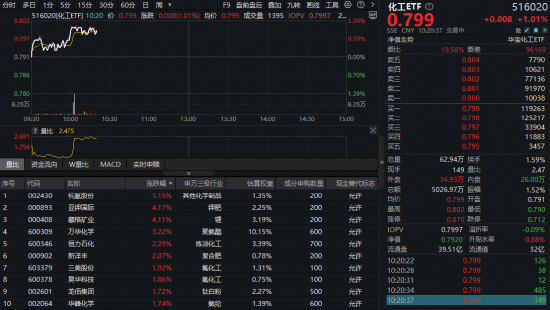
ETF盘中资讯 | 锂电储能迎利好催化,化工ETF(516020)盘中涨超1%!机构:化工板块2026年或迎“戴维斯双击”
Sou Hu Cai Jing· 2025-12-03 02:45
Group 1 - The chemical sector has regained momentum, with the chemical ETF (516020) experiencing a maximum intraday increase of 1.39% and closing up 1.01% [1] - Key stocks in the sector include Hangzhou Oxygen Plant, which surged over 5%, and other companies like Yara International and Zangge Mining, which rose over 4% [1] - The overall market sentiment is positive, driven by strong performances in potassium fertilizers, lithium batteries, and polyurethane segments [1] Group 2 - Investment enthusiasm in energy storage is high, supported by continuous capacity compensation policies and the ongoing development of renewable energy, which will sustain demand for energy storage [3] - The chemical ETF (516020) is currently at a relatively low price-to-book ratio of 2.33, indicating good long-term investment potential [3] - The chemical industry is expected to face negative growth in capital expenditure starting in 2024, with supply-side contractions anticipated due to the "anti-involution" trend and the clearing of outdated overseas capacities [3] Group 3 - The chemical ETF (516020) tracks the CSI segmented chemical industry index, covering various sub-sectors and concentrating nearly 50% of its holdings in large-cap leading stocks [4] - Investors can also access the chemical ETF through linked funds, enhancing investment efficiency in the chemical sector [4]

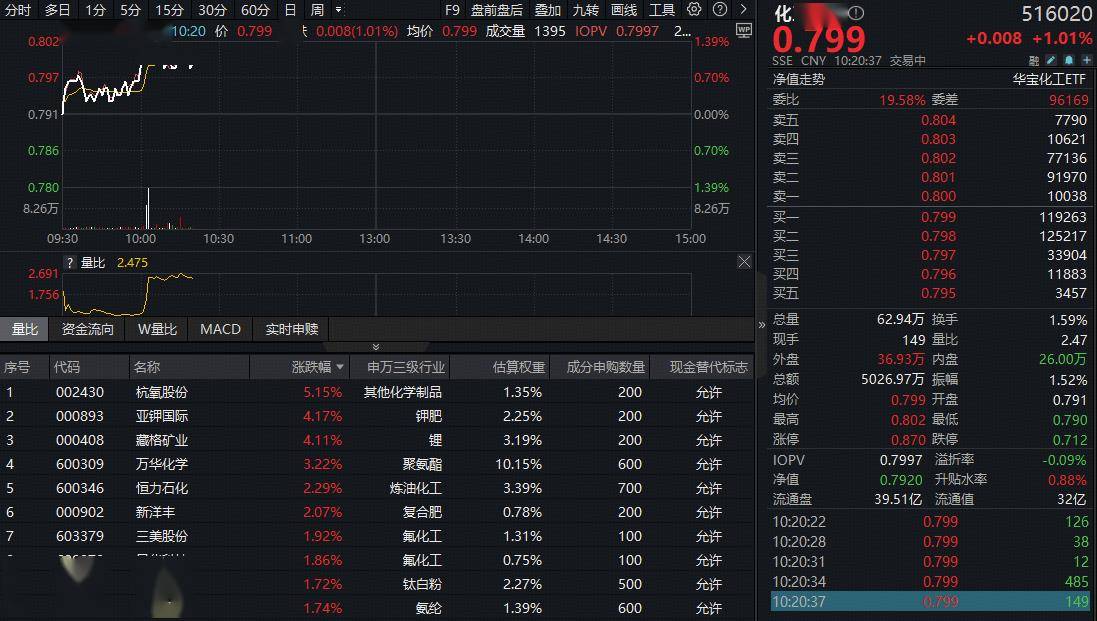
锂电储能迎利好催化,化工ETF(516020)盘中涨超1%!机构:化工板块2026年或迎“戴维斯双击”
Xin Lang Cai Jing· 2025-12-03 02:39
Group 1 - The chemical sector has regained momentum, with the Chemical ETF (516020) experiencing a maximum intraday increase of 1.39% and closing up 1.01% [1][6] - Key stocks in the sector include Hangzhou Oxygen Plant, which surged over 5%, and other significant gains from Yara International and Zangge Mining, both exceeding 4% [1][6] - The domestic first large-capacity all-solid-state battery production line has been completed and is in small-batch testing, potentially doubling battery energy density by 2026 [1][6] Group 2 - CITIC Securities highlights strong investment enthusiasm in energy storage, with policies supporting capacity compensation and a high growth rate in demand for renewable energy [3][8] - The chemical sector is currently viewed as having a favorable cost-performance ratio, with the Chemical ETF's price-to-book ratio at 2.33, placing it in the lower 39.73% of the last decade [3][9] - China Galaxy Securities anticipates a negative growth in capital expenditure for the chemical industry starting in 2024, with supply-side contraction expected due to the "anti-involution" trend and the clearing of outdated overseas capacity [4][10] Group 3 - The Chemical ETF (516020) tracks the CSI segmented chemical industry theme index, covering various sub-sectors, with nearly 50% of its holdings in large-cap leading stocks like Wanhua Chemical and Salt Lake Potash [4][10] - The ETF provides a more efficient way to capitalize on the rebound opportunities in the chemical sector, with a balanced exposure to different chemical sub-sectors [4][10]
化工ETF(159870)涨超1.7%,展望2026年6F仍是最紧缺环节
Xin Lang Cai Jing· 2025-12-01 02:48
Core Insights - The price agreement for 6F has exceeded expectations, with November delivery prices corresponding to an average of 85,000 (including tax) and December delivery prices expected to be around 130,000 to 140,000, significantly higher than the initial market expectation of 80,000 to 90,000 [1] - The net profit per ton for December 6F is estimated to be around 60,000 to 70,000 based on a cost of 60,000, corresponding to a 10x price-to-earnings ratio [1] - The industry is projected to remain tight through 2026, with current capacity just over 300,000 tons and only a 60,000-ton increase expected next year, primarily in the second half [1] Industry Developments - The solid-state battery sector is expected to see significant developments by the end of the year, including: 1. The Ministry of Industry and Information Technology is expected to release mid-term review results in December, with leading manufacturers likely to exceed expectations [1] 2. Bidding for pilot lines from major clients is starting to open [1] 3. Major manufacturers are expected to conduct road tests by the end of the year [1] Market Performance - As of December 1, 2025, the CSI Sub-Industry Chemical Theme Index (000813) rose by 1.82%, with notable increases in component stocks such as: - Andong Biological (603077) up 10.05% - Duofluor (002407) up 6.98% - Tianci Materials (002709) up 6.93% [1] - The Chemical ETF (159870) also increased by 1.74%, marking a third consecutive rise [1] Index Composition - The CSI Sub-Industry Chemical Theme Index (000813) closely tracks the performance of major companies in the chemical sector, with the top ten weighted stocks accounting for 45.41% of the index. These include: - Wanhua Chemical (600309) - Salt Lake Co. (000792) - Tianci Materials (002709) - Cangge Mining (000408) - Juhua Co. (600160) - Hualu Hengsheng (600426) - Duofluor (002407) - Hengli Petrochemical (600346) - Baofeng Energy (600989) - Yuntianhua (600096) [2]
资源/传统制造业定价权的重估、企业出海仍是核心增配方向,聚焦石化ETF(159731)布局价值
Sou Hu Cai Jing· 2025-12-01 01:55
Group 1 - The A-share market opened higher on December 1, with the Shanghai Composite Index rising by 0.14%, the Shenzhen Component Index by 0.42%, and the ChiNext Index by 0.26% [1] - The China Securities Petrochemical Industry Index experienced a fluctuating upward trend, increasing by approximately 1.4%, with stocks such as Andon Health hitting the daily limit, and others like Zangge Mining, Yara International, and Sankeshu also rising [1] - The Petrochemical ETF (159731) has seen continuous net inflows over the past six days, totaling 18.82 million yuan, indicating a clear investment trend [1] Group 2 - CITIC Securities analysis indicates that the market in December faces variables such as the Federal Reserve's interest rate decisions and the Central Economic Work Conference's directives, suggesting a potential "sharp drop and slow rise" pattern for A-shares and Hong Kong stocks [1] - From an allocation perspective, the revaluation of pricing power in resource and traditional manufacturing sectors, as well as the trend of companies going overseas, remain core investment directions, with recommendations to focus on chemical and new energy sectors [1] - The Petrochemical ETF (159731) and its linked funds (017855/017856) closely track the China Securities Petrochemical Industry Index, with the basic chemical industry accounting for 60.4% and the oil and petrochemical industry for 32.7%, likely benefiting from policies aimed at reducing competition, restructuring, and eliminating outdated production capacity [1]