华夏基金

Search documents
本周ETF市场净流入143.57亿元 结束此前净流出趋势
Sou Hu Cai Jing· 2026-02-08 07:57
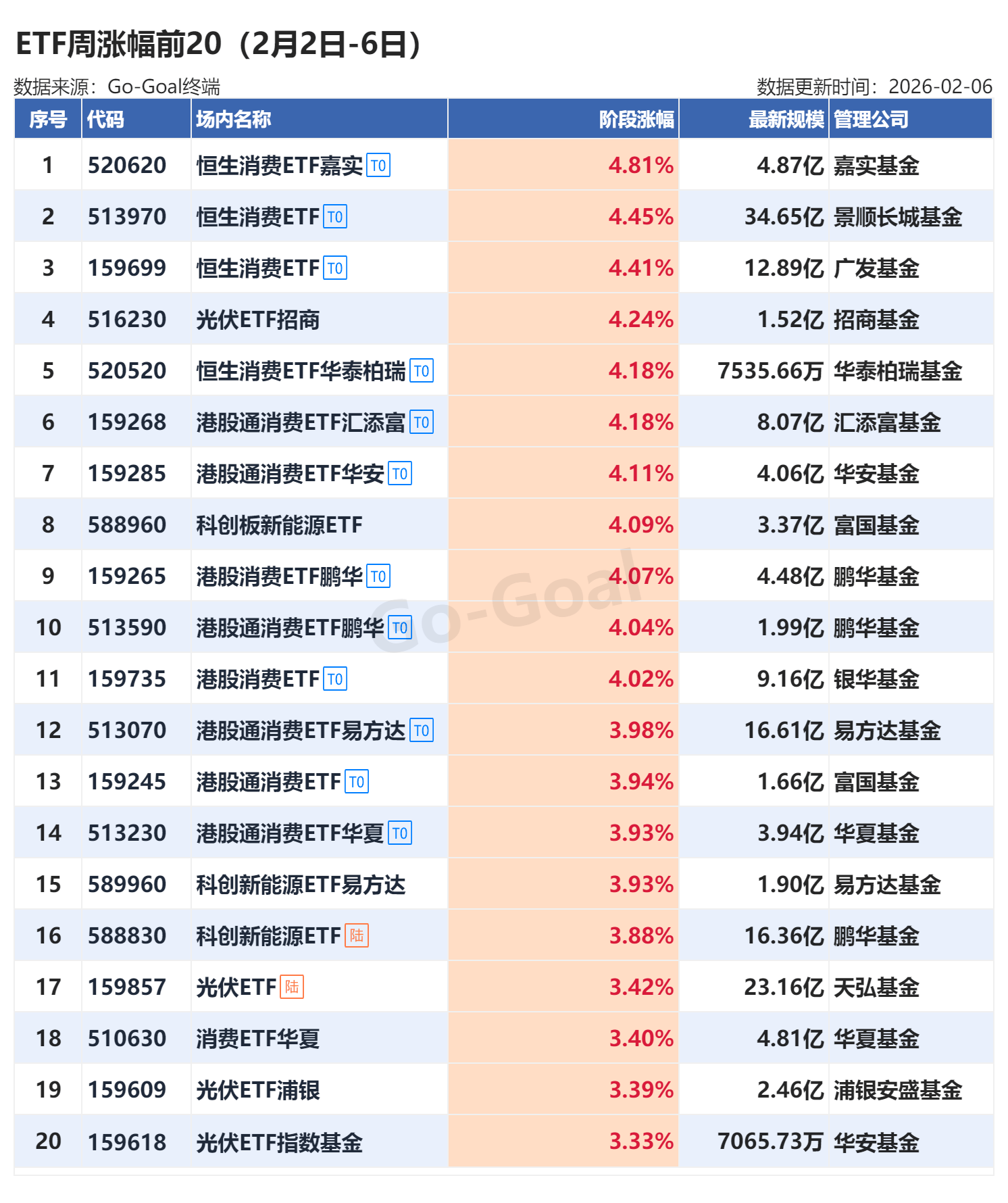
| 18 510630 消费ETF华夏 | | | 3.40% | | | --- | --- | --- | --- | --- | | 19 | 159609 | 光伏ETF浦银 | 3.39% | | | 20 159618 | | 光伏ETF指数基金 | 3.33% | 70 | 与此同时,受美联储鹰派预期升温影响,国际金银价格此前遭遇历史性暴跌,直接拖累本周A股有色金属板块表现。本周黄金、人工智能等相关ETF跌幅居 前。 大类资金方面,本周ETF净流入143.57亿元,结束此前净流出的趋势。其中跨境型ETF表现活跃,单周流入216.45亿元。 根据Go-Goal ETF数据,下周无ETF发行,春节后最早一批ETF发行为2月24日。上市方面,下周将有六只ETF上市。 本周上证指数收跌1.27%,深证成指跌2.11%,创业板指跌3.28%。Go-Goal ETF数据显示,本周涨幅居前的ETF包括恒生消费ETF、光伏ETF、科创板新能源 ETF等主题。 上证报中国证券网讯(记者 汪友若)本周上证指数收跌1.27%,深证成指跌2.11%,创业板指跌3.28%。Go-Goal ETF数据显示,本周涨幅居前的E ...

“千亿ETF”仅剩3只!股票型ETF开年“失血”超7000亿元
Mei Ri Jing Ji Xin Wen· 2026-02-08 03:30
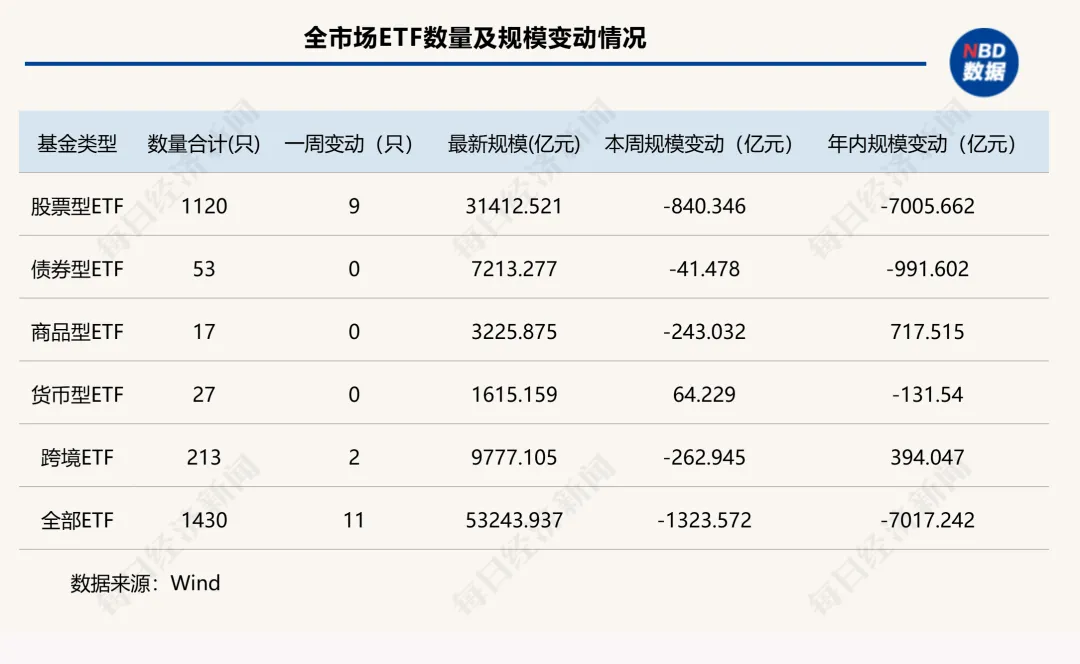
Market Overview - A-shares experienced fluctuations with major indices declining, including a 1.13% drop in the CSI 300 and a 3.28% drop in the ChiNext Index [1][16] - The ETF market is undergoing significant changes, with stock ETFs shrinking by over 700 billion yuan this year, reducing the number of "billion club" products to just three [1][16] ETF Market Dynamics - As of February 7, the total ETF market size decreased to 5.32 trillion yuan, with a weekly decline of 1,323 billion yuan [2][17] - Stock ETFs alone saw a reduction of 840.35 billion yuan, bringing their total size down to 31,412.52 billion yuan [3][18] - The number of ETFs listed reached 1,430, with 11 new ETFs introduced in the week, including 9 stock ETFs [2][17] Fund Management Changes - Fund size reshuffling is evident, with Guotai Fund maintaining its position in the top five, while Huabao Fund entered the top ten [1][22] - Major funds like Huaxia and E Fund have seen their ETF sizes shrink by over 100 billion yuan this year [1][22] Performance of Specific ETFs - The SGE Gold 9999 index saw a significant reduction of over 22 billion yuan, marking it as the largest decline among major indices [4][19] - The CSI 300 ETF managed by Huatai-PB has shrunk by over 2,000 billion yuan this year, now standing at 2,208.55 billion yuan [29][30] Institutional Fund Performance - Five institutions reported ETF size reductions exceeding 100 billion yuan, with Southern Fund experiencing the largest drop of 268.53 billion yuan [22][26] - Conversely, Huabao Fund and Hai Futong Fund both saw increases of over 30 billion yuan in their ETF sizes [23][26] Growth and Decline of ETFs - Only two products in the top 20 managed to achieve size growth, indicating a general trend of decline in the ETF market [26][27] - The "billion club" for ETFs has diminished, with only three members remaining due to widespread shrinkage [26][30]
金价这东西翻脸比翻书还快,连着跌了一周!听着风声还会继续跌?
Sou Hu Cai Jing· 2026-02-07 17:41
Core Viewpoint - The recent volatility in the gold market has led to significant losses for investors, highlighting the risks associated with high-leverage trading and emotional decision-making [1][3][5]. Group 1: Market Volatility - The gold market experienced extreme fluctuations, with prices soaring to $5,500 per ounce before plummeting, resulting in account losses exceeding 30% for some investors [1]. - Historical patterns show that gold prices have previously experienced sharp declines following peaks, such as a 65% drop after reaching $850 in 1980 and a 45% drop after hitting $1,920 in 2011 [3]. - The recent drop was triggered by multiple factors, including a 30% increase in gold prices at the start of 2026, profit-taking by investors, and increased margin requirements by the Chicago Mercantile Exchange [3]. Group 2: Investor Behavior - Investor psychology has amplified risks, with many chasing prices at highs and suffering losses due to failure to take profits [5]. - Panic selling was observed among retail investors, leading to significant declines in gold stocks, with some stocks hitting their daily limit down [5]. - The influx of capital into gold ETFs before the drop indicates a trend of following others without proper analysis, contributing to market instability [5]. Group 3: Risk Management Strategies - Experts recommend rational investment strategies, advising against one-sided speculation and suggesting a 3-6 month observation period before making decisions [7]. - For average investors, physical gold bars and gold ETFs are recommended, with a suggestion to limit gold allocation to 5-10% of household assets [7]. - Historical experiences emphasize the importance of avoiding emotional decision-making in precious metal investments, advocating for diversified asset allocation [8].

《上交所ETF行业发展报告(2026)》:大力发展ETF市场,引导增量资金入市
Xin Lang Cai Jing· 2026-02-07 14:01
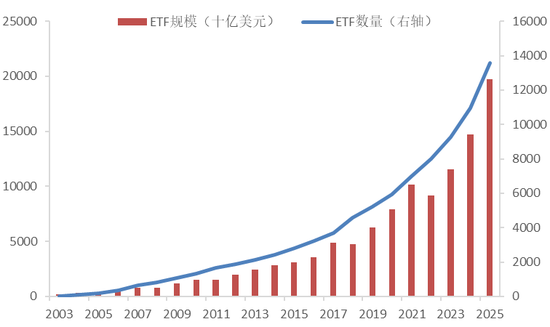
Core Insights - The report highlights the rapid growth and structural optimization of the ETF market in China, which has surpassed Japan to become the largest ETF market in Asia, with total assets exceeding 6 trillion yuan by the end of 2025 [1][12]. Global ETF Development Overview - By the end of 2025, the global ETF market reached a total asset size of over 19.7 trillion USD, marking a 31% increase from the previous year [3][42]. - The U.S. ETF market accounts for approximately 68% of the global total, with a market size of about 13.5 trillion USD [11][48]. - Stock ETFs dominate the asset categories, comprising about 78% of the total, while bond ETFs account for over 16% [8][42]. Domestic ETF Market Development - The domestic ETF market in China saw a significant increase, with the total scale reaching 6.02 trillion yuan, a 61.4% growth from 2024 [20][57]. - The number of listed ETFs in China rose to 1,381, reflecting a 35.7% increase year-on-year [20][57]. - In 2025, the net inflow of funds into domestic ETFs exceeded 1.16 trillion yuan, with bond ETFs attracting the highest net inflow of 552.7 billion yuan [20][57]. Shanghai Stock Exchange ETF Development - The Shanghai Stock Exchange's ETF market size grew from 2.72 trillion yuan to 4.22 trillion yuan, a 55% increase [24][61]. - The number of listed ETFs on the Shanghai Stock Exchange increased from 602 to 797, more than doubling the new listings compared to 2024 [61][62]. - Institutional investors held 65% of the ETF market by the end of 2025, indicating a shift towards more stable, long-term investment strategies [62][63]. Product Supply and Investor Demand - In 2025, 355 new ETF products were launched in the domestic market, with a total issuance scale of 273 billion yuan [21][58]. - The demand for ETFs from internet and banking channels is strong, with the scale of ETF-linked funds exceeding 900 billion yuan, growing over 40% from the previous year [59]. - The report emphasizes the importance of broadening the investor base and enhancing liquidity in the ETF market [62][63]. Future Outlook for the ETF Market - The report outlines plans for 2026 to further enrich the ETF product supply and optimize market mechanisms, aiming to enhance the role of ETFs in wealth management and long-term capital allocation [37][39]. - The focus will be on developing a multi-layered ETF market system that aligns with national strategies and promotes sustainable economic growth [37][39].
视频|华夏基金2026年度MV:《寄往未来的信》
Xin Lang Cai Jing· 2026-02-07 02:58
Group 1 - The core message of the article emphasizes the theme of pursuing dreams and striving towards a bright future in the context of the brokerage and fund industry for 2026 [1] - The article highlights the release of the annual MV "Letter to the Future" by Huaxia Fund, which symbolizes the collective effort towards achieving a shining future [1] - The mention of the MACD golden cross signal indicates positive momentum in certain stocks, suggesting potential investment opportunities [1]
金价过山车!一天暴跌12%,大家做好准备,明后两天或迎大行情
Sou Hu Cai Jing· 2026-02-06 17:08
Group 1 - The core event was a significant drop in gold prices on January 30, 2026, with London gold prices falling from a historical high of $5598 per ounce to a low of $4682, marking the largest single-day drop since 1983, with a peak decline of 12% [1][3] - The immediate trigger for the drop was the nomination of Kevin Warsh, known for his hawkish stance, to replace Jerome Powell as the Federal Reserve Chair, leading to a 1.01% increase in the US dollar index and subsequent selling pressure on gold [3] - Prior to the drop, gold prices had surged approximately 30% since the beginning of 2026, with speculative long positions reaching historical highs, indicating that the market was overbought and vulnerable to profit-taking [3] Group 2 - Following the extreme market conditions, major Chinese banks quickly adjusted gold contract margin requirements and trading limits to curb speculative trading, which inadvertently increased short-term market liquidity tension [5] - Despite the volatility, institutional interest in gold remained strong, with significant inflows into gold ETFs prior to the drop, indicating sustained long-term demand [5] - On February 3, gold prices rebounded with a single-day increase of over 6%, returning to the $5000 mark, although market sentiment had not fully recovered by February 5, as domestic gold prices fell again [5] Group 3 - The fluctuations in gold prices reflect a clash between short-term speculative sentiment and long-term investment logic, with central banks globally increasing their gold purchases, indicating ongoing macroeconomic support for gold [7] - In 2025, global central banks purchased a total of 863 tons of gold, with January 2026 alone seeing a surge to 1200 tons, highlighting a strong demand for gold amid geopolitical risks and a trend towards de-dollarization [7]
公募积极布局主题基金 掘金港股多元赛道长期机遇
Zheng Quan Ri Bao· 2026-02-06 16:16
本报记者 方凌晨 在业内人士看来,公募机构在当前积极布局港股主题基金,核心是基于对港股未来发展空间和投资机会的长期看好。罗佳 明认为:"今年港股和A股均有望吸引外资配置。考虑到中国经济的抗压能力已得到市场认可,加上新兴市场基金对中国仍处于 明显低配状态,恒生指数仍是全球估值洼地,沪深300指数亦处于中低分位。虽然今年偏多的港股IPO数量预计会对市场形成一 定冲击,但主要体现在资金分流和风险偏好下降方面,且2025年第四季度的市场表现已部分反映出这一影响,因此今年香港恒 生指数仍有一定空间。" 罗佳明表示:"港股市场虽然波动性高,但对于价值投资者而言,波动恰恰是争取超额收益的来源。在高波动、高供给的 市场环境下,坚持自下而上精选企业,仍有望通过结构性机会和个股选择争取回报。" 邢程表示,展望未来,短期去杠杆和流动性冲击大概率不会改变港股中期大趋势。同时,全球多极化格局和分散投资需求 构成了贵金属和以中国为代表的新兴市场具备较强投资价值的格局。此外,港股主要龙头权重公司2026年盈利预期仍在持续修 复,对港股市场形成有力支撑和正向催化。 整体来看,公募机构对港股主题基金的布局方向涉及科技、互联网、医药医疗、消费等 ...
蚂蚁基金王珺:财富管理迈入指数投资时代,平台指数基金投资者已超1亿
Sou Hu Cai Jing· 2026-02-06 14:00
Core Insights - The acceleration of index investment has become a widely accepted consensus, with discussions on how the capital market can enhance its service to the real economy through various dimensions such as policy empowerment and technological drivers [2] Index Investment - As of the end of 2025, the total scale of index fund products is expected to exceed 8 trillion yuan, representing a nearly 40% increase from the beginning of the year, with broad-based funds accounting for 49% of the overall index fund scale [3] Drivers of Index Fund Growth - The growth of index funds is attributed to three irreversible drivers: 1. The achievements of high-quality development in the capital market, providing more investment opportunities through the development of strategic emerging industries 2. The resonance of policy dividends, with the implementation of the new "National Nine Articles" and "long money long investment" policies boosting confidence in the market 3. The reshaping of tool value, where index products gradually replace traditional investment fields due to their low cost, high efficiency, and clear style [6] Investor Behavior and Trends - On the Ant Fund platform, the number of investors trading index products has surpassed those in active equity products, with over 100 million index fund investors expected by the end of 2025, of which over 50% are from the post-90s and post-00s generations [6] - The platform promotes rational scientific allocation and long-term investment, with over 30 million investors having initiated regular investments in index funds. Individual investors hold broad-based funds for an average of over 1,000 days, with 97% of those holding broad-based funds being profitable by 2025, significantly higher than the industry average [7] ETF Development and Financial Inclusion - ETFs are seen as a key tool for fulfilling the capital market's mission, serving as a core vehicle for wealth management and financial inclusion, while also supporting national strategies. The current challenges include insufficient tools and disconnected channels, necessitating optimization in product design, institutional supply, and ecological construction [8] Market Trends and Investment Opportunities - The focus of the market has shifted towards "new resources" that support the intelligent world and green revolution, with historical investment opportunities arising from the collision of rigid supply due to years of insufficient capital expenditure in the global resource sector and sudden demand changes [11] - The artificial intelligence sector is expected to experience significant advancements, with trends indicating a high growth in computing power demand and the arrival of the AI large model application era. Given the complexity and rapid iteration of the AI industry, diversified investment strategies through ETFs are recommended to mitigate risks [11]
资金加仓!这一方向显著吸金
Zhong Guo Zheng Quan Bao· 2026-02-06 13:16
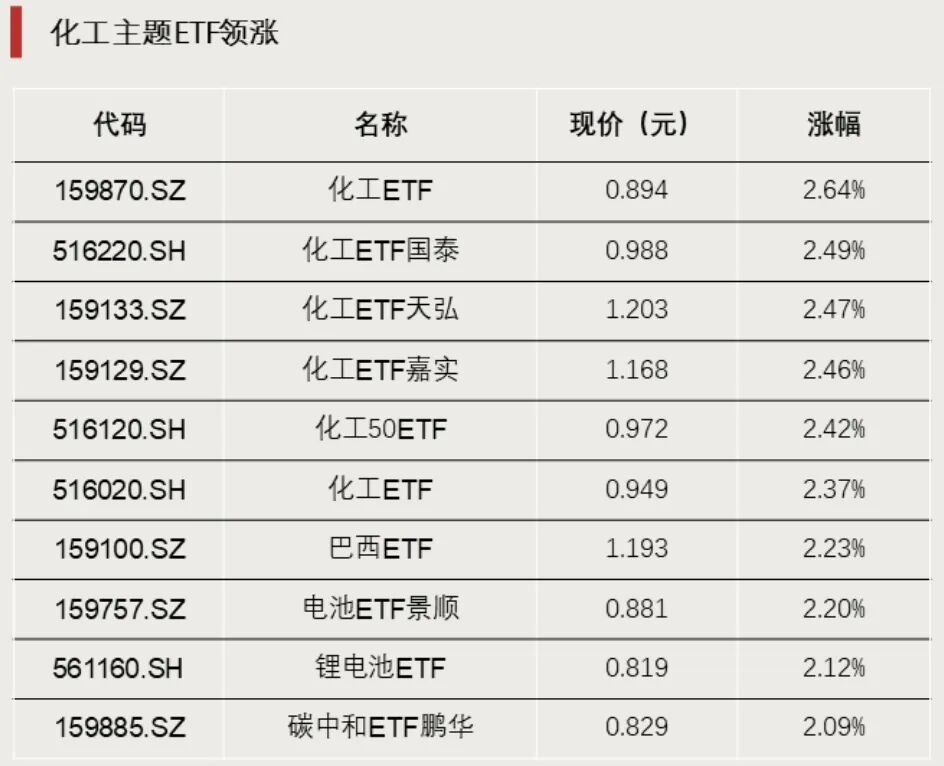
Group 1: Chemical Sector Performance - On February 6, the A-share chemical sector experienced a strong rally, with multiple sub-sectors such as chemical fibers, chemical products, chemical raw materials, and petrochemicals showing significant gains, leading to several chemical-themed ETFs rising over 2% [2][4] - The chemical ETF performance included notable increases: Chemical ETF (159870.SZ) rose by 2.64%, Chemical ETF Guotai (516220.SH) by 2.49%, and Chemical ETF Tianhong (159133.SZ) by 2.47% [3] - Analysts from Zhongyuan Securities noted a significant recovery in chemical prices in January, with liquid chlorine, acetonitrile, and butadiene performing well, suggesting that supply constraints in the chemical industry may strengthen in the future [3] Group 2: New Energy and Battery Sector - The new energy and battery sectors saw strong performance, with several related ETFs actively rising, including the Science and Innovation New Energy ETF and Battery ETF Jiashi, both nearing a 2% increase [4][5] - The Science and Innovation New Energy ETF (588830.SH) increased by 1.99%, while the Battery ETF Jiashi (562880.SH) rose by 1.96% [5] Group 3: ETF Market Trends - The ETF market has seen significant inflows, particularly in technology-themed ETFs, with the top ten products by net inflow mostly being technology-related [8] - The Huatai-PB Hang Seng Technology ETF recorded a net inflow of over 3.1 billion yuan, while other technology ETFs also saw substantial inflows exceeding 2 billion yuan [9] Group 4: A500 Index and Investment Value - The A500 index, represented by the A500 ETF (563800), has shown significant investment value due to its balanced industry distribution and focus on leading companies, making it attractive for long-term investment [10] - Analysts from GF Fund highlighted the index's advantages, including its ability to effectively capture growth opportunities while mitigating risks associated with single industries [10]
银行理财到期后怎么投?一个自建多元资产配置实例
雪球· 2026-02-06 13:01
Core Viewpoint - The article discusses a customized investment strategy aimed at achieving an annualized return of 8%-12% through a diversified asset allocation model tailored to the specific financial profile and risk tolerance of an individual investor [4][9]. Group 1: Investment Strategy Overview - The investment strategy is based on a "60/30/10" model, allocating 60% to equities, 30% to bonds, and 10% to commodities [10][11]. - Historical data indicates that when the holding period exceeds three years, the probability of achieving positive returns from equity assets exceeds 85% [13]. Group 2: Asset Allocation Breakdown - The equity portion (60%) is divided into three pillars: global technology growth (30%), A-share "barbell strategy" (30%), and a defensive component (10%) in gold [14][15]. - The global technology growth pillar includes QDII funds focused on U.S. and Hong Kong tech stocks, specifically selecting two funds: Franklin Global Technology Internet Fund and GF Global Select Equity Fund [16][17]. - The A-share component employs a "dividend + quantitative" strategy, utilizing various funds to balance stability and market volatility [19][20]. Group 3: Fixed Income and Commodities - The fixed income portion (30%) serves as a "safety cushion," providing liquidity and positive returns regardless of market fluctuations [25]. - The gold allocation (10%) is justified as a hedge against currency devaluation and extreme risks, supported by ongoing central bank purchases and geopolitical tensions [29]. Group 4: Performance Management - The strategy emphasizes the importance of managing expectations, acknowledging potential drawdowns of 15%-20% in extreme market conditions [36]. - The investment approach includes regular portfolio reviews to ensure performance aligns with benchmarks and to make necessary adjustments [36]. Group 5: Conclusion - The article concludes that the key to successful investing lies not in predicting market movements but in establishing a resilient investment framework that diversifies across asset classes and geographies [38].