京东健康

Search documents
ETF盘中资讯|AI应用元年启幕,港股互联网显著跑赢恒生科技!高人气513770暴力揽金逾11亿元
Sou Hu Cai Jing· 2026-01-16 02:06
Group 1 - The core viewpoint of the article highlights the strong performance of Hong Kong stocks, particularly in the AI sector, with significant inflows into the Hong Kong Internet ETF (513770) and a notable increase in stock prices for major companies like Alibaba and Tencent [1][4][5] - As of January 15, the Hong Kong Internet ETF has seen a year-to-date increase of 10.15%, outperforming the Hang Seng Tech Index, which rose by 5.66% [1][3] - The fund manager of the Hong Kong Internet ETF noted that the market is currently undervalued, with a price-to-earnings ratio (PE) of 26.29, significantly lower than other major markets, indicating a potential for valuation increases [4][5] Group 2 - Alibaba has announced the integration of its Qianwen App with various platforms within its ecosystem, positioning itself as a leader in AI-driven shopping functionalities [3][5] - The top ten holdings in the Hong Kong Internet ETF include major tech companies such as Alibaba, Tencent, and Xiaomi, which collectively account for nearly 77% of the fund's weight, showcasing the dominance of these firms in the AI application space [5][6] - The total fund size of the Hong Kong Internet ETF reached a historical high of 14.899 billion yuan, reflecting strong investor interest and liquidity in the market [6]

AI应用元年启幕,港股互联网显著跑赢恒生科技!高人气513770暴力揽金逾11亿元
Xin Lang Cai Jing· 2026-01-16 02:04
Core Viewpoint - The Hong Kong stock market is experiencing a strong interest in AI-related assets, particularly the Hong Kong Internet ETF, which has seen significant capital inflows and outperformed other indices in early 2026 [1][11]. Group 1: Market Performance - The Hong Kong Internet ETF (513770) has gained 10.15% year-to-date, outperforming the Hang Seng Tech Index, which increased by 5.66% [3][11]. - The ETF has recorded a net inflow of 1.137 billion yuan over the past 10 days, indicating strong buying interest [1][11]. - As of January 14, the fund size of the Hong Kong Internet ETF reached a historical high of 14.899 billion yuan, with an average daily trading volume exceeding 600 million yuan since 2025 [6][12]. Group 2: Key Companies and Weightings - Alibaba-W is the largest holding in the Hong Kong Internet ETF, with a weight of 14.71%, followed closely by Tencent Holdings at 14.64% and Xiaomi Group at 12.29% [5][13]. - The top ten holdings in the ETF account for nearly 77% of the total weight, showcasing the dominance of major tech companies in the fund [5][12]. Group 3: Future Outlook - Analysts predict that 2026 will be a pivotal year for AI commercialization, with significant investments expected in AI applications from leading internet companies [3][11]. - The valuation of Hong Kong AI assets remains low compared to global markets, with the latest PE ratio of the Hong Kong Internet Index at 26.29, significantly lower than that of the A-share and NASDAQ indices [4][12]. - The Hong Kong capital market is expected to remain active, with potential for increased trading volume if capital flows from the A-share market [4][11].
智通港股沽空统计|1月16日
智通财经网· 2026-01-16 00:28
Group 1 - The top short-selling ratios are led by China Resources Beer (100.00%), Lenovo Group (95.24%), and JD Health (94.15%) [1] - The highest short-selling amounts are recorded for Alibaba (3.923 billion), Tencent Holdings (2.552 billion), and Trip.com Group (1.172 billion) [1][2] - Meituan, Kanglong Chemical, and Haitong Securities have the highest deviation values at 55.33%, 50.16%, and 48.65% respectively [1] Group 2 - The top ten short-selling ratios include China Resources Beer (100.00%), Lenovo Group (95.24%), and JD Health (94.15%) with respective amounts of 11,700, 7,019,200, and 150,000 [2] - The top ten short-selling amounts show Alibaba at 39.23 billion, Tencent at 25.52 billion, and Trip.com at 11.72 billion with respective short-selling ratios of 17.78%, 15.59%, and 7.41% [2] - The top ten deviation values highlight Meituan (55.33%), Kanglong Chemical (50.16%), and Haitong Securities (48.65%) with their respective short-selling amounts [2]




朝阳区领跑 2025年北京新增1068家首店
Bei Jing Shang Bao· 2026-01-15 12:07
Group 1 - The core viewpoint of the article highlights that Beijing is set to add 1,068 new flagship stores by 2025, representing an 11.3% increase compared to 2024, showcasing strong commercial vitality and attractiveness [1] - Beijing has gathered 159 high-level flagship stores, including global, Asian, and Chinese first stores, as well as flagship and innovative concept stores, indicating a trend towards high-quality retail experiences [1] - The trend of specialization is emerging in the high-level flagship store economy, with 21 new flagship stores and 107 innovative concept stores added in 2025, moving from "check-in consumption" to "regular integration" [1] Group 2 - The spatial distribution of flagship stores continues to follow a "Chaoyang leading, multi-district collaboration" pattern, with Chaoyang District accounting for nearly 40% of new stores, followed by Dongcheng, Haidian, and Xicheng districts [2] - Shopping centers and commercial streets are the most attractive locations for product consumption flagship stores, with about 70% choosing shopping centers for their customer flow and synergy advantages [2] - Service consumption flagship stores are increasingly favoring community commercial spaces and industrial parks, with over 40% prioritizing these types of locations to meet local service needs [2] Group 3 - The new flagship stores in Beijing in 2025 are characterized by a dominance of local brands, particularly in retail, dining, and service sectors, with a focus on cultural and creative retail [3] - International brands are entering the high-end consumption market, with 20 countries represented, focusing on luxury goods, high-end dining, and lifestyle sectors [3] - Local brands are emphasizing traditional Chinese culture and consumer needs, with new offerings in dining and service sectors, such as art and heritage flagship stores [3] Group 4 - Looking ahead, Beijing has been approved as a pilot city for new consumption formats and scenarios, aiming to support various commercial spaces and create a multi-layered platform for brand launches and experiential consumption [4] - The city plans to attract domestic and international flagship stores and innovative concept stores to create a diverse and fashionable commercial environment [4] - Through effective funding guidance and a robust service system, Beijing's flagship economy is expected to evolve with higher quality and vitality, enhancing consumer supply and experience [4]
云南白药集团“舒列安”京东健康全网首发 携手深耕前列腺健康管理
Zhong Jin Zai Xian· 2026-01-15 06:53
Core Insights - Yunnan Baiyao Group's subsidiary, Guoyao Innovation, launched the proprietary traditional Chinese medicine product "Shulianan® Shulianan Capsules" on JD Health, targeting chronic non-bacterial prostatitis in men suffering from lower urinary tract symptoms [1][4] - The product aims to address the high prevalence of chronic prostatitis, particularly in men aged 30-39 and 60-69, where the incidence rates are 34.4% and 36.4% respectively [3] - The launch reflects Yunnan Baiyao's commitment to the "Healthy China" strategy and its focus on providing effective health solutions, showcasing its strategy of "big products + secondary development" [4] Product Details - Shulianan Capsules are derived from the traditional Yi medicine "Song Lou Zheng" and utilize the single herb "Da Fa Biao" to treat symptoms such as frequent urination, urgency, and pain associated with chronic non-bacterial prostatitis [3] - The development of Shulianan Capsules is based on modern pharmacology and clinical evaluation, validating its efficacy through systematic pharmacological and clinical research [3] Strategic Collaboration - The launch on JD Health represents a deepening of the strategic partnership established in April 2025, focusing on supply chain, retail, and innovative marketing collaboration [4] - JD Health will leverage its full-channel network to enhance the product's accessibility, integrating online consultations and patient education to create a comprehensive management experience [4] - Future initiatives will explore digital marketing, patient education projects, and the integration of online and offline services to develop a user-centered chronic disease management ecosystem [4]



千问全面接入阿里生态,开启AI“办事时代”;港股通互联网ETF易方达(513040)首破百亿规模大关,盘中溢价成交
Sou Hu Cai Jing· 2026-01-15 04:03
Group 1 - The core viewpoint of the news highlights a decline in the Hong Kong stock market, particularly in the internet sector, with significant drops in major companies like Alibaba and Tencent [1] - The Hong Kong Stock Connect Internet ETF managed by E Fund has seen a strong inflow of funds, accumulating over 700 million in the last five days and exceeding 1 billion in the last 20 days, with the latest fund size reaching 10.146 billion [1] - The ETF is closely tracking the CSI Hong Kong Stock Connect Internet Index, which includes 30 companies in the internet sector, with the top five companies accounting for 57.41% of the index [4] Group 2 - Alibaba's recent launch of the Qianwen App aims to integrate AI into various services, achieving over 100 million monthly active users within two months of its launch [3] - According to a report from Founder Securities, the investment cycle in the technology industry is entering a new phase, with AI applications being highlighted as a significant investment opportunity [4] - The valuation of the CSI Hong Kong Stock Connect Internet Index is currently at a historical low, with a price-to-earnings ratio of 26.78, indicating that it is lower than 63.6% of the time since the index's inception [4]
ETF盘中资讯 先于谷歌,千问推出AI购物!港股AI短线回调,港股互联网ETF(513770)宽幅溢价,连日大举吸金逾11亿元
Jin Rong Jie· 2026-01-15 03:21
Core Viewpoint - The Hong Kong stock market is experiencing a short-term pullback in AI-related stocks, with major internet companies like Alibaba, Kuaishou, and Bilibili seeing declines, while the Hong Kong Internet ETF shows strong buying interest despite the downturn [1][3]. Group 1: Market Performance - As of the latest report, Alibaba-W, Kuaishou-W, and Bilibili-W have all dropped over 2%, while Tencent Holdings fell by more than 1% [1]. - The Hong Kong Internet ETF (513770) has seen a price drop of 1.55%, indicating a significant premium in the market, reflecting strong buying sentiment [1]. - Over the past 10 days, the Hong Kong Internet ETF has recorded net inflows of 1.116 billion yuan, with funds increasing on 9 out of those 10 days [1]. Group 2: AI Developments - Alibaba's Qianwen App has integrated with various services within the Alibaba ecosystem, enabling AI shopping functionalities such as food delivery and ticket booking, with over 100 million monthly active users achieved within two months of launch [3]. - Analysts suggest that Alibaba's AI initiatives are shifting towards an ecosystem competition, with expectations for major updates to AI models like Qwen3.5 and Qwen4 in 2026, enhancing AI application capabilities [3]. - According to Guotai Junan Securities, AI applications are expected to evolve from usable to highly effective by 2026, positioning them as a core theme in the AI industry [3]. Group 3: Investment Opportunities - The Hong Kong Internet ETF (513770) and its associated funds are designed to passively track the CSI Hong Kong Internet Index, which includes major players like Alibaba, Tencent, and Xiaomi, with the top ten stocks accounting for over 76% of the index [4]. - The latest fund size for the Hong Kong Internet ETF has reached a historical high of 14.899 billion yuan, with an average daily trading volume exceeding 600 million yuan since 2025 [6]. - For investors seeking to balance technology exposure with lower volatility, the Hong Kong Large Cap 30 ETF (520560) is highlighted as a suitable option, combining high-growth tech stocks with stable dividend-paying companies [6].
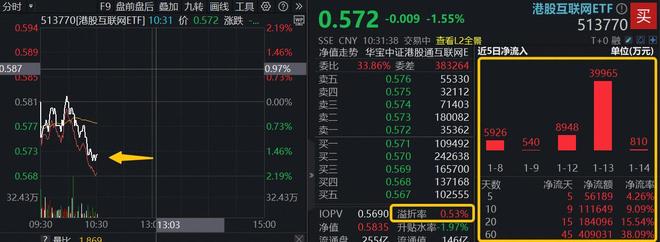
ETF盘中资讯|先于谷歌,千问推出AI购物!港股AI短线回调,港股互联网ETF(513770)宽幅溢价,连日大举吸金逾11亿元
Sou Hu Cai Jing· 2026-01-15 03:16
Core Viewpoint - The Hong Kong stock market experienced a short-term pullback in AI-related stocks, with major internet companies like Alibaba, Kuaishou, and Bilibili seeing declines, while the Hong Kong Internet ETF showed strong buying interest despite the drop [1][2]. Group 1: Market Performance - As of January 15, major internet stocks in Hong Kong, including Alibaba-W, Kuaishou-W, and Bilibili-W, fell over 2%, while Tencent Holdings dropped more than 1% [1]. - The Hong Kong Internet ETF (513770) saw a price decline of 1.55%, but it still exhibited a significant premium, indicating strong buying sentiment [1]. - Over the past 10 days, the Hong Kong Internet ETF has recorded net inflows of 1.116 billion yuan, with funds increasing on 9 out of those 10 days [1]. Group 2: AI Developments - Alibaba's Qianwen App has integrated with various Alibaba ecosystem services, enabling AI shopping functionalities, and has surpassed 100 million monthly active users within two months of launch [2]. - Analysts suggest that Alibaba's AI initiatives are entering a competitive phase focused on ecosystem development, with expectations for major model updates in 2026 [2]. - The AI applications are anticipated to evolve from usable to highly effective by 2026, with a focus on diverse business models and user engagement [2]. Group 3: Investment Opportunities - The Hong Kong Internet ETF (513770) tracks the CSI Hong Kong Internet Index, which includes major players like Alibaba, Tencent, and Xiaomi, with the top ten stocks accounting for over 76% of the index [3]. - The latest fund size of the Hong Kong Internet ETF reached 14.899 billion yuan, marking a historical high, with an average daily trading volume exceeding 600 million yuan since 2025 [4]. - For investors seeking to balance technology exposure with stability, the Hong Kong Large Cap 30 ETF (520560) is recommended, featuring a mix of high-growth tech stocks and stable dividend-paying companies [4].
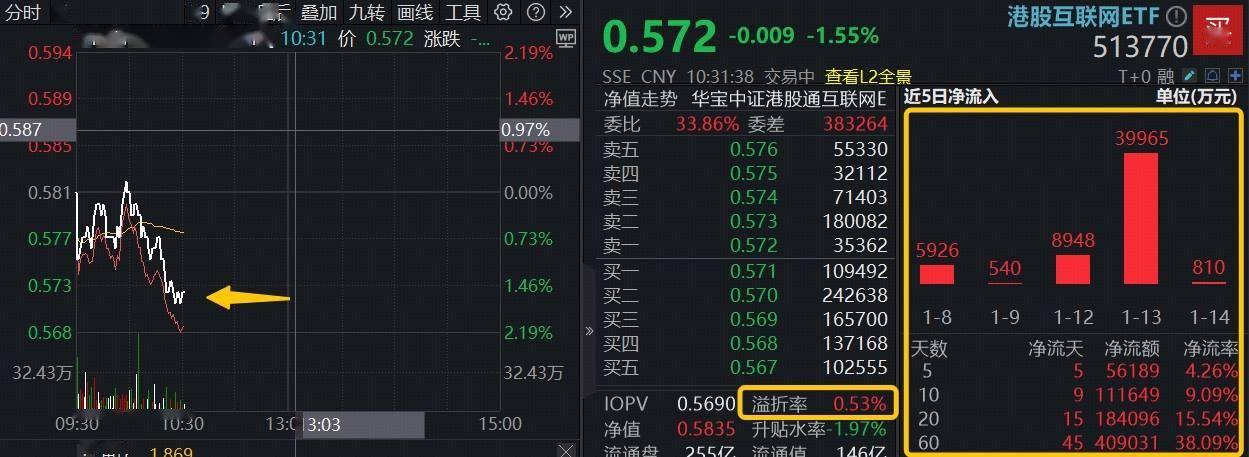
先于谷歌,千问推出AI购物!港股AI短线回调,港股互联网ETF(513770)宽幅溢价,连日大举吸金逾11亿元
Xin Lang Cai Jing· 2026-01-15 03:01
Core Viewpoint - The Hong Kong stock market experienced a short-term pullback in AI stocks, with major internet companies declining, while the Hong Kong Internet ETF showed strong buying interest despite the drop [1][7]. Group 1: Market Performance - As of January 15, major internet stocks such as Alibaba-W, Kuaishou-W, and Bilibili-W fell over 2%, while Tencent Holdings dropped more than 1% [1][7]. - The Hong Kong Internet ETF (513770) saw a price decline of 1.55%, indicating a wide premium and strong buying sentiment as investors actively sought to accumulate shares during the dip [1][7]. - Over the past 10 days, the Hong Kong Internet ETF recorded net inflows of 1.116 billion yuan, with funds increasing on 9 out of those 10 days [1][7]. Group 2: Company Developments - Alibaba's Qianwen App has integrated with various services within the Alibaba ecosystem, enabling AI shopping functionalities such as food delivery and ticket booking, and has opened testing to all users [9]. - The Qianwen App has surpassed 100 million monthly active users (MAU) within two months of launch, marking a significant milestone in its user engagement [9]. - Analysts from Dongfang Securities expect major updates to the Qianwen models (Qwen3.5, Qwen4) to be released in 2026, which could enhance AI application capabilities and expand Alibaba's AI application scenarios [9]. Group 3: Investment Insights - The Hong Kong Internet ETF (513770) and its linked funds are designed to passively track the CSI Hong Kong Internet Index, which includes major players like Alibaba-W, Tencent Holdings, and Xiaomi Group-W, with the top ten stocks accounting for over 76% of the index [10]. - The latest fund size of the Hong Kong Internet ETF reached 14.899 billion yuan, setting a new historical high, with an average daily trading volume exceeding 600 million yuan since 2025 [11]. - For investors looking to balance exposure to technology while minimizing volatility, the Hong Kong Large Cap 30 ETF (520560) is recommended, featuring a mix of high-growth tech stocks and stable dividend-paying companies [11].
A股集体低开,商业航天板块集体调整
Di Yi Cai Jing Zi Xun· 2026-01-15 01:58
Market Overview - The commercial aerospace sector experienced a collective adjustment, with companies like Tongyu Communication and Fenghuo Communication hitting the daily limit down, while Jili Rigging fell over 8% [1] - The A-share market opened lower, with the Shanghai Composite Index down 0.48%, the Shenzhen Component Index down 0.63%, and the ChiNext Index down 0.93% [1][2] - The AI application sector saw a decline, with CRO, commercial aerospace, brain-computer interface, nuclear fusion, and Yushu Robotics concepts leading the losses [2] Company Specifics - Tianpu Co. opened near the daily limit down after receiving an inquiry letter from the Shanghai Stock Exchange regarding its main business and executive qualifications [2] - Ctrip Group's stock fell nearly 15% following an investigation by the market regulatory authority, while other companies like Tongcheng Travel and Xpeng Motors also saw declines of over 2% [4][6] Index Performance - The Shanghai Composite Index was at 4106.22, down 19.87 points or 0.48% [2] - The Shenzhen Component Index was at 14158.66, down 89.94 points or 0.63% [2] - The ChiNext Index was at 3318.11, down 31.03 points or 0.93% [2] - The Science and Technology Innovation Index was at 1818.17, down 17.24 points or 0.94% [2]