
晶澳科技

Search documents
硅片集体涨价12%,上游硅料驱动行业反转,龙头率先响应
Xuan Gu Bao· 2025-12-25 23:18
Group 1 - Major silicon wafer companies have significantly raised prices, with 183N wafers priced at 1.4 yuan/piece, 210RN at 1.5 yuan/piece, and 210N at 1.7 yuan/piece, averaging a 12% increase [1] - The price increase is primarily driven by substantial rises in upstream silicon material costs, indicating a potential recovery in profitability across the industry [1] - The establishment of a new company focused on multi-crystalline silicon capacity integration and mergers, backed by leading silicon material firms, aims to promote technological upgrades and optimize production capacity and costs [1] Group 2 - China Galaxy Securities highlights that the photovoltaic industry, as a key sector for "anti-involution," may see accelerated supply clearing due to policy support and technological advancements, with a potential industry turnaround by 2026 [2] - Guohai Securities notes that the newly formed silicon material storage platform is expected to enhance capital investment and establish reasonable pricing for multi-crystalline silicon, contributing to ongoing supply-side reforms and improved industry conditions [2] - The silicon material segment is anticipated to be the primary beneficiary of price increases, leading to early profitability improvements, while the battery and module sectors will gradually recover as price structures stabilize [2] Group 3 - Longi Green Energy, a leading company in the domestic photovoltaic industry, has raised silicon wafer prices in line with industry trends, leveraging its core advantages in high-efficiency battery technology [3] - JA Solar Technology operates as an integrated enterprise in the photovoltaic sector, focusing on the research, development, production, and sales of silicon wafers, batteries, and modules, as well as the development and operation of solar power plants [3]

7家组件厂齐涨2-6分!未来组件价格大概率还将继续上涨
Xin Lang Cai Jing· 2025-12-25 13:34
Group 1 - The core viewpoint of the article is that the recent surge in photovoltaic component prices is both inevitable and a result of rising costs in the supply chain, particularly due to the increase in silver prices [8] - Major manufacturers such as Longi and JA Solar have initiated price increases of 2-4 cents, followed by Trina Solar raising prices by 5-6 cents, Tongwei by 3-4 cents, and others, leading to a general increase in component prices to 0.70 yuan/W or higher [2] - The price increase has created tension in the downstream solar power station sector, which is struggling to accept the higher costs due to declining profitability from the implementation of policy 136 [2][6] Group 2 - Many smaller component manufacturers are hesitant to raise prices due to fears of contract cancellations, as evidenced by reports of contracts being voided shortly after agreements were made [3][4] - The primary reason given by component manufacturers for the price hikes is the soaring cost of silver paste, which has become the largest cost component in solar modules, accounting for 17% of total costs [6][7] - The current situation presents a dilemma where rising production costs compel manufacturers to increase prices, while reduced profitability for solar power stations makes it difficult for investors to accept these price hikes [7]




硅业分会:硅片企业集体上调报价 成交价格涨幅明显
智通财经网· 2025-12-25 11:21
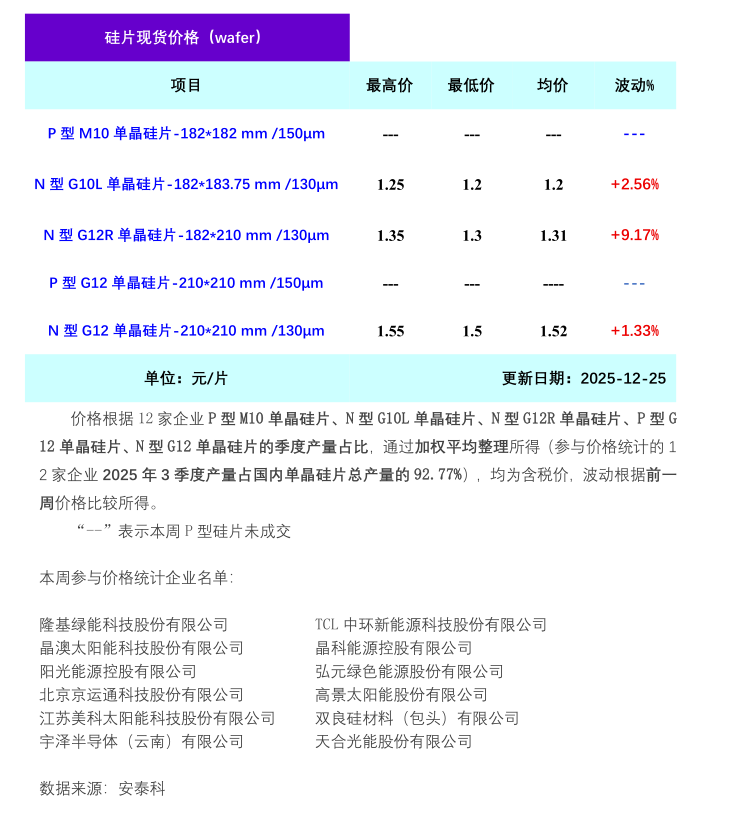
Core Viewpoint - The price of silicon wafers has significantly increased this week, driven by strong pricing strategies from silicon wafer companies and increased demand from downstream battery manufacturers [1][2]. Price Trends - N-type G10L monocrystalline silicon wafer (182*183.75mm/130μm) average transaction price is 1.2 yuan/piece, up 2.56% from last week - N-type G12R monocrystalline silicon wafer (182*210mm/130μm) average transaction price is 1.31 yuan/piece, up 9.17% from last week - N-type G12 monocrystalline silicon wafer (210*210mm/130μm) average transaction price is 1.52 yuan/piece, up 1.33% from last week [1][3]. Market Dynamics - Silicon wafer companies are strongly inclined to raise prices, with significant production cuts and a reluctance to sell at low prices observed - Increased procurement orders from downstream battery manufacturers have led to a higher tolerance for expensive silicon wafers - The rising price of polysilicon continues to support silicon wafer costs [2]. Production and Capacity - The overall operating rate in the industry remains stable, with major companies operating at 50% and 48% capacity, while integrated companies operate between 50%-70% - Most silicon wafer companies are adopting a cautious approach, implementing production cuts to control prices, leading to a market characterized by "price increase with fewer orders" [2]. Future Outlook - If price transmission throughout the entire industry chain proceeds smoothly, the silicon wafer market is expected to continue its positive development - A generally optimistic outlook from silicon wafer manufacturers suggests that the market may strengthen further in December [2].

被深证100“除名”,市值蒸发千亿:泰格医药如何走出“投资依赖症”?
Xin Lang Cai Jing· 2025-12-25 09:40
Group 1 - The core point of the article highlights the stark contrast between the overall recovery of the CRO industry, which has seen a rise of over 40% this year, and the significant decline of Tigermed, which has been removed from the Shenzhen 100 Index due to its stock price dropping over 70% since its peak in 2021, resulting in a market value loss of more than 130 billion yuan [1][2][7] Group 2 - The removal of Tigermed from the Shenzhen 100 Index reflects a decline in its industry status, as the adjustment is based on quantitative indicators such as market capitalization, liquidity, and industry representation, indicating a reassessment of its market leadership [2][3] - Despite holding a 10.6% market share and being the only Chinese clinical CRO in the global top ten, Tigermed's revenue is projected to decline by 10.58% in 2024, with net profit expected to plummet by nearly 80% [3][8] - In the first three quarters of 2025, while net profit increased by 25.45%, this growth was primarily driven by non-operating income, including a 303% surge in investment income and a more than tenfold increase in fair value changes [3][8] Group 3 - Tigermed faces dual challenges: external factors such as intensified industry competition and rising costs, alongside internal issues like an imbalanced profit model [4][9] - The gross margin for clinical trial services has dropped from 38.4% to 22.8%, indicating pricing pressure and cost control challenges [4][9] - The company's reliance on investment income has made its profit structure fragile, raising concerns about sustainability [4][9] Group 4 - The CEO's decision to cash out over 21 million yuan in September 2025 has further shaken market confidence in Tigermed [4][9] - Although some institutions predict potential revenue recovery in the next three years, Tigermed must transition from an "investment-driven" model to a "core business-driven" approach to regain market trust and improve its competitive edge [4][9][10]

光伏产业如何通过技术与整合走出低价困局
Zhong Guo Neng Yuan Wang· 2025-12-25 09:34
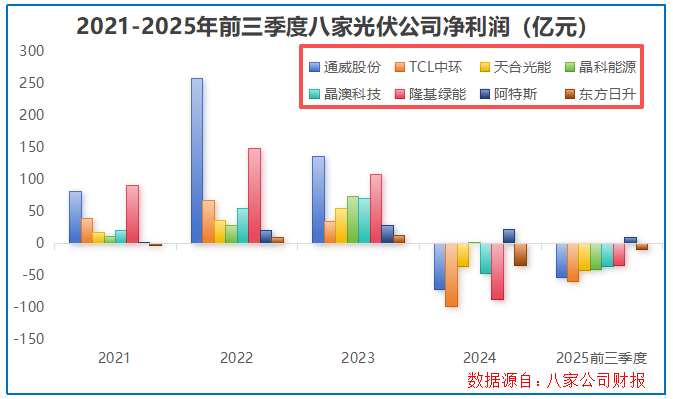
Core Insights - The photovoltaic industry is facing a severe oversupply and price decline due to excessive capacity expansion without corresponding demand growth [2][4] - Major companies in the industry have reported significant losses, with a total loss of 26.068 billion yuan in the first three quarters of 2025 [2] - The industry must shift from a focus on scale expansion to technological innovation to break free from the current predicament [4][32] Industry Overview - From 2021 to 2024, the photovoltaic industry has been in a race to expand production capacity, driven by carbon neutrality goals [1] - However, demand has not kept pace, leading to a decline in production across key segments, including polysilicon and silicon wafers, with polysilicon production down 29.6% year-on-year [2] - Prices for polysilicon have plummeted from over 300,000 yuan per ton in 2022 to 34,700 yuan per ton in mid-2025, a nearly 90% drop [2] Technological Innovation - The industry is at a crossroads where reliance on scale expansion is no longer viable, and technological innovation is essential for survival [4][32] - The transition from P-type to N-type solar cells represents a critical technological evolution, with N-type TOPCon technology becoming increasingly competitive [5][6] - Setting rigid efficiency standards for solar products is crucial to encourage innovation and eliminate low-quality competition [7][10] Policy and Regulation - The government is encouraged to implement policies that support high-efficiency solar components and set efficiency benchmarks for market entry [7][21] - The "three red lines" financial metrics, similar to those used in the real estate sector, could be applied to the photovoltaic industry to manage financial risks and prevent over-leverage [22][23] - Establishing a clear regulatory framework is deemed necessary to guide the industry towards sustainable development [20][32] Market Dynamics - The current market is characterized by a lack of unified efficiency data, leading to confusion and inconsistency in performance claims among companies [9] - The industry must focus on high-quality, high-efficiency products to move away from price-based competition and towards value-based competition [8][32] - Collaboration across the supply chain is essential to balance profitability and ensure sustainable operations for all stakeholders [14][17] Future Outlook - The photovoltaic industry is expected to evolve towards a model centered on technological innovation and quality improvement, moving away from the previous focus on scale and low prices [32] - Companies that prioritize innovation, manage risks effectively, and engage in ecosystem development are likely to emerge as leaders in the future [32]

晶澳科技涨2.01%,成交额2.97亿元,主力资金净流入549.08万元
Xin Lang Cai Jing· 2025-12-25 05:44
Core Viewpoint - JinkoSolar Technology Co., Ltd. has experienced a stock price decline of 15.20% year-to-date, with recent fluctuations indicating a 5.71% increase over the last five trading days, despite a 32.27% year-on-year decrease in revenue for the first nine months of 2025 [1][2]. Financial Performance - For the period from January to September 2025, JinkoSolar reported a revenue of 36.809 billion yuan, representing a year-on-year decrease of 32.27% [2]. - The company recorded a net profit attributable to shareholders of -3.553 billion yuan, a significant year-on-year decrease of 633.54% [2]. Stock Market Activity - As of December 25, JinkoSolar's stock price was 11.66 yuan per share, with a market capitalization of 38.591 billion yuan [1]. - The stock saw a trading volume of 297 million yuan and a turnover rate of 0.78% on the same day [1]. - The company has appeared on the "龙虎榜" (a stock trading list) twice this year, with the latest appearance on October 29, where it recorded a net buy of 1.56 billion yuan [1]. Shareholder Information - As of September 30, 2025, JinkoSolar had 147,800 shareholders, a decrease of 17.24% from the previous period [2]. - The average number of circulating shares per shareholder increased by 20.84% to 22,370 shares [2]. Dividend Distribution - Since its A-share listing, JinkoSolar has distributed a total of 3.055 billion yuan in dividends, with 2.415 billion yuan distributed over the last three years [3]. Institutional Holdings - As of September 30, 2025, the second-largest circulating shareholder was Hong Kong Central Clearing Limited, holding 214 million shares, a decrease of 7.3649 million shares from the previous period [3]. - Other notable institutional shareholders include GF Advanced Manufacturing Stock A and Huatai-PB CSI 300 ETF, with varying changes in their holdings [3].
山西证券研究早观点-20251225
Shanxi Securities· 2025-12-25 00:22
Core Insights - The report highlights a price increase announced by a leading carbon fiber company, indicating a potential recovery in the industry's bottom line and overall market conditions [4][5] - The report emphasizes the growth potential in the label printing sector, particularly for Jiangtian Technology, which specializes in high-quality label printing services [6][7] Industry Summary Chemical Raw Materials - The new materials sector experienced a slight decline, with the new materials index down by 0.23%, although it outperformed the ChiNext index by 2.03% [4] - Key price movements in the amino acids and biodegradable materials were noted, with valine increasing by 4.98% to 13,700 CNY/ton, while other prices remained stable [4] Carbon Fiber Industry - The carbon fiber market is showing signs of recovery, with a significant increase in demand expected, particularly in wind power and aerospace applications. The actual consumption of carbon fiber in China is projected to reach 96,446 tons in 2025, a year-on-year increase of 71.89% [5] - Major companies like Toray and Jilin Chemical Fiber have announced price hikes for their carbon fiber products, indicating a strengthening market position for high-performance carbon fiber suppliers [5] Label Printing Sector - Jiangtian Technology is positioned as a leading service provider in the label printing industry, with a focus on non-dry adhesive labels used in various consumer sectors. The company has established stable partnerships with major brands like Unilever and Procter & Gamble [6] - The label printing market in China is expected to grow significantly, with a projected compound annual growth rate of 10.44% from 2023 to 2031, driven by rising disposable incomes and consumption upgrades [6][7] Solar Industry - The report notes stable pricing for polysilicon and an increase in silicon wafer prices, with the average price for 130um N-type silicon wafers rising by 5.9% to 1.25 CNY/piece [8] - Battery cell prices have also increased, with N-type battery cells seeing a 13.3% rise to 0.34 CNY/W, reflecting a tightening supply and increased production costs [9]
2025年1-10月中国太阳能发电量产量为4798.2亿千瓦时 累计增长23.2%
Chan Ye Xin Xi Wang· 2025-12-24 03:19
2020-2025年1-10月中国太阳能发电量产量统计图 数据来源:国家统计局,智研咨询整理 知前沿,问智研。智研咨询是中国一流产业咨询机构,十数年持续深耕产业研究领域,提供深度产业研 究报告、商业计划书、可行性研究报告及定制服务等一站式产业咨询服务。专业的角度、品质化的服 务、敏锐的市场洞察力,专注于提供完善的产业解决方案,为您的投资决策赋能。 上市企业:隆基绿能(601012),通威股份(600438),阳光电源(300274),晶澳科技(002459),天合光 能(688599),特变电工(600089),正泰电器(601877),TCL中环(002129),林洋能源(601222),上 能电气(300827) 相关报告:智研咨询发布的《2025-2031年中国太阳能发电站行业市场行情监测及投资前景研判报告》 根据国家统计局数据显示:2025年10月中国太阳能发电量产量为394亿千瓦时,同比增长5.9%;2025年 1-10月中国太阳能发电量累计产量为4798.2亿千瓦时,累计增长23.2%。 ...


浙商证券:AI重塑光纤需求结构 供需拐点有望推动量价齐升
智通财经网· 2025-12-23 02:40
Core Viewpoint - The photovoltaic industry has been in a downturn for nearly two years due to an imbalance in supply and demand, leading to price and profit pressures. There is a strong consensus among companies to implement "anti-involution" policies to break the current deadlock, with expectations for a turning point in 2026 [1][2][3]. Supply and Demand Imbalance - The supply-demand situation is significantly oversupplied, with polysilicon production capacity expected to reach 3.39 million tons (equivalent to 1,695 GW) by 2024, which is more than three times the new installed capacity of 530 GW for that year [2]. - The industry has experienced a drastic decline in overall profits, with a drop of approximately 95% from the end of 2023 to the present, placing the industry at the brink of profitability [2]. Industry Challenges and Consensus - The photovoltaic industry has faced continuous losses since Q4 2023, resulting in an average employee reduction of 33% in 2024. The average interest-bearing debt ratio has increased from 23% to 31% due to losses and cash flow pressures [3]. - There is a stronger consensus among companies to push for "anti-involution" policies in the current challenging environment, indicating a need for a breakthrough [3]. Silica Material Storage Initiative - The establishment of the silica material storage platform, "Beijing Guanghe Qiancheng Technology Co., Ltd.," in December 2025 is expected to lead the industry into a new phase of "market-oriented operation + industry collaborative regulation" [4]. - The concentration of silica material production capacity is high and manageable, with minimal impact on downstream price acceptance. The cost of silica material is crucial, as a price increase of 10,000 yuan per ton corresponds to a 0.02 yuan/W increase in component costs, indicating potential for price increases in the future [4]. Expectations for 2026 and Fund Allocation - The "anti-involution" policy reflects national intent, with various policies being implemented to accelerate progress in the industry [5]. - Leading companies such as Longi, JA Solar, and Hongyuan Green Energy have announced stock incentive and employee shareholding plans, aiming for profitability by 2025/2026, demonstrating confidence in industry development [5]. - Fund allocation has returned to levels seen before the last market surge in 2020, indicating a wait-and-see approach for future growth [5].

“十五五”和2026年可再生能源发展展望
2025-12-22 15:47
"十五五"和 2026 年可再生能源发展展望 20251222 摘要 国家能源局设定的 2026 年新能源装机目标为 200 吉瓦,低于市场预期, 主要基于非化石能源消费比重已接近完成 2025 年目标,但可能限制未 来发展。 2030 年前新能源发展面临单位 GDP 碳排放强度严格要求,现有减排进 度滞后于目标,需大幅提升可再生能源利用效率并发展核电等其他能源。 中国计划在"十五"期间新增约 1,000 吉瓦可再生能源装机,以满足非 化石能源消费比重目标,但要实现碳排放强度目标仍需进一步提升能源 利用效率。 未来几年,中国新能源政策将侧重需求侧,关注电价波动和供给侧改革, 并加强对氢能、氨、醇等非电领域可再生能源应用的支持。 能源领域固定资产投资对中国经济增长贡献显著,"十四五"期间增速 约为 16%,电力领域更高达 20%,涵盖充电桩、电解槽等新兴领域。 预计"十五五"期间每年将开工 3 至 4 条特高压外送通道,总计约 15 条,每条可支撑 5 至 10 吉瓦的可再生能源外送,总体支持规模在 100 至 200 吉瓦之间。 2026 年国内光伏新增装机容量预期为 160 至 200 吉瓦,地面电站度电 ...