圆通速递

Search documents
全省投资促进系统“项目攻坚年”工作会在昆召开
Xin Lang Cai Jing· 2026-01-07 22:24
Group 1 - The core viewpoint of the articles emphasizes the importance of investment promotion in Yunnan, highlighting the achievements in 2025 and the strategic focus for 2026 as a critical year for project advancement [1][2] - In 2025, Yunnan's investment promotion efforts saw significant progress, with a favorable trend in project signing and implementation, and an optimized investment structure featuring notable companies like JD.com, Nongfu Spring, and YTO Express [1] - The 2026 investment promotion strategy will focus on precise actions, including organizing the "Investment in Yunnan" series of events and enhancing enterprise services to ensure effective problem-solving for businesses [2] Group 2 - The provincial investment promotion system aims to strengthen the tracking and conversion of investment intentions into agreements and actual investments, emphasizing a proactive approach to enterprise support [2] - There will be a strong emphasis on major projects that align with leading industries and regional advantages, with responsibilities shared between provincial and municipal levels to stimulate industrial development [2] - The strategy includes the implementation of new models for investment promotion, such as industry chain investment, scenario-based investment, and green electricity investment, to foster high-quality development in investment attraction [2]
交运物流行业2026投资策略:厚积薄发
HUAXI Securities· 2026-01-07 13:22
Macro Environment Summary - The nominal GDP growth rate for the first three quarters of 2025 is 5.2%, higher than 2024 but lower than 2023, with a decline from 4.6% in Q1 to 3.7% in Q3 [8][9] - The GDP deflator index has decreased to -1.08%, indicating deflationary pressures [8] - Non-manufacturing business expectations are stronger than manufacturing, with manufacturing PMI remaining below 50% for most months in 2025 [12][14] - Employment stability in manufacturing is better than in non-manufacturing, with manufacturing PMI for employment remaining stable [17][19] - Consumer confidence regarding employment has shown fluctuations, with a general upward trend in 2025 [21][23] - Retail sales growth has declined significantly, with November 2025 showing a year-on-year increase of only 1.3% [27][29] - Real estate investment has seen a cumulative decline of 15.9% from January to November 2025, with expectations of negative growth for four consecutive years [33][34] - Net exports have contributed positively to GDP growth, with total exports of 2.44 trillion yuan and imports of 1.67 trillion yuan from January to November 2025 [39][40] Express Delivery Industry - The growth rate of express delivery volume has significantly decreased from 22.4% in January-February 2025 to 5% in November, attributed to declining consumer demand and competition from instant retail [47][53] - Price changes in express delivery have led to a clear differentiation in demand, with rising costs affecting low-margin products and order-filling activities [57][61] - Different express companies have shown varying trends in volume growth and revenue per package, with Yunda experiencing negative volume growth but higher revenue per package compared to YTO [61][65] Aviation and Airport Industry - The number of civil transport airports in China is expected to reach 270 by the end of 2025, with significant progress in airport construction projects [75][77] - The fleet of major airlines has seen growth, with wide-body and narrow-body aircraft increasing by 8.9% and 13.3% respectively since the end of 2019 [81][82] - Domestic flight capacity has been adjusted, with a 1.8% decrease in weekly domestic flights for the winter-spring season of 2025 compared to the previous year [86][90] - Airlines are focusing on international routes, with a 17.3% increase in international flights compared to the previous year [90] - The average ticket price for domestic economy class has decreased by 6% year-on-year, reflecting a strategy to maintain passenger load factors [102][110] - The low oil prices and the appreciation of the RMB are expected to enhance profits for major airlines, with estimated profit increases ranging from 20.4 billion to 50 billion yuan depending on the airline [128]
快递行业2025年11月数据跟踪:旺季行业均价环比回升,通达系价格持续修复
CMS· 2026-01-07 09:38
Investment Rating - The report maintains a positive outlook on the express delivery industry, indicating a recovery in valuation driven by orderly competition and performance growth opportunities. Core Insights - The express delivery industry is experiencing a gradual optimization of its competitive landscape, with performance improvements expected as the market stabilizes. The demand is anticipated to benefit from the growth of the e-commerce market, while cost efficiencies are expected to arise from technological advancements and scale effects. The report highlights the potential for profitability improvement as pricing pressures ease and the competitive intensity diminishes [4][5][6]. Industry Key Data Tracking - In November 2025, the national express delivery volume reached 18.06 billion pieces, a year-on-year increase of 5.0%, although the growth rate has slowed by 2.9 percentage points compared to the previous month. The average revenue per package was 7.62 yuan, reflecting a year-on-year decline of 8.3%, with a month-on-month increase of 1.9%. The total express delivery revenue amounted to 137.65 billion yuan, showing a year-on-year growth of 3.7%, with a decrease in growth rate of 1.0 percentage points from the previous month [1][18][20]. Company Performance Data - In November 2025, major express delivery companies showed varied performance in terms of volume growth. SF Express led the industry with a volume of 1.53 billion pieces, marking a year-on-year increase of 20.1%. In contrast, Yunda experienced a decline of 4.2% in volume. Revenue figures for the same month were 20.7 billion yuan for SF Express, 6.0 billion yuan for Shentong, 6.5 billion yuan for YTO, and 4.7 billion yuan for Yunda, with year-on-year growth rates of 9.9%, 33.1%, 11.1%, and 2.2% respectively [3][62]. Market Share Insights - As of November 2025, the market share of express delivery volumes for SF Express, Shentong, YTO, and Yunda were 8.5%, 13.9%, 16.0%, and 12.0% respectively. The year-on-year changes in market share were +1.1, +1.2, +1.2, and -1.2 percentage points, indicating a slight shift in competitive positioning among these companies [3][62]. Investment Recommendations - The report recommends focusing on leading companies in the industry, such as ZTO Express, YTO Express, Shentong Express, Yunda, and SF Express, due to their strong operational certainty, stable cash flows, and low debt ratios, which provide a quasi-dividend characteristic. The overall industry valuation is considered low, with expectations for gradual improvement in profitability as competition stabilizes [4][5][6].
极兔的命有多硬?
3 6 Ke· 2026-01-07 00:31
Core Viewpoint - The Chinese express delivery industry is experiencing a significant price war, exacerbated by the entry of J&T Express, which has led to increased competition and price adjustments across the sector. Despite efforts to combat "involution," the industry has struggled with declining single-ticket prices and profitability challenges, particularly for major players like SF Express [1][2][4]. Group 1: Industry Dynamics - The express delivery industry in China has been in a state of price decline for 17 years, with a notable shift in 2016 when many companies went public, leading to expectations of price stabilization above 3 yuan per ticket. However, the industry has not consolidated effectively, maintaining over five major competitors reliant on price wars [4][6]. - The entry of J&T Express from Southeast Asia has intensified the price competition, with its stock price increasing over 70% this year, contrasting sharply with the struggles of established players like SF Express [2][3]. - The express delivery market in China is highly tied to the e-commerce sector, with the competitive landscape influenced by the strategies of e-commerce platforms, which have begun to build their own logistics networks [8][28]. Group 2: J&T Express's Strategy and Performance - J&T Express has successfully leveraged its experience in Southeast Asia to establish a strong market presence, achieving profitability in China by 2024 after initially struggling with low margins [11][15]. - The company has capitalized on the rapid growth of e-commerce in Southeast Asia, where online shopping revenue has surged from 0.8% to 22% of retail sales over a decade, positioning itself as a preferred logistics partner for major e-commerce platforms [20][24]. - J&T's operational model, which includes a regional agency system, allows for lower asset investment compared to direct management models, enhancing its competitive edge in the fragmented Southeast Asian market [22][24]. Group 3: Financial Metrics and Market Position - As of 2025, J&T Express's single-ticket revenue in Southeast Asia is projected to be 4.38 yuan, significantly higher than its Chinese competitors, indicating a strong pricing power in that region [15]. - The company's financial performance shows a decline in single-ticket revenue from 5.92 yuan in 2020 to 4.37 yuan in 2025, with a corresponding drop in gross margin from 29.8% to around 17-20% [30][31]. - Despite the challenges, J&T Express has maintained a competitive cost structure, with single-ticket costs decreasing from 4.15 yuan in 2020 to 3.59 yuan in the first half of 2025, allowing it to sustain profitability [31].

极兔的命有多硬?
远川研究所· 2026-01-06 13:07
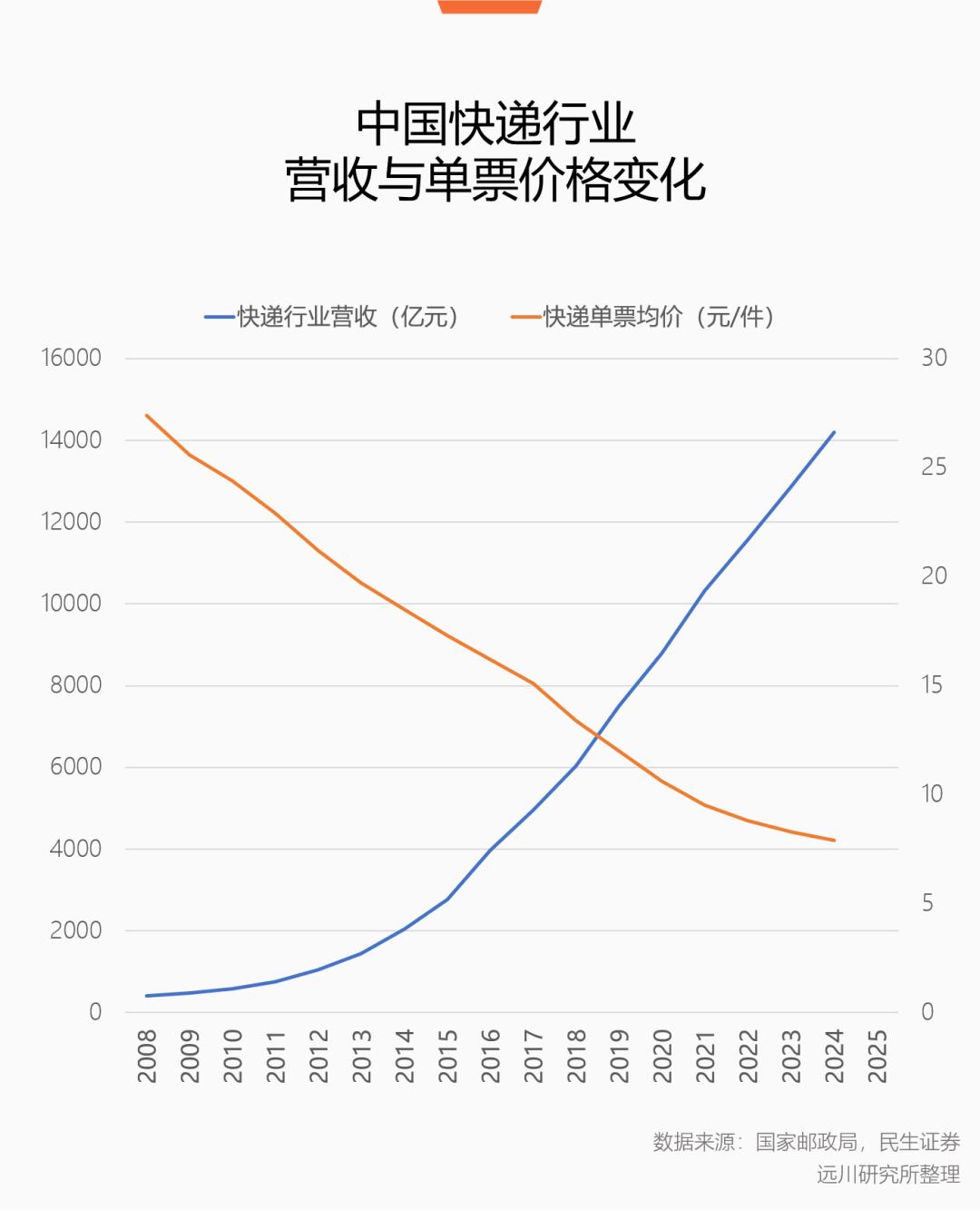
去年7月,国家邮政局召开快递企业座谈会,正式提出"反内卷"[12],电商宇宙中心义乌率先响应,快 递底价上调幅度高达1毛钱,随后广东跟进,底价涨至1.4元。 各大快递公司争相借坡下驴,截至11月,全国已经有22个省上调了快递价格。 2016年前后,快递企业扎堆上市,眼见终局将来,单票价格也有望站稳3元以上,形势似乎一片大好; 四年后的行业大会上,中通董事长痛心疾首[7],宣布单票价格进入2元时代。 如此开团秒跟,全因快递行业已经被卷麻了。单票价格提不上来,增收不增利的困境在通达系内蔓延, 即便体面如顺丰,下半年利润也承压下滑。 其实早在2019年,快递公司就曾见过希望的曙光。当时快递单票价格降幅已经趋缓,六大主要企业的 市占率提到80%以上。 怎么先内卷的是你,到头来先享福的也是你? 怎料天空一声巨响,留子闪亮登场。 东南亚起家的极兔回国起网,以一己之力把快递行业的价格战拖 进了加时赛。 冰火两重天 从财务表现来看,极兔的营收和利润都不足顺丰的零头,刚挣扎着爬上盈利线。 一句话概括中国快递行业与极兔的关系: 衡中学生惨遭归国留子插班 。 一眨眼过去五年,这边同行们借着这轮反内卷喘息片刻,那头的卷王极兔却开起了 ...

一个浙江小城,为什么跑出了“快递四巨头”?
创业邦· 2026-01-06 10:05
Core Viewpoint - The article highlights the rise of the express delivery industry in China, particularly focusing on the "Three Links and One Reach" (Shentong, Yunda, Yuantong, and Zhongtong) and their roots in the small county of Tonglu, Zhejiang, which is recognized as the "Hometown of Private Express" in China [6][7][12]. Group 1: Industry Overview - The "Three Links and One Reach" companies dominate the Chinese express delivery market, holding over 60% market share as of 2024 [6]. - Tonglu County is set to become a significant logistics hub with the establishment of "Tongda Future City," which will house the second headquarters of the "Three Links and One Reach" companies [9][10]. - The logistics industry in Tonglu is expected to form a large industrial cluster, attracting numerous upstream and downstream enterprises [12][56]. Group 2: Historical Context - The founders of the "Three Links and One Reach" companies originated from Tonglu, with a notable figure being Nie Tengfei, the founder of Shentong, who is regarded as the pioneer of private express delivery in China [14][17][22]. - The express delivery business began in the early 1990s, with Shentong being one of the first private companies to break the monopoly of the postal service [22][23]. - The initial success of Shentong was driven by a small team that effectively utilized local resources and community trust to expand their operations [27][36]. Group 3: Recent Developments - The "Tongda Future City" project, with a total investment of 13 billion yuan, aims to integrate technology and logistics, featuring various headquarters and innovation centers [52][54]. - The city is expected to focus on technological innovation, with companies like Chenchen Technology and Zhejiang Inline Power establishing operations to enhance logistics efficiency [56][57]. - The development of "Tongda Future City" represents a significant shift from labor-intensive to technology-driven logistics solutions, showcasing the evolution of the industry in Tonglu [63].



圆通速递股份有限公司 关于第二期股票期权激励计划2025年第四季度 自主行权结果暨股份变动的公告
Zhong Guo Zheng Quan Bao - Zhong Zheng Wang· 2026-01-06 07:43
Core Viewpoint - The company has announced the details of its second stock option incentive plan, highlighting the successful exercise of stock options by eligible participants and the associated financial implications. Group 1: Stock Option Exercise Overview - The third exercise period of the second stock option incentive plan allows for the exercise of 2,794,000 stock options, with the exercise period running from July 14, 2025, to June 5, 2026, and the exercise method being self-exercise [1] - As of the fourth quarter of 2025, 34,825 shares were exercised, representing 1.25% of the eligible options, generating funds of 524,812.75 yuan [2] - By December 31, 2025, a total of 2,348,533 shares had been exercised, accounting for 84.06% of the eligible options, with total funds raised amounting to 35,392,392.31 yuan, which will be used to supplement the company's working capital [2] Group 2: Share Changes - The announcement includes details on the changes in the company's shares before and after the stock option exercise, although specific figures are not provided in the text [2]
快递2025:谁在股价狂欢,谁在利润挣扎?
3 6 Ke· 2026-01-06 05:13
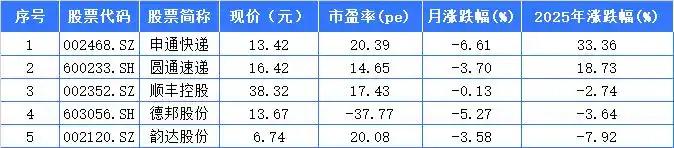
Group 1 - In 2025, the express delivery industry in China experienced significant stock price fluctuations, with Shentong Express leading the A-share market with a 33.36% increase, followed by YTO Express at 18.73%, and Jitu Express achieving a remarkable 70% increase in H-shares [1][3] - The overall express delivery business volume in China surpassed 180 billion packages by November 30, 2025, reflecting strong market vitality and economic growth [13] - Major listed express companies reported substantial growth in business volume, with SF Express exceeding 10 billion packages for the first time, Jitu surpassing 15 billion, YTO exceeding 20 billion, and Zhongtong surpassing 25 billion [14] Group 2 - The express delivery industry is shifting from a focus on price competition to a value-driven approach, emphasizing quality and digital transformation [3][4] - The National Postal Administration held discussions to address "involution" in the industry, promoting high-quality development and raising the minimum price for express services [5][7] - Companies are increasingly investing in automation and smart logistics, with major players like JD Logistics and SF Express developing advanced technologies to enhance efficiency and service quality [10][12] Group 3 - Revenue growth among major express companies varied, with SF Express reporting a revenue of 225.26 billion yuan, a year-on-year increase of 8.89%, while Shentong achieved 38.57 billion yuan, up 15.17% [15][17] - Despite overall revenue growth, profit margins are under pressure due to rising costs and intense competition, highlighting the need for improved operational efficiency [18][20] - The competitive landscape is expected to evolve, with a greater emphasis on service quality, supply chain solutions, and technological capabilities in the coming years [20]


招商证券:电商快递有望有序竞争 关注海外物流增长机遇
Zhi Tong Cai Jing· 2026-01-06 01:32
Core Viewpoint - The express delivery industry is expected to see demand growth exceeding expectations in 2025, driven by anti-involution policies that are pushing prices to recover from their lows. The overall industry valuation remains low, with an optimistic outlook on orderly competition, reduced competitive intensity, and improved profitability [1][2][3]. Group 1: Industry Demand and Growth - The express delivery business volume is projected to maintain rapid growth, with a cumulative completion of 1,807.4 billion pieces from January to November 2025, representing a year-on-year increase of 14.9%. The cumulative revenue reached 13,550.6 billion yuan, up 7.1% year-on-year, significantly outpacing the growth rates of retail sales and online retail [2]. - The anti-involution policies have led to a recovery in industry prices, with the average price decline narrowing from 8.8% in Q1 to 5.8% in Q3, and a slight increase of 1.7% in Q4 [2]. Group 2: Competitive Landscape and Company Performance - Major companies like SF Express and YTO Express have seen an increase in market share, with SF Express's market share rising by 1.3% year-on-year in Q3, while YTO Express's market share increased by 0.2% due to aggressive pricing strategies [2]. - The industry is expected to benefit from the continued development of the e-commerce market, with demand growth projected to stabilize at a mid-to-high level as the proportion of extremely low-priced e-commerce items decreases [3]. Group 3: Cost and Operational Efficiency - The industry is likely to see cost optimization through economies of scale, the application of new technologies (such as autonomous delivery vehicles), and improved management efficiency [3]. - The competitive landscape is anticipated to gradually improve due to regulatory support and a slow clearing of competition at the franchise and mainline levels, which will stabilize prices and enhance profitability [3]. Group 4: Broader Logistics Sector Insights - The cross-border air freight sector is expected to maintain year-on-year growth despite challenges from U.S. tariff policies, with a projected import and export volume of approximately 2.06 trillion yuan, up 6.4% year-on-year [4]. - The express delivery business overseas is experiencing rapid growth, particularly in Southeast Asia and emerging markets, with a significant increase in business volume, indicating strong potential for continued expansion [5].

聚焦一线网点生存战,2026快递行业六大趋势前瞻
3 6 Ke· 2026-01-05 12:39
Core Insights - The logistics industry is entering a phase of stock competition, with growth rates slowing to single digits due to various factors such as weak e-commerce growth and regulatory pressures [2][4] - The rise of instant retail is reshaping consumer behavior and threatening traditional logistics business models, with significant growth expected in the sector [15][18] - The integration of AI technology is revolutionizing operational efficiency in the logistics sector, enhancing service quality and operational management [9][11] Group 1: Industry Trends - Trend 1: The industry is shifting towards stock competition, leading to intensified price competition and a need for companies to innovate and improve service quality [4] - Trend 2: The challenge of increasing delivery fees persists due to ongoing price wars and a lack of motivation for fee increases among logistics providers [5][7] - Trend 3: AI is being embedded across all logistics processes, significantly improving efficiency and reducing complaint rates [9][10] Group 2: Market Dynamics - Trend 4: The elimination of underperforming logistics points is accelerating due to increased competition and regulatory pressures, with a focus on cost reduction and service improvement [12][14] - Trend 5: Instant retail is rapidly growing, with major platforms achieving significant daily order volumes, posing a threat to traditional logistics operations [15][17] - Trend 6: Chinese logistics companies are expanding internationally, driven by domestic competition and global opportunities, although they face challenges such as high operational costs and cultural differences [19][21]