
长江电力

Search documents
中国电力何时见底系列i:中美电价剪刀差:大国的相同与不同
HTSC· 2026-01-21 07:25
Investment Rating - The report maintains an "Overweight" rating for the public utility sector and the power generation sector [2]. Core Viewpoints - The report argues that the core logic determining the valuation of power stocks has changed in the new energy era, with expectations of a rebound in electricity prices and stock valuations as coal prices stabilize [4][6]. - It highlights that the most challenging phase for electricity supply and demand in China has passed, with expectations of a recovery in demand starting in 2026 [4][7]. - The report emphasizes that the valuation gap between U.S. and Chinese power stocks has widened significantly, with U.S. power stocks trading at 2-4 times the price-to-book (PB) ratio of their Chinese counterparts [4][6][7]. Summary by Sections Investment Recommendations - The report recommends several undervalued power operators, including Huaneng International, Guodian Power, and China Power [3][8]. - It suggests that the capacity price increase in 2026 will benefit thermal power, while the stabilization of energy prices will favor nuclear, green, and hydropower [8]. Market Dynamics - The report notes that both China and the U.S. are experiencing similar electricity shortages due to a slowdown in the growth of base-load power sources, with structural demand exceeding expectations potentially leading to supply crises [5][26]. - It discusses the significant differences in electricity pricing structures between the two countries, with U.S. electricity prices being significantly higher due to various systemic costs [56][58]. Price Trends and Projections - The report predicts that by 2026, the industrial electricity prices in China will be significantly lower than those in the U.S., enhancing the competitiveness of Chinese manufacturing [6][11]. - It highlights that the electricity price gap between the two countries is expected to continue to widen, benefiting China's manufacturing sector [6][8]. Supply and Demand Outlook - The report indicates that the most severe supply-demand imbalance in China has passed, with expectations of a recovery in electricity demand driven by increased manufacturing investment [7][8]. - It also notes that the U.S. is facing a similar situation, with a projected decline in gas-fired electricity generation and a potential increase in coal-fired generation [5][30].





2026年政策助力非化石能源提速,绿色电力ETF(159625)一键布局绿电资产机遇
Xin Lang Cai Jing· 2026-01-21 04:57
Group 1 - The National Development and Reform Commission emphasizes accelerating energy transition by developing non-fossil energy and enhancing the power grid's regulation capacity, aiming to increase the consumption ratio of non-fossil energy and promote new clean energy generation to meet the growing electricity demand [1] - In 2025, the national industrial power generation increased by 2.2% year-on-year, with solar power generation growing by 18.2% and wind power by 8.9% in December, indicating a positive expansion despite a slowdown in growth rates [1] - The performance of hydropower companies improved significantly in the fourth quarter due to abundant water resources in the Yangtze and Pearl River basins, leading to notable profit increases [1] Group 2 - As of December 31, 2025, the top ten weighted stocks in the National Green Power Index accounted for 54.68% of the index, including major companies like China Nuclear Power and Yangtze Power [2] - The Green Power ETF (159625) closely tracks the National Green Power Index, providing a convenient tool for investors to gain exposure to the overall performance of listed companies in the green power sector [2] - Investors can also access investment opportunities through the corresponding Green Power ETF linked fund (017057) [2]
上证180指数上涨0.08%,上证180ETF指数基金(530280)实现4连涨
Sou Hu Cai Jing· 2026-01-21 01:55
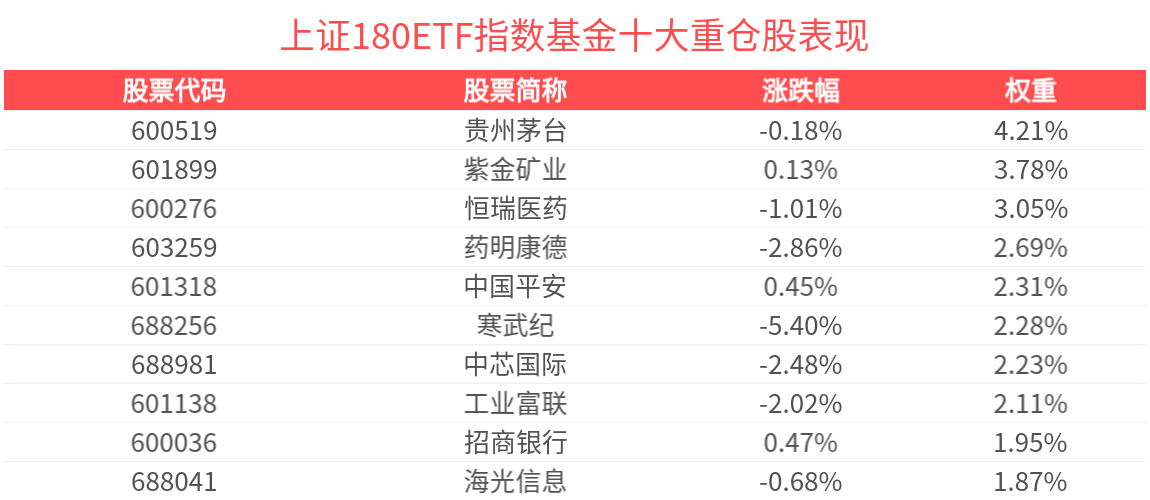
Core Viewpoint - The Shanghai 180 ETF Index Fund closely tracks the Shanghai 180 Index, which reflects the overall performance of 180 large-cap and liquid stocks in the Shanghai securities market [2] Group 1: Index Performance - As of January 20, 2026, the Shanghai 180 Index rose by 0.08%, with notable increases in constituent stocks such as China Chemical (+10.01%), China Power Construction (+7.02%), and Hengli Petrochemical (+6.62%) [1] - The Shanghai 180 ETF Index Fund achieved a four-day consecutive increase, with the latest price reported at 1.26 yuan [1] - The fund's average daily trading volume over the past year was 256.26 million yuan, with a turnover rate of 0.11% on January 20, 2026 [1] Group 2: Fund Metrics - The fund's Sharpe ratio since inception is 2.13, indicating a favorable risk-adjusted return [1] - The maximum drawdown for the fund year-to-date is 1.30%, with a relative benchmark drawdown of 0.06% [1] - The management fee for the fund is 0.15%, and the custody fee is 0.05% [1] Group 3: Top Holdings - As of December 31, 2025, the top ten weighted stocks in the Shanghai 180 Index account for 25.29% of the index, including Kweichow Moutai, Zijin Mining, and China Ping An [2] - The top ten stocks by weight are Kweichow Moutai (4.21%), Zijin Mining (3.78%), and China Ping An (2.31%), among others [3]






泰康基金桂跃强业绩透视:股债业绩显著分化 权益产品近三年亏超16%跑输业绩比较基准
Xin Lang Ji Jin· 2026-01-20 11:42
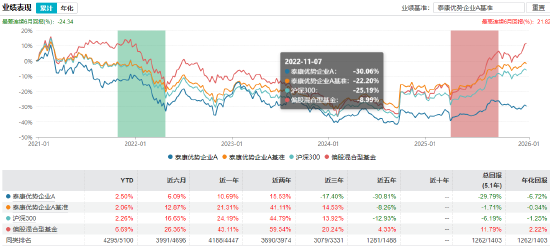
Core Viewpoint - The performance of fund manager Gui Yueqiang from Taikang Fund shows significant divergence across different product types, with equity products underperforming the market while fixed-income products have not met benchmarks either [1][27]. Group 1: Performance Overview - Gui Yueqiang's equity products have a three-year return of 3.89%, underperforming the CSI 300 index [1]. - His fixed-income products have a three-year return of 6.47%, also failing to beat the China Bond Composite Index [1]. - The two actively managed equity funds have seen losses exceeding 16% over three years, significantly trailing their performance benchmarks [2]. Group 2: Fund Composition and Holdings - Major holdings in the equity funds include Tencent Holdings (9.78%), Fuyao Glass (A+H combined 7.64%), and Nongfu Spring (3.03%) [3]. - The fixed-income investments constitute only 3.94% of the portfolio, indicating a core strategy driven by equity investments [3]. - The asset allocation in the third quarter report shows a concentration in manufacturing (40.74%), telecommunications (13.33%), and public utilities (2.36%), with no holdings in traditional blue-chip sectors like finance and real estate [8]. Group 3: Fund Performance Metrics - The Taikang Advantage Enterprise A fund has an asset size of 764 million yuan, with a return of -29.79% since its management began on December 22, 2020 [2]. - The Taikang Blue Chip Advantage fund has an asset size of 248 million yuan, with a total return of 1.56% since August 14, 2020, and a three-year return of -16.49% [5]. - The Taikang Hongtai Return A fund has an asset size of 450 million yuan, with a total return of 69.81% since June 8, 2016, but a three-year return of 6.25%, which does not beat its benchmark [15]. Group 4: Risk and Strategy - The fixed-income products generally maintain a solid foundation with over 75% in fixed income, focusing on high-quality bonds and minimizing credit risk [9][27]. - The equity products have shown a concentrated style, which has not yielded excess returns during recent market fluctuations [27].
A股两融余额结束10连增
Zheng Quan Shi Bao Wang· 2026-01-20 10:51
Core Viewpoint - The A-share market has experienced a cooling in margin trading, ending a streak of ten consecutive increases in margin balance as new regulations were implemented on January 19, 2026 [1][2]. Group 1: Margin Trading Regulations - On January 19, 2026, the minimum margin requirement for investors financing the purchase of securities was raised from 80% to 100% [3]. - This adjustment applies only to new financing contracts, while existing contracts will continue under the previous regulations [3]. Group 2: Market Data and Trends - As of January 19, 2026, the margin trading balance in the A-share market was approximately 27,232 billion yuan, a decrease of about 84 billion yuan from the previous trading day, marking the end of a ten-day growth streak [2]. - The financing balance on the same day was around 27,059 billion yuan, down by approximately 85 billion yuan, also ending a ten-day increase [2]. - The total margin trading volume on January 19 was about 2,684 billion yuan, the lowest daily figure since January 6, 2026, and the lowest for the year [2]. - The proportion of margin trading volume to total A-share trading volume fell to 9.82%, the first time it has been below 10% since December 16, 2025, compared to 11.01% on January 16, 2026 [2]. Group 3: High Margin Balances in Specific Stocks - Despite the overall decline in margin trading balance, many stocks still maintain high margin balances, with 17 stocks having balances exceeding 10 billion yuan as of January 19, 2026 [4]. - Notably, stocks such as China Ping An, Dongfang Wealth, and Ningde Times have margin balances exceeding 20 billion yuan [4].
A股重磅!宽基ETF连续出现净赎回,有“巨无霸”份额回落至“924”行情之前,多只科创、创业板系ETF份额缩水,发生了啥?
Jin Rong Jie· 2026-01-20 08:57
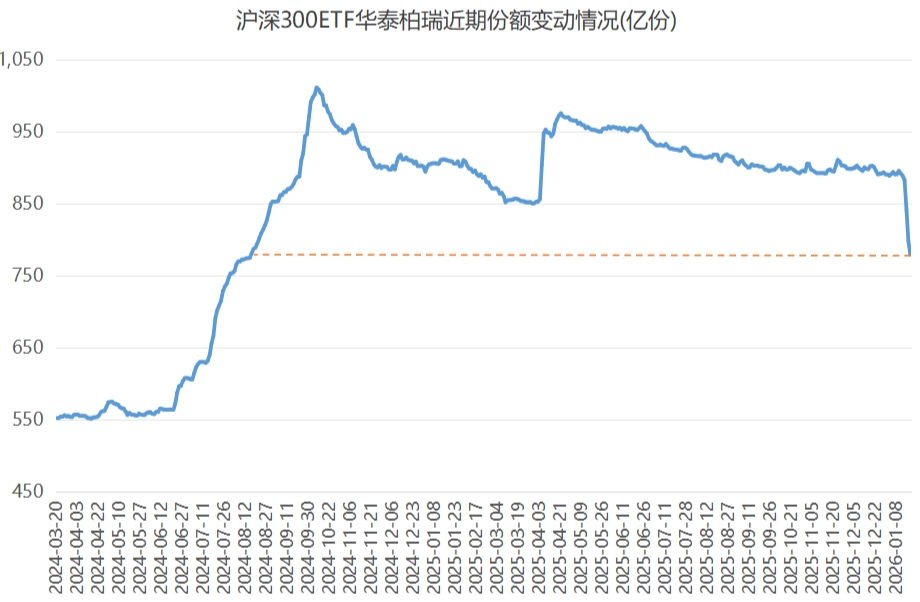
Group 1 - Recent net redemptions in A-share broad-based ETFs have drawn market attention, with significant outflows recorded on January 15 and 16, totaling 687 billion and 863 billion respectively, marking the highest single-day outflows in history [1] - As of January 19, four out of six major broad-based ETFs saw their shares decline by over 10% in the last three trading days, with the largest, Huatai-PB CSI 300 ETF, dropping to 778.63 billion shares, a scale of approximately 369.2 billion, the lowest since August 2024 [1] - The ChiNext and STAR Market ETFs also experienced significant declines, with the E Fund STAR 50 ETF and E Fund ChiNext ETF seeing share reductions of 34.55% and 20.22% respectively [3] Group 2 - In contrast to the outflows from broad-based ETFs, certain commodity, cross-border, and narrow-based ETFs attracted significant inflows, with the Southern Nonferrous ETF being the only product to receive over 10 billion in net inflows, totaling 100.87 billion, driven by rising base metal prices [3] - Other ETFs such as Yongying Satellite ETF, Harvest Software ETF, and GF Media ETF also received net inflows exceeding 6 billion [3] - According to CITIC Securities, the impact of ETF redemptions on individual stocks was significant, with main board, ChiNext, and STAR Market stocks experiencing sell-offs of 946 billion, 334 billion, and 265 billion respectively during the peak outflow days [3] Group 3 - Regulatory measures have been implemented to cool down the market following rapid price increases and overheated sentiment, including raising the minimum margin requirement for margin trading from 80% to 100% [5][6] - The China Securities Regulatory Commission emphasized the need for comprehensive market monitoring and timely counter-cyclical adjustments to maintain market stability and prevent excessive volatility [6] - There are differing views on the long-term outlook for A-shares, with some analysts suggesting the potential for a slow bull market due to reforms, while others remain skeptical about escaping historical volatility patterns [7]




电力行业月报:2025年全社会用电增速5%,12月火电发电降幅收窄
GOLDEN SUN SECURITIES· 2026-01-20 08:24
Investment Rating - The report suggests a positive outlook for the electricity sector, with a projected growth rate of 5% in total electricity consumption for 2025 [8][10]. Core Insights - Total electricity consumption in 2025 is expected to reach 103,682 billion kWh, reflecting a year-on-year increase of 5% [8][10]. - In December, total electricity consumption was 9,080 billion kWh, showing a year-on-year growth of 2.77% [8]. - The contribution of the tertiary industry and urban-rural residential electricity consumption to the growth of total electricity consumption is projected to reach 50% in 2025 [10]. - The electricity consumption growth rates for different sectors in 2025 are as follows: primary industry at 1,494 billion kWh (9.9% growth), secondary industry at 66,366 billion kWh (3.7% growth), tertiary industry at 19,942 billion kWh (8.2% growth), and urban-rural residential consumption at 15,880 billion kWh (6.3% growth) [10]. Summary by Sections Demand Side - The demand for electricity is driven significantly by the tertiary industry and urban-rural residential sectors, with notable growth in the charging and battery swapping services, as well as information transmission, software, and IT services, which grew by 48.8% and 17.0% respectively [10][13]. Supply Side - In December, the decline in thermal power generation narrowed, while the growth rates of other power sources slowed down. The total industrial power generation in December was 8,586 billion kWh, with a slight year-on-year increase of 0.1% [27]. - The year-on-year decline in industrial thermal power was 3.2%, which is a narrowing of 1.0 percentage points compared to November. Other power sources such as hydro, nuclear, wind, and solar also experienced slowed growth rates [34]. Investment Recommendations - The report recommends focusing on high-dividend thermal power leaders and companies with stable electricity prices and coal-electricity integration, such as Huaneng International, Huadian International, Guodian Power, Datang Power, Inner Mongolia Huadian, and Shaanxi Energy [49]. - It also suggests paying attention to wind and solar sectors, including Xintian Green Energy, Longyuan Power, and Zhongmin Energy. For gas sectors, it highlights quality leaders like Chengran, New Hope Energy, Kunlun Energy, and China Resources Gas [49].
长江电力20260119
2026-01-20 03:54
Summary of Conference Call on Hydropower Sector Industry Overview - The conference focused on the hydropower sector, particularly the performance of hydropower companies like Changjiang Electric Power (长江电力) amidst recent market fluctuations and regulatory changes in the energy sector [1][2]. Key Points and Arguments 1. **Market Performance**: - The overall hydropower sector experienced a significant weekly decline of 2.82%, marking the largest drop since early 2025. This decline is attributed to short-term market behaviors rather than fundamental issues [1][2]. 2. **Electricity Generation Growth**: - Changjiang Electric Power reported a year-on-year electricity generation growth of approximately 4%. However, the growth rate for Q4 was notably weaker compared to Q3, with a significant increase of around 20% in the single quarter [2]. 3. **Revenue and Earnings**: - The company's revenue for the year grew by 1.6%, slightly below the electricity generation growth, primarily due to a decline in electricity sales in coastal regions affecting external sales [2][3]. 4. **Non-Recurring Gains**: - In Q4, Changjiang Electric Power recognized a rare non-recurring gain of 1 billion, likely related to the IPO of a previously held non-listed entity, which positively impacted overall earnings [3][4]. 5. **Water Reservoir Levels**: - By the end of 2025, major reservoirs like the Three Gorges and Xiluodu showed increased water levels compared to the previous year, which is expected to support future electricity generation [4]. 6. **Market Sentiment and Fund Flows**: - Despite stable fundamentals, there was a notable outflow of funds from Changjiang Electric Power, reaching 950 million, the highest weekly outflow since March 2025. This reflects broader market sentiment and adjustments in investment strategies [5][6]. 7. **Dividend Policy**: - The company has committed to a 70% dividend payout ratio until 2030, which is expected to provide a stable yield of approximately 3.87%, with a significant spread over the 10-year government bond yield, indicating strong dividend attractiveness [6][7]. 8. **Comparative Analysis of Other Hydropower Companies**: - Other companies like Huaneng Hydropower and Guotou and ChuanTou are facing challenges due to electricity price pressures and growth slowdowns. Huaneng's valuation remains high, but it may face significant pressure in 2025-2026 due to expected declines in electricity prices [9][10][11]. 9. **Investment Recommendations**: - It is suggested to consider Changjiang Electric Power as a long-term investment due to its stable earnings and dividend profile. ChuanTou is also highlighted for its growth potential, while Guotou is recommended for observation due to its exposure to thermal power and associated risks [15]. Other Important Insights - The conference emphasized the importance of monitoring electricity price trends and regulatory changes, which could significantly impact the hydropower sector's performance in the coming years [10][11][12]. - The long-term growth potential of the hydropower sector remains strong, particularly for companies with robust asset bases and strategic investments in new projects [13][14]. This summary encapsulates the key discussions and insights from the conference call regarding the hydropower sector and specific companies within it.
晨会纪要-20260120
Guoxin Securities· 2026-01-20 03:26
Macro and Strategy - The bond market saw the 30-year to 10-year government bond yield spread rise to 46.2 basis points, the highest level since September 2022, driven by structural interest rate cuts signaling a dovish stance from the central bank [6] - The Ministry of Finance initiated the issuance of 30-year government bonds with a competitive bidding total of 32 billion yuan, raising concerns about supply pressure in the long-term bond market [6] - The increase in yield spread indicates a normalization of the bond market from extreme deflationary trading conditions, suggesting that the long-term bond's "scarcity" has been replaced by "scale" [6] Industry and Company Public Utilities and Environmental Protection - Shanxi Province has launched a bidding mechanism for the electricity price of new energy projects for 2026, with a total bidding scale of 9.576 billion kWh, including 3.527 billion kWh for wind power and 6.049 billion kWh for solar power [12] - The public utilities index rose by 0.06%, while the environmental index increased by 0.27%, indicating a relatively stable performance in these sectors [11] - Recommendations include large thermal power companies and national renewable energy leaders, as well as companies involved in nuclear power and water utilities [14] Home Appliances - The home appliance sector is experiencing pressure, with a significant decline in domestic retail sales of major appliances, down over 20% in December [15] - Exports of home appliances also fell by 8% in December, with air conditioning exports particularly affected due to high base effects [16] - Recommendations focus on leading white goods companies, anticipating a recovery in sales driven by continued government subsidies and improved export conditions in 2026 [18] Food and Beverage - The food and beverage sector is expected to benefit from cost reductions, particularly in sunflower seed prices, which are projected to decline by over 10% in 2026, benefiting companies like Qiaqia Food [20] - The report highlights the importance of effective cost transmission to improve profitability, emphasizing the need for stable competitive environments and strong cost control capabilities [19] - Recommendations include companies that can leverage cost advantages and maintain strong market positions [19] Beverage Industry - Dongpeng Beverage is projected to achieve revenue of 20.76 to 21.12 billion yuan in 2025, reflecting a year-on-year growth of 31.07% to 33.34% [21] - The company is expected to face some profit pressure in Q4 2025 due to pre-holiday inventory adjustments and upfront freezer costs [22] - The issuance of H-shares aims to support strategic initiatives, including supply chain improvements and overseas market expansion [22] Technology Sector - Haopeng Technology anticipates a revenue increase of 12% to 17% in 2025, driven by growth in AI-related battery applications [27] - The company is actively expanding its production capacity for energy-dense batteries to meet rising demand in AI applications [28] - The strategic focus on AI positions the company for sustained revenue growth in the coming years [27]
A股,两融降温!结束10连增
Zheng Quan Shi Bao Wang· 2026-01-20 03:21
Core Insights - The implementation of new margin requirements has led to a decline in the margin trading market, with a notable drop in both margin balance and trading volume on the first day of the new regulations [2][3][4]. Group 1: Market Overview - On January 19, 2026, the margin trading balance in the A-share market was approximately 27,232 billion yuan, a decrease of about 84 billion yuan from the previous trading day, ending a streak of 10 consecutive increases [3]. - The financing balance on the same day was around 27,059 billion yuan, down by approximately 85 billion yuan, also marking the end of a 10-day growth trend [3]. - The total margin trading volume on January 19 was about 2,684 billion yuan, the first time it fell below 3,000 billion yuan since January 6, 2026, and the lowest single-day figure for the year [3]. Group 2: Regulatory Changes - The new regulation, which increased the minimum margin requirement for investors from 80% to 100%, took effect on January 19, 2026, and applies only to new financing contracts [4]. - Existing financing contracts and their extensions are still governed by the previous margin requirements [4]. Group 3: Stock Performance - Despite the overall decline in margin trading balance, many stocks still maintain high margin balances, with 17 stocks having margin balances exceeding 10 billion yuan as of January 19 [5]. - Notably, stocks such as China Ping An, Dongfang Wealth, and Ningde Times have margin balances exceeding 20 billion yuan [5].