
国联安基金

Search documents
市场情绪现回暖迹象 资金借道ETF加速布局
Xin Hua Wang· 2025-08-12 06:27
Group 1 - The A-share market has shown weak overall performance this year, but there is still strong enthusiasm for ETF subscriptions, indicating a warming market sentiment and recovering investor confidence [1][5] - As of April 13, the total net inflow of funds into the ETF market reached 32.439 billion yuan, with stock-type ETFs seeing a net inflow of 17.610 billion yuan, significantly higher than previous months [2][7] - Major wide-based ETFs such as Huatai-PB CSI 300 ETF and Huaxia SSE Sci-Tech 50 ETF have seen substantial net inflows, ranking among the top in the stock and bond ETF categories [2][3] Group 2 - The number of shares for several wide-based ETFs has increased significantly, with the Huaxia SSE Sci-Tech 50 ETF's shares rising by 1.938 billion, reaching a historical high of over 21.9 billion shares [3] - Industry-specific ETFs have attracted funds into sectors with low valuations and recent rebounds, such as steel, real estate, and information technology, with the top three industry ETFs seeing net inflows of 988 million yuan, 619 million yuan, and 268 million yuan respectively [3][4] - Cross-border ETFs have also experienced significant growth, with a total net inflow of 42.566 billion yuan into 66 cross-border ETFs, including over 10 billion yuan into nine of them [4] Group 3 - Analysts remain optimistic about the long-term investment value of A-shares, suggesting that despite the current market being in a bottoming phase, quality leading companies still hold allocation value [5][6] - The market is expected to see a gradual resolution of unfavorable factors, with improvements in domestic economic conditions and a reduction in overseas liquidity concerns [6] - The second quarter is anticipated to maintain a favorable liquidity environment, with a focus on undervalued sectors such as energy and emerging industries like renewable energy [6]
同业存单基金规模破千亿 销售监管持续规范
Xin Hua Wang· 2025-08-12 06:26
Core Insights - The issuance of interbank certificate funds has rapidly progressed to the fifth batch, with over 80 fund companies actively applying for nearly 100 products, resulting in a total scale exceeding 100 billion yuan within just six months since the first batch was approved [1][2] - Regulatory authorities have proposed further norms and requirements regarding sales, promotion, and product operation to address potential violations amid the hot sales environment [1][3] Group 1: Market Dynamics - The total number of established interbank certificate funds has reached 17, with 27 approved for issuance, indicating strong market demand [1] - Major funds such as the GF and Guotai interbank certificate index funds have surpassed 10 billion yuan in early fundraising, with the latest fund from Harvest reaching the 10 billion yuan cap [1][2] Group 2: Investment Trends - Analysts highlight that the popularity of interbank certificate funds reflects a demand for liquidity management, with most funds being passively managed and tracking the AAA index [2] - The liquidity of interbank certificate funds is positioned between short-term bond funds and money market funds, catering to investors' needs for liquidity and yield certainty [2] Group 3: Regulatory Environment - The current phase is characterized by the digestion of existing applications, with an expected normalization of approvals for interbank certificate funds in the future [3] - Regulatory bodies have set clear guidelines for the promotion and sales of interbank certificate index funds, emphasizing the need to avoid misleading claims about stable returns and to disclose risks adequately [3][4] Group 4: Company Strategies - Fund companies are recognizing the importance of regulatory compliance in the issuance of interbank certificate index funds, which not only helps expand market scale but also enriches product lines [4] - Some companies are beginning to control the scale of their offerings, with announcements to suspend subscriptions or limit large subscriptions in response to high investor enthusiasm [4]
两市ETF两融余额增加29.93亿元丨ETF融资融券日报
Sou Hu Cai Jing· 2025-08-12 02:57
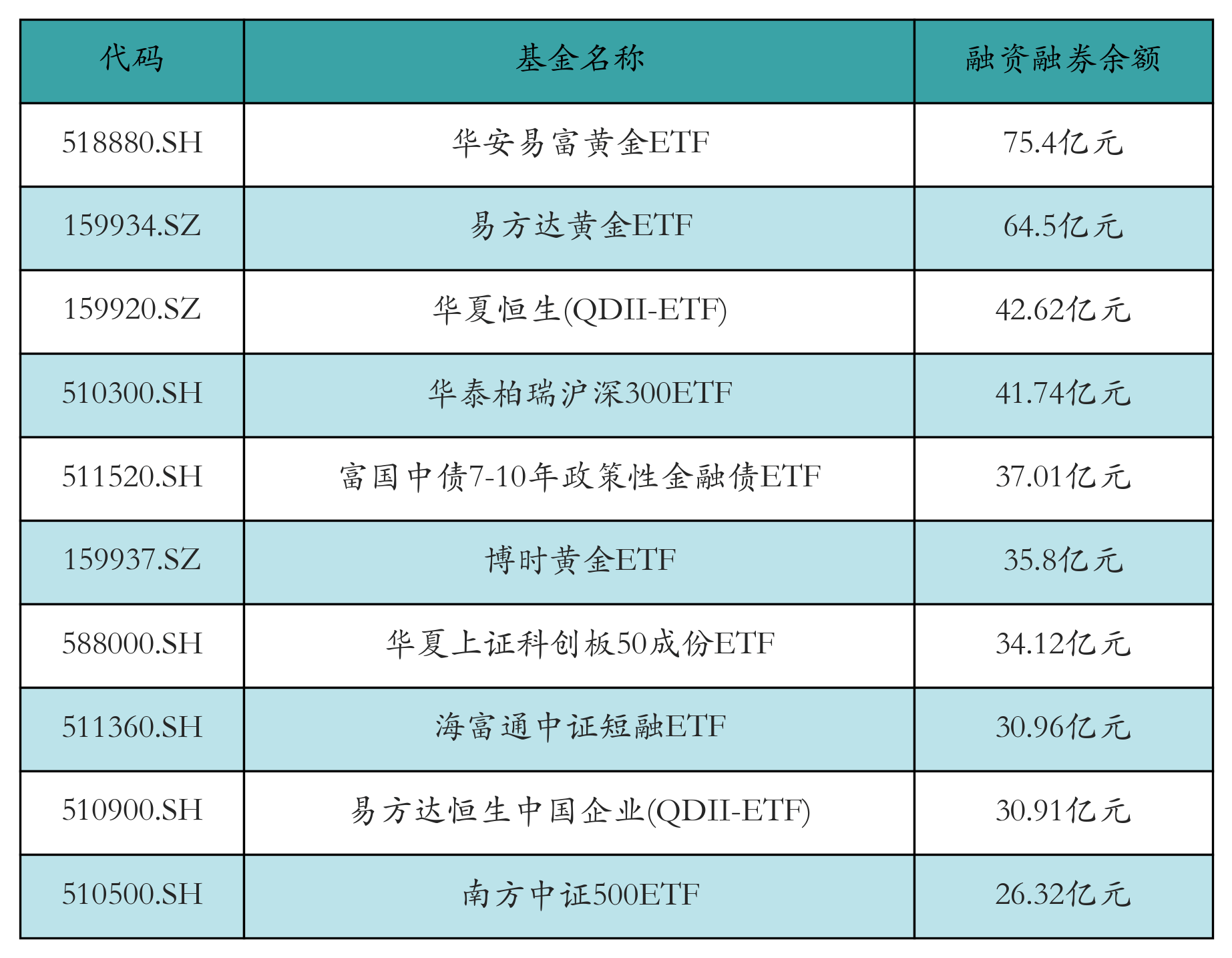
Market Overview - As of August 11, the total ETF margin balance in the two markets reached 105.293 billion, an increase of 2.993 billion from the previous trading day [1] - The financing balance was 99.098 billion, up by 3.257 billion, while the securities lending balance decreased by 263 million to 6.195 billion [1] - In the Shanghai market, the ETF margin balance was 72.832 billion, increasing by 2.585 billion, with a financing balance of 67.403 billion, up by 2.805 billion, and a securities lending balance of 5.429 billion, down by 220 million [1] - In the Shenzhen market, the ETF margin balance was 32.461 billion, an increase of 408 million, with a financing balance of 31.695 billion, up by 452 million, and a securities lending balance of 766 million, down by 43.596 million [1] Top ETF Margin Balances - The top three ETFs by margin balance on August 11 were: - Huaan Yifu Gold ETF (7.54 billion) - E Fund Gold ETF (6.45 billion) - Huaxia Hang Seng (QDII-ETF) (4.262 billion) [2] Top ETF Financing Buy Amounts - The top three ETFs by financing buy amounts on August 11 were: - Hai Futong Zhong Zheng Short Bond ETF (2.835 billion) - Fu Guo Zhong Dai 7-10 Year Policy Financial Bond ETF (1.939 billion) - E Fund Zhong Zheng Hong Kong Securities Investment Theme ETF (1.602 billion) [4] Top ETF Financing Net Buy Amounts - The top three ETFs by financing net buy amounts on August 11 were: - Fu Guo Zhong Dai 7-10 Year Policy Financial Bond ETF (1.293 billion) - Hai Futong Zhong Zheng Short Bond ETF (226 million) - Boshi Zhong Dai 0-3 Year National Development Bank Bond ETF (154 million) [5] Top ETF Securities Lending Sell Amounts - The top three ETFs by securities lending sell amounts on August 11 were: - Huatai Bairui Shanghai Shenzhen 300 ETF (20.897 million) - Huaxia Shanghai 50 ETF (19.016 million) - Southern Zhong Zheng 500 ETF (13.443 million) [6]

基金市场与ESG产品周报:周期主题基金表现占优,被动资金加仓金融地产、周期ETF-20250811
EBSCN· 2025-08-11 14:27
2025 年 8 月 11 日 总量研究 周期主题基金表现占优,被动资金加仓金融地产、周期 ETF ——基金市场与 ESG 产品周报 20250811 要点 市场表现综述:大类资产方面,本周(下文如无特殊说明,本周均指代 2025.8.4-2025.8.8)国内权益市场指数集体上涨,原油价格大跌。行业方 面,本周各申万一级行业多数上涨,国防军工、有色金属、机械设备行业涨 幅居前,医药生物、计算机、商贸零售行业跌幅居前。基金市场方面,本周 权益市场表现较好,各类基金净值均呈现上涨,偏股混合型基金涨幅为 1.73%。 基金产品发行情况:本周国内新基市场热度较高,新成立基金 34 只,合计 发行份额为 397.4 亿份。其中债券型基金 11 只、股票型基金 13 只、混合型 基金 7 只、FOF 基金 3 只。全市场新发行基金 38 只,从类型来看,股票型 基金 19 只、混合型基金 9 只、债券型基金 8 只、FOF 基金 2 只。 基金产品表现跟踪:行业主题基金方面,近期各板块基金轮动表现,本周除 医药主题外,其余各主题基金均呈现上涨,周期主题基金表现占优,净值上 涨 4.42%。截至 2025 年 8 月 8 ...
一周基金回顾:创新药板块巨震,资金借ETF逆市扫货
Sou Hu Cai Jing· 2025-08-11 01:05
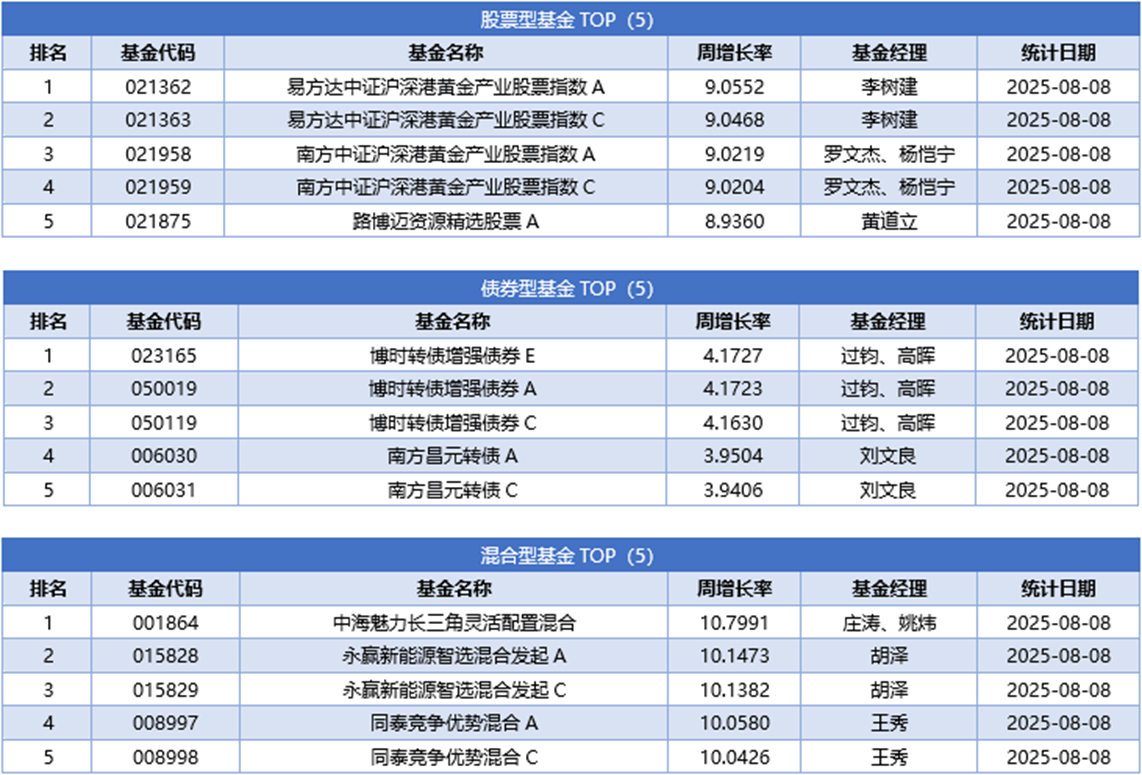
Group 1: ETF Market Insights - Innovative drug sector experiences a high-level correction, leading to increased inflows into ETFs, with over 3 billion yuan net inflow in the past week and record high shares [1] - As of the end of July, the number of ETFs listed on the Shanghai Stock Exchange reached 719, with a total scale exceeding 3.3 trillion yuan, including over 140 billion yuan in dividend ETFs and over 370 billion yuan in bond ETFs [1] - Year-to-date, the Shanghai market has seen cumulative net inflows into ETFs exceeding 400 billion yuan, indicating a continued influx of funds into index-based tools [1] Group 2: Fund Performance Overview - The overall market saw an increase last week, with the Shanghai Composite Index rising by 2.11%, the Shenzhen Component Index by 1.25%, and the ChiNext Index by 0.49% [2] - The top three performing sectors were defense and military, non-ferrous metals, and machinery equipment, with increases of 7.27%, 5.83%, and 5.38% respectively [2] - Conversely, the pharmaceutical, commercial trade, and computer sectors experienced declines of 0.45%, 0.16%, and 0.15% respectively [2] Group 3: Top Performing Funds - The best-performing fund last week was the China Ocean Charm Yangtze River Delta Flexible Allocation Mixed Fund, with a weekly increase of 10.7991% [3] - In the stock fund category, the top performer was the E Fund CSI Hong Kong and Shanghai Gold Industry Stock Index A, with a weekly increase of 9.0552% [3] - The leading bond fund was the Bosera Convertible Bond Enhanced Bond E, with a weekly increase of 4.1727% [3] Group 4: New Fund Launches - A total of 71 new funds were launched last week, with the largest fundraising target being the Huashang CSI 300 Index Enhanced A Fund, aiming for 8 billion yuan [1][5] - The majority of the new funds were mixed funds, with 17 launched, while 64 funds distributed dividends, primarily bond funds [1][5] - The fund with the highest dividend payout was the ICBC Credit Suisse Clean Energy Closed-End Infrastructure Securities Investment Fund, distributing 6.0000 yuan per 10 fund shares [1]
投资大家谈 | 杨岳斌:对风险的定义和误区
Sou Hu Cai Jing· 2025-08-10 12:10
Core Viewpoint - The article discusses the fundamental differences in the definition of risk between Wall Street and value investors, emphasizing that these differences lead to distinct investment strategies and perspectives when evaluating undervalued businesses [1][3][27]. Group 1: Definitions of Risk - Wall Street defines risk primarily as the relative volatility of a stock or portfolio, often measured by beta, which quantifies past price fluctuations [7][18]. - Value investors, on the other hand, view risk as the potential loss of principal and related returns, focusing on the intrinsic value of a business rather than its historical price volatility [6][19]. - The article highlights that the understanding of risk is crucial for making accurate investment decisions, as a misinterpretation can lead to significant financial losses [4][27]. Group 2: Investment Strategies - Value investors adopt a long-term perspective, believing that holding undervalued businesses over time reduces risk, while Wall Street often emphasizes short-term trading strategies [20][21]. - The article contrasts the "Business Picker" approach of value investors, who focus on the underlying business fundamentals, with the "Stock Picker" mentality of Wall Street, which prioritizes market trends and price movements [14][15]. - Value investors prefer concentrated investments in a few well-understood businesses, arguing that diversification can increase risk due to the complexity of managing multiple variables [22][23]. Group 3: Risk Assessment Methodologies - The article outlines Buffett's five-factor method for assessing investment risks, which includes evaluating the long-term economic characteristics of a business, the competence of its management, and the impact of inflation on purchasing power [10][11]. - This method contrasts with Wall Street's reliance on quantitative measures like beta, which may not accurately reflect the true risks associated with an investment [12][19]. - The emphasis on qualitative assessments in value investing allows for a more nuanced understanding of risk, which can lead to better investment outcomes over time [26][27]. Group 4: Conclusion - The article concludes that the differing definitions and approaches to risk between Wall Street and value investors result in fundamentally different investment philosophies, with value investors more likely to achieve long-term success by focusing on intrinsic value and business fundamentals [24][27].
基金市场一周观察(20250804-20250808):股债齐涨,小盘成长风格占优
CMS· 2025-08-09 15:38
1. Report Industry Investment Rating No relevant content provided. 2. Core Viewpoints of the Report - This week, the equity market closed higher overall, with the CSI 1000 leading the way and the small - cap growth style outperforming. The bond market also trended upward, and the convertible bond market rose [1][2][6]. - Among the industries, non - ferrous metals, machinery, and national defense and military industries led the gains, while pharmaceuticals and consumer services declined [2][6][9]. - Active equity funds had an average return of 1.80%. For bond - type funds, short - term bond funds had an average return of 0.06%, medium - and long - term bond funds had an average return of 0.08%, and convertible bond funds and bond funds with equity exposure achieved positive average returns [1][2]. - This week, there were 3 new stocks listed, and no new stocks broke their issue prices on the first day of listing. The average return of sample new - stock subscription funds was 0.59%, and the new - stock subscription yield of an 800 - million - yuan account was 0.023% [2][37]. - As of August 6, 2025, the average returns of low - risk, medium - risk, and high - risk FOF funds in the sample in the past week were 0.22%, 0.37%, and 0.47% respectively [2]. - During the statistical period, equity - biased QDII and bond - type QDII funds rose by 0.34% and 0.52% on average, while index - type and other - type QDII funds fell by 0.30% and 0.45% on average. REITs funds fell by 0.31% on average this week [2]. 3. Summary by Directory 3.1 Market Review - The equity market closed higher overall this week, with the CSI 1000 leading the gains and the small - cap growth style outperforming. As of the close, the Shanghai - Shenzhen 300 Index closed at 4105 points, up 1.23%; the Shanghai Composite Index closed at 3635 points, up 2.11%; the Shenzhen Component Index closed at 11129 points, up 1.25%; and the ChiNext Index closed at 2334 points, up 0.49%. In the Hong Kong stock market, the Hang Seng Index rose 1.43%, and the Hang Seng Tech Index rose 1.17% [6]. - In terms of industry performance, non - ferrous metals, machinery, and national defense and military industries led the gains, with increases of over 5%, while pharmaceuticals and consumer services declined [9]. - As of August 8, 2025, among the 5422 stocks in the A - share market, 4041 stocks rose this week. The number of rising stocks on the Beijing Stock Exchange, ChiNext, Science and Technology Innovation Board, and Main Board were 140, 1035, 421, and 2445 respectively [12]. 3.2 Key Fund Tracking 3.2.1 Active Equity - **Fund Performance**: The average return of the full - market funds in the sample this week was 1.80%. Funds with better performance were heavily invested in industries such as automobiles and machinery. For industry - themed funds, funds in the cyclical and mid - stream manufacturing sectors had leading average returns, while those in the pharmaceutical sector lagged behind [18][20]. - **Position Estimation**: This week, the positions of ordinary stock - type and partial - stock hybrid funds both increased. Compared with the previous week, the position of ordinary stock - type funds rose by 1.06 percentage points, and that of partial - stock hybrid funds rose by 2.19 percentage points. Actively managed partial - stock funds increased their allocations to cyclical, consumer, growth, and financial sectors and reduced their allocations to stable sectors. In terms of sub - industries, the allocations to household appliances, communications, and computers increased, while those to automobiles, electronics, and petroleum and petrochemicals decreased [23]. 3.2.2 Bond - type Funds - **Bond Market Performance**: This week, the bond market trended upward. The ChinaBond Total Wealth Index closed at 246.91, up 0.1% from last week; the ChinaBond Treasury Bond Index closed at 247.9, up 0.13%; and the ChinaBond Credit Bond Index closed at 224.18, up 0.09%. The CSI Non - Pure Bond Fund Index closed at 2229.59 on Thursday, up 0.45% from last Thursday. The CSI Convertible Bond Index closed at 467.77, with a weekly increase of 2.31%, and the trading volume was 422.4 billion yuan, a change of 36.293 billion yuan from last week [25][27]. - **Fund Performance Overview**: This week, the average return of short - term bond funds was 0.06%, and the median was 0.06%; the average return of medium - and long - term bond funds was 0.08%, and the median was 0.08%. The average return of first - tier bond funds was 0.29%, and the median was 0.16%; the average return of second - tier bond funds was 0.57%, and the median was 0.44%. The average return of partial - bond hybrid funds was 0.62%, and the median was 0.53%; the average return of low - position flexible allocation funds was 0.53%, and the median was 0.38%. The average return of convertible bond funds was 2.59%, and the median was 2.52% [31][33][34][36]. 3.2.3 New - stock Subscription Funds - **New - stock Overview**: This week, 3 new stocks were listed, and 2 had inquiry and offline placement details, with a total raised capital of 1.877 billion yuan. There were no break - even stocks on the first day of listing, and the total expected入围 income was 182,500 yuan [37]. - **New - stock Subscription Yield Calculation**: Assuming participation in the offline new - stock subscription of new stocks every week and being入围, the weekly new - stock subscription yield sequence of an 800 - million - yuan account was calculated based on the winning rate of Class A investors [38]. - **Fund Company New - stock Subscription Overview**: Six fund companies with more than 2 new - stock subscription funds were selected. The weekly new - stock subscription yield of an 800 - million - yuan account this week was 0.023%. The optimal scale for weekly and annual new - stock subscription was 400 million yuan [40]. - **New - stock Subscription Fund Performance**: According to the screening method, 38 new - stock subscription funds were selected. The average return of the new - stock subscription funds in the sample this week was 0.59% [43]. 3.2.4 FOF Funds - The average returns of low - risk, medium - risk, and high - risk FOF funds in the sample in the past week were 0.22%, 0.37%, and 0.47% respectively [44]. 3.2.5 QDII Funds - During the statistical period, equity - biased QDII funds rose by 0.34% on average, and index - type QDII funds fell by 0.30% on average. Other - type QDII funds fell by 0.45% on average, and bond - type QDII funds rose by 0.52% on average [45][46]. 3.2.6 REITs Funds - This week, REITs funds fell by 0.31% on average. Among them, Huatai Zijin Baowan Logistics Warehouse REIT led the gains, rising 4.31% in the past week. Huaxia Huadian Clean Energy REIT had the highest liquidity, with a trading volume of 214.361 million yuan in the past week [47].
业绩增长推动规模扩张 基金积极布局QDII业务
Shang Hai Zheng Quan Bao· 2025-08-08 18:55
Group 1 - The core viewpoint of the news is the increasing enthusiasm among fund companies to apply for QDII (Qualified Domestic Institutional Investor) business, driven by the strong performance of QDII products over the past three years [1][2] - As of August 1, 2023, Xinyin Fund has officially applied for QDII business qualifications, becoming the fourth fund company to do so this year, following Xinyuan Fund, Minsheng Jia Yin Fund, and Guolian An Fund [1] - The total scale of QDII funds reached approximately 680 billion yuan by the end of June 2023, more than double the scale at the end of 2022, indicating a significant growth trend [2] Group 2 - The average net value growth of QDII funds has shown a positive trend, with annual average net value increases of 6%, 12%, and 16% in recent years, highlighting a consistent upward trajectory [1][2] - The most profitable QDII fund this year is the Huatai-PB Hong Kong Advantage Selected Mixed Fund, which has achieved a net value increase of 144% [1] - QDII-ETF products have seen substantial inflows, with over 16 billion units net subscribed since July, contributing to a total scale of 364.5 billion yuan [2]
资金持续流入港股市场,宽基ETF资金净流出居前
Zhong Guo Jing Ji Wang· 2025-08-08 08:55
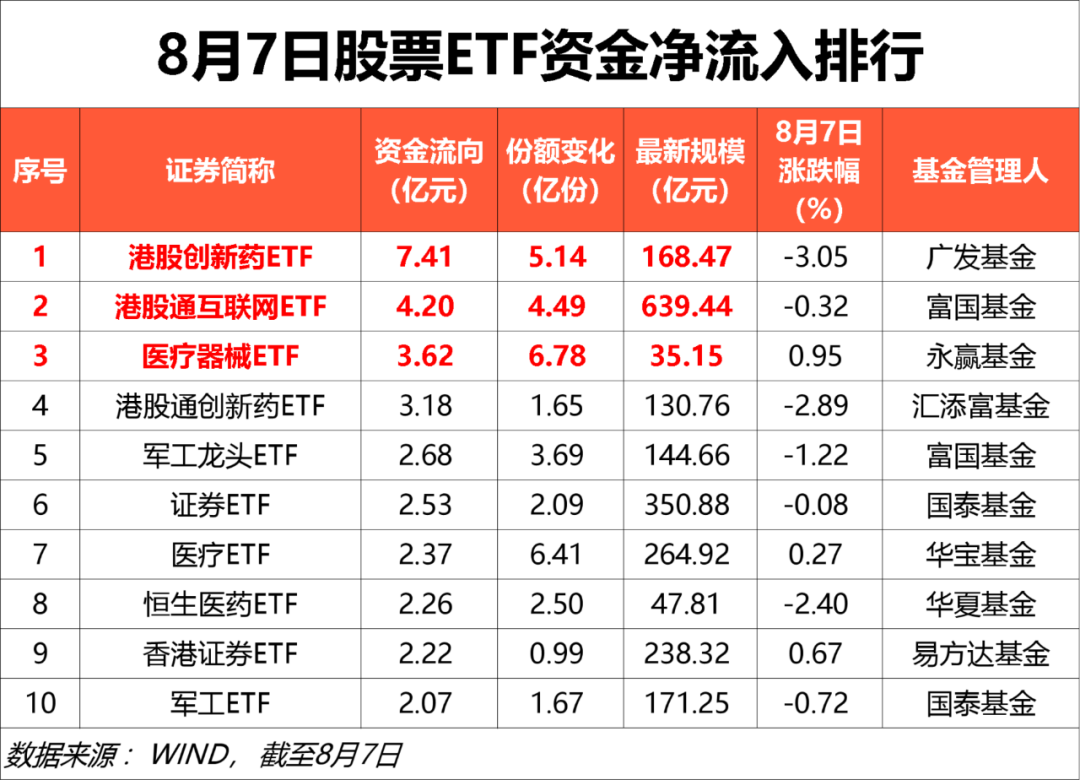
8月7日,A股三大指数震荡分化。半导体芯片、稀土永磁、医疗器械等板块表现强势,创新药板块迎来调整。 当日股票ETF市场整体表现活跃,港股相关ETF"吸金"明显,单日净买入超27亿元,近5日资金流入恒生科技指数超45亿元;宽基ETF净流出明显。 来源:中国基金报 资金持续流入港股市场 Wind数据显示,截至8月7日,全市场1157只股票ETF(含跨境ETF)总规模达3.81万亿元。在当日股市震荡分化的行情下,按照区间成交均价测算, 股票ETF整体净流出达31.7亿元,部分资金选择"落袋为安"。 从大类型来看,资金持续流入港股市场。上一交易日港股市场ETF资金净流入居前,达27.16亿元。从5日角度观测,近期资金流入恒生科技指数超45 亿元,流入港股通互联网指数超29亿元。 从板块看,昨日资金净流入居前的板块包括港股医药、港股互联网、港股科技,净流入分别为16亿元、5.7亿元和4.8亿元,显示部分资金对这些港股 行业后市继续看好。 具体到指数维度,8月7日中证短融指数单日资金净流入居前,达18.69亿元。另外,债券ETF净流入达43.13亿元。 股市震荡分化背景下,头部基金公司旗下ETF持续获得资金净流入。 易方 ...
热门基现发行小高峰!这些创新指数也来了
Zheng Quan Shi Bao· 2025-08-08 07:17
Core Insights - The recent surge in the issuance of the CSI A500 index funds has shifted from large public funds to small and medium-sized public funds, with over 75 fund companies participating since Q4 2024 [1][4][3] - The total number of CSI A500 index funds has reached 113, with a total issuance scale of approximately 216.56 billion yuan, and the current scale is about 296.48 billion yuan [4][5] - New strategy indices related to the CSI A500, such as "dividend" and "quality" indices, have been developed, indicating a diversification in fund company strategies [1][6] Fund Issuance Details - As of June 12, there are 9 CSI A500 index-related funds currently being issued, with notable funds from CITIC Jiantou and Guolian An [2][3] - The issuance period for these funds varies, with some starting as early as late May and others beginning in June [2][3] Market Trends - The average unit net value of the 113 CSI A500 index funds is 0.997 yuan, with an average return rate of -0.23% since inception, indicating a significant number of funds are below the 1 yuan mark [5][6] - The market remains optimistic about the CSI A500 index funds, with expectations for new fund products tracking the newly developed indices [6][7] Economic Context - The low interest rate environment is making dividends from listed companies more attractive, potentially increasing stock valuations [7] - Despite some short-term performance declines, overall corporate profits have shown a growth trend, with a year-on-year increase of approximately 3% in Q1 [7]