杭州银行

Search documents
银行行业点评报告:企业信贷超季节性增长,信贷投放前置趋势或延续
KAIYUAN SECURITIES· 2026-01-16 05:44
Investment Rating - Investment rating: Positive (maintained) [2] Core Viewpoints - In December, corporate credit experienced a seasonal growth, with expectations that the credit issuance in Q1 2026 may reach the highest level in history [4] - The report highlights that while the year-end credit issuance slowed down, the impact of debt reduction policies has weakened, allowing for stable credit growth [4] - The report indicates that the demand for corporate loans has shown signs of recovery, with a year-on-year increase of 5.8 trillion yuan in December, although the overall demand still requires further observation [4] - The report notes that the new issuance rates for corporate and personal housing loans have stabilized at 3.10%, reflecting a shift in bank lending strategies [5][6] Summary by Sections Credit Market Analysis - December saw a new issuance of 910 billion yuan in RMB loans, a year-on-year decrease of 80 billion yuan, with a balance growth rate of 6.4% [4] - The corporate loan structure improved, with short-term and medium-to-long-term loans increasing by 3.9 trillion yuan and 2.9 trillion yuan respectively [4] - The report emphasizes that the overall credit demand from residents remains weak, with a year-on-year decrease of 441.6 billion yuan in December [4] Social Financing and Government Bonds - In December, social financing increased by 2.2 trillion yuan, a year-on-year decrease of 646.2 billion yuan, with a stock growth rate of 8.3% [5] - The slowdown in government bond issuance has been identified as a drag on social financing, with new government bonds issued at 683.3 billion yuan, one of the lowest levels of the year [5] Monetary Supply and Deposits - M2 growth in December was 8.5%, while M1 growth fell to 3.8% [6] - The report notes that the increase in fiscal deposits may indicate a weaker year-end fiscal spending compared to the previous year [6] Investment Recommendations - The report suggests that banks with strong wealth management businesses and active financial environments in key regions will benefit from the stable growth policies [7] - Recommended banks include CITIC Bank, with beneficiaries including Agricultural Bank of China, China Merchants Bank, and others [7]




银行行业点评报告:政策支撑稳增长,关注Q1银行景气度修复行情
KAIYUAN SECURITIES· 2026-01-16 03:11
Investment Rating - The investment rating for the banking industry is "Positive" (maintained) [2] Core Viewpoints - The report emphasizes that policy support is crucial for stabilizing growth, with a focus on the recovery of banking sector sentiment in Q1 [4][7] - The People's Bank of China (PBOC) has indicated the feasibility of further interest rate cuts and reserve requirement ratio (RRR) reductions due to high current levels of RRR and a stable exchange rate environment [4] - Structural monetary policy tools have been introduced to lower the overall financing costs in society, with specific interest rate cuts for various loans [5] - The resumption of government bond trading operations by the PBOC is aimed at enhancing the monetary policy toolkit and ensuring smooth issuance of government bonds [6] Summary by Sections Monetary Policy and Economic Recovery - The PBOC's recent measures include a potential for 1-2 interest rate cuts within the year, with a possible reduction of 10 basis points each time, with the earliest cut expected in Q1 [4] - The report notes that the core Consumer Price Index (CPI) has shown positive growth, indicating effective policy collaboration [7] Banking Sector Performance - The banking sector is expected to benefit from improved economic conditions, with a significant increase in credit issuance anticipated in January, potentially the highest in history [7] - Banks with strong wealth management capabilities and those in active financial environments are likely to gain more from the supportive policy landscape [7] Recommendations - The report recommends focusing on banks such as CITIC Bank, Construction Bank, Agricultural Bank, and others, which are expected to benefit from the current economic recovery and policy support [7]

银行行业:2025年12月金融数据点评:企业中长贷边际修复,关注政策成效释放
Yin He Zheng Quan· 2026-01-16 03:11
Investment Rating - The report maintains a "Recommended" rating for the banking industry [1] Core Insights - The banking sector is experiencing a marginal recovery in medium to long-term loans, with a focus on the effectiveness of policy measures being released [1] - Social financing (社融) has shown a year-on-year decrease, with a month-on-month decline in growth rate. In December, new social financing amounted to 2.21 trillion yuan, a year-on-year decrease of 645.7 billion yuan [5] - The growth of RMB loans and corporate bonds has made a significant positive contribution to social financing increment, with RMB loans increasing by 975.7 billion yuan in December, a year-on-year increase of 135.5 billion yuan [5] - Corporate loans have shown a notable increase, with a total increase of 1.1 trillion yuan in December, a year-on-year increase of 580 billion yuan, indicating a marginal recovery in financing demand from the real economy [5] - The M2 growth rate has risen, with M1 and M2 increasing by 3.8% and 8.5% year-on-year, respectively [5] - The report suggests that the government bond's contribution to social financing has weakened towards the end of the year, while RMB credit shows signs of marginal improvement, primarily supported by corporate loans [5] Summary by Sections Social Financing - In December, the total social financing stock increased by 8.3% year-on-year, with a month-on-month decline of 0.2 percentage points [5] - The structure of corporate loans has improved, with medium to long-term loans increasing by 330 billion yuan and short-term loans by 370 billion yuan [5] Loan Data - As of the end of December, the balance of RMB loans from financial institutions increased by 6.4% year-on-year, remaining stable compared to the previous month [5] - The demand for loans from the household sector remains weak, with a decrease of 916 billion yuan in December, a year-on-year decrease of 4.416 trillion yuan [5] Investment Recommendations - The report emphasizes the continued attractiveness of the banking sector's dividend value, recommending specific banks such as Industrial and Commercial Bank of China, Agricultural Bank of China, and others [5]



银行财富管理架构变阵 抢滩300万亿居民资产
2 1 Shi Ji Jing Ji Bao Dao· 2026-01-15 15:07
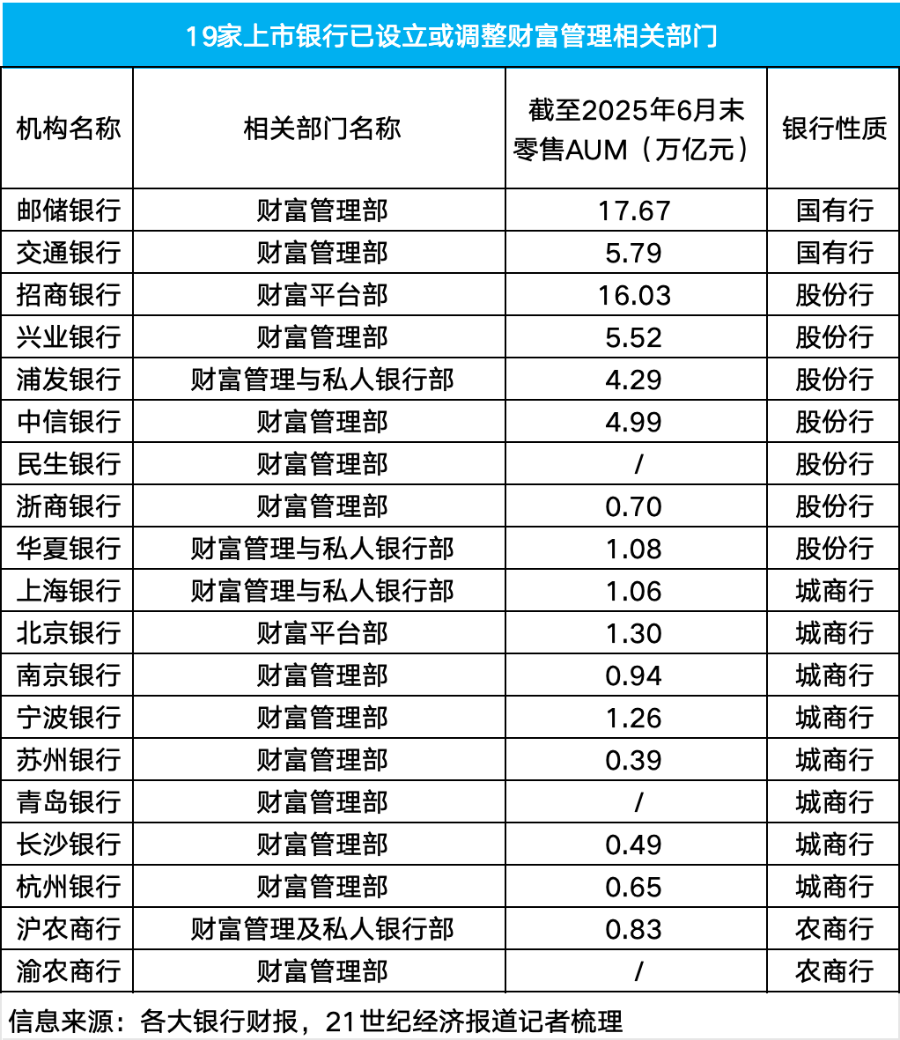
Core Insights - The wealth management market is heating up, with banks accelerating the integration of their wealth management departments to capture this promising market [1][2] - By June 2025, China's investable assets are expected to exceed 300 trillion yuan, indicating significant growth potential in wealth management as many assets remain "asleep" [1] - Major banks are restructuring their organizational frameworks to enhance their wealth management strategies and business layouts [1] Group 1: Bank Actions and Adjustments - In 2025, several major banks, including Bank of Communications and Postal Savings Bank, announced the establishment of wealth management departments at the head office level [3] - As of June 2025, 19 listed banks have established or adjusted their wealth management-related departments, including 2 state-owned banks, 7 joint-stock banks, 8 city commercial banks, and 2 rural commercial banks [3][4] - The establishment of these departments is seen as a key move for state-owned banks to deepen their wealth management strategies and promote digital transformation [3] Group 2: Strategic Focus and Market Dynamics - Different banks are focusing on various aspects of wealth management, with some emphasizing the establishment of wealth management departments as a core strategy [5] - The restructuring of wealth management departments signals a strategic shift in response to narrowing interest margins and evolving customer demands for diversified asset allocation [6][7] - The actions of major state-owned banks serve as a bellwether for the industry, indicating a shift from incremental competition to in-depth management of existing clients [8] Group 3: Wealth Management Market Landscape - As of June 2025, the retail asset management scale (AUM) among 42 listed banks shows a clear tiered structure, with state-owned banks leading the market [11] - The first tier includes major state-owned banks like ICBC, ABC, and CCB, with AUMs of 24 trillion yuan, 23.68 trillion yuan, and 22 trillion yuan respectively [11] - The second tier consists mainly of joint-stock banks, while the third tier includes city commercial banks and rural commercial banks, which are crucial for local wealth management ecosystems [11] Group 4: Future Competition and Technological Integration - Future competition in wealth management will focus on service quality, technological capabilities, and comprehensive financial ecosystems [13] - The establishment of wealth management departments aims to shift banks from product-driven to customer-driven models, enhancing service consistency and customer loyalty [13] - Financial technology is expected to play a critical role in enhancing service depth and breadth, with AI being utilized for investment advisory and customer experience management [14][15]

家庭资配视角:日本存款也搬家了吗?
NORTHEAST SECURITIES· 2026-01-15 14:42
Investment Rating - The report assigns an "Outperform" rating for the banking sector, indicating that the sector is expected to outperform the market benchmark in the next six months [5]. Core Insights - The core insight of the report is that the allocation of household assets in Japan is primarily influenced by the risk-return ratio. Even with declining deposit rates, the proportion of cash and deposits in household asset allocation tends to increase when risk aversion rises. There is no systemic shift of deposits towards riskier assets observed in the long term [1][10][16]. Summary by Sections Household Asset Allocation - The report examines the changes in household asset allocation in Japan since 1990, highlighting that the core factor influencing this allocation is the risk-return ratio. When risk aversion increases, the proportion of cash and deposits rises despite falling interest rates [1][10]. - The report suggests that household wealth allocation behavior aligns with the "Merton Rule," where the proportion of risk assets depends on expected returns, excess returns over risk-free rates, risk levels, and the household's risk aversion coefficient [2][12]. Financial Asset Flow and Structure - From a short-term perspective, the net flow of equity and fund investments is closely correlated with stock market performance. Positive net inflows occur during strong market performance, while negative outflows happen during weak performance [3][13]. - Long-term observations show that from 1994 to 2002, the proportion of deposits and cash increased from 49% to 54%, despite a shift in the structure of deposits where time deposits saw negative net flows while demand deposits increased [14][15]. Investment Outlook for 2026 - The report anticipates that high real interest rates will continue to suppress credit demand from private enterprises and retail sectors, with local state-owned enterprises expected to drive growth due to increased investment in larger provinces as per the "14th Five-Year Plan" [26]. - It is expected that there will be a significant interest rate cut in the first quarter of 2026, which may improve bank interest margins in the latter half of the year [26].
杭州银行聘任张精科为新任行长 此前担任该行副行长
Xi Niu Cai Jing· 2026-01-15 08:10
公告显示,张精科现任杭州银行党委副书记、副行长。曾任杭州银行科技支行副行长,杭州银行文创支行行长,杭州银行资产管理部总经理,杭州银行科技 文创金融事业部党委书记、总经理,杭州银行党委委员、人力资源部总经理。截至公告披露日,张精科持有该行股份117600股。 1月12日,杭州银行发布公告称,董事会已审议通过《关于聘任杭州银行股份有限公司行长的议案》,同意聘任张精科为行长。 2025年4月,杭州银行原行长虞利明因个人原因离任,此后,该行行长一职便空缺至今。 与张精科的内部成长路径不同,杭州银行前任行长虞利明是"空降"而来。他曾任杭州市金融投资集团有限公司党委副书记、副董事长、总经理,2016年至 2022年期间,还担任杭州金投董事长兼杭州工商信托董事长,主导了多个房地产信托项目。 ...

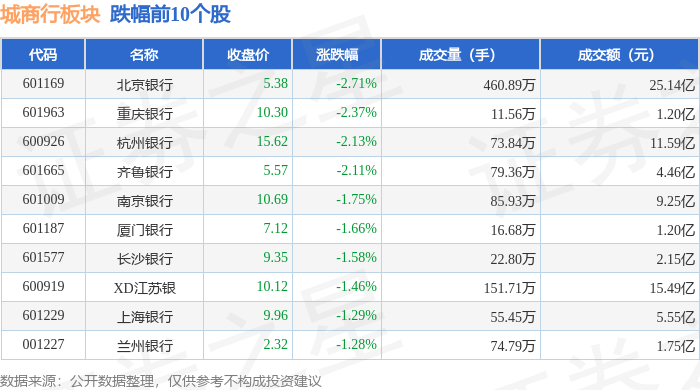
城商行板块1月14日跌2.11%,北京银行领跌,主力资金净流出7.29亿元
Zheng Xing Xing Ye Ri Bao· 2026-01-14 08:58
Core Viewpoint - The city commercial bank sector experienced a decline of 2.11% on January 14, with Beijing Bank leading the drop, while the overall market showed mixed results with the Shanghai Composite Index down 0.31% and the Shenzhen Component Index up 0.56% [1] Group 1: Market Performance - The closing price of Beijing Bank was 5.38, down 2.71%, with a trading volume of 4.6089 million shares and a transaction value of 2.514 billion [1] - Other notable declines included Chongqing Bank at 10.30 (-2.37%), Hangzhou Bank at 15.62 (-2.13%), and Qilu Bank at 5.57 (-2.11%) [1] - The city commercial bank sector saw a net outflow of 729 million in main funds, while retail investors contributed a net inflow of 53.1975 million [1] Group 2: Fund Flow Analysis - Hangzhou Bank had a main fund net inflow of 1.20 billion, but a net outflow from retail investors of 92.9469 million [2] - Suzhou Bank recorded a net inflow of 52.503 million from main funds, while retail investors had a net outflow of 54.0558 million [2] - Shanghai Bank experienced a main fund net inflow of 45.3249 million, with a retail net outflow of 46.6735 million [2]

强势股追踪 主力资金连续5日净流入90股
Zheng Quan Shi Bao Wang· 2026-01-14 08:53
连续5日或以上主力资金净流入个股排名 (文章来源:证券时报网) 证券时报·数据宝统计,截至1月14日收盘,深沪北共90只个股连续5日或5日以上主力资金净流入。税友 股份等连续14日主力资金净流入,排名第一;合锻智能等连续12日主力资金净流入,位列第二。从主力 资金净流入总规模来看,烽火通信主力资金净流入金额最大,连续6天累计净流入24.34亿元,用友网络 紧随其后,5天累计净流入19.08亿元。从主力资金净流入占成交额的比例来看,美年健康占比排名居 首,该股近5日上涨50.65%。(数据宝) | 605168 | 三人行 | 12 | 4.14 | 6.01 | 33.84 | | --- | --- | --- | --- | --- | --- | | 000875 | 吉电股 | 6 | 3.78 | 8.73 | 19.61 | | | 份 | | | | | | 000538 | 云南白 | 8 | 3.77 | 8.60 | -0.21 | | | 药 | | | | | | 603171 | 税友股 | 14 | 3.62 | 4.61 | 76.40 | | | 份 | | | | | | 6 ...



午评:沪指半日涨1.2% AI应用概念持续活跃
Zhong Guo Jin Rong Xin Xi Wang· 2026-01-14 04:04
Market Overview - A-shares experienced a collective rebound on January 14, with the Shanghai Composite Index rising over 1% and the ChiNext Index increasing over 2% [1] - The total trading volume in the Shanghai and Shenzhen markets reached 2.22 trillion yuan, a decrease of 215.5 billion yuan compared to the previous trading day [1] - Key sectors showing strong performance included AI applications, medical services, and internet finance, with numerous stocks hitting the daily limit [1][2] Sector Performance - The AI application sector saw significant gains, with over twenty constituent stocks reaching the daily limit, including Liou Co., which achieved six consecutive limit-ups in nine days [1] - The medical services sector also performed well, with companies like Nuo Si Ge and Pu Rui Si seeing increases of over 20%, and Mei Nian Health hitting the limit [1] - The internet finance sector was active, with La Ka La reaching a 20% limit-up and several other stocks rising over 10% [1] - Conversely, the banking sector faced adjustments, with Chongqing Bank and Hangzhou Bank both declining over 1% [1][2] Institutional Insights - CITIC Securities highlighted that AI in healthcare is expected to accelerate the restructuring of the trillion-yuan pharmaceutical market, with a stronger payment capability anticipated by 2026 [3] - Huatai Securities noted that the introduction of new REITs policies by the end of 2025 could lead to a significant development phase for C-REITs, enhancing asset liquidity and value reassessment for commercial real estate [3] - Galaxy Securities emphasized the ongoing commercialization of AI applications, particularly in generative search and content interaction, suggesting a focus on core internet assets and AI-enabled applications [4] Trade Data - China's total goods trade import and export value reached 45.47 trillion yuan in 2025, marking a 3.8% year-on-year increase and maintaining growth for nine consecutive years [5] - Exports reached 26.99 trillion yuan, up 6.1%, while imports hit a record high of 18.48 trillion yuan, growing by 0.5% [5] Medical Supply Procurement - The sixth batch of high-value medical consumables procurement results was announced, including 12 types of medical consumables, with 202 companies and 440 products successfully procured [6] Chip Export Regulations - The U.S. government has relaxed export controls on NVIDIA's H200 chips to China, allowing for renewed shipments to Chinese clients, with the U.S. Department of Commerce overseeing the approval process [7]
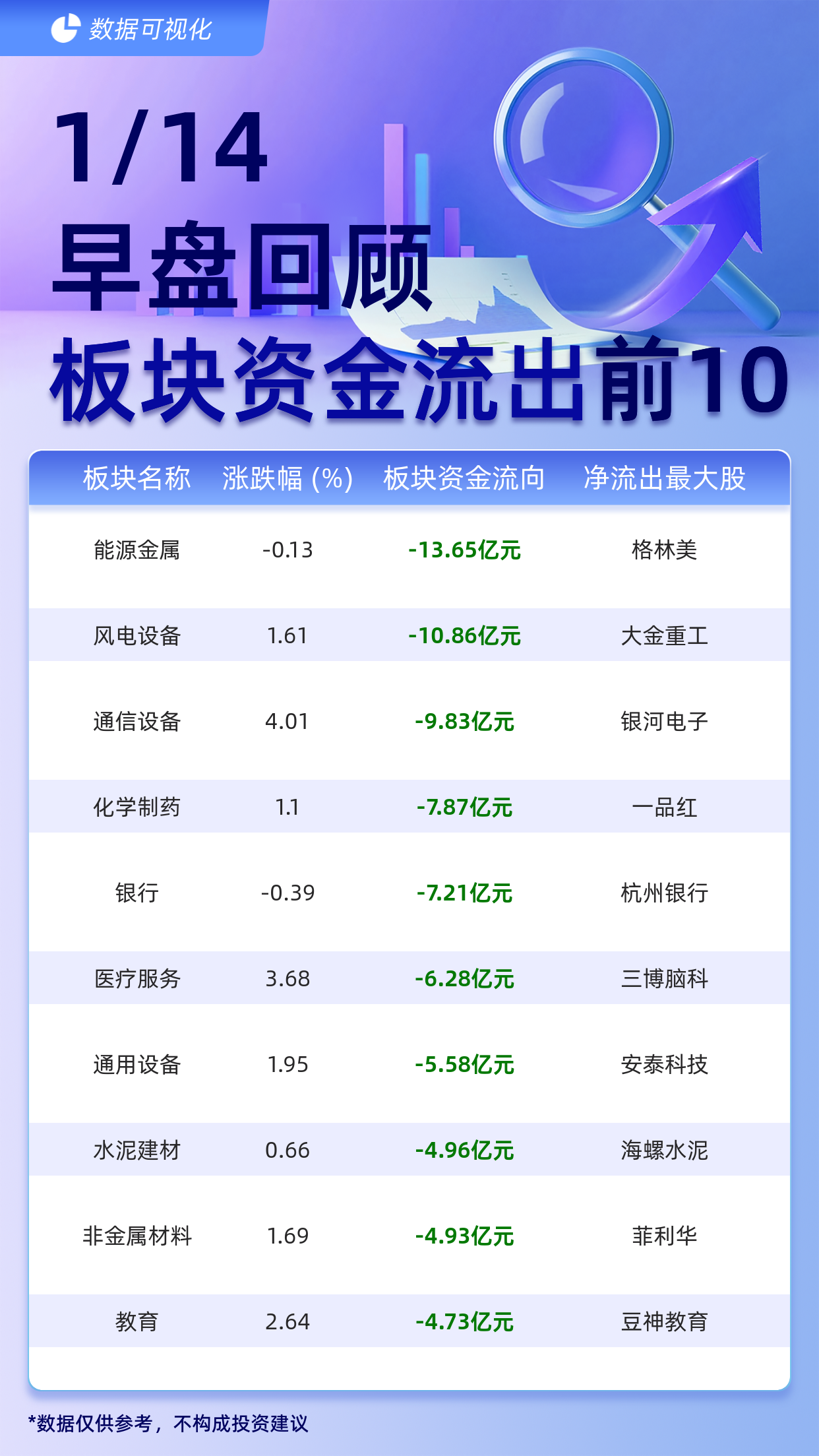
主力板块资金流出前10:能源金属流出13.65亿元、风电设备流出10.86亿元
Jin Rong Jie· 2026-01-14 04:03
Group 1 - The main market saw a net inflow of 19.18 billion yuan as of January 14 [1] - The top ten sectors with the largest capital outflows included Energy Metals (-1.365 billion yuan), Wind Power Equipment (-1.086 billion yuan), and Communication Equipment (-0.983 billion yuan) [1] - The banking sector experienced a capital outflow of 0.721 billion yuan, while the healthcare services sector saw an outflow of 0.628 billion yuan [1] Group 2 - The Energy Metals sector had a slight decline of 0.13% with a net outflow of 1.365 billion yuan, led by the company Greenmei [2] - The Wind Power Equipment sector increased by 1.61% but still faced a net outflow of 1.086 billion yuan, with major outflow attributed to Daikin Heavy Industries [2] - The Communication Equipment sector rose by 4.01% despite a net outflow of 0.983 billion yuan, primarily driven by Galaxy Electronics [2][3]