
洽洽食品

Search documents
休闲食品板块11月12日跌0.01%,桂发祥领跌,主力资金净流出1.71亿元
Zheng Xing Xing Ye Ri Bao· 2025-11-12 08:42
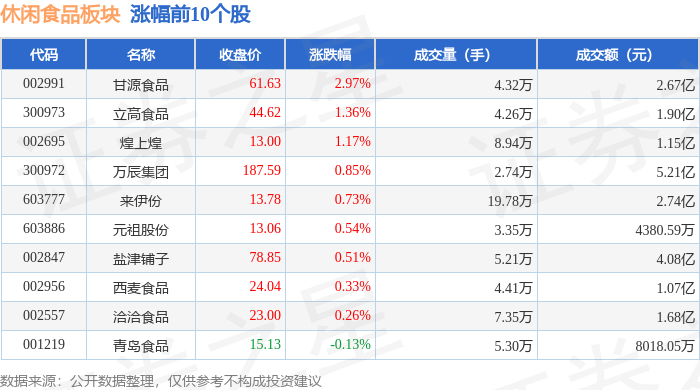
Market Overview - The leisure food sector experienced a slight decline of 0.01% on November 12, with Gui Faxiang leading the drop [1] - The Shanghai Composite Index closed at 4000.14, down 0.07%, while the Shenzhen Component Index closed at 13240.62, down 0.36% [1] Stock Performance - Notable gainers in the leisure food sector included: - Ganyuan Food: closed at 61.63, up 2.97% with a trading volume of 43,200 lots and a transaction value of 267 million [1] - Lihai Food: closed at 44.62, up 1.36% with a trading volume of 42,600 lots and a transaction value of 206.1 million [1] - Major decliners included: - Gui Faxiang: closed at 14.30, down 2.26% with a trading volume of 273,100 lots and a transaction value of 394 million [2] - Ziyan Food: closed at 19.27, down 2.18% with a trading volume of 29,900 lots and a transaction value of 58.19 million [2] Capital Flow - The leisure food sector saw a net outflow of 171 million from institutional investors, while retail investors contributed a net inflow of 249 million [2] - Specific stock capital flows included: - Ganyuan Food: net inflow of 17.70 million from institutional investors, with a net outflow of 12.58 million from speculative funds [3] - Lihai Food: net inflow of 10.29 million from institutional investors, with a net outflow of 7.30 million from speculative funds [3]



洽洽食品成立洽宝文化传播公司
Zheng Quan Shi Bao Wang· 2025-11-12 06:16
Core Viewpoint - Hefei Qiabao Cultural Communication Co., Ltd. has been established, fully owned by Qiaqia Food Co., Ltd. (002557) [1] Company Summary - The legal representative of Hefei Qiabao Cultural Communication Co., Ltd. is Chen Lili [1] - The business scope of the new company includes retail of daily ceramic products, kitchenware, daily miscellaneous goods, and cosmetics [1]

洽洽食品股份有限公司关于第五期员工持股计划存续期即将届满的提示性公告
Shang Hai Zheng Quan Bao· 2025-11-11 20:01
Core Viewpoint - The announcement details the upcoming expiration of the fifth employee stock ownership plan of Qiaqia Food Co., Ltd., which is set to end on April 7, 2026, and outlines the plan's history, current status, and future arrangements [1][2][3]. Group 1: Employee Stock Ownership Plan Overview - The fifth employee stock ownership plan was approved on January 26, 2021, allowing the company to acquire shares through non-trading transfers [1][2]. - As of the announcement date, the plan holds 91,947 shares, representing 0.018% of the company's total share capital, and has not sold any shares since its establishment [4][5]. Group 2: Plan Duration and Extensions - The original duration of the plan was 36 months, from April 8, 2021, to April 7, 2024. It was extended twice, first to April 7, 2025, and then to April 7, 2026, following approvals from the management committee and the board [3][6][8]. Group 3: Future Arrangements - After the lock-up period ends, the management committee will decide on the timing for selling the shares held under the plan and will distribute the proceeds to participants based on their shareholding proportions, after deducting relevant taxes [5][6]. - The plan will adhere to market trading rules and regulations regarding sensitive periods for trading [6][9].
可选消费W45周度趋势解析:海内外消费子版块均无共振,内部因素催化股价表现-20251111
Haitong Securities International· 2025-11-11 15:11
Investment Rating - The report assigns an "Outperform" rating to multiple companies including Nike, Midea Group, JD Group, Haier Smart Home, Gree Electric, Anta Sports, China Duty Free, and others [1]. Core Insights - The report highlights that domestic and overseas consumer subsectors are not showing synchronized movements, with internal factors driving stock performance [4][10]. - The performance of various sectors is analyzed, indicating that the U.S. hotel sector has outperformed others, while luxury goods and overseas cosmetics have seen significant declines [10][13]. Sector Performance Summary - **U.S. Hotels**: The sector saw a weekly increase of 7.9%, driven by strong performance from Marriott and Hilton, with Marriott's RevPAR growth meeting market expectations [5][13]. - **Pet Sector**: Increased by 1.1%, with leading brands showing significant growth in GMV despite overall sales being weak [5][13]. - **Gambling Sector**: Rose by 0.7%, with Macau's GGR exceeding expectations, indicating strong future performance [5][13]. - **Retail Sector**: Experienced a slight decline of 0.3%, with China Duty Free benefiting from new tax policies [7][13]. - **Snack Sector**: Fell by 1.9%, with competitive pressures affecting performance [7][13]. - **Gold and Jewelry Sector**: Decreased by 2.5% due to tax reforms impacting profitability [7][13]. - **Overseas Sportswear**: Dropped by 2.8%, facing tariff pressures and concerns over U.S. consumer spending [7][13]. - **Luxury Goods**: Declined by 3.0%, with concerns over upcoming earnings reports affecting stock prices [7][13]. - **Domestic Cosmetics**: Fell by 3.4%, with overall performance weaker than international brands [7][13]. - **Overseas Cosmetics**: Experienced a significant drop of 11.6%, primarily due to ELF Beauty's disappointing earnings [7][13]. Valuation Analysis - Most sectors are valued below their average over the past five years, with specific PE ratios indicating potential undervaluation [8][14]. - **Overseas Sportswear**: Expected PE of 28.6, 54% of the past five-year average [14]. - **Domestic Sportswear**: Expected PE of 14.1, 74% of the past five-year average [14]. - **Gold and Jewelry**: Expected PE of 22.1, 42% of the past five-year average [14]. - **Luxury Goods**: Expected PE of 25.6, 46% of the past five-year average [14]. - **Gambling**: Expected PE of 29.1, 47% of the past five-year average [14]. - **Overseas Cosmetics**: Expected PE of 35.5, 53% of the past five-year average [14]. - **Domestic Cosmetics**: Expected PE of 27.9, 52% of the past five-year average [14]. - **Pet Sector**: Expected PE of 40.3, 55% of the past five-year average [14]. - **Snack Sector**: Expected PE of 26.8, 65% of the past five-year average [14]. - **Retail Sector**: Expected PE of 28.6, 53% of the past five-year average [14]. - **U.S. Hotels**: Expected PE of 31.4, 19% of the past five-year average [14]. - **Credit Card Sector**: Expected PE of 28.9, 55% of the past five-year average [14].
休闲食品行业专题报告之一:大浪淘沙,沉者为金
Guoxin Securities· 2025-11-11 11:18
Investment Rating - The report maintains an "Outperform" rating for the leisure food industry and specific companies such as Wei Long Mei Wei, Yan Jin Pu Zi, Jin Zai Food, and Wan Chen Group [4][5]. Core Insights - The leisure food market in China is projected to reach 1.344 trillion yuan in 2024, with a year-on-year growth of 5.3% and a CAGR of 4.4% from 2019 to 2024, expected to increase to 5.5% from 2025 to 2029 [1][15]. - The industry is characterized by a highly fragmented competitive landscape, with the top five and ten companies holding only 5.9% and 10.4% of the market share, respectively [1][22]. - Structural changes are reshaping the industry, including the rise of new retail channels, increased health consciousness among consumers, vertical integration in supply chains, and accelerated globalization efforts by leading companies [1][2][33]. Summary by Sections Industry Overview - The leisure food sector is a multi-billion market with diverse product categories, including snacks, nuts, and baked goods, focusing on fulfilling various consumer needs beyond mere hunger [15][18]. - The market is expected to continue expanding, with significant room for growth in per capita consumption, currently at 954.4 yuan, which is substantially lower than in the US and Japan [2][15]. Competitive Landscape - The industry is marked by intense competition and low concentration, with major players like Mars and Mondelez holding a small market share compared to their counterparts in the US [22][23]. - The competitive dynamics are shifting from price wars to differentiation and efficiency battles, as consumer demands become more diverse and nuanced [2][3]. Structural Changes - New retail formats such as bulk snack stores and instant retail are emerging, challenging traditional retail channels [33][34]. - Health awareness is driving innovation in product offerings, with a notable rise in demand for healthier snack options like konjac products, which are low in calories and high in dietary fiber [66][70]. Future Outlook - The report identifies three core drivers for industry growth: product innovation, scenario extension, and international expansion [2][3]. - Leading brands are expected to strengthen their market positions, with opportunities for both manufacturing and channel-focused companies to benefit from evolving consumer preferences and retail dynamics [2][3][4]. Company-Specific Insights - Wei Long Mei Wei and Yan Jin Pu Zi are highlighted as key players in the konjac snack segment, with significant revenue growth anticipated [3][70]. - Jin Zai Food is undergoing channel reforms and launching new products, while Wan Chen Group is expanding its discount supermarket presence, indicating potential for long-term growth [3][4].
洽洽食品(002557) - 洽洽食品股份有限公司关于第五期员工持股计划存续期即将届满的提示性公告
2025-11-11 10:46
证券代码:002557 证券简称:洽洽食品 公告编号:2025-084 债券代码:128135 债券简称:洽洽转债 洽洽食品股份有限公司 关于第五期员工持股计划存续期即将届满的提示性公告 本公司及董事会全体成员保证信息披露内容的真实、准确和完 整,没有虚假记载、误导性陈述或重大遗漏。 洽洽食品股份有限公司(以下简称"公司")于 2021 年 1 月 8 日召开第五 届董事会第八次会议、第五届监事会第七次会议,于 2021 年 1 月 26 日召开 2021 年第一次临时股东大会,审议通过了《<洽洽食品股份有限公司第五期员工持股 计划(草案)>及摘要》等议案,同意公司实施第五期员工持股计划(以下简称 "本次员工持股计划"或"本员工持股计划")。本次员工持股计划通过非交易 过户等法律法规允许的方式获得公司回购专用证券账户所持有的公司股票(以下 简称"标的股票")。具体内容详见公司刊登于《中国证券报》《证券时报》《上 海证券报》《证券日报》和巨潮资讯网(http://www.cninfo.com.cn)的相关公告。 鉴于公司第五期员工持股计划存续期将于 2026 年 4 月 7 日届满,根据《关 于上市公司实施员工 ...
洽洽食品(002557) - 洽洽食品股份有限公司关于第八期员工持股计划存续期即将届满的提示性公告
2025-11-11 10:46
证券代码:002557 证券简称:洽洽食品 公告编号:2025-085 债券代码:128135 债券简称:洽洽转债 洽洽食品股份有限公司 关于第八期员工持股计划存续期即将届满的提示性公告 本公司及董事会全体成员保证信息披露内容的真实、准确和完 整,没有虚假记载、误导性陈述或重大遗漏。 洽洽食品股份有限公司(以下简称"公司")于 2022 年 10 月 26 日召开第 五届董事会第二十四次会议、第五届监事会第二十次会议,于 2022 年 11 月 11 日召开 2022 年第二次临时股东大会,审议通过《关于<洽洽食品股份有限公司第 八期员工持股计划(草案)>及摘要的议案》等员工持股计划相关议案,同意公 司实施第八期员工持股计划(以下简称"本次员工持股计划"或"本员工持股计 划")。本员工持股计划的股票来源部分为公司于 2019 年 5 月 23 日至 2020 年 5 月 10 日期间回购的公司股票以及部分为通过二级市场购买(包括但不限于大 宗交易、竞价交易等方式)或法律法规允许的其他方式取得的公司股票(以下简 称"标的股票")。具体内容详见公司刊登于《中国证券报》《证券时报》《上 海证券报》《证券日报》和巨潮 ...
乳业概念上涨2.37%,10股主力资金净流入超千万元
Zheng Quan Shi Bao Wang· 2025-11-11 08:40
Core Insights - The dairy sector has seen a rise of 2.37%, ranking third among concept sectors, with 30 stocks increasing in value, including notable gains from companies like Huanlejia and Sanyuan [1][2] Group 1: Market Performance - The dairy concept sector experienced a net inflow of 76 million yuan, with 12 stocks receiving significant capital inflows [2] - Major gainers in the dairy sector included Huanlejia with a 20% increase, Sanyuan and Fucheng with gains of 10.05% and 7.92% respectively [1][3] - The stocks with the highest net inflow included Dabeinong with 70.65 million yuan, followed by Yiming Food and Jinjian Rice Industry with inflows of 48.01 million yuan and 36.69 million yuan respectively [2][3] Group 2: Stock Performance Metrics - Sanyuan, Jinjian Rice Industry, and Qiaqia Food had the highest net inflow ratios at 21.18%, 20.08%, and 13.66% respectively [3] - The trading volume for Dabeinong was 3.85%, while Yiming Food had a turnover rate of 6.16% [3][4] - Other notable performers included Fucheng with a 5.42% turnover rate and Guangming Dairy with 2.21% [4]
2025年零食行业消费趋势洞察-艺恩
Sou Hu Cai Jing· 2025-11-10 10:50
Group 1 - The core viewpoint of the report indicates that the Chinese snack market will continue to grow positively in 2024, driven by health, personalization, and scenario-based consumption, with a shift from "satiation needs" to "emotional value" and "social attributes" [1][5][29] - Young consumers account for over 70% of the market, showing a preference for ingredients and nutrition while also being willing to pay for emotional appeal, aesthetics, and IP collaborations [1][5][29] - The optimistic outlook for the snack industry includes key segments such as nuts, meat snacks, and baked goods, with mixed nuts remaining a focus despite a decline in social media heat [1][5][19] Group 2 - Consumer demand is distinctly segmented into three categories: stress relief, novelty seeking, and healthy light snacks, with workplace individuals and students showing different preferences [2][31] - Key purchasing considerations for consumers include taste, snack ingredients, and consumption scenarios, with home, late-night, travel, and binge-watching being significant contexts for consumption [2][34] - Regional specialty snacks are gaining traction through "culture + innovation," while health snacks are shifting from "quantity control" to "precise nutrition," with low-calorie, low-GI, and high-protein products seeing a surge in popularity [2][5][29] Group 3 - Marketing trends show that Xiaohongshu has become a primary platform for commercial investment, with growth in both investment amounts and content output, while Douyin's investment has decreased [2][5][29] - Brands are adopting a "health + scenario + word-of-mouth" strategy to effectively reach target audiences, with leading brands like Wei Long, Lay's, Oreo, and Three Squirrels excelling in social media engagement [2][5][29] - The social media volume for snack recommendations and reviews has seen significant interaction, with Xiaohongshu's snack recommendation topic achieving 1.33 billion interactions, a 28% year-on-year increase [11][12][29]

食品饮料行业10月月报:个股表现好于板块整体,关注新消费-20251107
Zhongyuan Securities· 2025-11-07 09:00
Investment Rating - The industry investment rating is "In line with the market," indicating that the industry index is expected to fluctuate between -10% to 10% relative to the CSI 300 over the next six months [58]. Core Insights - The food and beverage sector recorded a decline in October 2025, with a component index drop of -0.58%. The performance of the liquor segment significantly dragged down the overall results, while sectors like prepared foods, health products, and baking showed positive growth [6][7]. - From January to October 2025, the food and beverage sector's cumulative performance was -0.97%, underperforming the market benchmark index, with significant contributions from the weak performance of major segments like liquor and beer [11][14]. - The valuation of the food and beverage sector is at a relative low point historically, with a current valuation of 20.06 times earnings, down 6.27% from the previous month. This is the lowest in ten years, with liquor valuations also below the sector average [17]. - In October 2025, 60.16% of individual stocks in the sector saw price increases, indicating that individual stock performance was better than the overall sector [23][29]. Summary by Sections 1. Market Performance of the Food and Beverage Sector - The food and beverage sector experienced a decline in October 2025, with a component index drop of -0.58%. The total trading volume for the sector was 20.352 billion shares, a significant decrease from September [6][7]. - The cumulative performance from January to October 2025 was -0.97%, with the sector ranking last among 31 primary industries [11][14]. 2. Valuation of the Food and Beverage Sector - As of October 31, 2025, the sector's valuation stood at 20.06 times earnings, marking a 6.27% decrease from the previous month. This valuation is lower than 20 other industries, placing it in the lower tier of industry valuations [17]. 3. Individual Stock Performance - In October 2025, 60.16% of individual stocks in the food and beverage sector increased in value, with notable performances from composite seasoning, dairy, health products, and prepared foods [23][29]. - Specific stocks that performed well included Hai Xin Foods (+12.65%), Tang Chen Bei Jian (+8.85%), and others across various sub-sectors [24][25]. 4. Industry Output and Price Factors - The food and beverage manufacturing sector saw a fixed asset investment increase of 22.9% year-on-year in 2024, with a continued high growth level into 2025 [31]. - Production trends showed a decline in liquor and wine output, while fresh meat and edible oil production maintained growth [35][37]. 5. Investment Strategy - The report recommends focusing on investment opportunities in soft drinks, health products, baking, yeast, composite seasoning, and snacks for November 2025 [54][55]. - The suggested stock portfolio includes companies like Bao Li Foods, Li Gao Foods, and Xian Le Health, all rated for potential growth [56].