阿里云

Search documents
从联网设备到智能体终端,阿里云开启AI硬件的普惠元年
3 6 Ke· 2026-01-09 13:26
Core Insights - The CES 2026 event highlights the significant presence of Chinese companies, which account for one-quarter of all exhibitors, signaling a shift in AI hardware from novelty to independent intelligent agents [1][3] - Alibaba Cloud is playing a crucial role in this transformation, providing foundational support for hardware innovation without pursuing independent hardware development [4][13] - The evolution of AI hardware is marked by a transition from "functional intelligence" to "system-level intelligence," driven by advancements in underlying technologies and business models [5][6] Group 1: Industry Transformation - The AI hardware industry is entering a phase of explosive growth, moving away from "pseudo-intelligence" to devices capable of understanding complex human interactions [5][6] - The collaboration between cloud computing and edge computing is becoming the industry standard, with Alibaba Cloud offering tailored intelligence solutions for various hardware needs [7][8] - The integration of AI capabilities into hardware is redefining user interactions, allowing devices to respond to more abstract user requests and adapt to human habits [8][10] Group 2: Alibaba Cloud's Role - Alibaba Cloud is recognized as an "emerging leader" in key areas such as cloud infrastructure and model capabilities, positioning itself alongside top global AI companies [9] - The company emphasizes the importance of making technology accessible and affordable, ensuring that AI hardware becomes a common tool rather than an expensive luxury [4][24] - By providing extensive model capabilities, Alibaba Cloud enables over 150,000 hardware manufacturers to innovate without the need for substantial resources [27][28] Group 3: Market Dynamics - The market for AI consumer hardware is shifting towards a more discerning consumer base that values stability, experience, and real-world application [10][12] - Users are increasingly willing to pay for perceived value, with a notable rise in subscription models for AI functionalities, particularly in health-related applications [12][10] - The relationship between large tech companies and smaller manufacturers is evolving from competition to collaboration, fostering a more symbiotic ecosystem [24][28] Group 4: Product Innovations - New AI products, such as the Mooni M1 for children, demonstrate how AI can enhance user interaction by focusing on individual needs and preferences [14][16] - In the smartphone sector, companies like OPPO and Honor are integrating advanced AI capabilities to improve user experience and interaction [18][19] - The automotive industry is also seeing significant advancements, with AI systems transforming vehicle interfaces into intelligent hubs that understand and respond to user needs [19][21]


从联网设备到智能体终端,阿里云开启AI硬件的普惠元年
36氪· 2026-01-09 13:09
Core Viewpoint - The article emphasizes that AI hardware has evolved from being mere gimmicks to becoming independent intelligent entities, showcasing significant innovation from Chinese manufacturers at CES 2026 and the role of Alibaba Cloud in this transformation [3][6][19]. Group 1: AI Hardware Evolution - AI hardware has crossed the threshold from being toys to independent intelligent agents, indicating a major shift in the industry [3][6]. - The transition from "China manufacturing" to "China creation" is highlighted, with Alibaba Cloud playing a crucial role in providing the necessary technological support for hardware innovation [7][19]. - The year 2026 marks the beginning of a "species explosion" in AI hardware, driven by continuous technological advancements and a shift in business logic [9][10]. Group 2: Technological Advancements - AI hardware is undergoing a transformation from "functional intelligence" to "system-level intelligence," with the ability to understand complex environments [10][11]. - The collaboration between cloud computing and edge computing is becoming the industry standard, allowing for a balance between performance and power consumption [11][12]. - Alibaba Cloud's models, ranging from 0.5 billion to 480 billion parameters, provide tailored intelligence solutions for various hardware needs [11][12]. Group 3: Market Dynamics - The market for AI consumer hardware is shifting from an "enlightenment market" to a more mature one, where users demand stable performance and real-life value [13][14]. - Users are increasingly willing to pay for AI functionalities, particularly in health-related applications, indicating a significant change in consumer behavior [14][16]. - The evolution of payment models from one-time purchases to subscription services reflects a deeper integration of AI into everyday life [16]. Group 4: Role of Alibaba Cloud - Alibaba Cloud is positioned as a silent innovator, supporting over 150,000 hardware manufacturers without competing directly in the hardware market [19][34]. - The company’s approach fosters trust among manufacturers, allowing them to innovate collaboratively rather than defensively [19][34]. - By providing a robust AI infrastructure, Alibaba Cloud enables Chinese manufacturers to transition from low-margin assembly to high-value innovation [39][40]. Group 5: New Product Innovations - New AI products, such as the Mooni M1 for children, demonstrate how AI capabilities are integrated into hardware, enhancing user interaction [22][28]. - The collaboration with various companies has led to significant advancements in wearable technology and creative hardware, showcasing the versatility of AI applications [24][26]. - The smartphone industry is also experiencing a transformation, with enhanced interaction capabilities through AI, making devices more intuitive and responsive [29][30]. Group 6: Global Market Position - Chinese hardware is evolving from being a follower in the global tech landscape to becoming a leader in defining new standards [36][38]. - The collaboration between Alibaba Cloud and hardware manufacturers is reshaping the global value chain, allowing for a more competitive stance in the international market [39][40].

阿里云要给万千硬件“注入灵魂”
Hua Er Jie Jian Wen· 2026-01-09 13:07
Core Viewpoint - The article discusses Alibaba Cloud's launch of a multimodal interaction development kit, marking a significant step towards the practical application of AI in everyday life, moving beyond just software to integrate AI into hardware [2][4]. Group 1: AI Application and Interaction - The new development kit aims to make AI more tangible, allowing devices like glasses and toys to possess intelligent capabilities, thus transforming user interaction with technology [2][3]. - The kit achieves low latency in interactions, with voice response times as low as 1 second and video interactions at 1.5 seconds, enabling real-time feedback that aligns with human communication speeds [3][4]. - This shift from a "Chatbot" experience to a more immersive hardware interaction signifies a crucial advancement in AI's integration into daily life [3][4]. Group 2: Business Model and Accessibility - Alibaba Cloud has altered its pricing model from a token-based system to a more hardware-friendly "per device license" approach, making it easier for hardware manufacturers to adopt AI technology [4][7]. - The company provides pre-built agents and tools, allowing developers to create complex devices with simple drag-and-drop functionality, thereby lowering the barrier to entry for AI hardware development [4][7]. - This strategy is seen as a long-term investment, anticipating that the data and user engagement generated by AI-enabled devices will surpass traditional cloud service revenue [4][9]. Group 3: Future Prospects and Innovations - Alibaba Cloud's collaboration with RISC-V architecture aims to create a new ecosystem for AI hardware, likened to a modern Wintel alliance, facilitating efficient deployment and performance of AI models [5][6]. - The company envisions a surge in innovative AI hardware by 2026, with products designed to understand and interact with users in more meaningful ways, such as emotionally responsive toys and intelligent glasses [5][6]. - The article emphasizes the potential for diverse new AI-enabled devices to emerge, moving beyond conventional smartphones to cater to specific needs in various physical environments [7][9].
国际赛事交通服务系统是菜鸟造,菜鸟持续构建全球物流科技服务体系
Di Yi Cai Jing· 2026-01-09 06:51
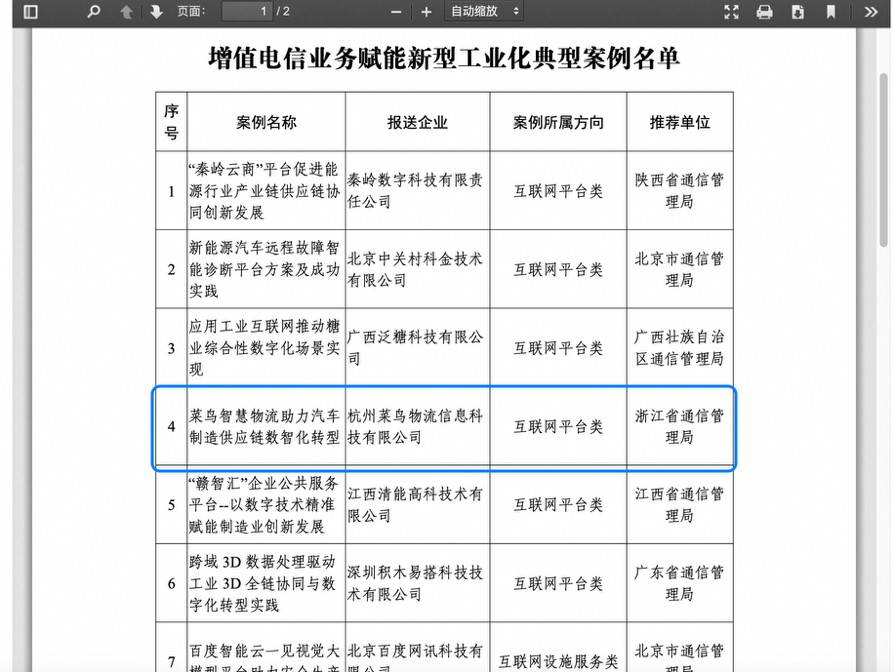
Core Insights - The Ministry of Industry and Information Technology has announced 13 exemplary cases of value-added telecommunications business empowering new industrialization, with projects from companies like Baidu, Alibaba Cloud, China Mobile, China Unicom, and Cainiao being selected [1][2] Group 1: Cainiao's Selected Projects - Cainiao's project involves creating a smart logistics system for an automotive parts manufacturer, utilizing AI and automation technologies to enhance efficiency and reduce costs [1][4] - The project features a four-way shuttle robot warehouse that increases storage capacity by three times, and a self-developed intelligent scheduling system that improves path planning efficiency to 98% [3][4] Group 2: International Event Transportation Service - Cainiao has launched a transportation service app for a major international sports event, allowing users to navigate venues and book official shuttles, integrating local public transport services [5][6] - This app aims to streamline transportation for tens of thousands of athletes, staff, and spectators arriving from around the world, eliminating the need for multiple local transport registrations [5][6] Group 3: Future Market Expansion - Cainiao's Vice President, Bi Jianghua, predicts that 2026 will be a breakout year for logistics technology, with plans to increase investments in key markets such as Japan, South Korea, the US, and Europe [7] - The company is focusing on building a sustainable global delivery and after-sales system while leveraging its strengths in AI and robotics to compete in mature markets [7]
中国车企出海100%用阿里云 长安打造可复用的欧洲数字化模板
Di Yi Cai Jing· 2026-01-09 06:04
Group 1 - Changan Automobile has fully deployed Alibaba Cloud services at its Frankfurt site in Europe, achieving cloud-based deployment of numerous core systems [1] - The comprehensive cloud costs are reduced by 40% compared to traditional solutions, and operational efficiency has improved by 30% [1] - This deployment provides a reusable digital template for future expansion into new European markets [1] Group 2 - At the 2026 Singapore International Auto Show, it was revealed that Alibaba Cloud has achieved a "double hundred" breakthrough in the automotive industry, with Chinese automakers fully adopting Alibaba Cloud domestically and 100% using it for overseas operations [1]

乐聚机器人与阿里云达成全栈AI合作!机器人ETF(562500)放量上行,成交破10亿元
Mei Ri Jing Ji Xin Wen· 2026-01-09 05:50
Group 1 - The Robot ETF (562500) has risen by 1.05%, showing strong upward momentum and resilience despite some fluctuations during the day [1] - Key holdings such as Hongxun Technology and Paislin have hit the daily limit, while Tianzhun Technology surged over 7%, indicating significant profitability within the sector [1] - The trading volume reached 1.047 billion yuan, reflecting high investor sensitivity to structural opportunities in the robotics industry [1] Group 2 - Citic Securities highlights the challenge of a lack of large-scale training data for embodied intelligence, contrasting it with the success of large language models and autonomous driving [2] - The Robot ETF (562500) is the only robot-themed ETF in the market with a scale exceeding 20 billion yuan, covering various segments including humanoid robots and industrial robots [2] - The recent adjustment of component stocks in the Robot ETF has increased the humanoid robot content in the index to nearly 70%, successfully removing underperforming stocks and retaining strong performers [2]


乐聚机器人与阿里云达成全栈AI合作 有机器人已接入千问模型
Xin Jing Bao· 2026-01-09 05:49
Group 1 - Leju Robotics has formed a full-stack AI collaboration with Alibaba Cloud, focusing on humanoid robot training and the development of embodied intelligence solutions and products [1] - Leju Robotics specializes in the independent research and industrialization of core humanoid robot technologies, having launched a series of products including AELOS (small), ROBAN (medium), and KUAVO (large) for industrial manufacturing, commercial services, and scientific education [1] - The newly updated exhibition robot from Leju has integrated the Qianwen model, resulting in faster responses, more accurate answers, and more natural interactions in voice communication and knowledge-based Q&A scenarios [1] Group 2 - Leju's open-source humanoid robot real-world dataset has been launched on the Modao community, achieving over 600,000 downloads since its release in December, ranking in the top ten for total downloads on the platform [1] - The collaboration aims to optimize the entire data collection process for humanoid robot training and explore new paths for integrating embodied intelligence technologies across various sectors including industry, research, commercial services, and households [1] - Alibaba Cloud has released a multimodal interaction development kit that integrates multiple foundational models and pre-configured tools for various applications, including AI glasses and smart robots [2]
菜鸟加速物流科技出海 构建全球物流科技服务体系
Zheng Quan Shi Bao Wang· 2026-01-09 05:44
Group 1 - The Ministry of Industry and Information Technology has recognized 13 exemplary cases of value-added telecommunications business empowering new industrialization, with projects from companies like Baidu, Alibaba Cloud, China Mobile, China Unicom, and Cainiao being selected [1] - Cainiao's project involves creating a smart logistics system for an automotive parts manufacturer, utilizing AI and automation technologies, which has become a benchmark case for the digital transformation of the manufacturing industry [1] - The project enhances storage capacity by three times through a four-way shuttle robot system, and the use of RFID technology for precise material delivery to production lines, resulting in over 50% improvement in labor efficiency [1] Group 2 - Cainiao has recently delivered a transportation service system for an international sports event, providing venue navigation and local public transport services through a single app for athletes, staff, and visitors [2] - The company is focusing on expanding its logistics technology in key markets such as Japan, South Korea, the United States, and Europe, anticipating 2026 to be a breakthrough year for logistics technology [2] - Cainiao has established a local office in Japan to enhance delivery and after-sales capabilities, leveraging its advantages in AI and robotics to compete in the Japanese market, which is undergoing a logistics equipment upgrade [2]
广汽集团发布:2025年连续3个季度销量环比正增长
2 1 Shi Ji Jing Ji Bao Dao· 2026-01-09 04:51
Core Viewpoint - GAC Group is experiencing significant growth in sales and is actively transforming its operations and product offerings to adapt to the evolving automotive industry landscape [1][3][4]. Sales Performance - In December 2025, GAC Group's vehicle sales exceeded 187,400 units, representing a month-on-month increase of 4.3%. The total vehicle sales for the year reached 1.7215 million units, with terminal sales at 1.8135 million units [1]. - The total sales for the fourth quarter surpassed 537,800 units, marking a 25.56% increase compared to the third quarter, achieving positive growth for three consecutive quarters [1]. - GAC's overseas sales for its self-owned brands approached 130,000 units, reflecting a year-on-year growth of 47% [1]. Brand Performance - GAC Aion's December sales reached 42,000 units, with a month-on-month growth of 10%. GAC Trumpchi's annual sales of new energy vehicles surpassed 150,000 units [3]. - GAC Toyota's annual sales reached 756,000 units, a year-on-year increase of 2.4%. GAC Honda's December sales exceeded 50,000 units, with a month-on-month growth of 23.3% [3]. Organizational Transformation - GAC Group is implementing the "Panyu Action" integrated reform to enhance organizational efficiency and break traditional operational boundaries [4]. - The company has shifted to a user demand management approach, transforming its organizational structure to be more process-oriented and project-based [4]. - GAC has reduced the new vehicle development cycle to 18-21 months and lowered R&D costs by over 10%, improving overall business efficiency by approximately 50% [4]. Technological Advancements - GAC is focusing on core technologies and advanced applications, achieving breakthroughs in the fields of electrification and intelligent driving [8][10]. - The "Star Source Range Extender" technology was launched in 2025, achieving an oil-electric conversion rate of 3.73 kWh/L, and has been recognized as one of the world's top ten range extender systems [10]. - GAC's ADiGO GSD intelligent driving assistance system now covers 99.9% of road scenarios, and the new ADiGO intelligent cockpit has improved interaction response speed by three times [10]. International Expansion - GAC Group's "One GAC 2.0" strategy aims to accelerate global market, product, and capacity expansion, with plans to introduce five new models to overseas markets in 2025 [21][23]. - The company has established operations in 86 countries and regions, with over 630 outlets and five KD factories in Nigeria, Thailand, Malaysia, Indonesia, and Cambodia [25]. Ecosystem Development - GAC is actively building an industrial ecosystem and expanding strategic partnerships, including collaborations with Huawei and JD.com [27]. - The company has established the largest V2G microgrid in the country and has over 23,000 self-operated charging piles, enhancing its energy service capabilities [25][27].


Agent 2.0时代来了,首批「工业级智能体」正在核心位置上岗
机器之心· 2026-01-09 04:08
Core Insights - The article discusses the transformative impact of AI tools on work efficiency, suggesting that if these tools had been available earlier, many tasks could have been completed much faster [2][5]. - A new working paradigm centered around AI agents is emerging, significantly altering workflows in development and data analysis [5]. Group 1: AI Tools and Efficiency - AI tools have led to substantial reductions in project completion times, with engineers from major tech companies sharing their experiences [2][5]. - The focus of AI applications is shifting from validating usability to realizing actual value, with upgrades to application components aimed at lowering the entry barrier for users [10]. Group 2: Alibab Cloud's Baolian Upgrades - Alibaba Cloud's Baolian has undergone a comprehensive upgrade, marking the transition from a "handcrafted workshop" era to an "industrial assembly line" era for AI agents [6]. - The upgraded Baolian framework includes a "1+2+N" blueprint, which encompasses model and cloud services, high-code and low-code development paradigms, and task-specific development components [6]. Group 3: Multi-modal Data Integration - The ability to integrate and utilize multi-modal data is crucial for large-scale AI applications, with Baolian enhancing its multi-modal knowledge base capabilities to support various file types [12][15]. - Baolian's upgrades allow for flexible processing of multi-modal data, enabling users to orchestrate document, image, audio, and video data through a visual interface [13]. Group 4: Asynchronous API and Cost Efficiency - Baolian has introduced an asynchronous API that extends the timeout limit for long-running tasks from 5 minutes to over 24 hours, ensuring stable execution of lengthy tasks [18]. - The idle scheduling feature of Baolian can reduce AI inference costs by over 50% [19]. Group 5: Development Framework - Baolian provides a dual-mode development capability, allowing both high-code and low-code approaches to coexist, catering to different roles within enterprises [23]. - The upgraded Agent 2.0 architecture enhances task planning and introduces a "Plan-Execute-React" feedback loop, improving the overall development process [26]. Group 6: Model and Cloud Services - The model service layer of Baolian has been strengthened to enhance enterprise-level capabilities, supporting structured metadata display and multi-model comparisons [33]. - Baolian offers a native training and fine-tuning capability for its models, enabling businesses to create customized models using their own data [36]. Group 7: Security and Deployment - Baolian's confidential inference service utilizes a trusted execution environment to provide high-security model inference capabilities [37]. - The release of the enterprise version of the Agent platform allows for the development and deployment of AI agents in private clouds and on-premises environments [40]. Group 8: Industry Implications - The upgrades to Baolian are expected to lower the barriers for AI technology adoption across various industries, facilitating the emergence of AI as a capable "digital employee" [43][45].