vivo

Search documents
华为折叠屏国内份额超70%,坐等苹果入局
Guan Cha Zhe Wang· 2026-01-22 09:16
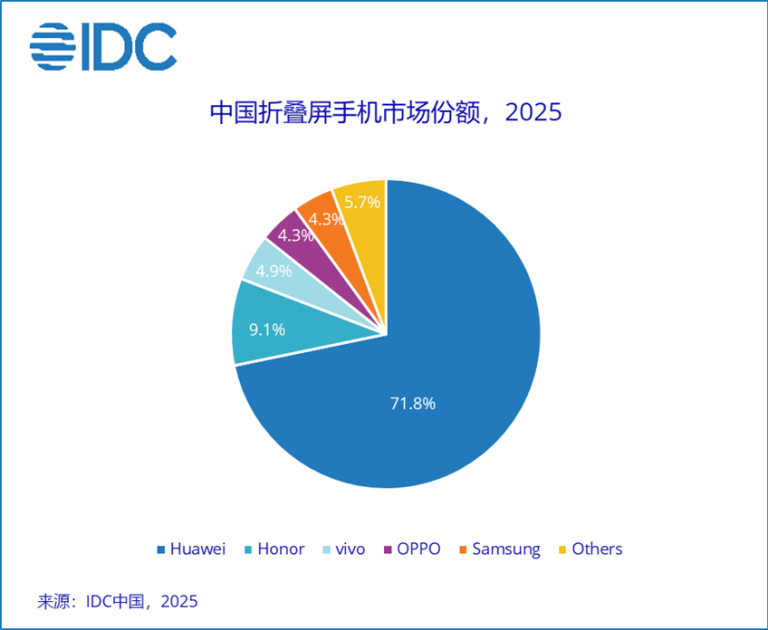
Core Insights - The Chinese foldable smartphone market is projected to see a shipment of approximately 10.01 million units in 2025, reflecting a year-on-year growth of 9.2%, contrasting with a slight decline of 0.6% in the overall smartphone market [1] - Huawei leads the market with a significant share of 71.8%, while other brands like Honor, Vivo, and OPPO have much smaller shares, indicating Huawei's dominant position [1][3] - Despite the emergence of competitive products from other manufacturers, Huawei's comprehensive product lineup and brand strength have solidified its market leadership [4][6] Market Dynamics - The foldable smartphone segment has reached a bottleneck since 2019, with manufacturers struggling to drive sales through hardware improvements alone, leading to a decline in the overall market in Q4 of the previous year [3][4] - Brand strength is increasingly influencing consumer preferences in the high-end market, with Huawei's focus on balanced capabilities and innovative designs contributing to its market share growth of over 20 percentage points in 2025 [4] - The foldable smartphone market still represents only 3.5% of total smartphone shipments in China, prompting some manufacturers to reconsider their strategies in this niche segment [4][6] Technological Innovations - Manufacturers are exploring soft-hard collaboration as a breakthrough direction, with Huawei's MateX7 focusing on AI integration rather than just hardware enhancements [6] - Other brands like OPPO and Vivo are also attempting to bridge compatibility with Apple ecosystems, indicating a trend towards cross-platform functionality [6] Future Outlook - The anticipated entry of Apple's foldable smartphone, expected to be released in the fall of 2026, is generating significant market interest, particularly regarding its potential to enhance hardware and software integration [7][8] - The overall smartphone market in China may face challenges in 2026 due to rising storage costs, which could lead to a noticeable decline in shipments [8]


华为折叠屏国内份额超70%,苹果今年能带来惊喜吗?
Guan Cha Zhe Wang· 2026-01-22 09:12
Core Insights - The Chinese foldable smartphone market is projected to see a shipment of approximately 10.01 million units in 2025, marking a year-on-year growth of 9.2%, contrasting with a slight decline of 0.6% in the overall smartphone market [1] - Huawei leads the market with a significant share of 71.8%, while other brands like Honor, Vivo, and OPPO have much smaller shares, with Xiaomi dropping out of the top five [1][3] - The foldable smartphone segment is experiencing a bottleneck phase, with hardware improvements no longer sufficient to drive significant sales growth, leading to a decline in market performance [3][4] Market Dynamics - Huawei's dominance is attributed to its comprehensive product lineup, including various foldable designs and a focus on balanced capabilities rather than just lightweight models [4] - Other manufacturers have introduced innovative products, such as OPPO's Find N5 and Vivo's lightweight foldable, but these have not significantly challenged Huawei's market position [3][4] - The foldable smartphone market only accounts for 3.5% of total smartphone shipments in China, leading some companies like Xiaomi to reconsider their strategies in this niche [4][6] Technological Innovations - Manufacturers are focusing on soft-hard collaboration to enhance user experience, with Huawei's MateX7 introducing AI capabilities to improve functionality [6] - Competitors like OPPO and Vivo are also exploring compatibility with Apple ecosystems to attract users [6] - The anticipated entry of Apple's foldable phone, expected in 2026, is generating significant market interest, with expectations for superior hardware and software integration [7][9] Future Outlook - The smartphone market is expected to face cost pressures due to rising storage prices, potentially leading to a noticeable decline in shipments in 2026 [9] - The success of Apple's foldable device and its impact on the market remains a key point of interest for industry stakeholders [9]
苹果官网限时优惠最高降千元 iPhone 17系列不在内!
Zhong Guo Jing Ying Bao· 2026-01-22 09:00
苹果中国官网为迎接2026年新春开启了为期4天的限时优惠,官网几乎所有产品都有折扣,除了最新发 布的iPhone 17系列。 1月22日,苹果中国官网推出"新春限时优惠活动",用户于1月24日至1月27日以符合条件的支付方式购 买iPhone、Mac、iPad和Apple Watch等指定产品最高立省1000元。 但《中国经营报》记者留意到,在这场新春大促中,2025年秋季才发布的最新旗舰——iPhone 17系列 并未出现在优惠名单之中。 具体来看,iPhone 16系列的多款机型则享受了不同程度的优惠,iPhone 16及iPhone 16 Plus可立省300 元,而iPhone 16e则可节省200元,MacBook Pro最高降1000元,MacBook Air降700—800元。 近几年,苹果几乎每年农历新年前都会在中国官网推出为期数天的"限时优惠"活动,这已成为其固定营 销日历的一部分。2024年9月发布的iPhone 16系列,在苹果2025年1月的"叱咤福利"新年促销活动中就有 400—500元的优惠。 事实上,记者留意到,从苹果直营渠道2025年"双11"购物促销就可以看出,iPhone ...
“广货”又火了!广东多地市委书记、市长与“大V”同框带货
Nan Fang Du Shi Bao· 2026-01-22 05:30
Core Viewpoint - Local government officials in Guangdong are actively promoting regional products and city images through live streaming and public events, enhancing consumer trust and engagement with local goods [1][2][5] Group 1: Promotion of Local Products - City leaders are taking on the role of "chief promoters" for local specialties, which helps to bridge the psychological gap between consumers and products [2] - The introduction of innovative products, such as the "frozen dormancy" technology for lychee, allows for extended freshness and showcases the potential of local agricultural products [2] - The promotion of unique local items, like "Chenpi coffee," reflects a broader strategy to highlight the entire industry chain and cultural significance behind these products [2] Group 2: Cultural and Economic Integration - The integration of agricultural products with cultural tourism is being emphasized, as seen in the promotional efforts of cities like Qingyuan and Chaozhou [3] - Events like the "Dongguan Manufacturing Aesthetic Tour" showcase the transformation of industrial cities into centers of aesthetic and cultural value, highlighting the evolution of local manufacturing [4] - The shift from merely selling products to promoting lifestyle and experiences indicates a strategic change in how local governments engage with consumers [5] Group 3: Government Engagement and Image - Local officials are leveraging popular media platforms to enhance the visibility of their cities, transforming from abstract managers to relatable service-oriented representatives [5] - The active participation of city leaders in promotional activities reflects a commitment to fostering a service-oriented government that resonates with the public [5]
2025 年中国手机:激活量 vs 出货量
程序员的那些事· 2026-01-22 05:15
Core Viewpoint - The article discusses the shipment data released by IDC, highlighting the performance of various smartphone manufacturers in terms of shipment volume and market share for 2024 and 2025, along with year-on-year growth rates [2][3]. Group 1: Shipment Data Overview - Huawei is projected to ship 46.7 million units in 2025, holding a market share of 16.4%, down from 47.6 million units and 16.6% market share in 2024, reflecting a year-on-year decline of 1.9% [3]. - Apple is expected to ship 46.2 million units in 2025, with a market share of 16.2%, an increase from 44.4 million units and 15.5% market share in 2024, showing a growth of 4.0% [3]. - Vivo's shipment is forecasted at 46.1 million units in 2025, maintaining a market share of 16.2%, down from 49.3 million units and 17.2% market share in 2024, indicating a decline of 6.6% [3]. - Xiaomi is anticipated to ship 43.8 million units in 2025, with a market share of 15.4%, up from 42.0 million units and 14.7% market share in 2024, reflecting a growth of 4.3% [3]. - OPPO is projected to ship 43.4 million units in 2025, holding a market share of 15.2%, slightly increasing from 42.5 million units and 14.8% market share in 2024, with a growth of 2.1% [3]. - The total shipment for all manufacturers is expected to be 284.6 million units in 2025, a slight decrease from 286.2 million units in 2024, resulting in a year-on-year decline of 0.6% [3].


苹果官宣手机电脑等最高降价1000
Guan Cha Zhe Wang· 2026-01-22 02:56
1月19日,Counterpoint Research发布的最新报告显示,受存储短缺导致价格上涨影响,2025年第四季度 中国智能手机出货量同比下降1.6%,全年同比下降0.6%。除第一季度外,2025年其余季度均录得同比 收缩。 从第四季度来看,苹果以21.8%的市场份额领跑国内市场,OPPO以15.8%的市场份额位居第二,vivo以 15.7%的份额紧随其后,华为、小米、荣耀分别排名第四至第六。从全年来看,华为以16.9%的市场份 额夺得榜首,但前三名并未拉开明显差距。苹果、vivo分别以16.7%、16.4%的市场份额位列第二、第三 名。小米(15.7%)、OPPO(15.5%)、荣耀(13.4%)分列第四至第六。 1月22日,苹果中国官网上线新春限时优惠活动,用户于2026年1月24日0时1分至1月27日23时59分以符 合条件的支付方式购买iPhone、Mac、iPad和Apple Watch等指定产品,最高可立省1000元。 不过观察者网注意到,最新发布的iPhone 17系列手机产品不在降价范围内。 该机构分析认为,苹果四季度出货量同比大增28%,得益于iPhone 17系列的强劲吸引力和供应量 ...

小米国内激活量超苹果 卢伟冰:竞争极其焦灼
Xin Lang Cai Jing· 2026-01-22 01:23
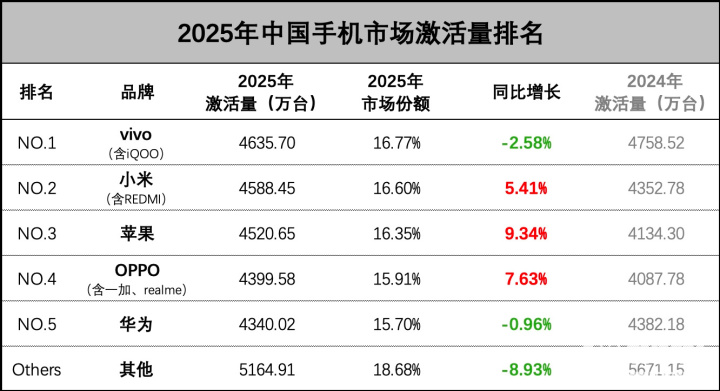
Core Insights - The top three smartphone brands in China by activation volume in 2025 are vivo, Xiaomi, and Apple, with vivo maintaining the first position despite a slight decline in activation volume [1][5] - Xiaomi surpassed Apple to claim the second position, largely due to the success of the Xiaomi 17 series, which includes models with activation volumes exceeding one million [2][6] - The activation volume gap between the top five brands is minimal, with less than 3 million units separating vivo from Huawei, indicating a highly competitive market where a single popular model can significantly influence brand rankings [1][5] Brand Performance Summary - **Vivo**: Ranked first with an activation volume of 4,635.70 thousand units, a market share of 16.77%, and a year-on-year decline of 2.58% from 4,758.52 thousand units in 2024 [2][6] - **Xiaomi**: Ranked second with an activation volume of 4,588.45 thousand units, a market share of 16.60%, and a year-on-year growth of 5.41% from 4,352.78 thousand units in 2024 [2][6] - **Apple**: Ranked third with an activation volume of 4,520.65 thousand units, a market share of 16.35%, and a year-on-year growth of 9.34% from 4,134.30 thousand units in 2024 [2][6] - **OPPO**: Ranked fourth with an activation volume of 4,399.58 thousand units, a market share of 15.91%, and a year-on-year growth of 7.63% from 4,087.78 thousand units in 2024 [2][6] - **Huawei**: Ranked fifth with an activation volume of 4,340.02 thousand units, a market share of 15.70%, and a year-on-year decline of 0.96% from 4,382.18 thousand units in 2024 [2][6] - **Others**: The remaining brands collectively accounted for 5,164.91 thousand units, with a market share of 18.68% and a year-on-year decline of 8.93% from 5,671.15 thousand units in 2024 [2][6] Market Dynamics - The competition among the top brands is extremely tight, with minor differences in activation volumes leading to significant shifts in rankings [5][9] - The timing of new product launches, such as the Huawei Mate 80 series, can greatly impact market standings, suggesting that strategic release schedules are crucial for maintaining competitive positions [5][8] - Xiaomi's Lu Weibing emphasized the intense competition in the Chinese market, indicating that the leading positions are very fragile and require continuous effort to maintain [9]
欧盟拟推「高风险供应商」禁令,华为回应;DeepSeek新模型「MODEL1」曝光;某汽车品牌LOGO撞脸小米?网友:百分百在蹭小米丨雷峰早报
雷峰网· 2026-01-22 00:31
Key Points - The European Union plans to implement a ban on "high-risk suppliers," which Huawei has criticized as violating fair principles based on nationality [4][5] - DeepSeek has unveiled a new model called "Model 1," which is expected to be more efficient and suitable for edge devices [10][11] - Yu Minhong has launched a "retirement club" targeting individuals aged 50 to 75, offering low-cost experience classes [7][8] - iQIYI's CFO Wang Jun has resigned, with Senior Vice President Zeng Ying taking over as acting CFO [16][17] - Tesla's CEO Elon Musk has restarted the Dojo3 chip project, aiming for advancements in space AI [37][38] - Nvidia's CEO Jensen Huang expressed regret over selling Nvidia stock to buy a car for his parents, calling it the most expensive car in the world [39] - Vivo has maintained a leading position in the Indian smartphone market with a 23% share, significantly ahead of competitors [40][41]



国产手机海外角逐
2 1 Shi Ji Jing Ji Bao Dao· 2026-01-21 23:11
Core Insights - The global smartphone market is projected to grow in 2025, with an expected shipment volume of 1.26 billion units, reflecting a year-on-year increase of 1.9% [1] - Chinese smartphone manufacturers have established a significant presence in the global market, capturing approximately 60% of global shipments, with brands like OPPO, vivo, Xiaomi, and Honor leading the way [1] - Honor is expected to see rapid growth in overseas shipments, with a projected year-on-year increase of about 55% in the first three quarters of 2025 [1][2] Industry Trends - Chinese companies are adopting two main strategies for overseas markets: full AI integration and brand premiumization, with a focus on "Glocal" strategies that combine global thinking with local actions [2] - Honor's international business has undergone a structural transformation, with overseas shipments rising from less than 10% of total shipments in early 2021 to nearly 50% by the third quarter of 2025 [2] - The competition in emerging overseas markets is intense, particularly in the entry-level segment priced below $200, which remains a primary focus for many manufacturers despite profit pressures [2] Market Positioning - Increasingly, Chinese smartphone manufacturers are shifting towards the mid-to-high-end market to balance scale and profitability, with Honor targeting the $300-$500 price range, which accounted for approximately 23% of its overseas shipments in the first three quarters of 2025 [3] - The high-end market, particularly in Europe, is becoming a battleground for Chinese manufacturers, who are transitioning from a scale competition to a capability competition, emphasizing high-end product offerings [4] Product Innovation - To penetrate the high-end market, product capability is essential, with manufacturers upgrading their high-end product lines, such as Honor's Magic8 series and Huawei's Mate80Pro [5] - Honor is set to showcase its ROBOT PHONE, a unique product that integrates AI capabilities, at the 2026 International Consumer Electronics Show (CES) [5] AI Integration - Since 2025, there have been significant advancements in AI capabilities for consumer applications, with Honor achieving breakthroughs in on-device AI technologies that enhance real-time processing and user experience [6] - Huawei's strengths lie in its foundational system capabilities, with HarmonyOS 6 enabling multi-device AI computing, enhancing the processing of complex tasks [6] Future Outlook - The market is expected to continue evolving, with two prominent trends: premiumization and globalization, driven by improvements in AI capabilities and a focus on high-end user experiences [6] - Globalization is a core theme for Chinese companies, emphasizing the need to not only expand internationally but also to enhance their global presence and competitiveness [6]
免费领取!100+硅碳负极项目清单(第1批)——企业、产能、技术、进度......
DT新材料· 2026-01-21 16:05
| 800+ 200+ 30+ 50,000m | | --- | | 企业参展 科研院所 | | 2026 . 06 . 10 → 06 . 12 | 在新能源产业迭代升级的浪潮中,固态电池已成为撬动行业变革的核心支点,是衡量国家高端制造实力的重要 标志。 在固态电池体系中,负极直接决定电池的能量密度、循环寿命, 是制约电池整体性能升级的关 键环节 。 相比于传统石墨负极, 硅基负极凭借优异的性能 ( 硅理论 比容量 是传统石墨负极的10倍以上 )和与固态 电池体系的高匹 配 度( 降低 固-固界面阻抗,抑制锂 枝晶析出 ), 已成为当前固态电池体系主流选择 。 作为高能量密度电池的核心材料, 硅碳负极已成为固态电池产业链的关键布局方向。 2025年,国内硅碳负极 赛道更是呈现全面开花、项目密集落地的火热态势。 据 DT 新材料不完全统计,2025年国内硅碳负极落地项 目数量突破 100 个,规划总产能超 30 万吨,行业总投资额高达800 亿元! 我们已梳理2025年硅碳负极项目(涵盖受理、公示、开工、投产等全阶段)的核心信息 , 囊括产能规划、技 术路线、项目规模等关键内容。 扫描下方二维码,转发即可领 ...