
华硕

Search documents
企业需求复苏+AI PC带动!联想(00992)以超19%增速领跑第二季度印度PC市场
智通财经网· 2025-09-15 08:32
Core Insights - The Indian PC market (excluding tablets) experienced a 6% year-on-year growth in Q2 2025, with shipments reaching 3.6 million units, driven by strong enterprise demand and steady consumer market improvement [1][3] - Lenovo emerged as the market leader with a 19.3% year-on-year growth rate, capturing a 19.9% market share, significantly outperforming its competitors [1][2] Market Performance - HP maintained the highest market share at 30.2% but showed minimal growth of only 0.2% year-on-year [1][2] - Dell's performance declined, with a year-on-year shipment drop of 12.2%, indicating a weakening competitive position [2] - Acer and Asus recorded growth rates of 4.2% and 12.4% respectively, but did not achieve double-digit growth [2] Demand Drivers - The growth in the PC market is attributed to a strong recovery in enterprise demand, particularly for AI-enabled laptops, which saw a nearly threefold increase in shipments [3] - The demand for workstations surged by 41% year-on-year, reflecting a robust need for high-performance computing in engineering, design, and content creation sectors [3] Future Outlook - The Indian PC market is projected to grow by 7% in 2025, reaching 15.1 million units, with sustained growth expected in 2026 due to ongoing device upgrades and AI application proliferation [3] - Key factors influencing future growth include the adoption of AI, educational tenders, and local manufacturing initiatives [3]


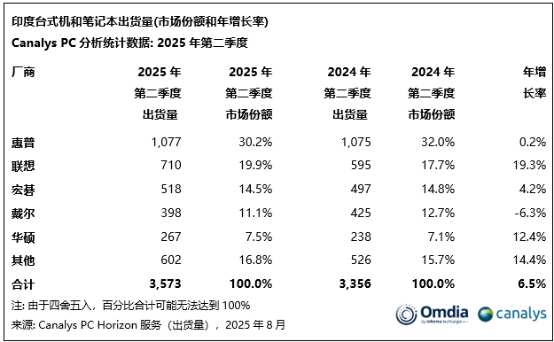
2025年第二季度联想以两位数增速领跑印度PC市场成最大赢家
Ge Long Hui· 2025-09-15 08:30
Core Insights - The Indian PC market (excluding tablets) experienced a 6% year-on-year growth in Q2 2025, with shipments reaching 3.6 million units, driven by strong demand from enterprises and steady consumer market improvements [1][3] Company Performance - Lenovo led the market with a 19.3% year-on-year growth rate, achieving a market share of 19.9%, significantly outperforming its competitors [1][2] - HP maintained the highest market share at 30.2%, but its year-on-year growth was only 0.2%, indicating stagnation [1][2] - Acer and Asus showed growth, but their rates did not reach double digits, failing to challenge the top two brands effectively [2] - Dell's performance declined, with a year-on-year shipment drop of 12.2%, reflecting a weakening competitive position [2] Market Trends - The growth in the PC market is attributed to a strong recovery in enterprise demand, particularly for AI-enabled laptops, which saw a nearly threefold increase in shipments [3] - The demand for workstations surged by 41% year-on-year, highlighting the need for high-performance computing in engineering, design, and content creation sectors [3] - The overall PC market in India is projected to grow by 7% in 2025, reaching 15.1 million units, with sustained growth expected in 2026 due to ongoing device upgrades and AI application adoption [3] Future Outlook - The Indian PC market is entering a critical development phase, with AI adoption, educational tenders, and local manufacturing being key factors influencing growth trajectories [3] - Companies that effectively leverage the shift towards enterprise AI transformation and changing consumer demands are likely to be the biggest beneficiaries of this growth wave [3]
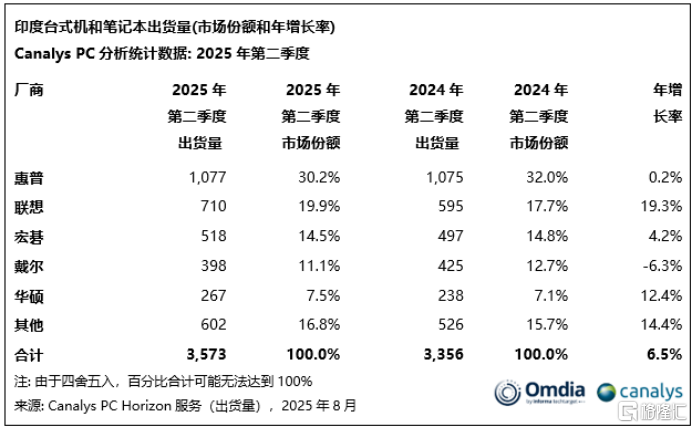
Canalys:2025年第二季度印度PC市场同比增长6% 联想(00992)增幅最大
智通财经网· 2025-09-15 06:21
Core Insights - The Indian PC market (excluding tablets) is projected to grow by 6% year-on-year in Q2 2025, reaching 3.6 million units, driven primarily by increased enterprise demand and a preference for AI devices [1][3] - The tablet market, however, is expected to decline significantly by 27% year-on-year, with shipments dropping to 1.2 million units due to reduced government procurement [1][5] PC Market Overview - The growth in the PC market is largely attributed to the demand for laptops, which saw an 8% increase in shipments to 2.7 million units, while desktop shipments remained stable with a slight increase of 1% to 861,000 units [1][3] - The overall PC market in India is expected to grow by 7% in 2025, reaching 15.1 million units, while the tablet market is forecasted to shrink by 13% to 5.2 million units [1][6] Enterprise Demand - Enterprise-led demand is the primary driver of growth in the Indian laptop market, with AI laptop shipments nearly tripling year-on-year as companies accelerate AI infrastructure deployment [3][5] - Device upgrades, particularly related to the transition to Windows 11, have also played a crucial role, contributing to an over 11% increase in enterprise PC shipments in Q2 2025 [3] Consumer Market Dynamics - The consumer market is experiencing growth driven by enhanced retail momentum and digital adoption, with consumer laptop shipments increasing by 12% year-on-year [3][5] - The tablet market's consumer segment showed a remarkable 35% growth, supported by online promotions and demand for affordable devices [5] Future Projections - The PC market is entering a critical phase where AI adoption, educational tenders, and local manufacturing will shape its growth trajectory [6] - By 2026, the PC market is expected to maintain stable growth, benefiting from further device upgrades and the proliferation of AI applications [1][6] Tablet Market Challenges - The tablet market faces challenges due to a significant drop in commercial shipments, which fell by 64% as government and educational orders slowed down after last year's large-scale procurement [5] - Despite the overall decline, the consumer segment of the tablet market is expected to remain strong, driven by competitive pricing and increased demand for entertainment and home learning [5][6]
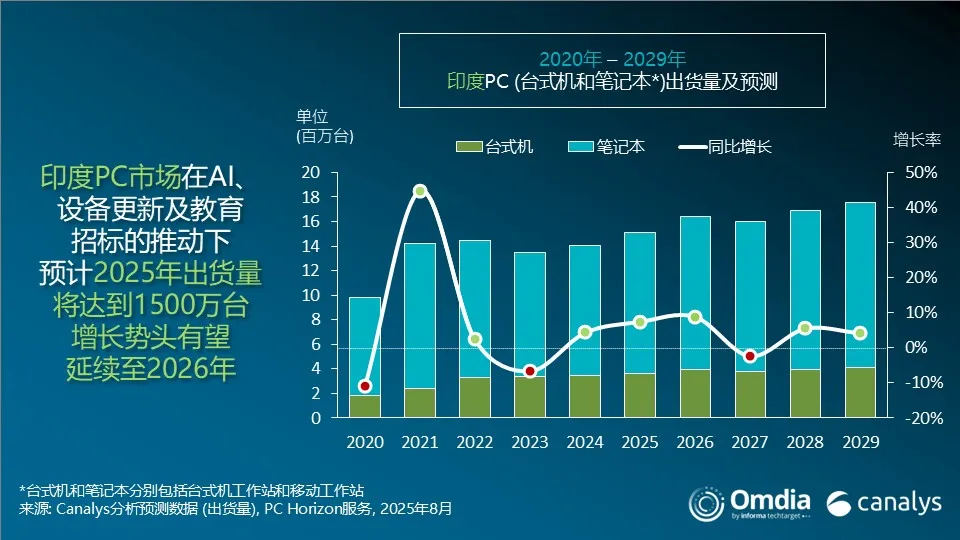
2025年第二季度,印度PC市场同比增长6%,联想增幅最大,小米在平板电脑市场超越联想,跃居第三
Canalys· 2025-09-15 05:32
Core Insights - The Indian PC market (excluding tablets) is projected to grow by 7% in 2025, reaching 15.1 million units, driven by increased enterprise demand and a preference for AI devices [1][6] - The tablet market, however, is expected to decline by 13% in 2025, totaling 5.2 million units, primarily due to reduced government procurement [1][6] PC Market Overview - In Q2 2025, the Indian PC market saw a year-on-year growth of 6%, with shipments reaching 3.6 million units [1] - Notebook shipments increased by 8% to 2.7 million units, while desktop shipments remained stable, rising by 1% to 861,000 units [1] - The growth in the notebook segment is largely attributed to enterprise demand and the adoption of AI technologies [3][5] Tablet Market Dynamics - The tablet market experienced a significant decline of 27% year-on-year in Q2 2025, with shipments dropping to 1.2 million units [5] - The primary reason for this decline was a 64% drop in commercial shipments due to a slowdown in government and educational orders [5] - In contrast, the consumer market for tablets grew by 35%, driven by online promotions and increased demand for affordable devices [5] Future Projections - The PC market is expected to maintain stable growth through 2026, supported by ongoing device upgrades and the proliferation of AI applications [1][6] - The tablet market may see a recovery in 2026, with a projected 15% growth due to government-funded educational projects [1][6] - The demand for AI PCs and updates related to Windows 11 will dominate procurement in the commercial sector [5][6] Market Share Insights - In Q2 2025, the leading brands in the Indian PC market included HP with a 30.2% market share, followed by Lenovo at 19.9% and Dell at 14.5% [8] - For the tablet market, the top brands were Samsung with 28.9% market share, followed by Lenovo at 19.6% and Xiaomi at 13.4% [8]

正式停产停供,这款主板还值得购买吗?
猿大侠· 2025-09-15 04:06
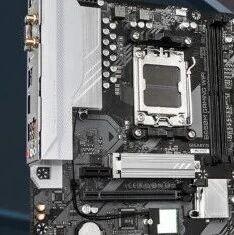
Core Viewpoint - AMD has officially discontinued the B650 chipset, leading to a phase of inventory clearance for B650 motherboards, raising questions about their viability for building AM5 Ryzen systems [1] Group 1: B650 vs B850 Chipset Comparison - The B850 chipset is positioned as a successor to the B650, targeting mainstream users with enhanced specifications and features [1][3] - B850 requires PCIe 5.0×4 M.2 support, while B650 offers it as an option, indicating a more robust performance standard for the newer chipset [1] - B850 provides greater flexibility in PCIe channel configurations and USB specifications compared to B650, enhancing user experience and upgrade potential [2][3] Group 2: Advantages of B850 - B850 offers improved power delivery, bandwidth support, and upgrade potential, making it a preferred choice for users seeking longevity in their systems [3] - AMD's commitment to the AM5 interface until at least 2027 suggests that investing in B850 motherboards will provide a longer usable lifespan for consumers [4] Group 3: Product Recommendations - ASUS TUF GAMING B850M-PLUS WIFI7 is priced at 1429 yuan, featuring robust power delivery and support for high-frequency DDR5 memory [6] - GIGABYTE B850M EAGLE WIFI6E is priced at 1099 yuan, offering a solid build with AI-driven enhancements for better performance [8] - For budget-conscious users, B650 motherboards like GIGABYTE B650M GAMING WHITE EAGLE WIFI at 699 yuan and ASRock B650M-H/M.2+ at 589 yuan are recommended, providing adequate specifications for mid-range Ryzen CPUs [9][10][13][15]

人工智能成果云集!2025中国国际消费电子博览会下周开幕
Qi Lu Wan Bao Wang· 2025-09-13 11:35
Core Viewpoint - The 2025 China International Consumer Electronics Expo will be held in Qingdao from September 19 to 21, focusing on the theme "Connecting Everything, AI Empowering the Future" and showcasing over 300 renowned brands across six exhibition areas covering 60,000 square meters [1][2]. Group 1: Focus on Artificial Intelligence - The expo emphasizes the transformation of artificial intelligence achievements, aligning with the State Council's initiative to integrate AI with six key sectors, including technology and consumption [1]. - Qingdao produces approximately 9.6% of the national smart home appliance output, with 1 in 10 appliances manufactured there. In the first seven months of this year, Qingdao's electromechanical product exports reached 161.6 billion yuan, a 7.8% increase, accounting for 51.8% of total exports [1]. Group 2: International Brand Participation - This year's expo features an international comprehensive exhibition area exceeding 10,000 square meters, with 52 international brands from 17 countries and regions, making up over one-sixth of the exhibitors [2]. - Notable returning brands include Tesla, Hexagon, Toshiba, and Sony, alongside new participants like AIXR (UK), Hanshil (Germany), and Konica Minolta (Japan) [2]. Group 3: New Product Launches - The expo will host product launches from 57 companies, including Huawei, Gree, and ASUS, highlighting the importance of the "first launch economy" in boosting consumption [3]. - Innovative products include a consumer-grade AI glasses from Dapeng VR and a sleep aid product series from DENBA Health, showcasing advancements in technology [3]. Group 4: Exhibition and Trade Linkage - The expo aims to create a full-service system for "display—negotiation—transaction," facilitating trade connections and global procurement [4]. - Collaborations with over 40 domestic and international industry associations will enhance the interaction between exhibitors and buyers, promoting overseas market expansion [4]. Group 5: Interactive Experience - The expo will enhance visitor engagement through various formats, including competitions and immersive experiences, such as VR and humanoid robot interactions [5]. - A live streaming area will be set up to integrate online and offline sales, broadening the reach of the exhibition [5].
PC掌机“挂尿袋”,究竟是技术局限、还是创新?
3 6 Ke· 2025-09-12 12:32
关注智能手机行业的朋友想必都知道,在最近这两三年里,电池可以说是智能手机上进步最快、给使用体 验带来改善最为明显的方向之一。 比如在今年秋季亮相的新机里,基本都会是6500mAh、甚至7000mAh"起步"的电池容量,甚至一些特定型 号有可能会直接突破10000mAh,实现典型使用场景四五天、乃至一周左右的续航能力。而在这样的技术 背景下,即便部分厂商在宣发时声称新机"可以摆脱对移动电源的依赖",也不会被当做是吹牛。 但也正是在这样的情况下,如果还有厂商将"挂尿袋"式的外置电池包作为新品的"创新",不知道大家会不 会与我们三易生活一样,产生一种与时代"违和"的错愕感。 更具体一点来说,这款名为"GPD Win5"的掌机运行的是Windows操作系统,而它的处理器则是理论TDP高 达100W以上,此前从没有厂商敢"塞"进掌机里的AMD锐龙AI MAX+ 395。 那么这是什么概念呢?对比目前PC掌机行业里已经发售的"最强平台"AMD锐龙Z2E可以看到,MAX+ 395 的CPU核心数量比Z2E多了50%,CPU缓存是后者的近5倍,内存带宽比Z2E大100%,其核显的峰值算力更 是达到了Z2E的近300%。 很显 ...

线下无理由退货何时成“标配”
Bei Jing Wan Bao· 2025-09-12 06:54
Core Viewpoint - The implementation of the "Beijing Offline No-Reason Return Commitment Guidelines (Trial)" has led to varying experiences in return policies across different retail formats, with brand counters generally supporting returns while small shops face challenges in accommodating such requests [1][3][4]. Group 1: Brand Counters - Most brand counters in major shopping malls allow for returns, with policies typically permitting returns within 7 days as long as the receipt and tags are retained [3][6]. - The return process at brand counters is generally efficient, with refunds processed immediately upon return [3]. - Some brands, like Uniqlo, offer a more extended return period of 30 days, contrasting with the stricter 7-day limit common among others [6]. Group 2: Small Shops - Small retail shops exhibit a more restrictive return policy, with many refusing returns unless there is a quality issue, leading to consumer frustration [4][5]. - A survey of 12 small clothing stores revealed that only 2 allowed returns within 7 days, while 9 outright refused [4]. - Consumers often feel pressured to provide reasons for returns and face pushback from staff, making the return experience uncomfortable [4][5]. Group 3: Refund Process - The refund process can be lengthy, with some consumers reporting waits of over 20 days to receive their refunds due to internal approval processes [5]. - Refunds are often contingent on the store's internal procedures, which can vary significantly from online shopping experiences where refunds are typically faster [5][6]. Group 4: Consumer Rights and Incentives - Consumers face additional challenges as returned items can lead to the loss of promotional benefits, such as coupons or loyalty points, which do not get refunded upon return [7][8]. - The inability to reuse promotional benefits after a return can deter consumers from making purchases, impacting overall sales [7][8]. Group 5: Merchant Concerns - Merchants express concerns about potential losses from returned items, including depreciation and increased management costs associated with handling returns [9]. - Some retailers fear that lenient return policies may encourage misuse by consumers, leading to a reluctance to adopt more flexible return practices [9]. - Experts suggest that clearer return policies could enhance consumer confidence and stimulate in-store purchases, benefiting overall retail performance [9].

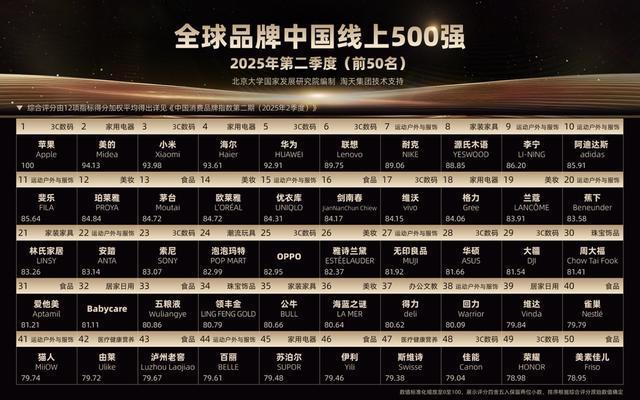
“中国线上消费品牌指数”亮相服贸会,淘宝天猫助力“品质消费”研究
Huan Qiu Wang Zi Xun· 2025-09-11 09:07
Core Insights - The "China Online Consumption Brand Index" (CBI) was prominently featured at the 2025 China International Service Trade Fair, showcasing its significance in measuring online consumer quality [1][3] - The CBI index reflects a shift towards higher quality consumption in China, with the average score increasing from 59.42 in Q1 2023 to 65.21 in Q2 2025, indicating a notable improvement in consumer brand quality [5][6] Group 1: CBI Index Overview - The CBI index is the first of its kind to utilize real consumer data to focus on high-quality development in online consumption, filling a gap in macroeconomic statistics regarding consumption quality [2][3] - The index includes various sub-indices such as the China Online Brand Purchasing Power Index and the Global Brand China Online 500 Strong list, providing insights at both national and regional levels [3] Group 2: Industry Insights - The highest CBI scores are found in the 3C and home appliance sectors, indicating a consumer preference for high-scoring brands in these categories [5] - Emerging sectors like pet products and jewelry are experiencing the fastest growth in CBI scores, reflecting an increasing consumer focus on quality and brand [5] Group 3: Regional Characteristics - New first-tier and second-tier cities exhibit stronger CBI scores, suggesting higher average consumption quality in these areas, while first-tier cities dominate in total purchasing power [5] - Regions with a high proportion of mobile populations show a balanced consumption quality and strong purchasing power [5] Group 4: Consumer Demographics - The middle-income group in China exceeds 400 million, providing a solid foundation for quality consumption growth, despite perceptions of a "white label era" [6] - The research indicates that new brands on the list share characteristics such as strong originality and a focus on product innovation in niche consumption scenarios [5]
半导体行业月报:半导体行业25Q2持续稳健增长,国产AI算力厂商业绩表现亮眼-20250911
Zhongyuan Securities· 2025-09-11 08:25
Investment Rating - The semiconductor industry is rated as "Outperform" [1] Core Viewpoints - The semiconductor industry continues to show steady growth in Q2 2025, with significant performance from domestic AI computing chip manufacturers [4][5] - The global semiconductor monthly sales continue to grow year-on-year, driven by increased capital expenditure from domestic and international cloud service providers [4][6] - The demand for AI computing hardware infrastructure remains strong, with major cloud companies increasing their capital expenditures significantly [6] Summary by Sections 1. Semiconductor Industry Performance - In August 2025, the domestic semiconductor industry (CITIC) rose by 23.84%, significantly outperforming the Shanghai and Shenzhen 300 index, which increased by 10.33% [4][12] - The semiconductor industry (CITIC) has seen a year-to-date increase of 36.16% [12] 2. Q2 2025 Financial Performance - The semiconductor industry reported a revenue of 188.43 billion yuan in Q2 2025, a year-on-year growth of 13.87%, with a net profit of 14.76 billion yuan, up 23.99% year-on-year [4][22] - The gross margin for the semiconductor industry has been on the rise, with Q2 2025 showing a gross margin of 26.29%, an increase of 1.72% year-on-year [22][25] 3. AI Computing Chip Manufacturers - Domestic AI computing chip manufacturers have shown remarkable performance in Q2 2025, with companies like Cambricon reporting a revenue increase of 4425.01% year-on-year [4][5][22] - The domestic AI computing chip sector is entering a period of accelerated growth, with expectations of increased market share [5][22] 4. Global Semiconductor Sales - Global semiconductor sales in July 2025 increased by 20.6% year-on-year, marking the 21st consecutive month of growth [4][6] - The demand for consumer electronics is gradually recovering, with expectations for rapid growth in AI smartphones and AI PCs [4][6] 5. Capital Expenditure Trends - Major North American cloud service providers have significantly increased their capital expenditures, with a combined increase of 69% year-on-year in Q2 2025 [6] - The total capital expenditure of the three major domestic internet companies (Alibaba, Baidu, Tencent) reached 61.6 billion yuan in Q2 2025, a year-on-year increase of 168% [5][6] 6. Market Dynamics - The inventory levels of some global chip manufacturers have slightly decreased, while domestic chip manufacturers have seen a significant reduction in inventory levels [4][22] - The utilization rate of global wafer fabs has significantly improved in Q2 2025, indicating a positive trend in production capacity [4][22]


