Stellantis N.V.

Search documents
美国关税施压,欧洲汽车制造商股价集体下滑
Xin Lang Cai Jing· 2026-01-20 06:32
Group 1 - The European automotive sector experienced a collective sell-off due to the threat of new tariffs from the U.S., with major automakers' stock prices declining significantly during early trading [1][3] - President Trump announced a plan to impose a 10% tariff on goods from Denmark, Norway, Sweden, France, Germany, the UK, the Netherlands, and Finland starting February 1, with a potential increase to 25% on June 1 [3] - Following the announcement, stocks of major automotive companies such as BMW, Mercedes-Benz, and Porsche fell by over 3%, while Volkswagen and Ferrari saw declines exceeding 2% [3] Group 2 - The market is concerned that the new tariffs will increase operational uncertainty for European automakers in the North American market, putting long-term pressure on their profit expectations [3] - Previously, the Trump administration had announced a 25% tariff on EU automobiles, which was later adjusted to 15% under certain conditions, reflecting a history of fluctuating trade policies affecting the automotive industry [3] - The UK has implemented a tiered tariff system, with the first 100,000 cars subject to a 10% tariff and any additional units incurring a 27.5% tariff [3]


德国30亿欧元电车补贴对中企开放,“不设限,有信心赢得竞争”
Guan Cha Zhe Wang· 2026-01-20 03:42
Core Viewpoint - Germany has reintroduced an electric vehicle (EV) subsidy program worth €3 billion to stimulate market growth, contrasting with restrictive measures in other European countries that limit access for Chinese automakers [1][3]. Group 1: Subsidy Program Details - The new subsidy plan targets private consumers and applies to new registrations of pure electric vehicles, certain plug-in hybrids, and range-extended electric vehicles starting from January 1, 2026, until 2029 [3][4]. - Subsidy amounts range from €1,500 to €6,000 based on vehicle type, household size, and income level, with an expectation to support approximately 800,000 new vehicle purchases or leases [4]. Group 2: Market Impact and Industry Response - The German automotive industry association (VDA) welcomed the new subsidy plan but emphasized the need for improved infrastructure to ensure the program's effectiveness [4]. - Companies like Volkswagen and Stellantis are expected to benefit from the subsidy, as well as Chinese brands like BYD that are expanding in the European market [4]. Group 3: Trade Relations and Market Share - Recent negotiations between China and the EU regarding electric vehicle trade have shown positive progress, potentially allowing Chinese automakers to enter the EU market without facing anti-subsidy taxes [6][10]. - Chinese brands are gaining market share in Europe, with projections indicating that by November 2025, their share in the European electric vehicle market could reach a record 12.8% [7][10].

30亿补贴对中企开放,“不设限,德国有信心”
Guan Cha Zhe Wang· 2026-01-20 02:52
Group 1 - Germany has reintroduced an electric vehicle (EV) subsidy program worth €3 billion, aimed at stimulating market growth and open to all manufacturers, including Chinese companies [1][3] - The new subsidy plan will support approximately 800,000 new vehicle purchases or leases, focusing on low- to middle-income groups, and is expected to accelerate the adoption of electric vehicles in Germany [4] - The subsidy amounts will range from €1,500 to €6,000 based on vehicle type, household size, and income level, applicable to new registrations starting January 1, 2026, and lasting until 2029 [3][4] Group 2 - The German automotive industry association (VDA) welcomed the new subsidy plan but emphasized the need for improved infrastructure to ensure its effectiveness [4] - The new subsidy is seen as beneficial for companies like Volkswagen and Stellantis, which are increasing their focus on affordable electric vehicle models, as well as for Chinese brands like BYD that are expanding in the European market [4] - Recent developments in EU-China electric vehicle trade negotiations indicate a potential easing of tensions, with agreements that could allow Chinese manufacturers to enter the EU market without facing anti-subsidy tariffs [6][7] Group 3 - Chinese brands are gaining market share in Europe, with projections indicating that by November 2025, their share in the European electric vehicle market could reach a record 12.8% [7] - The expected annual growth rate for Chinese electric vehicle exports to the EU is around 20% from 2026 to 2028, positioning them as a significant driver of global electric vehicle market growth [10]


2026 中国新能源汽车与动力电池手册_从自动驾驶到人工智能-2026 China EV & EV Battery Handbook_ From Autonomous Driving to AI
2026-01-20 01:50
Summary of Key Points from the Conference Call Industry Overview: Greater China Auto, EV, and EV Battery Industry Forecasts - **China's Auto Industry**: Expected to face challenges in 2026 with a forecasted decline in auto wholesales by **1.6% YoY** compared to a **10% YoY** increase in 2025. This decline is attributed to front-loaded demand in 2025 [1] - **Domestic EV Sales**: Anticipated to grow only **7% YoY** in 2026 due to a **5% increase in purchase tax** and reduced trade-in subsidies [1] - **Export Sales**: Projected to increase by **12% YoY**, reaching **7.9 million units** in 2026, with EV exports expected to surge by **40% YoY** [1] - **Competition Dynamics**: Shift from price competition to configuration-based competition, necessitating more investment in autonomous driving (AD) and smart cabin technologies [1] Key Automotive/EV Themes for 2026 Theme 1: Export Growth - **Export Growth**: Companies like Chery and BYD are expected to benefit significantly from exports, especially with the EU's minimum EV price replacing tariffs [2] Theme 2: Autonomous Driving Development - **ADAS to AD Transition**: L3 permits issued to Changan and BAIC, with highway/city NOA penetration expected to exceed **40%** in 2026 and **85%** by 2030. L4/L5 penetration is projected to reach **8%** by 2030 [3] Theme 3: Cost Concerns - **Battery and Memory Costs**: Rising costs and supply stability of memory are key concerns for auto OEMs [3] Key Battery Themes for 2026 Theme 1: Energy Storage Systems (ESS) - **ESS Demand**: Global battery ESS installations expected to grow by **33% YoY** in 2026, with shipments increasing by **41% YoY** [4] Theme 2: Global Expansion - **Overseas Capacity Expansion**: Chinese battery manufacturers are accelerating their overseas capacity expansion, particularly in Europe and Southeast Asia, in response to rising tariffs and trade tensions [4] Theme 3: VAT Rebate Changes - **Export VAT Rebate Cut**: Anticipated to lead to a rush in battery production and shipment in Q1 2026, potentially increasing raw material prices and exerting cost pressure on battery makers and auto OEMs [5] Theme 4: Technological Innovation - **Sodium-Ion Battery**: Launch of Gen-2 sodium-ion battery expected, with ASSB (all-solid-state battery) small-batch production anticipated to start in 2027 and scale up significantly post-2029 [5] Investment Recommendations - **Top Picks**: - **XPeng**: Launch of Mona SUV and HR in 2H26, with a focus on AI-related businesses [6] - **CATL**: Growth driven by CEV, ESS, and overseas capacity despite short-term cost pressures [6] - **Tuopu**: Major supplier for humanoid robots with overseas expansion [6] - **Minth**: Resilient earnings growth supported by high overseas market exposure [6] - **Hesai**: Increased LiDAR adoption in China alongside L3 ADAS development [6] Additional Insights - **Market Dynamics**: The shift in competition and the focus on technological advancements highlight the evolving landscape of the automotive and EV sectors in China, emphasizing the need for companies to adapt to changing consumer preferences and regulatory environments [1][3][4][5]






电网都没铺好!非洲电动车却找到野路子
汽车商业评论· 2026-01-19 23:07
Core Viewpoint - The research indicates that electric vehicles (EVs) in Africa could achieve total cost of ownership comparable to that of fuel vehicles by 2040, particularly in off-grid solar and fixed storage charging systems, bypassing traditional grid limitations [3][8][10]. Group 1: Market Dynamics - The African vehicle fleet is expected to double by 2050, with growth rates surpassing other continents [3]. - In 2024, new car sales in Africa are projected to be around 1.05 million units, with South Africa and Morocco accounting for significant shares [5]. - The reliance on imports in the African automotive market suggests that the electrification process may begin with taxis, two-wheelers, and buses rather than waiting for public charging networks to be established [5][10]. Group 2: Technological Advancements - Off-grid solar solutions are seen as a key breakthrough, providing a viable alternative to traditional grid systems [6][8]. - The research conducted by ETH Zurich and partners modeled over 2,000 locations across 52 countries, demonstrating that off-grid solar and battery systems can be economically viable [8][9]. - A compact solar system can meet the daily charging needs of a small electric vehicle that drives approximately 50 kilometers per day, making the charging cost a minor part of total usage costs [8]. Group 3: Economic Considerations - The study emphasizes that financing is a major barrier to EV adoption in Africa, with high loan interest rates affecting the initial purchase costs of electric vehicles [9][10]. - Solutions such as government guarantees, innovative financing models, and international support are necessary to facilitate the transition to electric vehicles [10][18]. - The potential for local economic opportunities, such as domestic vehicle assembly and new service industries, is highlighted as a benefit of EV development in Africa [10]. Group 4: Current Trends and Future Outlook - Electric two-wheelers and electric buses are currently more economically viable, with operational models like battery swapping gaining traction in cities like Nairobi [12][14]. - The introduction of electric buses in urban areas is seen as a scalable entry point for electrification, with significant orders already placed in cities like Nairobi and Kigali [12][13]. - The African market is attracting more players, including Chinese automakers, who view it as a potential growth market for hybrid and electric vehicles [17]. Group 5: Policy and Fiscal Implications - The transition to electric vehicles poses fiscal challenges for governments, particularly in low-income countries where fuel tax revenues are significant [18]. - The need for tax reform and international support is emphasized to mitigate potential fiscal gaps arising from reduced fuel tax income as EV adoption increases [18].
不学英法!德国推出30亿欧元电动车补贴 中国车企同样可享
Zhi Tong Cai Jing· 2026-01-19 12:24
Group 1 - The German government has launched a €3 billion (approximately $3.5 billion) electric vehicle subsidy program open to all car manufacturers, including Chinese brands, aimed at boosting electric vehicle sales in Europe’s largest automotive market [1] - The new subsidy policy, announced on Monday, is part of a broader stimulus initiative by the German government, following a significant drop in electric vehicle demand after the previous subsidy program ended in 2023 [1] - German Environment Minister Carsten Schneider expressed confidence in the quality of European and German brands, stating that there is no evidence of a significant influx of Chinese car manufacturers into the German market, leading to a decision to face competition rather than impose restrictive barriers [1] Group 2 - Germany's open attitude towards Chinese car manufacturers contrasts sharply with other European countries, such as the UK and France, which have implemented stringent standards that effectively exclude Chinese electric vehicles from their markets [2] - The new subsidy plan, initially disclosed in October of last year, is expected to facilitate the sale of approximately 800,000 electric vehicles by 2029, with subsidy amounts ranging from €1,500 to €6,000 based on household income, population size, and vehicle type [2] - Major automakers like Volkswagen Group and Stellantis are expected to benefit from this subsidy policy as they increase their focus on affordable electric vehicle models [2] Group 3 - The ruling coalition led by Chancellor Merz has extended the electric vehicle tax exemption policy until 2035, with the German Finance Ministry estimating a tax revenue loss of approximately €600 million by 2029 [3] - Chancellor Merz has publicly advocated for slowing down the EU's proposed phase-out of combustion engine vehicles [3]
US Futures Slide on MLK Day Amidst Fresh Tariff Threats, Global Markets React
Stock Market News· 2026-01-19 11:07
Market Overview - U.S. stock markets are closed on January 19, 2026, for Martin Luther King Jr. Day, with no cash equity trading or after-hours sessions occurring [1] - U.S. equity futures are experiencing notable declines, with E-mini S&P 500 futures down approximately 0.7% to 0.9%, Nasdaq 100 futures down between 1% and 1.2%, and Dow Jones Industrial Average futures sliding by about 0.6% to 0.7% [2] Geopolitical Developments - President Trump announced a 10% tariff on imports from eight European countries, effective February 1, which could escalate to 25% by June 1 if no agreement is reached regarding the U.S. acquisition of Greenland [3] - European leaders are considering retaliatory measures, including activating the EU's Anti-Coercion Instrument, in response to the tariff threats [3] Safe-Haven Assets - Investors are flocking to safe-haven assets, with gold futures surging to a record high above $4,670 an ounce and silver futures reaching a new record above $94 an ounce [4] Global Market Performance - European equity markets are broadly lower, with the STOXX Europe 600 index down approximately 0.9%, Germany's DAX declining by 1.1%, and France's CAC 40 down 1.3% [5] - Asian markets show mixed results, with Japan's Nikkei 225 dipping by 0.7% to 0.8%, while China's economy expanded by 4.5% year-on-year in Q4 2025, despite disappointing retail sales figures [6] Upcoming Market Events - Key economic data and corporate earnings reports are expected to influence market sentiment upon the reopening of U.S. markets [7] - The Personal Consumption Expenditures (PCE) price index and a further estimate of third-quarter GDP growth are scheduled for release, which will be vital for assessing the U.S. economy [8] Earnings Season - The fourth-quarter earnings season is underway, with major companies such as Netflix, Intel, Visa, 3M, Johnson & Johnson, Procter & Gamble, and NextEra Energy set to report their results [10] Major Stock News - BRC Group Holdings reported a significant turnaround with a net income of $89.1 million in Q3, contrasting with a loss in the same period last year [14] - Goldman Sachs shares increased by 4.6% due to record-setting equity trading revenue [14] - European defense stocks are gaining amidst geopolitical tensions, while European car manufacturers are seeing declines due to fears of increased U.S. tariffs [14]

特朗普“让中国进来”后,中国汽车产业将如何走向美国
Guan Cha Zhe Wang· 2026-01-19 10:19
Core Viewpoint - The recent decline in stock prices of major U.S. automakers is linked to Trump's statements regarding support for American auto workers and a shift in attitude towards Chinese automakers, raising concerns about the profitability and market conditions for U.S. companies [3][4][6]. Group 1: Stock Market Reaction - Major U.S. automakers saw significant stock price declines, with General Motors down approximately 3%, Ford down about 4%, and Stellantis down around 11% [1]. - The market's reaction indicates a focus on uncertainties regarding corporate profitability, trade barriers, and industry direction, despite Trump's seemingly welcoming remarks towards Chinese automakers [3][4]. Group 2: Trade and Regulatory Environment - Trump's welcoming remarks for Chinese automakers are made against the backdrop of high tariffs on Chinese imports, which remain a significant barrier to entry for Chinese vehicles in the U.S. market [4][6]. - U.S. Trade Representative stated that tariffs are in place to protect American workers from foreign vehicles, highlighting the ongoing regulatory challenges for Chinese automakers [6]. Group 3: Globalization Trends - Despite the challenges, there is a growing trend of easing restrictions on Chinese electric vehicles in other markets, with Canada recently removing punitive tariffs and the EU adjusting tax rates [7][9]. - Chinese automakers, such as BYD, have shown strong growth in international markets, with a reported 276% increase in deliveries to Europe [9]. Group 4: Potential Pathways for Chinese Automakers - Three potential pathways for Chinese automakers to enter the U.S. market include: 1. Embedding within the U.S. supply chain without direct competition as a brand [11][12]. 2. Local manufacturing in the U.S. to mitigate political resistance, although this comes with its own set of challenges [16][18]. 3. Establishing production bases in nearby regions like Mexico or Brazil to create an indirect entry into the U.S. market [19][21]. Group 5: Strategic Implications - The overarching strategy for Chinese automakers is not merely to sell vehicles in the U.S. but to navigate the complex political and regulatory landscape to establish a presence [23]. - The shift from exporting vehicles to becoming participants in a global automotive ecosystem reflects a broader trend in the industry, with the U.S. market being one of many avenues for growth [23].

事涉中国电动汽车,加拿大表态了
Zhong Guo Qi Che Bao Wang· 2026-01-19 08:56
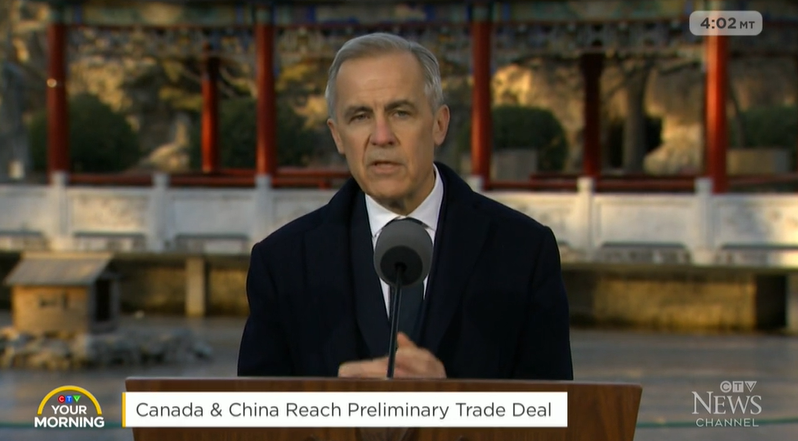
Group 1 - Canada will allow up to 49,000 Chinese electric vehicles annually at a Most Favored Nation (MFN) tariff rate of 6.1%, increasing to 70,000 by the fifth year [1][3] - The agreement aims to boost Chinese investment in Canadian manufacturing and create new jobs in the Canadian automotive sector [3] - Over 50% of the imported vehicles will be affordable models priced below CAD 35,000 (approximately RMB 176,000), providing more options for Canadian consumers [3] Group 2 - In 2023, Canada imported electric vehicles worth CAD 2.2 billion from China, a significant increase from less than CAD 100 million in 2022, primarily driven by Tesla's Model Y [5] - The Canadian automotive market sees annual vehicle purchases of approximately 1.8 million, with the new Chinese EV quota representing a small percentage of this market [5][6] - Ontario Premier Doug Ford expressed strong opposition to the removal of tariffs on Chinese electric vehicles, although he is open to Chinese automakers investing in local manufacturing [6]
剑指中期选举?特朗普政府打出“汽车可负担性”牌
Xin Lang Cai Jing· 2026-01-18 10:11
Core Viewpoint - The Trump administration is intensifying efforts to promote the relaxation of vehicle emissions regulations, claiming it will help lower car prices and alleviate purchasing pressure on American consumers [1][3]. Group 1: Policy Changes - The policy to relax emissions regulations was initially proposed in December, aiming to revoke fuel efficiency standards set during the Biden administration [3]. - The U.S. Department of Transportation estimates that the proposal could reduce the average upfront cost of new cars by approximately $930 (about 6,481.7 RMB) [3]. - The Environmental Protection Agency is expected to finalize the cancellation of vehicle emissions requirements in the coming weeks [3]. Group 2: Economic Context - Amid high inflation and record car prices, the affordability of vehicles has become a central issue in American society [3]. - The average transaction price for new cars in the U.S. reached $50,000 (about 348,000 RMB) in December, marking a historical high [5]. - The automotive industry is facing pressure from high tariffs imposed on imported cars and parts, which could impact pricing strategies [5]. Group 3: Political Implications - The relaxation of emissions regulations is seen as part of the Trump administration's broader strategy to overturn Biden-era electric vehicle regulations [4]. - The administration's actions include the cancellation of a $7,500 (about 52,000 RMB) tax credit for electric vehicles and the revocation of California's electric vehicle regulations [4]. - As midterm elections approach, inflation is becoming a significant political challenge for Trump [5]. Group 4: Industry Outlook - Despite opposition to the new emissions policy, the automotive industry and analysts remain optimistic about new car sales growth in the coming year, with expectations of a 2.4% increase in U.S. new car sales by 2026, reaching 16.2 million units [6].