国信证券

Search documents
非银金融行业周报:融资新规夯实“慢牛”根基,险企渠道深度重塑
东方财富· 2026-01-21 00:25
Investment Rating - The report maintains an "Outperform" rating for the non-bank financial sector, indicating a positive outlook for investment opportunities in this industry [2]. Core Insights - The report highlights the strengthening of the "slow bull" market foundation due to new financing regulations, which are expected to stabilize the capital market and promote long-term healthy development [12][13]. - The insurance sector is undergoing a significant transformation, with a notable trend of branch institution exits, indicating a shift from extensive expansion to a more concentrated and quality-focused approach [42][43][44]. Summary by Sections 1. Securities Business Overview and Weekly Review - The financing margin ratio has been raised to 100%, reinforcing the foundation of a "slow bull" market. This adjustment aims to lower market leverage and protect investor rights, promoting long-term stability [12]. - The China Securities Regulatory Commission (CSRC) emphasizes risk prevention, strong regulation, and high-quality development as the main themes for 2026, aiming to enhance the capital market's stability and service to the real economy [13][14]. - CITIC Securities reported a net profit of 30.05 billion CNY for 2025, marking a 38.46% year-on-year increase, reflecting a recovery in the securities industry amid a rising market [15][17]. 2. Insurance Business Overview and Weekly Review - The insurance industry has seen over 3,100 institutions exit in 2025, the highest in six years, indicating a long-term structural adjustment away from extensive physical network expansion [42]. - The exit trend is primarily driven by life insurance companies, focusing on optimizing low-efficiency branches, particularly in third and fourth-tier cities [43]. - This transformation is pushing insurance companies towards digitalization and intelligent management, redefining the role of physical branches to focus on complex business consultations and service integration [44]. 3. Market Liquidity Tracking - The central bank's net injection in the open market was 1,112.8 billion CNY, with significant reverse repos contributing to liquidity [49]. - The interbank lending rates showed mixed performance, with the weighted average rate for interbank lending at 1.33% [54].

50万亿定存到期潮来袭,分红险争当“存款搬家”热选 ?
Nan Fang Du Shi Bao· 2026-01-21 00:04
Core Viewpoint - The article discusses the impending maturity of a significant amount of fixed-term deposits in China, estimated to reach around 50 trillion yuan by early 2026, and the potential shift of these funds towards insurance products, particularly dividend insurance, as a stable investment option amid declining interest rates [2][3][4]. Group 1: Deposit Maturity and Market Impact - A substantial amount of fixed-term deposits, estimated at 50 trillion yuan, will mature by early 2026, with state-owned banks holding the largest share [3]. - The surge in savings began in 2020 due to weak performance in stock and real estate markets, leading to a high demand for fixed-term deposits with attractive interest rates [3][4]. - The current interest rates for short-term large deposits have dropped below 1%, marking a significant decline from the previous rates above 3% in 2023 [2]. Group 2: Shift to Insurance Products - The demand for "wealth migration" has increased, with dividend insurance products becoming a primary choice for residents seeking stable returns [2][4]. - Insurance products are seen as capable of meeting the dual goals of risk management and wealth growth, especially in the context of long-term savings and retirement planning [4][8]. - The insurance industry is expected to adapt by offering better products and services to capture this flow of funds, supporting both the economy and national strategies [3][4]. Group 3: Growth of Bancassurance - Bancassurance is experiencing a resurgence, with new premium income from this channel surpassing individual insurance sales, indicating a strong recovery in the insurance market [5]. - The first half of 2025 saw significant growth in bancassurance premiums, with a year-on-year increase of 10% in the life insurance sector [5]. - The natural advantages of banks, such as stable customer flow and targeted marketing, are driving the growth of bancassurance [5][6]. Group 4: Dividend Insurance as a Key Product - Dividend insurance is highlighted as a core product in the insurance sector, offering guaranteed returns combined with floating dividends, making it attractive during a declining interest rate environment [7]. - The expected yield for dividend insurance products is between 2.5% and 2.9%, appealing to consumers looking for stable returns [7]. - The insurance sector is increasingly viewed as a vital channel for wealth management and risk protection, especially in light of demographic changes and economic conditions [8].


南方稳源优选3个月持有期混合型基金中基金(FOF)基金份额发售公告
Zhong Guo Zheng Quan Bao - Zhong Zheng Wang· 2026-01-20 23:23
登录新浪财经APP 搜索【信披】查看更多考评等级 [重要提示] 1、南方稳源优选3个月持有期混合型基金中基金(FOF)(以下简称"本基金")的发售已获中国证监会 2025年12月5日证监许可[2025]2691号文注册。 2、南方稳源优选3个月持有期混合型基金中基金(FOF)是契约型开放式基金。 3、本基金的管理人和登记机构为南方基金管理股份有限公司(以下简称"本公司"),基金托管人为交 通银行股份有限公司(以下简称"交通银行")。 4、本基金募集期自2026年1月26日至2026年2月6日,通过基金管理人指定的销售机构公开发售。募集期 内,本基金募集规模上限为 50 亿元人民币(不包括募集期利息,下 同),采用末日比例确认的方式实 现募集规模的有效控制。 若本基金在募集期内任何一天(含第一天)当日募集截止时间后,基金募集总规模接近、达到或超过募 集规模上限,本公司将结束本次募集并于次日在规定媒介上公告。若募集期内 认购申请金额全部确认 后本基金募集规模不超过 50 亿元人民币(含 50 亿元人民币),则所有的认购申请予以确认。 若募集期内认购申请金额超过 50 亿元人民币,则对募集期内的认购申请采用末日比例 ...

50万亿存款大迁徙 谁将承接“泼天富贵”
Nan Fang Du Shi Bao· 2026-01-20 23:11
Core Insights - A significant amount of fixed deposits, estimated at 50 trillion yuan, is set to mature this year, prompting discussions on where these funds will be allocated in a low-interest-rate environment [3][8][10] Group 1: Deposit Maturity Trends - Multiple brokerages estimate that the total amount of fixed deposits maturing this year will reach tens of trillions of yuan, with projections varying among institutions [8][9] - Guotai Junan Securities estimates that 38% of the total deposits at the six major state-owned banks will mature within the next year, with a significant portion concentrated at the end of 2025 and early 2026 [8] - CITIC Securities predicts that the scale of fixed deposits maturing in 2026 could reach 45 trillion yuan, with over 35 trillion yuan being from three-year products initiated in 2023 [9] Group 2: Investment Preferences - As depositors face declining interest rates, there is a noticeable shift towards alternative investment options, including funds and insurance products [10][11] - The demand for insurance products, particularly dividend insurance, is expected to increase due to their stable return characteristics, which are becoming scarce in the current market [10] - The report suggests that the funds released from maturing deposits will likely flow into investment areas, with a preference for stable and low-risk products in the short term [10][11] Group 3: Individual Investor Behavior - Individual investors exhibit varied responses to maturing deposits, with some opting to reinvest in fixed deposits for security, while others are exploring more aggressive investment strategies [4][5][6] - Investors like Mr. Wang are transitioning from fixed deposits to funds and securities, driven by the desire for higher returns, despite experiencing anxiety over market fluctuations [4][6] - Conversely, conservative investors like Mr. Yu prefer to maintain their funds in fixed deposits, valuing simplicity and security over potential higher returns [5][6]


50万亿存款到期是“笼中虎”?
Sou Hu Cai Jing· 2026-01-20 14:09
Core Viewpoint - The upcoming maturity of over 50 trillion yuan in residential time deposits in 2026 is raising concerns and speculation about potential shifts in wealth allocation and its impact on the stock market [3][4]. Group 1: Scale of Maturing Deposits - The total scale of maturing time deposits in 2026 is estimated to be around 50 trillion yuan, with various estimates suggesting figures between 59 trillion and 75 trillion yuan [5][6]. - The high volume of maturing deposits is attributed to a significant increase in precautionary savings during 2022-2023, driven by weak performance in the stock and real estate markets [4][5]. - The current low interest rate environment, with one-year deposit rates falling below 1%, is prompting residents to consider reallocating their deposits [5][6]. Group 2: Wealth Reallocation and Market Impact - The concept of "deposit migration" has gained traction, with analysts suggesting that the large volume of maturing deposits could lead to significant liquidity impacts across asset markets [6][9]. - However, historical context indicates that large-scale withdrawals have not occurred in the past, as residents tend to prioritize safety and stability in their savings [8][9]. - Most residents are expected to keep their deposits within the banking system, with a retention rate historically around 90% [9]. Group 3: Potential Directions for Reallocated Funds - The primary destinations for reallocated funds are expected to be consumption, housing purchases, and loan repayments, with consumption accounting for approximately 68% of disposable income [9][10]. - Other potential allocations include low-risk financial products such as bank wealth management, insurance, and mutual funds, with a small percentage directed towards the stock market [9][10]. - Analysts suggest that while direct investment in the stock market may be limited, indirect investments through mutual funds and other financial instruments could increase [15][16]. Group 4: Future Asset Allocation Strategies - The low interest rate environment is likely to drive a shift from long-term deposits to more flexible financial products, reflecting a need for liquidity and better returns [11][15]. - Residents are encouraged to adopt a diversified asset allocation strategy, balancing between stable core assets and growth-oriented satellite assets [15][16]. - The transition towards a more diversified investment approach is seen as a gradual process, with a focus on risk management and long-term perspectives [15][16].

非银金融行业周报:融资新规夯实“慢牛”根基,险企渠道深度重塑-20260120
East Money Securities· 2026-01-20 13:47
Investment Rating - The report maintains an "Outperform" rating for the non-bank financial sector, indicating a positive outlook for investment opportunities in this industry [2]. Core Insights - The report highlights the strengthening of the "slow bull" market foundation due to new financing regulations, which aim to stabilize market operations and protect investor rights. The increase in financing margin requirements to 100% is seen as a measure to prevent excessive leverage and ensure long-term market stability [12][13]. - The insurance sector is undergoing a significant transformation, with a notable trend of branch exits, indicating a shift from extensive expansion to a more concentrated and quality-focused approach. This is driven by cost reduction demands, digital transformation, and regulatory guidance [42][43][44]. Summary by Sections 1. Securities Business Overview and Weekly Review - The financing margin ratio has been raised to 100%, reinforcing the foundation of a "slow bull" market. This adjustment is aimed at reducing market leverage and ensuring investor protection [12]. - The China Securities Regulatory Commission (CSRC) emphasizes a focus on risk prevention, strong regulation, and promoting high-quality development in the capital market for 2026 [13]. - The report notes that CITIC Securities achieved a record net profit of 30.05 billion CNY in 2025, reflecting a 38.46% year-on-year increase, indicating a recovery in the securities industry [15][17]. 2. Insurance Business Overview and Weekly Review - The insurance industry is experiencing a significant net exit of branches, with over 3,100 institutions exiting in 2025, marking a six-year high. This trend reflects a strategic shift towards high-value areas and a reduction in reliance on extensive physical networks [42][43]. - The restructuring is primarily driven by life insurance companies, which account for over 70% of the exits, indicating a transition towards bank cooperation channels and a focus on efficiency [43]. - The ongoing exit process is expected to lead to a fundamental reshaping of the insurance industry's operational logic, moving towards digitalization and a more refined management approach [44]. 3. Market Liquidity Tracking - The report indicates that the central bank conducted a net injection of 111.28 billion CNY in the open market during the week, with significant reverse repurchase operations contributing to liquidity [49].
国信证券王开:策略研究进入全球资产配置的新时代
点拾投资· 2026-01-20 11:01
Core Viewpoint - The year 2025 is seen as a pivotal moment for global asset allocation among Chinese households, with a significant increase in the scale of FOF products and growing interest in global assets like US stocks and gold [1]. Group 1: Changes in Asset Allocation Paradigms - Traditional stock-bond allocation frameworks are no longer sufficient to meet current financial needs, as stocks exhibit high volatility and low win rates, while bond yields are too low [3][4]. - From 2024, more FOF clients are seeking higher win-rate global asset allocation combinations, with a focus on assets like the Nasdaq and gold ETFs, which have historically shown higher success rates [3][4]. - Emerging markets such as India and Vietnam are being explored for their potential, as they replicate the urbanization and industrialization logic seen in China's past [3][4]. Group 2: Market Insights and Historical Context - The performance of "old blue-chip stocks" in China, which have seen stagnant profit growth but high dividend yields, mirrors the current growth stocks in emerging markets like India and Vietnam [4]. - Japan's experience during its low-interest era, where institutional investors significantly increased global asset allocations, serves as a reference point for current trends [15]. Group 3: Evolving Research and Strategy Frameworks - The shift from traditional top-down strategies to a more nuanced global asset allocation approach reflects the changing landscape of wealth management, with a focus on integrating various asset classes [9][11]. - The development of a comprehensive high-frequency data system and the need for more granular industry analysis highlight the evolution of investment strategies [11][12]. Group 4: Future Outlook on Key Assets - Gold is expected to gain importance as a safe-haven asset, especially in light of geopolitical tensions and the weakening of dollar credibility, with predictions of significant price increases [16]. - The long-term outlook for US stocks remains positive, driven by substantial capital expenditures in the tech sector, particularly in AI, which is anticipated to yield profitable returns [17][18]. Group 5: Role of AI in Investment Strategies - AI is transforming investment research by enhancing efficiency and allowing for more objective analysis, thus reducing emotional biases in decision-making [20]. - The integration of AI into investment frameworks is expected to streamline processes and improve the accuracy of asset allocation strategies [20]. Group 6: Organizational Changes and Research Integration - The restructuring of the research team under the leadership of a chief economist aims to enhance collaboration across various sectors, facilitating a more integrated approach to asset allocation [21].


万孚生物(300482) - 300482万孚生物投资者关系管理信息20260119
2026-01-20 07:54
Group 1: Company Overview and AI Medical Layout - Guangzhou Wanfu Biological Technology Co., Ltd. has been investing in AI medical since 2018, aiming to become a leading enterprise in the domestic AI medical field through a "merger + hospital end + consumer end" strategy [2][4] - The company’s investment in Saiweisen Medical Technology led to the first domestic Class III medical device registration for cervical cancer cell digital pathology software in February 2025 [2][3] - Wanfu has developed the "Wanfu Smart Inspection" AI platform for hospitals, which has been implemented in various medical scenarios [3][4] Group 2: Investment and Collaboration - The company collaborates with Saiweisen, Shengqiang, and Yizhun Intelligent to enhance diagnostic capabilities through software and hardware integration [4][5] - The partnership aims to leverage each company's strengths in imaging, pathology, and laboratory testing to capture opportunities in AI applications [4][5] Group 3: Product Development and Market Position - Saiweisen has received the first Class III certification for AI-assisted diagnosis in gynecology, with ongoing clinical trials for non-gynecological applications [5][6] - Shengqiang Technology has developed a comprehensive digital pathology solution, covering approximately 2,000 hospitals domestically and 12 overseas regions [7][8] - Yizhun Intelligent holds 15 Class II and 6 Class III certifications, with a focus on ultrasound AI technology, which is more complex than radiology AI [9][10] Group 4: Market Trends and Future Outlook - The introduction of new policies is expected to significantly increase the volume of digital slices in the pathology market, creating substantial market capacity [8][9] - The AI medical sector is projected to grow rapidly, with a focus on enhancing brand influence and operational efficiency through innovative AI applications [10][11] - The company anticipates a recovery in domestic business in 2026, supported by overseas growth driven by various platforms [12][13]

信胜科技北交所IPO被暂缓审议:国信证券保荐,王海江夫妻控股99%
Sou Hu Cai Jing· 2026-01-20 06:40
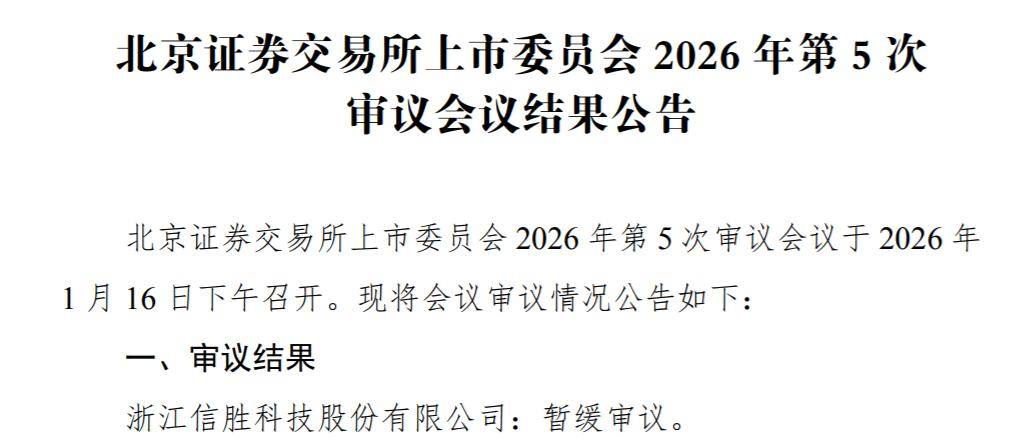
Core Viewpoint - Xinxing Technology's IPO application on the Beijing Stock Exchange has been postponed, marking the first such case for 2026 among major Chinese exchanges, with Guosen Securities as the sponsor [2] Group 1: IPO Application and Regulatory Requirements - The listing committee has requested further verification from the sponsor and the reporting accountant regarding sales customers with "cross-border foreign exchange payment capabilities," focusing on payment agreements and execution [2] - Xinxing Technology is required to disclose additional information about borrowing from subsidiaries for fundraising projects and measures to control the use of raised funds to protect the interests of the company and minority investors [4] - The committee has raised questions about the authenticity and sustainability of the company's operating performance and the implementation of fundraising projects through its subsidiaries [4] Group 2: Company Overview and Financial Performance - Xinxing Technology specializes in the research, production, and sales of computer embroidery machines, recognized as a "little giant" enterprise by the Ministry of Industry and Information Technology [4] - The company's total assets have increased from approximately 618.49 million yuan in 2022 to about 1.20 billion yuan by mid-2025, with total equity rising from 302.14 million yuan to approximately 563.74 million yuan in the same period [5] - Revenue for the years 2022 to 2025 is projected to grow from 600 million yuan to between 1.35 billion and 1.55 billion yuan, with net profit expected to rise significantly from 52.6 million yuan in 2022 to between 195 million and 225 million yuan in 2025 [6] Group 3: Shareholding Structure - The actual controllers of Xinxing Technology, Wang Haijiang and Yao Xiaoyan, hold 46.67% of the company's shares directly and control 99.05% of the voting rights through affiliated entities [8]
机构称A股慢牛上行的趋势不变,A500ETF易方达(159361)助力便捷布局A股核心资产
Sou Hu Cai Jing· 2026-01-20 05:09
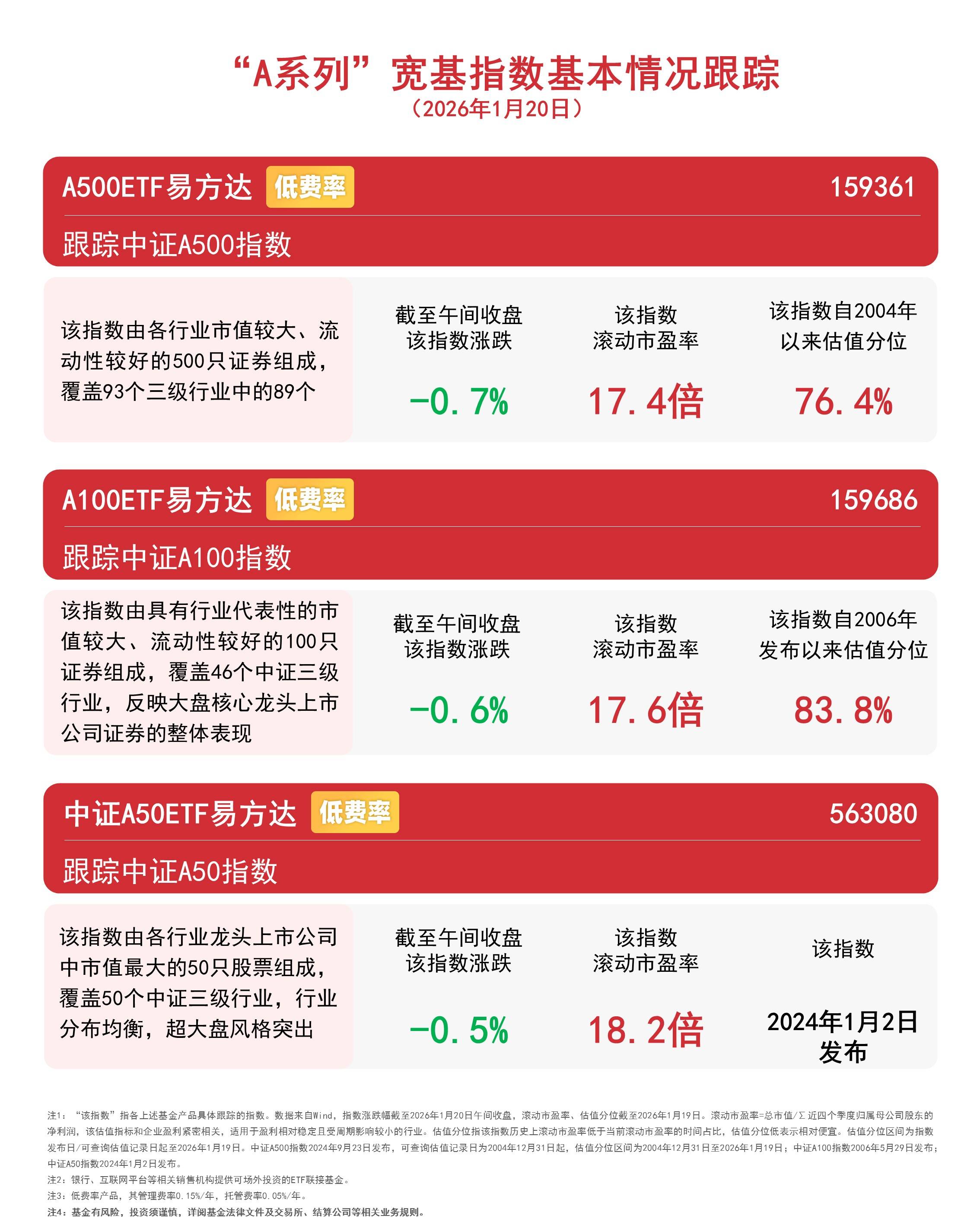
Core Viewpoint - The long-term upward trend of A-shares remains unchanged despite short-term declines in major indices, supported by macroeconomic policies and expected recovery in corporate earnings [1] Group 1: Market Performance - As of the midday close, the CSI A500 index fell by 0.7%, the CSI A100 index decreased by 0.6%, and the CSI A50 index dropped by 0.5% [1] Group 2: Macroeconomic Policies - In the medium to long term, the macro policy cycle is expected to create a favorable liquidity environment for the market, particularly with the start of the 14th Five-Year Plan in 2026, which will see multiple departments issuing supporting industrial policies and investment plans [1] Group 3: Capital Inflows - The anticipated inflow of long-term funds, including insurance capital, resident funds, and foreign capital driven by currency appreciation, is expected to bring additional capital into the market [1] Group 4: Corporate Earnings Outlook - It is projected that corporate earnings will enter a mild recovery phase in 2026, and the market will focus on the potential turning point in profitability as a key support for market trends [1]