国家开发银行

Search documents
华能水电: 2025年度第六期科技创新债券和第九期绿色超短期融资券(乡村振兴)发行公告
Zheng Quan Zhi Xing· 2025-08-21 16:11
Group 1 - The company has completed the issuance of the sixth phase of technology innovation bonds amounting to RMB 1.4 billion and the ninth phase of green ultra-short-term financing bonds (rural revitalization) amounting to RMB 0.8 billion, with interest rates of 1.63% and 1.65% respectively [1][2] - The total balance of short-term financing bonds (including ultra-short-term financing bonds) after this issuance is RMB 6.7 billion, while the balance of medium-term notes (including perpetual medium-term notes) is not specified [1] - The funds raised from the bond issuance will be used to repay interest-bearing liabilities, and the issuance was conducted through a public offering in the national interbank bond market [1] Group 2 - The company received approval from the shareholders' meeting on May 27, 2024, to issue debt financing instruments with a total principal balance not exceeding RMB 34 billion until June 13, 2026 [2] - The limits for individual categories of debt financing instruments are set at RMB 14 billion for short-term financing bonds (including ultra-short-term financing bonds) and RMB 20 billion for medium-term notes (including perpetual medium-term notes) [2] - The company must ensure that the bond principal balance does not exceed RMB 23 billion at the end of each year, with specific limits for short-term and medium-term financing bonds [2]

5000亿“准财政”工具要来了
2 1 Shi Ji Jing Ji Bao Dao· 2025-08-21 14:31
Core Viewpoint - The new policy financial tools, with a funding scale of 500 billion yuan, aim to boost investment in emerging industries and infrastructure, including digital economy, artificial intelligence, and green low-carbon sectors [2][3][9] Group 1: Policy and Government Initiatives - Since May, various regions have been organizing policy briefings and project preparation meetings regarding new policy financial tools [2] - The central government has signaled an increase in investment efforts, with the State Council emphasizing the need to expand effective investment and promote private investment [2][3] - The National Development and Reform Commission (NDRC) plans to expedite the establishment of new policy financial tools [2][3] Group 2: Project Preparation and Focus Areas - Local governments are actively preparing project reserves, focusing on matching projects with the new financial tools, including traditional industry upgrades and high-tech projects [5][6] - Specific regions, such as Hubei and Guangdong, are identifying projects that align with national strategies and the requirements of the new financial tools [5][6] - In Shanxi, 11 projects have been reserved with a total investment of 13.369 billion yuan, indicating a strong focus on transportation, logistics, and green transformation [5][6] Group 3: Financial Mechanism and Market Impact - The new policy financial tools are characterized as "quasi-fiscal" instruments, with project selection managed by the NDRC and funding provided by policy banks [3][10] - The tools are designed to address capital shortages for project construction and to lower financing thresholds, thereby expanding effective investment [7][11] - The implementation of these tools is expected to complement special bonds and enhance capital input for projects [10][11] Group 4: Economic Context and Challenges - The introduction of new policy financial tools comes in response to declining investment growth, with fixed asset investment growth slowing to 1.6% in July [10][11] - There are concerns regarding the effectiveness of policy banks in investing in emerging industries, which require specialized judgment [11] - The focus on ensuring that investments yield returns while avoiding increased local hidden debt is a critical consideration for the successful deployment of these tools [11]

5000亿“准财政”工具要来了
21世纪经济报道· 2025-08-21 13:47
Core Viewpoint - The article discusses the establishment and implementation of new policy financial tools aimed at stabilizing investment and promoting economic growth, with a focus on emerging industries and infrastructure projects [1][2][8]. Group 1: Overview of New Policy Financial Tools - Since May 2023, various regions have been conducting policy briefings and project preparation meetings regarding new policy financial tools, with a total funding scale of 500 billion yuan [1]. - The new policy financial tools are designed as "quasi-fiscal" instruments, with project lists curated by the National Development and Reform Commission (NDRC) and financing provided by policy banks [2][10]. - The tools will focus on sectors such as digital economy, artificial intelligence, low-altitude economy, consumption, green and low-carbon initiatives, agriculture, rural development, transportation logistics, and urban infrastructure [1][2]. Group 2: Project Preparation and Implementation - Multiple regions have completed project reserves, with Hubei and Guangdong actively matching projects from their planning libraries to align with national strategies [4][5]. - In Shanxi, 11 projects have been reserved with a total investment of 13.369 billion yuan, requiring 2.186 billion yuan from the new policy financial tools [5][6]. - Nanjing's Pukou District has added 12 new projects with a total investment of 4.2 billion yuan, focusing on high-tech and green projects [6]. Group 3: Government Support and Economic Context - The central government has signaled an increase in investment efforts, with the State Council emphasizing the need for effective investment to adapt to changing demands [1][11]. - Investment data from June and July 2023 indicates a need for stronger measures to stabilize investment, as fixed asset investment growth has slowed to 1.6% [11]. - The new policy financial tools are expected to help address capital shortages for project construction and stimulate effective investment, particularly in infrastructure and technology innovation [11].

5000亿“准财政”工具将出,重点支持新兴产业、基础设施等
2 1 Shi Ji Jing Ji Bao Dao· 2025-08-21 12:37
Core Insights - The new policy financial tools are aimed at stabilizing investment and promoting innovation, with a total funding scale of 500 billion yuan, focusing on emerging industries and infrastructure [1][6][8] - Local governments are actively preparing and identifying projects for funding, with a focus on high-tech and socially beneficial projects [3][4][5] Group 1: Policy and Funding Mechanism - The new policy financial tools are classified as "quasi-fiscal" instruments, with project lists screened by development and reform departments, and funding provided by policy banks [2][8] - The tools are designed to address capital shortages for project construction, lower financing thresholds, and expand effective investment [6][8] Group 2: Project Identification and Preparation - Various regions, including Hubei and Guangdong, are conducting project preparation meetings to align with national strategies and identify high-quality projects [3][5] - Specific projects have been identified, such as 11 projects in Shanxi with a total investment of 13.369 billion yuan, requiring 2.186 billion yuan from the new financial tools [4][6] Group 3: Economic Context and Challenges - The introduction of these tools comes in response to declining investment growth, with fixed asset investment growth slowing to 1.6% in July [8][9] - There are concerns regarding the effectiveness of policy banks in investing in emerging industries, which require specialized judgment [9]
中国化学与国家开发银行交流座谈
Zheng Quan Shi Bao Wang· 2025-08-21 10:38
Group 1 - The core viewpoint of the article highlights a meeting between China Chemical's Vice Chairman and General Manager, Deng Zhaojing, and Wang Peng, the Vice President of the National Development Bank, focusing on deepening strategic cooperation and promoting the implementation of key projects [1] Group 2 - The meeting took place at the headquarters of China Chemical on August 21 [1] - The discussion emphasized the importance of collaboration between the two entities to facilitate project execution [1]

国开行前7个月发放先进制造业和战略性新兴产业贷款3850亿元
Yang Shi Xin Wen· 2025-08-20 08:50
Group 1 - The core viewpoint of the articles highlights the significant increase in loans issued by the National Development Bank (NDB) for advanced manufacturing and strategic emerging industries, amounting to 385 billion yuan from January to July, representing a year-on-year growth of 51.3% [1] - The NDB has intensified its efforts in corporate engagement, customizing financial service plans for individual enterprises, particularly focusing on key industrial chains such as integrated circuits, domestic large aircraft, high-end equipment manufacturing, and new materials [1] - In Shanghai, the NDB's branch has increased R&D loan disbursements to support 15 enterprises in high-end equipment manufacturing and new energy vehicles, addressing the significant funding needs for R&D [1] Group 2 - In Liaoning, the NDB's branch is focusing resources on four trillion-yuan industrial bases and 22 key industrial clusters, providing long-term financing support to companies like Shenyang Siasun Robot and Ansteel Group, thereby aiding the province's equipment manufacturing sector [2] - The NDB plans to align its efforts with the recent guidelines issued by the People's Bank of China and other departments to provide long-term financing support for key industrial chains, enhancing financial services for characteristic industrial clusters and key enterprises [2]
前7个月国开行发放先进制造业和战略性新兴产业贷款同比增51.3%至3850亿元
Xin Hua Cai Jing· 2025-08-20 05:21
Group 1 - The core viewpoint of the news is that the China Development Bank (CDB) is increasing its support for the transformation and upgrading of the manufacturing industry by providing tailored financial services and loans to key sectors [1][4] - In the first seven months of this year, CDB issued loans amounting to 385 billion yuan for advanced manufacturing and strategic emerging industries, representing a year-on-year increase of 51.3% [1] - CDB is focusing on providing long-term financing support for key industrial chains and projects, including integrated circuits, domestic large aircraft, high-end equipment manufacturing, and new materials [1][3] Group 2 - CDB's Qingdao branch has been actively supporting Qingdao Bay Chemical Co., particularly in the construction of a 150,000 tons/year epoxy resin project, as well as various technological upgrades [2] - The Shanghai branch of CDB has increased its R&D loan disbursement to support 15 enterprises in high-end equipment manufacturing and new energy vehicles, including the development of a new MPV model by SAIC Maxus [3] - CDB's Henan branch is supporting the "Hunting One" commercial launch vehicle project with a 250 million yuan R&D loan, aimed at developing a reliable and cost-effective medium-sized liquid launch vehicle [3]
以“三位一体”创新路径促进债券市场高质量发展
Xin Lang Cai Jing· 2025-08-20 00:24
Core Viewpoint - The article emphasizes the need for reform and innovation to promote high-quality development in the bond market, focusing on product, technology, and institutional innovations to address existing challenges and stimulate financing for innovative enterprises [1][2][3]. Group 1: Current State of the Bond Market - China's bond market has achieved significant growth, with a total outstanding scale exceeding 180 trillion yuan, maintaining its position as the second largest globally [2]. - The bond market plays a crucial role in China's financial system, with recent reforms aimed at increasing direct financing and supporting technological innovation [2][3]. - Despite its size, the bond market faces structural challenges compared to mature international markets, including market segmentation and liquidity issues [3][4]. Group 2: Structural Challenges - There are issues with market segmentation and liquidity, particularly between the interbank and exchange markets [4]. - Product innovation and risk management tools are insufficient, with a low issuance ratio of bonds rated below AA, failing to meet the financing needs of small and medium-sized enterprises [4]. - The credit rating mechanism has systemic biases, with over 90% of bonds rated AA or above, leading to distorted risk pricing [4]. - The application of financial technology is lagging, particularly in integrating blockchain and digital currency with traditional systems [4][5]. Group 3: Innovation Pathways - The article proposes a "three-in-one" innovation approach focusing on product, technology, and institutional innovations to enhance the bond market [5][6]. - Product innovation should target the financing needs of innovative enterprises, particularly in the technology sector, with a significant increase in the issuance of technology bonds expected in 2024 [6][7]. - The bond market's product system needs improvement, with gaps in areas such as inflation-linked bonds and catastrophe bonds [8]. Group 4: Technological Innovation - Technological innovation is essential for the digital and intelligent transformation of the bond market, with applications of blockchain, AI, and big data expected to enhance market efficiency [10][11]. - The integration of blockchain technology has already begun in China, with the launch of a blockchain digital bond platform [11][12]. - Future technological advancements should focus on establishing unified standards and data ecosystems to overcome current fragmentation and privacy concerns [12]. Group 5: Institutional Innovation - Institutional innovation is critical for addressing structural contradictions in the bond market, including market segmentation and inadequate risk pricing mechanisms [13][14]. - Proposed reforms include creating unified management regulations for the bond market and enhancing the interconnectivity between different market segments [13]. - Strengthening risk prevention measures through AI and big data technologies is necessary for maintaining market stability [14]. Group 6: Synergistic Development - The synergy between product, technology, and institutional innovations is vital for enhancing market efficiency and resource allocation [15][16]. - This collaboration can lead to improved risk management and support for national strategies, particularly in green finance and technological innovation [16][17]. - The development of a new market ecosystem driven by these innovations is expected to foster long-term competitiveness in the bond market [17].
东方甄选报警◆胖东来董事长:胖东来的经营模式要完全复制不容易,也没必要◆一地将全面暂停网约车“一口价”“特惠单”?官方回应:属实
Jin Rong Shi Bao· 2025-08-19 23:00
2025年8月20日 ■ 8月19日,外交部发言人毛宁主持例行记者会。有记者提问,特朗普与泽连斯基以及与欧洲多国领导 人在白宫举行了会晤,外交部对此有何评论?毛宁表示,中方始终认为对话谈判是解决乌克兰危机的唯 一可行出路,我们支持一切有利于和平的努力。 ■ 工业和信息化部、中央社会工作部、国家发展改革委、国务院国资委、市场监管总局、国家能源局8 月19日联合召开光伏产业座谈会,深入学习贯彻习近平总书记重要指示批示精神,贯彻落实党中央、国 务院决策部署,进一步规范光伏产业竞争秩序。 ■ 财政部19日发布数据显示,今年前7个月,全国一般公共预算收入135839亿元,同比增长0.1%。 ■ 人力资源社会保障部等5部门8月19日对外发布《关于领取个人养老金有关问题的通知》,进一步丰富 个人养老金领取情形,明确具体操作办法,自9月1日起开始实施。(详情) ■ 水利部于19日对天津、河北、辽宁、云南4省份启动洪水防御Ⅳ级应急响应,并维持对北京市的洪水 防御Ⅳ级应急响应。 ■ 据国家档案局19日消息,《抗日战争档案汇编》新书发布会19日在北京举行,其中多数档案属首次公 布。 ■ 据西藏自治区财政厅19日消息,在西藏自治区成 ...

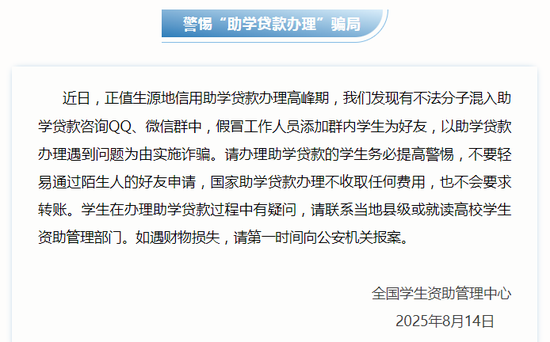
谨防助学贷款变“诈骗陷阱”!有人已混入QQ群假冒工作人员
Xin Lang Cai Jing· 2025-08-19 11:21
Group 1 - The Ministry of Education's National Student Financial Aid Center issued a warning about "student loan processing" scams, particularly during the peak period for local credit student loan applications [1][2][3] - Scammers are infiltrating student loan consultation groups on platforms like QQ and WeChat, posing as staff to defraud students [2][3] - Previous warnings were issued earlier this year regarding "student loan repayment" scams and illegal "campus loans" [1][4] Group 2 - The center advises students to be cautious and not to accept friend requests from strangers, emphasizing that the national student loan process does not require any fees or transfers [3][4] - Reports indicate that two students were scammed out of 3,500 yuan by fraudsters posing as loan facilitators [3][4] - Local police have shared common scam tactics, including impersonating officials and creating urgency through misleading statements [4] Group 3 - The national student loan program is government-led, providing credit loans to economically disadvantaged students for tuition and living expenses [5][6] - The maximum loan amounts have been increased: from 16,000 yuan to 20,000 yuan for undergraduates and from 20,000 yuan to 25,000 yuan for graduate students starting from the 2024 academic year [5] - Loan terms include a repayment period of up to 22 years, with interest rates set at 70 basis points below the market rate [5][6] Group 4 - The student loan program includes both local credit loans and campus-based loans, with specific eligibility criteria for applicants [6][9] - Students must not have outstanding loans to act as co-borrowers for others, and those under 16 require a guardian as a co-borrower [7] - Repayment schedules vary, with no payments required during the study period and structured repayments starting after graduation [8] Group 5 - Banks require cooperation with specific universities to process student loans, and students can only apply for one type of loan per academic year [9][11] - Students are advised to verify loan details through official channels and not to engage in any transactions requested via phone or online [11]