
荣昌生物

Search documents
荣昌达成重磅交易,国产创新药有望引领肿瘤免疫新时代
Orient Securities· 2026-01-14 13:12
Investment Rating - The report maintains a "Positive" outlook for the pharmaceutical and biotechnology industry in China [5] Core Insights - Domestic innovative drugs are expected to lead the tumor immunotherapy 2.0 era, with bispecific antibodies becoming a global focus and business development (BD) transaction volumes reaching new highs. The global value of Chinese innovative drugs is being rapidly uncovered [3][6] - A significant collaboration was established between Rongchang Biopharma and AbbVie, involving the PD-1/VEGF bispecific antibody (RC148), which includes a $650 million upfront payment and potential milestone payments of up to $4.95 billion, along with double-digit royalties on net sales outside Greater China. This partnership accelerates the internationalization of RC148 and highlights the potential of the tumor pipeline [6] - The report emphasizes the increasing interest from multinational pharmaceutical companies in domestic bispecific antibody drugs, indicating that these innovative drugs will be a key growth engine in the tumor immunotherapy 2.0 era [6] Summary by Sections Industry Overview - The pharmaceutical and biotechnology industry is positioned for growth, particularly in the area of innovative drugs and tumor immunotherapy [5] Investment Recommendations and Targets - Key investment targets include Rongchang Biopharma (688331), 3SBio (01530), 3SBio Guojian (688336), Innovent Biologics (01801), CanSino Biologics (09926), Kintor Pharmaceutical (06990), and Eucure Biopharma (09606), all of which are not rated yet [3] Recent Developments - The collaboration between Rongchang Biopharma and AbbVie is a pivotal event, marking a significant step in the global commercialization of innovative drugs [6]

向“领跑者”跨越! 中国双抗药物再迎高光时刻
Mei Ri Jing Ji Xin Wen· 2026-01-14 11:59
Core Insights - The announcement of a $5.6 billion licensing agreement between Rongchang Biopharma and AbbVie marks a significant milestone for Chinese innovative drugs entering the global market, indicating a shift from follower to leader in the dual antibody space [1][3] - Concurrently, Kangfang Biopharma's partner, Summit Therapeutics, submitted a Biologics License Application (BLA) for Ivoris monoclonal antibody to the FDA, further highlighting the progress of Chinese dual antibodies on the international stage [1][4] - However, the termination of a licensing agreement by Yiming Oncology with Instil Bio serves as a cautionary tale for the challenges faced by Chinese companies in global expansion [1][10] Group 1: Major Developments - Rongchang Biopharma's agreement with AbbVie includes an upfront payment of $650 million and potential milestone payments of up to $4.95 billion, along with double-digit royalties on net sales outside Greater China [3] - Kangfang Biopharma's Ivoris monoclonal antibody is positioned to address a significant unmet clinical need in treating EGFR-mutant non-small cell lung cancer, with the FDA expected to make a decision by Q4 2026 [4][5] - The competitive landscape for PD-1/VEGF dual antibodies is intensifying, with major pharmaceutical companies increasingly focusing on a few validated "winners" in the market [2][9] Group 2: Industry Trends - The recent high-value transactions in the dual antibody space reflect a growing recognition of the clinical and commercial potential of Chinese innovative drugs, with transaction amounts reaching new heights [9] - The competitive dynamics are shifting, as the number of potential international buyers decreases due to the concentration of capital and interest in a limited number of validated products [10][13] - The success of PD-1/VEGF dual antibodies is seen as pivotal for the future of cancer treatment, with ongoing clinical trials exploring their combination with other therapies to enhance efficacy [14]

荣昌生物(688331):400亿BD大单落地,创新药烽烟再起
市值风云· 2026-01-14 11:05
Investment Rating - The report indicates a strong investment opportunity for Rongchang Biopharma following the signing of a significant licensing agreement with AbbVie, which is expected to enhance the company's financial position and market presence [2][25]. Core Insights - Rongchang Biopharma has signed an exclusive licensing agreement with AbbVie for the novel PD-1/VEGF bispecific antibody drug RC148, which includes an upfront payment of $650 million (approximately 4.5 billion RMB) and potential milestone payments totaling up to $4.95 billion (approximately 34.5 billion RMB) [2][8]. - The total transaction value is close to $4 billion, marking a record for the company in terms of external licensing agreements [3][8]. - The PD-1/VEGF bispecific antibody market is identified as a "golden track" for Chinese innovative drugs going global, with increasing upfront payments reflecting the growing value of these assets [9][10]. Industry Overview - The number of BD licensing deals for Chinese innovative drugs has surged from 85 in 2023 to 157 in 2025, with a compound annual growth rate of 35.9% [11]. - The total transaction value for these deals has skyrocketed from $32 billion in 2023 to $135.7 billion in 2025, representing a growth of over three times [13]. - The industry is entering an accelerated growth phase, with a year-on-year growth rate of 161% for BD licensing deals in 2025, significantly outpacing previous years [15]. Financial Performance - Rongchang Biopharma's revenue for the first three quarters of 2025 reached 1.72 billion RMB, reflecting a year-on-year increase of 42.27% [16]. - Despite ongoing net losses exceeding 1 billion RMB from 2022 to 2024, the company has shown improvement, with losses narrowing to 551 million RMB in the first three quarters of 2025 compared to 1.071 billion RMB in the same period of 2024 [17][19]. - The anticipated upfront payment from the AbbVie deal is expected to further improve Rongchang Biopharma's profitability and cash reserves, potentially leading to profitability in 2026 if the payment is fully received [19]. Product Pipeline - Rongchang Biopharma's key products include Taitasip (IL-4Rα antibody) and Vidisicimab (HER2 ADC), which are currently the main sources of revenue [20]. - The RC148 bispecific antibody is a focus for the company, currently in I/II clinical stages, and the collaboration with AbbVie is expected to accelerate its global development [23].
荣昌生物400亿BD大单落地,创新药烽烟再起!
市值风云· 2026-01-14 10:08
Core Viewpoint - Rongchang Biopharmaceutical has signed an exclusive licensing agreement with AbbVie for the novel PD-1/VEGF bispecific antibody drug RC148, which is expected to significantly enhance the company's financial position and growth prospects [3][20]. Group 1: Licensing Agreement Details - The agreement grants AbbVie exclusive rights to develop, manufacture, and commercialize RC148 outside Greater China, with Rongchang receiving an upfront payment of $650 million (approximately 4.5 billion RMB) [3][7]. - The total potential transaction value could reach $4.95 billion (approximately 34.5 billion RMB), including milestone payments and royalties based on net sales [3][7]. - This transaction marks a record for Rongchang in terms of both upfront payment and total deal value, surpassing previous agreements [7][20]. Group 2: Industry Trends - The number of BD (business development) licensing agreements for Chinese innovative drugs has surged, with transactions increasing from 85 in 2023 to 157 in 2025, reflecting a compound annual growth rate of 35.9% [9]. - The total transaction value for these agreements is projected to rise from $32 billion in 2023 to $135.7 billion in 2025, representing over a threefold increase [11]. - The average upfront payment has also seen significant growth, increasing from $2.5 billion to $7 billion, a rise of 180% [11][13]. Group 3: Company Financial Performance - Rongchang's revenue for the first three quarters of 2025 reached 1.72 billion RMB, marking a year-on-year growth of 42.27% [14]. - Despite the revenue growth, the company has reported net losses exceeding 1 billion RMB from 2022 to 2024, with a reduced loss of 551 million RMB in the first three quarters of 2025 compared to 1.071 billion RMB in the same period of 2024 [15][16]. - The anticipated upfront payment from the AbbVie agreement is expected to further improve Rongchang's profitability and cash reserves, potentially leading to profitability in 2026 if the payment is fully received [16].

医药生物行业周报:聚焦脑机接口与小核酸药物,JPM盛会前奏下医疗布局新浪潮-20260114
East Money Securities· 2026-01-14 10:07
Investment Rating - The report maintains a "Strong Buy" rating for the pharmaceutical and biotechnology sector, indicating a positive outlook for investment opportunities [3]. Core Insights - The pharmaceutical sector has shown a strong performance with a 7.81% increase in the index, outperforming the CSI 300 index by 5.03 percentage points, ranking 6th in industry performance [9][14]. - The report highlights significant growth in sub-sectors such as medical services and medical devices, with increases of 12.34% and 9.42% respectively [17][22]. - The report emphasizes the potential of small nucleic acid drugs, predicting a market valuation of $18.6 billion by 2029, with a CAGR of 29.5% from 2024 to 2029 [38]. - The upcoming JPMorgan Healthcare Conference is expected to showcase over 20 Chinese companies, with a focus on significant R&D advancements [39]. Summary by Sections Market Review - The pharmaceutical index increased by 7.81% this week, outperforming the CSI 300 index by 5.03 percentage points, ranking 6th in industry performance [14]. - The best-performing sub-sector this week was medical services, which rose by 12.34%, while traditional Chinese medicine had the smallest increase at 2.89% [17][22]. Individual Stock Performance - In the A-share market, 453 out of 478 pharmaceutical stocks rose, with the top five performers being Bibet (+68.89%), Innovation Medical (+61.04%), and Sanbo Brain Science (+56.15%) [25]. - In the Hong Kong market, 104 out of 116 pharmaceutical stocks increased, with the top performers including Zhaoyan New Drug (+30.76%) and Rongchang Bio (+28.51%) [29]. Industry News and Policies - The National Health Commission has outlined ten key initiatives for 2026, focusing on enhancing pediatric services and mental health care [32]. - The National Medical Products Administration has announced the establishment of two industry standards for brain-computer interface medical devices, indicating a regulatory push for this technology [32]. Weekly Insights - The report notes that the pharmaceutical sector is experiencing a "New Year Rally" driven by favorable policies for brain-computer interfaces and the launch of small nucleic acid innovative drugs [36]. - The report suggests monitoring companies involved in brain-computer interfaces, such as Chengyitong and Weisi Medical, as they are in the R&D phase [37].
A股成交额连续3日超3万亿元
Cai Jing Wang· 2026-01-14 09:06
Core Viewpoint - The A-share market experienced an overall adjustment, with significant trading activity continuing, particularly in the AI application and pharmaceutical sectors, while the commercial aerospace sector faced a notable decline [1][2][3]. Group 1: Market Performance - The Shanghai Composite Index closed at 4138.76 points, down 0.64%, while the Shenzhen Component Index fell 1.37% to 14169.40 points. The ChiNext Index and the Sci-Tech Innovation Board Index also saw declines of 1.96% and 2.66%, respectively [1]. - The total trading volume in the Shanghai and Shenzhen markets reached 36,988 billion yuan, marking the third consecutive trading day exceeding 30 trillion yuan, setting a new record for single-day trading volume in A-shares [1]. Group 2: Sector Performance - The AI application sector remained active, with the GEO (Generative Engine Optimization) direction leading gains. Notable stocks included Ingrity Media, which achieved six consecutive trading limits, and Tianlong Group and Lio Co., which saw three consecutive trading limits [1]. - The pharmaceutical sector collectively rose, with AI medical, innovative drugs, and CRO (Contract Research Organization) sectors showing strong performance. Stocks like Nossger and Rongchang Bio reached their daily limit of 20% [3][4]. Group 3: Pharmaceutical Sector Developments - Pharmaceutical companies are experiencing multiple favorable factors, including positive earnings forecasts from leading companies. WuXi AppTec projected a net profit of approximately 19.15 billion yuan for 2025, representing a year-on-year increase of about 102.65% [4]. - Rongchang Bio announced a significant business development agreement with AbbVie for its new PD-1/VEGF dual-specific antibody drug, RC148, which includes an upfront payment of 650 million USD and potential milestone payments up to 4.95 billion USD [4]. - The establishment of a new AI joint innovation laboratory by NVIDIA and Eli Lilly in the San Francisco Bay Area, with an investment of up to 1 billion USD over five years, aims to enhance drug discovery and development processes [4]. Group 4: Commercial Aerospace Sector - The commercial aerospace sector faced a significant pullback, with stocks like Aerospace Hanyu and Aerospace Software dropping over 10%, and several stocks hitting their daily limit down [2]. - Chinese Satellite's stock experienced a daily fluctuation of 19.53%, closing up 4.17%, with a trading volume of 22.74 billion yuan, ranking fourth in A-shares [2]. Group 5: Market Outlook - Analysts suggest that the market is in a critical window for policy catalysis and industrial rotation, with structural trends continuing but increasing differentiation. The market is expected to maintain a slow upward trend supported by policy and industrial upgrades [7][8]. - The pharmaceutical and resource sectors are anticipated to be core investment themes for 2026, with frequent sector rotation and style switching expected [8].
生物制品板块1月14日跌0.9%,荣昌生物领跌,主力资金净流出6.56亿元
Zheng Xing Xing Ye Ri Bao· 2026-01-14 08:58
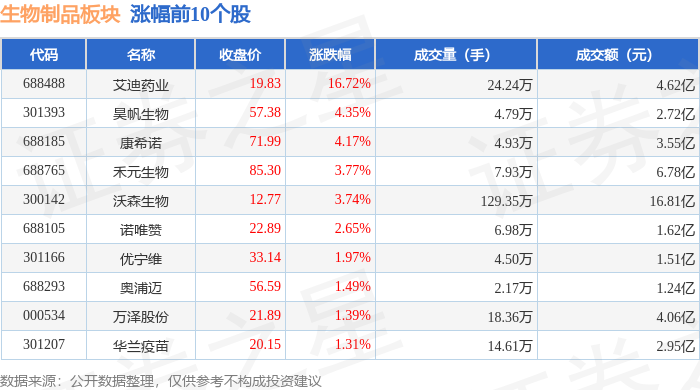
Market Overview - The biopharmaceutical sector experienced a decline of 0.9% on January 14, with Rongchang Biopharmaceutical leading the drop [1] - The Shanghai Composite Index closed at 4126.09, down 0.31%, while the Shenzhen Component Index closed at 14248.6, up 0.56% [1] Stock Performance - Notable gainers in the biopharmaceutical sector included: - Aidi Pharmaceutical, closing at 19.83 with a rise of 16.72% and a trading volume of 242,400 shares, totaling 462 million yuan [1] - Wufan Biopharmaceutical, closing at 57.38 with an increase of 4.35% and a trading volume of 47,900 shares, totaling 272 million yuan [1] - Kangbuno, closing at 71.99 with a rise of 4.17% and a trading volume of 49,300 shares, totaling 355 million yuan [1] - Rongchang Biopharmaceutical saw a significant decline, closing at 103.34 with a drop of 9.72% and a trading volume of 196,700 shares, totaling 2.091 billion yuan [2] Capital Flow - The biopharmaceutical sector experienced a net outflow of 656 million yuan from institutional investors, while retail investors saw a net inflow of 407 million yuan [2] - Notable capital flows included: - Watson Biopharmaceuticals with a net inflow of 63.73 million yuan from institutional investors [3] - Kanghua Biopharmaceuticals with a net inflow of 18.92 million yuan from institutional investors [3] - Overall, retail investors contributed a net inflow of 4.07 billion yuan to the sector [2]
科创板收盘播报:科创50指数涨2.13% 通信设备股表现活跃
Xin Hua Cai Jing· 2026-01-14 08:03
Group 1 - The core index, the Sci-Tech 50 Index, opened high on January 14, 2023, and closed significantly up at 1500.91 points, with a gain of 2.13% and a total trading volume of approximately 123.9 billion yuan [1] - The overall Sci-Tech Index rose by 1.63% to close at 1835.41 points, with a total trading volume of about 406.6 billion yuan [1] - The performance of the 600 stocks on the Sci-Tech board showed more gainers than losers, with notable activity in software services and communication equipment sectors, while biopharmaceuticals and chemical materials sectors faced declines [1] Group 2 - The average gain for the 600 stocks on the Sci-Tech board was 1.29%, with an average turnover rate of 5.29% and an average volatility of 6.64% [1] - Individual stock performances included Haohan Deep, Youche Technology, Guangyun Technology, and Yinghantong reaching the daily limit up, while Rongchang Biopharmaceuticals saw a decline of 9.72%, the largest drop [1] Group 3 - In terms of trading volume, Cambrian Technology led with a volume of 12.77 billion yuan, while ST Pava had the lowest at 1.366 million yuan [2] Group 4 - Regarding turnover rates, Angrui Micro had the highest turnover rate at 28.09%, while Sany Heavy Energy had the lowest at 0.38% [3]
荣昌生物跌9.72% 华泰证券华安证券昨刚喊买入就跌
Zhong Guo Jing Ji Wang· 2026-01-14 07:45
Core Viewpoint - Rongchang Biopharmaceutical (688331.SH) experienced a significant decline in stock price, closing at 103.34 yuan, down 9.72% [1] Group 1: Analyst Reports - Huatai Securities analysts Dai Wen, Yuan Zhongping, and Li Hang published a report on January 13, maintaining a WACC of 6.5% and a perpetual growth rate of 2.5%, adjusting the DCF-based target price for A-shares to 151.79 yuan (previously 140.42 yuan) [1] - The A/H premium was adjusted to 16.46%, consistent with the past three months' A/H premium for Rongchang Biopharmaceutical, up from the previous 8.95% [1] - The target price for H-shares was adjusted to 142.72 HKD (previously 141.13 HKD), with a "buy" rating maintained for both A-shares and H-shares [1] Group 2: Clinical Development and Product Pipeline - Huazhong Securities analysts Tan Guochao and Ren Wanying also published a report on January 13, expressing optimism about the clinical advancement of RC148, the progress of the company's pipeline, and the stable sales growth of its listed products, maintaining a "buy" rating [1]

医疗AI加速十万亿级医药市场重构,科创医药ETF嘉实(588700)一键布局AI医药发展机遇
Sou Hu Cai Jing· 2026-01-14 06:13
Group 1 - The Shanghai Stock Exchange Sci-Tech Innovation Board Biopharmaceutical Index decreased by 1.00% as of January 14, 2026, with Tianzhihang leading the gain at 18.97% and Rongchang Biopharmaceuticals experiencing the largest drop at 9.83% [1] - Eight departments jointly issued the "Implementation Opinions on the Special Action of 'Artificial Intelligence + Manufacturing'," emphasizing the promotion of intelligent equipment iteration and supporting AI applications in high-end medical equipment and telemedicine [1] - Nvidia and Eli Lilly announced the establishment of an AI joint laboratory, planning to invest up to $1 billion over the next five years to accelerate drug development, indicating increased investment from leading overseas companies in domestic related fields [1] Group 2 - CITIC Securities reported that the medical AI sector is expected to accelerate the restructuring of the trillion-yuan pharmaceutical market, with a fundamental change in the payment logic for AI medical services anticipated in 2026 [2] - The top ten weighted stocks in the Shanghai Stock Exchange Sci-Tech Innovation Board Biopharmaceutical Index accounted for 48.85% as of December 31, 2025, including companies like United Imaging Healthcare and BeiGene [2] Group 3 - The Jiashi Sci-Tech Medical ETF closely tracks the Shanghai Stock Exchange Sci-Tech Innovation Board Biopharmaceutical Index, providing an opportunity for investors to easily access the biopharmaceutical sector [3]