Lyft

Search documents
Elon Musk says there's 'no need' for Tesla to buy Uber since Tesla owners could one day join its autonomous fleet
Business Insider· 2025-05-20 22:23
Core Viewpoint - Elon Musk has dismissed the idea of Tesla acquiring Uber, stating that Tesla can operate independently with its own autonomous vehicle fleet [1] Group 1: Tesla's Autonomous Vehicle Strategy - Musk envisions a future where users can summon an autonomous Tesla instead of using rideshare services like Uber [1] - Tesla plans to allow its car owners to rent out their vehicles for autonomous ride-hailing, similar to how Airbnb operates [2] - The company aims to launch its robotaxi service in Austin next month, starting with a small fleet and scaling up to 1,000 vehicles within a few months [3] Group 2: Technology and Fleet Readiness - Musk believes Tesla has all the necessary technology and fleet capabilities to support a large-scale robotaxi service [4] - Tesla's upcoming robotaxi fleet will utilize its Full Self-Driving software, which does not require a driver [3] Group 3: Competitors' Strategies - Uber and Lyft have shifted away from developing their own autonomous vehicles but plan to offer robotaxis through partnerships with self-driving technology companies [4] - Uber has already integrated Alphabet's Waymo into its app in select cities, while Lyft has partnered with several companies to introduce autonomous vehicles by summer 2025 [5]



高盛:2025 年美股十大行业主题及前景聚焦股票(年中更新)
Zhi Tong Cai Jing· 2025-05-19 04:27
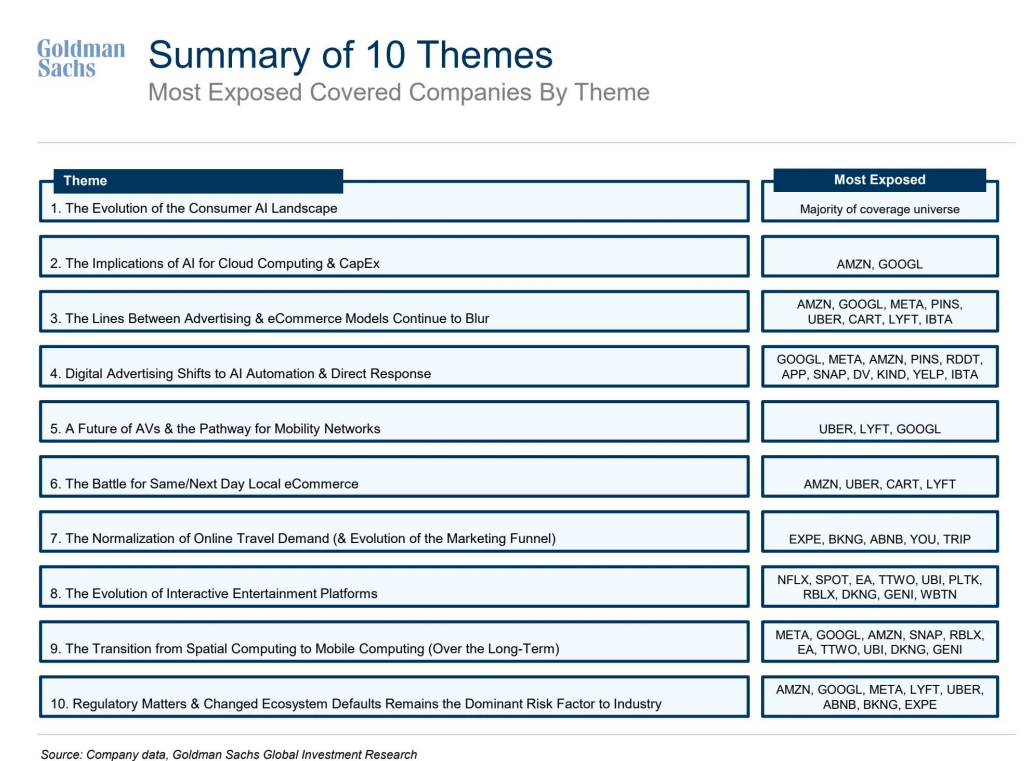
Core Insights - Goldman Sachs has updated its top investment themes for 2025, focusing on long-term growth opportunities, key sub-industry controversies, and significant risk factors [1][2]. Group 1: Long-term Growth Opportunities - The investment themes primarily target sectors such as the evolving digital advertising industry, the blurring lines between large-scale advertising and commerce, cloud computing, and local business [2]. - Artificial intelligence (AI) is highlighted as a major driver of change, particularly impacting cloud service providers and digital advertising platforms [2]. Group 2: Key Sub-industry Controversies - The report discusses the implications of autonomous vehicles on transportation networks, the normalization of online travel patterns, and the expansion of interactive entertainment companies [2][6][8]. Group 3: Significant Risk Factors - Ongoing regulatory scrutiny, political and judicial reviews, and potential disruptions from AI are identified as critical risks facing the industry [2][9]. - The year 2025 is seen as pivotal for platforms to demonstrate the practical applications and effectiveness of their AI investments, as investor expectations for tangible returns increase [3]. Group 4: Overview of Investment Themes - The ten investment themes cover various companies, including: 1. Evolution of consumer AI landscape: Most companies within the coverage [5]. 2. Impact of AI on cloud computing and capital expenditures: Major companies affected include Amazon (AMZN) and Google (GOOGL) [5]. 3. Blurring lines between advertising and e-commerce: Companies such as Amazon (AMZN), Google (GOOGL), Meta (META), and others are involved [5]. 4. Shift of digital advertising towards AI automation: Key players include Google (GOOGL), Meta (META), and Amazon (AMZN) [5]. 5. Future of autonomous vehicles and transportation networks: Companies like Uber (UBER) and Lyft (LYFT) are discussed [6]. 6. E-commerce competition in Japan: Involves Amazon (AMZN) and Uber (UBER) [7]. 7. Normalization of online travel demand: Companies such as Expedia (EXPE) and Booking Holdings (BKNG) are highlighted [8]. 8. Evolution of interactive entertainment platforms: Companies like Netflix (NFLX) and Spotify (SPOT) are included [8]. 9. Long-term shift from spatial computing to mobile computing: Involves Meta (META), Google (GOOGL), and others [8]. 10. Regulatory issues and ecosystem defaults as major risk factors: Affected companies include Amazon (AMZN), Google (GOOGL), and others [9].





高盛:2025 年美股十大行业主题及前景聚焦股票(年中更新)
贝塔投资智库· 2025-05-19 04:17
Core Insights - Goldman Sachs has updated its top investment themes for 2025, focusing on long-term growth opportunities, key sub-industry controversies, and significant risk factors [1][2]. Group 1: Long-term Growth Opportunities - The investment themes emphasize identifying major long-term growth opportunities in evolving sectors such as digital advertising, cloud computing, and local commerce [2]. - The rise of artificial intelligence (AI) is highlighted as a transformative force, particularly impacting cloud service providers and digital advertising platforms [2][3]. Group 2: Key Sub-industry Controversies - The report discusses the implications of autonomous vehicles on transportation networks and the normalization of online travel demand [2][4]. - It also addresses the evolving landscape of interactive entertainment companies and the blurring lines between advertising and e-commerce models [4][6]. Group 3: Significant Risk Factors - Ongoing regulatory scrutiny, political and judicial reviews, and potential disruptions from AI are identified as critical risk factors for the industry [2][4]. - The need for major platforms to demonstrate the practical applications and effectiveness of their AI investments is emphasized, especially as they enter a high cycle of operational and capital expenditures [3].


Meta、Google、亚马逊、Uber、Expedia、Doordash 1Q25业绩及展望交流会
2025-05-18 15:48
Summary of Earnings Call and Industry Insights Companies and Industries Involved - **Google** - **Meta** - **Amazon** - **Uber** - **DoorDash** - **Expedia** - **Booking** - **Airbnb** Key Points and Arguments Google - **Q1 2025 Financial Performance**: Google reported total revenue of $90.23 billion, meeting expectations with a year-over-year growth of 12%. Net profit was $34.54 billion, exceeding expectations by 40% and showing a 46% increase year-over-year, primarily due to a $8 billion adjustment in fair value of investments [3][4]. - **Advertising and Cloud Business**: Advertising revenue grew by 8.5%, with core search ads up 9.8%. YouTube ads increased by 10%, benefiting from performance advertising. Cloud revenue grew by 28%, with an operating margin of 17.8%, a record high [2][4]. - **AI Developments**: Google launched the Gamma 2.5 Pro model and related products, with active users exceeding 1.5 billion. The average query length in AI Mode is double that of traditional searches, contributing to a 7% increase in search ad prices [5][8]. Meta - **Q1 2025 Financial Performance**: Meta's revenue grew by 16% to $42.3 billion, with net profit increasing by 35% to $16.6 billion, surpassing market expectations. The company expects Q2 revenue growth of 9% to 16% [10][12]. - **AI Impact on Advertising**: AI technology improved user engagement across platforms, with user time on Facebook, Instagram, and Threads increasing by 7%, 6%, and 35% respectively. The introduction of generative ad models improved ad conversion rates by 5% [12][15]. - **Regional Performance**: North America saw the highest revenue growth at 23.6%, while Asia-Pacific growth slowed to 9% due to high previous year comparisons [13][14]. Amazon - **Q1 2025 Financial Performance**: Amazon's revenue met expectations, with operating profit exceeding forecasts. AWS revenue grew by 17%, with an operating margin of 39.5%, a record high [19][21]. - **Retail Business Insights**: The retail segment faced challenges from one-time factors affecting profit margins. However, improvements in fulfillment efficiency and advertising growth are expected to enhance retail margins [20][24]. Uber - **Q1 2025 Financial Performance**: Uber's revenue grew by 14%, with a 13% increase in U.S. business. The company reported a stable EBITDA, exceeding market expectations by 1% [30][32]. - **Market Resilience**: The ride-hailing industry demonstrated strong resilience against economic pressures, with both Uber and Lyft showing robust performance through differentiated competition and product innovation [32][33]. DoorDash - **Q1 2025 Financial Performance**: DoorDash's total order value increased by 20%, with revenue up 21%. The company plans to acquire UK-based Deliveroo to enhance scale and cash flow [22][25]. - **Membership Growth**: The company saw a doubling of international subscription service members year-over-year, indicating strong user engagement [22]. OTA Companies (Expedia, Booking, Airbnb) - **Q1 2025 Performance**: Expedia's performance fell short of expectations, while Booking and Airbnb met or slightly exceeded forecasts. Booking's adjusted profit was 30% above market expectations due to significant layoffs [36][41]. - **Market Dynamics**: The U.S. market showed weakened demand, impacting OTA companies significantly. However, Latin America experienced strong growth, with Expedia's growth nearing 20% in that region [37][39]. Other Important Insights - **Regulatory Risks**: Meta faces antitrust scrutiny, particularly regarding its acquisitions of WhatsApp and Instagram, although the likelihood of severe penalties appears low [48]. - **Tariff Implications**: Ongoing U.S. tariff policies may pose regulatory risks for tech companies like Meta and Google, particularly in European markets where they derive significant revenue [49]. - **Valuation Trends**: Current valuations for Google and Meta are at historical lows, with Google trading at 17 times GAAP PE for 2025, while Meta trades at 26 times [8][16]. This comprehensive overview highlights the financial performance, strategic initiatives, and market dynamics of the involved companies, providing insights into potential investment opportunities and risks.


13F持仓更新:桥水爆买中概股,巴菲特0新建仓但坚守苹果
Jin Shi Shu Ju· 2025-05-16 06:54
Group 1 - Berkshire Hathaway's total U.S. stock holdings decreased to $259 billion as of March 31, down from $267 billion in the previous quarter, with no new positions added and adjustments made to 15 stocks [2] - Bridgewater Associates significantly increased its position in Alibaba by 5.4 million shares, a 21-fold increase, making it the fourth-largest holding, while also building positions in gold ETFs and other Chinese stocks [2][3] - Hillhouse Capital's HHLR Advisors increased its total holdings from $2.887 billion to $3.539 billion, a nearly 23% increase, while continuing to invest in Chinese assets [4] Group 2 - Berkshire Hathaway completely exited its positions in Citigroup and Nu Holdings, while maintaining its 300 million shares in Apple [6] - Alibaba reduced its stake in XPeng by 3.08 million shares, representing an 8.13% decrease [8] - New positions were established in companies like Baidu and Li Auto, while Alibaba and BeiGene saw reductions in holdings [7]
押注“东升西降”!桥水最新持仓曝光:爆买阿里加仓百度,砍仓标普500ETF
Zheng Quan Shi Bao· 2025-05-15 14:22
Core Insights - Bridgewater Associates made significant changes to its portfolio in Q1 2023, notably increasing its stake in Alibaba and gold ETFs while reducing its holdings in major tech stocks like Nvidia [1][2][3] Group 1: Portfolio Adjustments - Bridgewater purchased over 5.4 million shares of Alibaba, investing $710 million, making it the largest position in its portfolio [2] - The fund also initiated a position in SPDR Gold ETF, acquiring over 1.1 million shares valued at approximately $319 million, representing 1.48% of its total holdings [2] - In the Chinese stock market, Bridgewater increased its holdings in Baidu by nearly 1.88 million shares and in Pinduoduo by around 500,000 shares, while also establishing a position in JD.com [3] Group 2: Major Sell-offs - Bridgewater significantly reduced its position in SPDR S&P 500 ETF by $2.74 billion, decreasing its weight from 22% to less than 9% of the total portfolio [3] - The fund also cut its holdings in Nvidia by 65,540 shares (18.74%), Google by 579,000 shares (15.99%), and Meta by 19,550 shares (31.47%) [3] - Additionally, Bridgewater almost completely exited its position in AppLovin, which had seen an 18% decline in Q1, and also sold off shares in several other companies including ON Semiconductor and Moderna [4] Group 3: Market Outlook - Bridgewater's founder, Ray Dalio, emphasized the importance of a well-thought-out investment strategy in light of the changing global economic landscape, driven by factors such as debt monetization and international power restructuring [5][6] - Dalio highlighted the critical question of whether the U.S. fiscal deficit can be reduced to 3% of GDP, which will influence the future of debt and currency value [5]


Best Gig Economy Stocks to Monitor Amid its Growing Popularity
ZACKS· 2025-05-15 13:56
Industry Overview - The gig economy has transformed traditional employment by providing workers with flexibility in work hours, workload, and workspace, which has gained popularity during and after the pandemic [2][4] - The gig economy market is projected to grow from $556.7 billion in 2024 to $648.8 billion in 2025 and reach $2.15 trillion by 2033, indicating a compound annual growth rate of approximately 16.2% from 2025 to 2033 [4] Company Insights - Companies like Uber, Lyft, DoorDash, Upwork, and Fiverr are capitalizing on the gig economy by offering platforms for short-term, freelance, or contract-based work [3][5] - Amazon is a significant player in the gig economy, providing flexible work opportunities through programs like Flex, Delivery Service Partners, Mechanical Turk, and its cloud computing service, AWS [6][7][8] - Lyft focuses on the ride-hailing segment, allowing drivers to work flexibly and earn income through ridesharing, shared rides, and other transportation services [9][10][11] - Angi operates as an online marketplace for home services, connecting homeowners with skilled service professionals, thus exemplifying the evolution of the gig economy into home services [12][13][14]


AI日报丨减仓英伟达,爆买阿里巴巴!全球最大对冲基金桥水基金公布一季度调仓新动向
美股研究社· 2025-05-15 11:02
Core Insights - The rapid development of artificial intelligence technology is creating extensive opportunities in the market [1] - The article focuses on analyzing AI concept stocks and market trends to provide deep industry insights and value analysis [1] AI Developments - Google DeepMind launched AlphaEvolve, a programming AI agent designed for advanced algorithm development, which solved a 300-year-old mathematical problem, establishing a new lower bound in 11-dimensional space with a structure of 593 outer spheres [3] - A research team from Oregon State University developed a new AI chip that reduces the energy consumption of large language models by 50%, marking a significant breakthrough in the semiconductor field [4] Company Performance - CoreWeave's stock fell after announcing that accelerated AI investment plans would lead to lower profits, with quarterly profit forecasts between $140 million and $170 million, below analyst expectations of $192 million [5] - Bridgewater Associates reported significant portfolio adjustments in its Q1 holdings, increasing positions in 283 stocks while reducing positions in 252 stocks, indicating a cautious approach towards the U.S. stock market [6][7] Investment Trends - Bridgewater's largest holding, SPDR S&P 500 ETF, was reduced by nearly 60%, while Alibaba saw a dramatic increase in holdings from 255,000 shares to 5.66 million shares, marking a 21-fold increase [6][7] - The fund also established a new position in a gold ETF, reflecting a shift towards more stable investment options amid global economic uncertainty [6][7] Industry Outlook - CITIC Securities expressed optimism about high-quality innovative pharmaceutical companies and suggested focusing on cutting-edge technologies such as AI and brain-computer interfaces [9] - Foxconn, an Apple supplier, received approval to build a $435 million factory in India, aimed at diversifying the supply chain outside of China, with plans to produce display driver chips and eventually transition to chip manufacturing [11][12]


隔夜美股 | 三大指数涨跌不一 特斯拉(TSLA.US)连涨六日
智通财经网· 2025-05-14 22:25
Market Performance - The three major U.S. indices showed mixed results, with the Dow Jones Industrial Average declining for the second consecutive trading day, down 89.37 points or 0.21% to 42051.06 points [1] - The Nasdaq Composite rose by 136.73 points or 0.72% to 19146.81 points, while the S&P 500 increased by 6.03 points or 0.1% to 5892.58 points [1] - Notable stock movements included Tesla rising 4% for six consecutive trading days, Google A increasing by 3.6%, and Nvidia gaining 4% with a weekly increase of 16% [1] European Market - European indices experienced declines, with Germany's DAX30 down 100.14 points or 0.42% to 23519.45 points, and the UK's FTSE 100 down 21.07 points or 0.24% to 8581.85 points [1] - The French CAC40 index fell by 37.04 points or 0.47% to 7836.79 points, while the Spanish IBEX35 rose by 70.67 points or 0.51% to 13842.27 points [1] Asian Market - The Nikkei 225 index in Japan decreased by 0.14%, while the KOSPI index in South Korea rose over 1.2% and the Indonesian Composite Index increased by over 2% [2] Currency and Commodities - The U.S. dollar index rose by 0.03% to 101.037, with fluctuations against major currencies including the euro and the British pound [2] - Spot gold fell by 2.14% to $3180.90 per ounce, while COMEX gold futures dropped by 1.91% to $3185.70 per ounce [2][3] - WTI crude oil prices decreased by 0.8% to approximately $63 per barrel, ending a four-day increase [3] Cryptocurrency - Bitcoin declined by 0.59% to $103,561.4, while Ethereum dropped over 3% to $2,595.77 [3] Macro News - The U.S. and Qatar signed economic and military cooperation agreements valued at over $243.5 billion, including significant purchases from Boeing and defense contracts [4] - OPEC+ members increased oil production by only 25,000 barrels per day in April, significantly below the planned increase of 138,000 barrels per day [4] Company News - Apple is developing a groundbreaking eye-tracking feature for its Vision Pro headset, which will allow users to scroll through interfaces using eye movements [7] - Bridgewater Associates significantly increased its holdings in Alibaba by over 540,000 shares, marking a 21-fold increase, and also built positions in JD.com and gold ETFs [8]
从99%到99.99%,Robotaxi正在跨越“最后一公里”?
3 6 Ke· 2025-05-14 10:48
Group 1 - The year 2025 is anticipated to be a breakthrough year for the integration of autonomous driving and artificial intelligence, with Tesla launching a "fully autonomous" Robotaxi service in Austin, Texas, and planning to mass-produce the CyberCab model by 2026 [1] - Tesla's AI company, xAI, has completed a $6 billion financing round aimed at creating a supercomputing factory to enhance Tesla's autonomous driving technology [1] - Global ride-hailing giants Uber and Lyft are accelerating the commercialization of autonomous driving through partnerships with Waymo and Mobileye, with both companies reporting significant progress in their autonomous driving businesses [1][3] Group 2 - Tesla's Full Self-Driving (FSD) system is a key competitive advantage, having accumulated over 1.6 billion miles of driving data, with plans for the FSD V13 version to increase the required mileage by six times [2] - The FSD system utilizes end-to-end neural network technology to achieve "human-like" driving decisions, capable of handling complex scenarios [2] - The global Robotaxi market is projected to exceed $2 trillion by 2030, driven by technological breakthroughs and capital influx [3] Group 3 - The competition in the Robotaxi market is bifurcating into two camps: cost-driven and ecosystem-driven, with Waymo leveraging Google's ecosystem and Chinese players like Pony.ai and WeRide focusing on cost advantages [3] - Pony.ai has significantly reduced hardware costs, with an 80% decrease in onboard computing unit costs and a 68% reduction in lidar costs [3] - The financing for Robotaxi-related ventures has surged, with Waymo's valuation exceeding $45 billion and Uber's stock rising by 46.05% due to autonomous driving collaborations [3] Group 4 - The traditional automotive industry's business model is shifting from hardware sales to a data-driven, service-oriented ecosystem, with Tesla's "shared economy + subscription model" expected to transform its revenue structure [5][7] - Uber and Lyft are adopting a light-asset platform strategy, integrating third-party technologies to mitigate high costs associated with building their own fleets [7] - Chinese companies are leveraging local advantages to expand into international markets, with Pony.ai and WeRide entering the Middle East and Europe [8][12] Group 5 - China's regulatory environment is becoming more favorable for autonomous driving, with local legislation paving the way for commercial applications of Level 3 autonomous driving by 2025 [11] - Chinese companies are focusing on cost efficiency and localized innovation, with Pony.ai's seventh-generation system achieving significant cost reductions [11] - The global landscape is characterized by a complex interplay of policies, technology, and globalization, with China positioning itself to capitalize on these dynamics [10][12]