石头科技

Search documents
本周新增石头科技、海致科技等5家企业港股发行上市获证监会备案
Sou Hu Cai Jing· 2026-01-11 06:54
Core Viewpoint - The China Securities Regulatory Commission (CSRC) has disclosed that five companies have recently obtained approval for overseas issuance and listing or full circulation of unlisted shares in China, all targeting the Hong Kong Stock Exchange and are in the process of secondary applications [1] Group 1: Company Summaries - Stone Technology, once known as a "sweeping broom" in the A-share market, saw its stock price peak at 1494.99 yuan per share in June 2021, with a market capitalization of 99.266 billion yuan, but has since decreased to a total market value of 42.361 billion yuan, representing a decline of over 50%. The company plans to issue no more than 33.108 million shares [1] - Haizhi Technology, an AI application company founded by former Baidu executives and backed by Hillhouse Capital, focuses on products like the Atlas mapping solution and Atlas intelligent agents. It intends to issue no more than 47.5846 million shares and convert 372 million shares held by shareholders into H-shares [1] - Yushi Technology specializes in L4-level autonomous driving technology, with investors including Innovation Works. The company plans to issue no more than 18.9142 million shares and convert 112 million shares held by shareholders into H-shares [1] - Deshi Biotech aims to become the first company to launch a medical imaging large model, planning to issue no more than 31.004 million shares and convert 80.88 million shares held by shareholders into H-shares [1] - Shangmi Technology, a provider of commercial IoT (BIoT) solutions with shareholders including Ant Group, Meituan, and Xiaomi, plans to issue no more than 46.004 million shares and convert 261 million shares held by shareholders into H-shares [1]

科技周报|国务院调查外卖行业无序竞争问题,多款机器人亮相CES
Di Yi Cai Jing· 2026-01-11 05:58
Group 1: Food Delivery Industry - The State Council's Anti-Monopoly and Anti-Unfair Competition Committee is investigating the competitive landscape of the food delivery service industry, highlighting issues such as subsidy wars, price competition, and traffic control, while emphasizing opposition to "involution-style" competition [2] - Major platforms like Meituan, Taobao Flash, and JD responded collectively, asserting their commitment to maintaining fair and orderly competition in the industry [2] - Experts believe that regulatory investigations will clarify competitive boundaries and behavioral bottom lines, pushing platforms to shift from price competition to efficiency, service, and innovation [2] Group 2: E-commerce and Support Policies - Douyin E-commerce announced an upgraded support plan for merchants, focusing on cost, traffic, conversion, fulfillment, technology, and governance, aiming to enhance long-term operational certainty for merchants [4] - The nine support policies were initially launched in early 2025, and over the past year, Douyin has saved merchants over 32 billion yuan through various initiatives [4] Group 3: Autonomous Driving and Technology - Baidu's "Roborock" received the first full unmanned testing license in Dubai, marking a significant step towards commercial operations planned for Q1 2026, with plans to expand the fleet to over 1,000 vehicles [8] - The establishment of an integrated operation base in Dubai will support the scale of unmanned vehicle operations, indicating China's deep involvement in global transportation ecosystem restructuring [8] Group 4: Battery Technology - Donut Lab introduced what it claims to be the world's first mass-producible all-solid-state battery, featuring an energy density of 400 Wh/kg and rapid charging capabilities [9] - The battery is designed to withstand extreme temperatures and has a minimal capacity degradation after 100,000 charge cycles, with no flammable liquid electrolytes [9][10] Group 5: Air Conditioning Industry - Gree Electric Appliances announced that it will not raise air conditioner prices and has no plans to replace copper with aluminum in its products, despite rising copper prices [11] - The transition to aluminum in air conditioning systems faces technical verification and standardization challenges, with Gree emphasizing that aluminum has not yet reached the same technical reliability as copper [11]

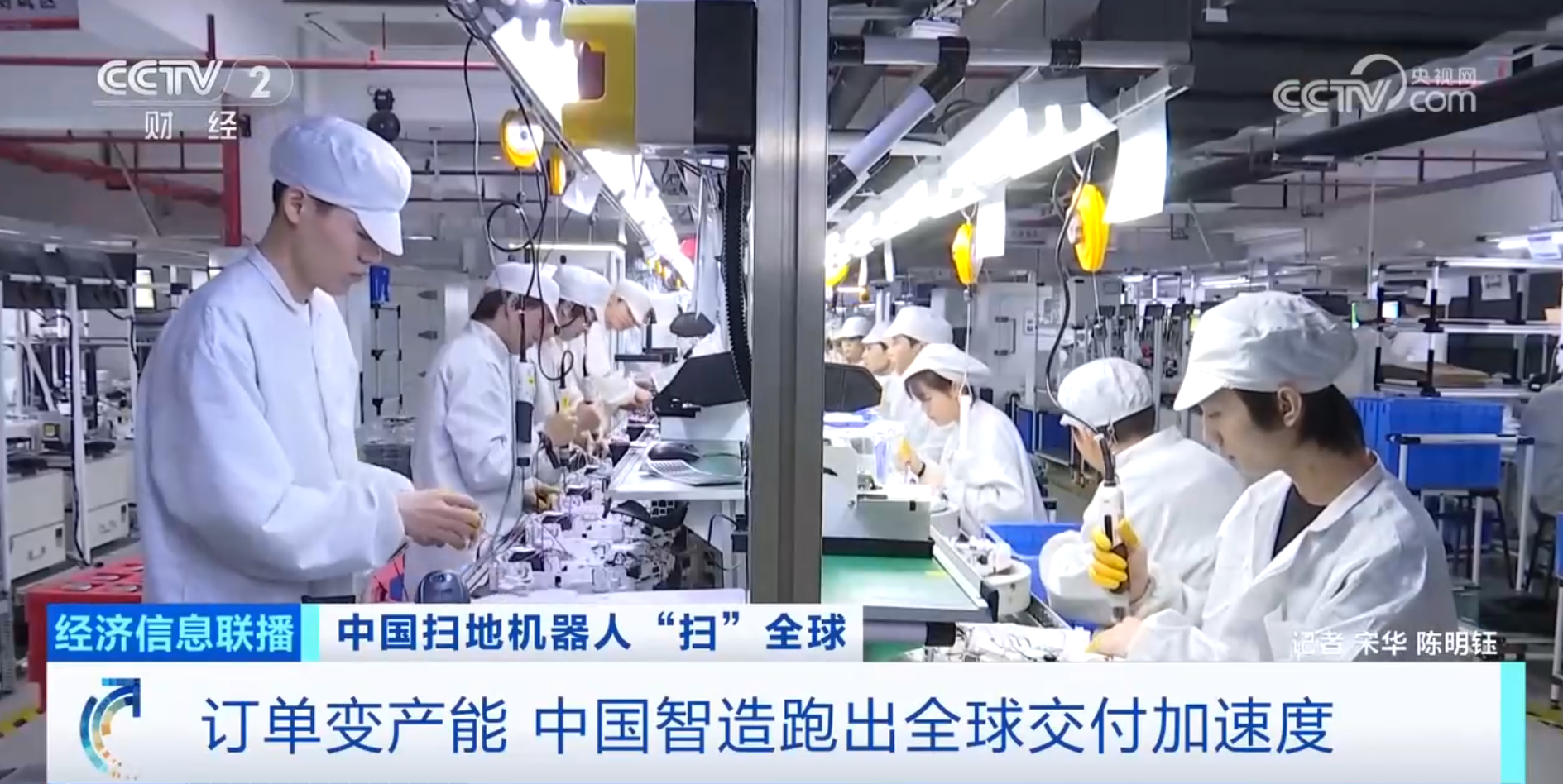
扫地机器人35天送抵欧洲!中国智造跑出全球交付加速度→
Yang Shi Wang· 2026-01-10 18:55
Core Viewpoint - The article highlights the robust demand for Chinese smart manufacturing, particularly in the vacuum cleaner sector, driven by overseas orders and the need for efficient delivery capabilities [1]. Group 1: Manufacturing Capacity and Orders - In a manufacturing facility in Huizhou, production lines are operating at full capacity, with a monthly output of up to 200,000 units, over 60% of which are for overseas markets [3]. - The most popular model for North America and Europe has orders extending to April 2026, showcasing strong global demand [3]. - Another production line is focused on new products that debuted at the Consumer Electronics Show, with preparations made in December to ensure timely global distribution [5]. Group 2: Revenue and Market Expansion - Stone Technology anticipates global shipments exceeding 7.2 million units by 2025, with overseas revenue surpassing 50% starting in 2024 [5]. - The company’s products are now present in over 17 countries and regions, reaching more than 20 million households [5]. - Yunji Intelligent has secured orders worth at least 300-400 million yuan from overseas markets, with strategic collaborations leading to over 600 million yuan in orders [7]. Group 3: Export Performance - In the first 11 months of 2025, Shenzhen exported vacuum cleaners worth 11.12 billion yuan, marking a 71.8% year-on-year increase [9]. - Exports to the EU grew by 121%, accounting for 41.6% of total exports, while exports to the US and ASEAN also saw significant increases [9]. - The logistics process has been optimized, reducing the overall shipping time to Europe by over 30%, with delivery times around 35 days [9].

上海冲出千亿AI应用龙头,上市首日暴涨109%!马斯克旗下xAI公司完成200亿美元融资,英伟达参与投资; OpenAI发布ChatGPT健康 | AI周报
创业邦· 2026-01-10 10:38
Group 1 - MiniMax, a Chinese AI unicorn, made its debut on the Hong Kong Stock Exchange, with its stock price soaring 109% on the first day, pushing its market value over HKD 100 billion, reflecting strong investor interest in generative AI assets [8] - xAI, founded by Elon Musk, completed a $20 billion funding round with participation from Nvidia, Cisco Investments, and Qatar Investment Authority, although specific investment amounts were not disclosed [9] - OpenAI launched ChatGPT Health, targeting the trillion-dollar AI healthcare market, with projections indicating the market could grow from approximately $26.65 billion in 2024 to about $505.59 billion by 2033, at a CAGR of 38.8% [9] Group 2 - Alibaba Cloud introduced a multimodal interaction development kit, integrating various AI models and tools for applications in smart devices [9] - Roborock showcased a stair-climbing robot, Saros Rover, which utilizes AI and multiple sensors for navigation, demonstrating advanced mobility capabilities [10] - Tencent's AI workspace, ima, launched a "generate PPT" feature, allowing users to create presentations using their personal knowledge base [17] Group 3 - WeChat announced an AI application growth plan, providing comprehensive support for AI applications and tools from January 1 to December 31, 2026 [19] - Ant Group's AI assistant, Ant Fu, reached 30 million monthly active users, with daily inquiries exceeding 10 million, doubling in both metrics compared to the previous month [24] - JD.com established a "Chameleon Business Unit" to accelerate the commercialization of AI technologies, with plans to launch a second batch of self-developed AI toys in mid-January [25] Group 4 - AMD's CEO stated that AI active users surged from 1 million to 1 billion since the launch of ChatGPT, predicting that by 2030, there will be 5 billion active AI users, necessitating a 100-fold increase in global computing power in the coming years [26] - Hyundai began mass production of an AI chip named Edge Brain, enabling robots to operate autonomously without external network connections, with plans for pilot projects in various locations [23] - A report indicated that global humanoid robot shipments are expected to reach 13,000 units by 2025, with Chinese manufacturers leading the market [32] Group 5 - The global AI financing landscape saw 21 disclosed events this period, totaling approximately RMB 162.96 billion, with an average funding amount of RMB 14.81 billion [34] - In the domestic AI sector, a total of RMB 3.38 billion was disclosed, with BrainCo securing the highest funding of RMB 1.8 billion in a Pre-B+ round [41] - The overseas AI financing total reached RMB 159.57 billion, with xAI leading with its $20 billion funding round [49]

整个社会都在喊没钱了,为什么这些公司反而年赚百亿?
创业家· 2026-01-10 10:18
Core Insights - The article emphasizes that despite the prevailing narrative of economic hardship, certain industries are thriving and generating substantial profits, particularly in Japan and China [3][4]. - It identifies eight key sectors that are capitalizing on changing consumer behaviors and preferences, suggesting that a low-desire society does not equate to a lack of opportunities [4][5]. Group 1: Key Industries - **Second-Hand Economy**: The second-hand luxury market in Japan, exemplified by companies like Daikokuya, has seen significant revenue growth. In China, platforms like Hongbulin and Panghu are experiencing similar success [6][7][8]. - **Pet Economy**: With a decline in birth rates, spending on pets has surged. Companies like Inaba in Japan and Guobao in China are benefiting from this trend, with various pet brands seeing continuous sales growth [12][13][14][15][16]. - **Adult Care**: The adult diaper market in Japan has surpassed $10 billion, indicating that aging populations can create substantial economic opportunities rather than being a burden [17][18][19]. - **Health Food and Beverages**: The rise in health consciousness has led to increased demand for products like sugar-free tea and functional beverages in both Japan and China, reflecting a broader trend in post-pandemic consumer behavior [21][22]. Group 2: Emerging Consumer Trends - **Beauty Economy**: Despite economic constraints, spending on beauty products like collagen supplements remains high, with brands like Weimei and U like achieving significant sales [23][24][25][26]. - **Outdoor Recreation**: Companies in the outdoor equipment sector, such as Snow Peak in Japan and various Chinese brands, are thriving as consumers seek outdoor experiences [29][30][31][32]. - **Convenience Economy**: The demand for convenience products, such as frozen foods and smart home appliances, is rising as younger generations prioritize time-saving solutions [39][40][42]. - **Lazy Economy**: The trend towards convenience is evident in the growth of products that save time, indicating that in a low-desire economy, time-saving may be more valuable than cost-saving [42][43][44].

在拉斯维加斯,我看到概念已死
虎嗅APP· 2026-01-10 09:16
Core Viewpoint - The article discusses the shift in the AI hardware industry from a focus on disruptive innovation to a more pragmatic approach, emphasizing the importance of "scene value" in product development [4][7]. Group 1: AI Hardware Trends - At CES 2026, the atmosphere was notably different from previous years, with less emphasis on grand concepts and more on practical upgrades [5][6]. - The AI hardware industry is moving towards a focus on specific use cases and functionality, rather than broad, ambitious claims [7][15]. Group 2: Wearable Devices - The wearable device sector saw an increase in cross-industry players, particularly in the AI glasses market, with products designed for specific functionalities rather than flashy features [9][12]. - Notable products include the MemoMind AI glasses, which offer user-friendly design and practical applications, and the OpenGuide AI glasses aimed at assisting visually impaired users [11][12][15]. Group 3: Companion Robots - The companion robot market has expanded rapidly, with over 50 companies showcasing products at CES, but many face challenges related to product consistency [20][21]. - There is a trend towards customization in companion robots, allowing for personalized features and interactions, as seen in prototypes like the Fourier desktop companion robot [24][28]. Group 4: Cleaning Robots - The cleaning robot sector is experiencing significant technological advancements, with products like the Cyber X and G-Rover capable of navigating stairs and complex environments [36][38]. - Future developments may include robots with mechanical arms for more precise cleaning tasks, as demonstrated by the AI cleaning robot that can handle laundry processes [43][45].

供应链与技术创新双赋能!中国智能家电加速出海 全球市场份额持续攀升
Yang Shi Wang· 2026-01-10 07:59
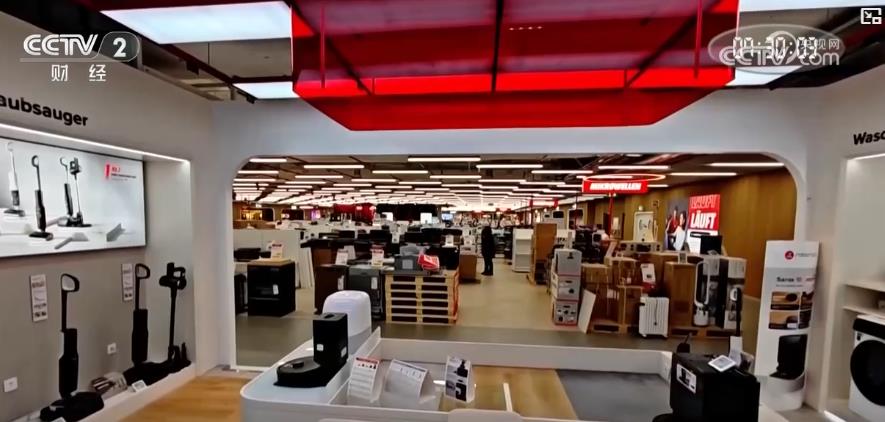
Core Insights - Chinese robotic vacuum cleaners are becoming a popular choice among global consumers, both at technology exhibitions and in retail markets across Europe and Southeast Asia [1] Market Presence - In Germany, Chinese brands like Roborock and Dreame occupy prominent positions in the robotic vacuum cleaner section, with prices ranging from €200 to €2000, and many consumers prioritize these products when shopping for smart home devices [3] - Germany is one of the most important overseas markets for Chinese robotic vacuum cleaners, with GfK data indicating that over 60% of robotic vacuums sold in Western Europe are from China [5] Market Growth - In Southeast Asia, the market share of Chinese robotic vacuum cleaners has significantly increased from 38.8% in 2024 to 64.1% in 2025, marking it as a rapidly growing emerging market [5] - In Ho Chi Minh City, Vietnam, numerous small appliance stores showcase cutting-edge Chinese brand robotic vacuums, with the Ecovacs brand having dozens of dedicated stores and hundreds of sales points [5] Global Shipment Data - According to IDC, the total global shipment of smart robotic vacuums reached 17.424 million units in the first three quarters of 2025, representing a year-on-year growth of 18.7% [7] - Chinese brands such as Roborock, Ecovacs, Dreame, Xiaomi, and Yunji dominate the global market, collectively accounting for nearly 70% of the total shipment volume [7] Competitive Advantage - The strong performance of Chinese brands is attributed to their robust supply chain advantages and superior innovation capabilities in robotic vacuum technology, allowing them to lead overseas markets by one to two generations in terms of technological advancements [7]


中国扫地机器人扫全球!中国扫地机器人占全球份额近70%
Ge Long Hui· 2026-01-10 04:56
Core Viewpoint - The 2026 Consumer Electronics Show in Las Vegas showcased the latest technologies in smart home cleaning devices, particularly highlighting the advancements in AI-integrated robotic vacuum cleaners from Chinese companies [1] Industry Summary - The event featured multiple new robotic vacuum models that incorporate artificial intelligence, demonstrating significant capabilities in perception, decision-making, and execution [1] - Chinese products dominated the exhibition, indicating a strong presence in the global smart home market [1] Market Performance - By the third quarter of 2025, the global shipment of smart robotic vacuums reached 17.424 million units, marking an 18.7% year-on-year increase [1] - Leading Chinese brands such as Roborock, Ecovacs, Dreame, Xiaomi, and Yunji captured nearly 70% of the global market share, ranking as the top five in worldwide shipments [1]
直击CES:“AI正急切地走出屏幕”
Xin Lang Cai Jing· 2026-01-10 00:55
Core Insights - The CES 2023 showcased a significant shift towards consumer-oriented technology, emphasizing the integration of AI into everyday products and experiences [5][20][21] - Chinese companies made a notable impact at CES, with a strong presence in robotics and AI applications, reflecting a growing trend of innovation and market engagement [15][17][18] Group 1: Event Overview - CES is described as a "global technology spring festival," attracting a diverse audience including tech professionals and curious consumers [3][5] - The event is characterized by a more accessible and consumer-friendly atmosphere, moving away from purely business-focused interactions [5][10] Group 2: AI and Robotics - AI applications were prominently featured, with a focus on practical implementations such as robots performing various tasks and AI-enhanced wearable devices [7][9] - The number of robotic exhibitors increased significantly, with a dedicated theme area for "embodied intelligence" [7][15] Group 3: Chinese Companies' Participation - Over 1,200 Chinese exhibitors participated, making up approximately 30% of the total, with a strong emphasis on innovation and market readiness [15][17] - Many Chinese startups showcased their products for the first time, indicating a shift towards proactive international engagement [12][13] Group 4: Market Trends and Consumer Engagement - The feedback from international markets has been overwhelmingly positive, with many products exceeding expectations in terms of interest and potential sales [13][18] - The focus has shifted from merely showcasing AI capabilities to demonstrating measurable value in real-world applications [20][22] Group 5: Competitive Landscape - The event highlighted the competitive dynamics between major AI nations, with Chinese companies focusing on commercialization while U.S. firms emphasized foundational technologies [17][18] - The presence of Korean companies also contributed to the competitive landscape, showcasing strengths in smart manufacturing and AI applications [17][18] Group 6: Future Directions - The integration of AI into physical products is seen as a key trend, with a focus on creating embedded capabilities that enhance user experiences [20][21] - The concept of digital twins is emerging as a foundational element for AI applications in industrial settings, facilitating design and optimization processes [22]

直击CES:“AI正急切地走出屏幕”
吴晓波频道· 2026-01-10 00:21
Core Insights - The CES 2023 showcased a significant shift towards consumer-oriented technology, emphasizing the integration of AI into everyday life and products [4][10][39] - The event highlighted the growing presence of Chinese companies, with over 1,200 exhibitors, reflecting a proactive approach to global markets and innovation [22][28] Group 1: Event Overview - CES is described as a "global technology spring festival," attracting a diverse audience including tech enthusiasts and ordinary consumers [4][9] - The event's theme, "Innovators Show Up," underscores the emergence of new companies and technologies, particularly in AI and robotics [21][22] Group 2: AI and Robotics - AI applications at CES 2023 were notably diverse, featuring robots capable of various tasks and AI-enhanced wearable devices [11][12] - The focus has shifted from merely showcasing AI capabilities to demonstrating how AI can create measurable value in the physical world [16][39] Group 3: Chinese Companies' Impact - Chinese enterprises dominated the robotics and AI application sectors, with a significant number of exhibitors and innovative products [28][29] - The enthusiasm of Chinese companies at CES is attributed to the AI-driven innovation ecosystem in China and a shift towards more aggressive international market strategies [22][26] Group 4: Market Trends and Consumer Engagement - The event revealed a trend towards practical, market-ready products rather than mere conceptual showcases, indicating a maturation of the tech industry [13][39] - There was a notable increase in consumer engagement, with many attendees expressing excitement over AI products that enhance daily life [23][26] Group 5: Industry Comparisons - A comparison of Chinese and American companies revealed differing focuses, with Chinese firms emphasizing product commercialization while American companies concentrated on foundational technologies and software ecosystems [29][42] - Korean companies also made a significant impact, leveraging cross-border supply chains and focusing on home service applications [32]