华夏航空

Search documents
2026年度交通运输行业投资策略:稳内启外,质高为帆
ZHESHANG SECURITIES· 2025-11-16 07:08
Core Insights - 2026 marks the beginning of the "14th Five-Year Plan," with strategies focusing on "reducing internal competition" and "promoting overseas expansion" as key measures to address current economic challenges and foster new growth momentum in the transportation sector [3]. Group 1: Industry Focus Areas - The transportation industry will concentrate on four main lines of development in alignment with the "14th Five-Year Plan" policies and industry trends [3]. - The aviation and express delivery sectors are highlighted for their potential in achieving high-quality development through reduced internal competition [4]. - The shipping industry is undergoing global changes, with oil transportation experiencing a boom while the dry bulk sector faces challenges [5]. Group 2: Overseas Expansion Opportunities - Jitu Express is positioned as a rare player in Southeast Asia and Latin America, benefiting from the rapid growth of Tiktok and a projected 65% increase in parcel volume in Southeast Asia for the first three quarters of 2025 [6]. - Jiao You International is focusing on logistics in Africa, with coal trade in Mongolia expected to rebound significantly in the second half of 2025, while Africa is anticipated to become a major growth driver [6]. - The aviation sector is expected to see accelerated profit recovery in 2026, with major airlines likely to achieve profitability in 2025 [6]. Group 3: Market Dynamics and Predictions - The express delivery sector is set to improve in 2026, with the industry experiencing a price recovery following a period of intense competition [6]. - Oil transportation is benefiting from OPEC+ production increases and seasonal demand, leading to rising freight rates [6]. - The dry bulk shipping sector is expected to see a recovery in demand due to new mining projects and potential interest rate cuts [6]. Group 4: Economic Transition and Stability - The report emphasizes the importance of stable output during the economic transition period, with recommendations for investments in highway and port infrastructure [6].

海外航空市场25Q3景气度跟踪:全球航空业需求稳步回暖,供应链约束仍存
Shenwan Hongyuan Securities· 2025-11-15 07:18
Investment Rating - The report recommends a "Buy" rating for the aviation sector, highlighting strong supply logic and elastic demand, with specific recommendations for several airlines and global aircraft leasing companies [4][104][105]. Core Insights - The global aviation market is experiencing steady recovery, with passenger turnover (RPK) increasing by 4.8% year-on-year in the first three quarters of 2025, driven by international routes [4][7]. - The report emphasizes the ongoing constraints in the aircraft manufacturing supply chain, predicting that the trend of aging aircraft will continue for the next 5-10 years, leading to significant supply limitations [4][104]. - Airlines are expected to see substantial improvements in profitability as they approach a pivotal moment in the industry, with a notable increase in international passenger traffic anticipated [4][104]. Summary by Sections Global Aviation Market Overview - The global aviation market is stabilizing, with RPK growth of 4.8% and ASK growth of 4.7% in the first three quarters of 2025, resulting in an overall passenger load factor increase to 83.5% [4][7]. - The Asia-Pacific region leads in RPK growth at 7.7%, while North America shows minimal growth [4][13]. U.S. Aviation Market Tracking - In Q3 2025, U.S. airline ticket sales saw a rebound with domestic passenger volume up by 7.4% and average ticket prices increasing by 4.1% [4][43]. - The report notes a divergence in performance among major U.S. airlines, with Delta Airlines showing significant profit growth while American Airlines reported losses [4][61][69]. European Aviation Market Tracking - The European aviation market has shown steady recovery, with passenger volumes returning to pre-pandemic levels and ticket prices experiencing slight increases [4][74][83]. - Lufthansa reported a 4% increase in revenue for Q3 2025, driven by strong demand for leisure travel [4][83]. Asian Aviation Market Tracking - Major airports in Southeast Asia and Japan are experiencing continued growth, with passenger volumes surpassing pre-pandemic levels [4][88][94]. - The report highlights the strong recovery in passenger traffic at key transit airports, benefiting from robust demand [4][94]. Investment Analysis - The report suggests that the aviation sector is at a turning point, with airlines likely to experience a "golden era" of profitability due to increasing international travel and effective capacity management [4][104]. - Specific airline recommendations include China Eastern Airlines, China Southern Airlines, and Spring Airlines, among others, with a focus on companies showing continuous improvement in performance [4][104][105].






吉祥航空(603885):更新报告:超级周期弹性龙头,业绩估值双重空间
GUOTAI HAITONG SECURITIES· 2025-11-14 09:06
Investment Rating - The investment rating for the company is "Accumulate" with a target price of 21.81 CNY [2][3]. Core Views - The report indicates that the company's profitability is expected to rebound despite short-term pressures from engine maintenance affecting fleet turnover in the first three quarters of 2025. The overall industry supply and demand are projected to improve, and the company's high-quality route network is anticipated to demonstrate significant profit elasticity [3][14]. Financial Summary - Total revenue is projected to grow from 20,096 million CNY in 2023 to 27,036 million CNY by 2027, reflecting a compound annual growth rate (CAGR) of approximately 10.6% [5]. - Net profit attributable to the parent company is expected to increase from 778 million CNY in 2023 to 2,641 million CNY in 2027, with a notable growth rate of 118.8% in 2023 and 32.3% in 2027 [5]. - Earnings per share (EPS) is forecasted to rise from 0.36 CNY in 2023 to 1.21 CNY in 2027 [5]. - The return on equity (ROE) is expected to improve from 9.0% in 2023 to 20.0% in 2027 [5]. Market Data - The company's market capitalization is approximately 32,214 million CNY, with a 52-week stock price range of 12.17 to 15.28 CNY [6]. - The current stock price is 14.75 CNY, indicating a potential upside based on the target price [14]. Operational Insights - The company operates a fleet of 130 aircraft, with about 25% equipped with Pratt & Whitney engines, which are subject to maintenance issues affecting profitability [14]. - The introduction of the B787 wide-body aircraft is expected to enhance the company's international operations, with optimistic long-term prospects for profitability [14]. Comparative Analysis - The report includes a comparative valuation of similar airlines, indicating that the company maintains a competitive position within the industry [16][17].
航空机场板块11月14日跌0.84%,华夏航空领跌,主力资金净流出2.25亿元
Zheng Xing Xing Ye Ri Bao· 2025-11-14 08:58
从资金流向上来看,当日航空机场板块主力资金净流出2.25亿元,游资资金净流出4645.78万元,散户资 金净流入2.71亿元。航空机场板块个股资金流向见下表: 以上内容为证券之星据公开信息整理,由AI算法生成(网信算备310104345710301240019号),不构成投资建议。 证券之星消息,11月14日航空机场板块较上一交易日下跌0.84%,华夏航空领跌。当日上证指数报收于 3990.49,下跌0.97%。深证成指报收于13216.03,下跌1.93%。航空机场板块个股涨跌见下表: ...


甘肃庆阳机场联合华夏航空解锁国宝北石窟寺 航旅融合承载传统文化传承开发
Zhong Guo Min Hang Wang· 2025-11-14 01:41
庆阳机场负责人在座谈会上表示,航空作为高效的交通载体,与文旅资源的深度融合,不仅是交通线路 的延伸,更是文化传播渠道的拓展。三方合作正是立足庆阳"红色圣地、岐黄故里、农耕之源、能源新 都"的城市定位,以航空为纽带激活文化资源价值的重要实践。据测算,随着串飞航线的稳定运营与主 题服务的全面落地,预计2026年北石窟寺年接待游客量争取突破50万人次,带动庆阳周边餐饮、住宿、 文创等相关产业增收超2亿元。 从泾河崖壁上的千年雕琢,到蓝天上的航班,北石窟寺的文化传播路径正被重新定义为与时代相称的文 化符号。庆阳机场、华夏航空与北石窟寺保护研究所三方携手,打破了交通与文旅之间的融合壁垒,更 为地方特色资源与航空产业的协同发展建设了"陇东方案",三方还将探索推出"航空+石窟研学""航空 +非遗体验"等更多定制化产品,让丝路石窟文化借助航空的翅膀飞向全国,让陇东大地的文化魅力被 更多人看见、感知与传承。(《中国民航报》、中国民航网 记者路泞)(编辑:陈虹莹 校对:李佳洹 审核:韩磊) 同时,地面衔接服务保障,三方的联动精准高效。庆阳机场联合北石窟寺保护研究所开通"机场—北石 窟寺"定制旅游专线,专线大巴与航班时刻精准对接, ...
航空业竞争激烈,华夏航空业绩却创新高 华夏航空CEO吴龙江:应该乐观,公司七成乘客是头回坐飞机
Mei Ri Jing Ji Xin Wen· 2025-11-13 13:33
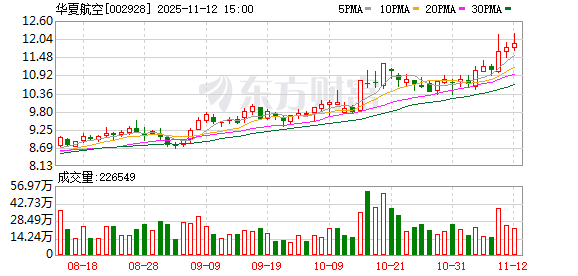
Core Insights - Huaxia Airlines adopts a unique strategy by focusing on connecting remote small cities rather than pursuing popular routes or joining airline alliances, positioning itself as the only independent regional airline in the A-share market [1] - The company has seen a significant turnaround, with a 102.17% year-on-year increase in net profit attributable to shareholders in the first three quarters of the year, and its stock price reaching a two-year high [1][2] Strategic Focus - The airline's strategy is increasingly centered on the regional market, driven by changing industry demands and government policies that support regional air travel [3] - Huaxia Airlines aims to meet the needs of underserved markets rather than competing in saturated routes, focusing on enhancing air connectivity for remote areas [3][4] Customer Base - Approximately 70% of Huaxia Airlines' passengers are first-time flyers, indicating a significant potential market for air travel in regions where flying is not common [6] - The company employs extensive marketing efforts to reach potential customers in rural and county areas, which results in higher customer acquisition costs [6] Government Support - Government subsidies play a crucial role in the airline's business model, helping to offset high operational costs and enabling the airline to offer affordable ticket prices in emerging markets [7][8] - The sustainability of these subsidies is linked to the development of local economies and tourism, creating a closed-loop model that benefits both the airline and the communities it serves [8] Industry Standards and Challenges - The "dry and branch connection, full network integration" service model has become an industry standard, facilitating better passenger experiences and increasing the volume of connecting flights [9] - Challenges remain, such as resource constraints at hub airports and limited cooperation between different airline groups, which Huaxia Airlines aims to leverage through its independent operations [10] Future Development - The airline is committed to maintaining its independent strategy and is not interested in becoming part of a larger airline group, focusing instead on enhancing its unique market position [12] - Huaxia Airlines is evolving its strategy from merely providing connectivity to creating a more integrated travel experience, addressing the changing consumer preferences in the tourism market [12][13]
交运行业2025年三季报总结:关注顺周期板块基本面改善,红利标的仍有上行空间
CMS· 2025-11-13 10:03
Investment Rating - The report maintains a positive outlook on cyclical sectors, indicating that quality dividend stocks still have upward potential [1]. Core Insights - The transportation industry showed stable performance in the first three quarters of 2025, with infrastructure sector key stocks meeting expectations, shipping stocks recovering, and express delivery volumes and prices increasing due to anti-involution policies [1][7]. - The report emphasizes the importance of monitoring cyclical sector fundamentals and highlights the potential for further gains in quality dividend stocks [1][7]. Summary by Sections Overview of the Transportation Sector - The overall performance of the transportation industry from the beginning of 2025 to November 10 showed an increase of 8.5%, underperforming compared to the Shanghai and Shenzhen 300 index, which rose by 31.6% [11]. - The logistics sector benefited from anti-involution policies, while infrastructure sectors like highways and railways experienced declines [11]. Highway Sector - In the first three quarters of 2025, highway passenger transport decreased by 2.6% year-on-year, while freight transport increased by 4.1% [16]. - The performance of listed companies varied, with some showing stable toll revenue while others faced declines due to network adjustments and acquisitions [16][17]. Port Sector - National port cargo throughput reached 1.357 billion tons, a year-on-year increase of 4.6%, with container throughput growing by 6.3% [18]. - Key companies like China Merchants Port and Qingdao Port maintained stable performance, while Tangshan Port showed significant recovery in Q3 [18][19]. Railway Sector - Railway passenger volume grew by 6% year-on-year, while freight volume increased by 2.8% [22]. - The report anticipates continued growth in passenger transport, driven by new projects, although freight transport may face challenges due to economic conditions [22]. Shipping Sector - The shipping sector experienced a decline in container shipping rates in the first three quarters, but Q3 showed signs of recovery [25]. - The report forecasts improved performance for oil tanker companies in Q4 and 2026 due to favorable market conditions [28]. Express Delivery Sector - The express delivery industry saw a 17.2% increase in business volume in the first three quarters, although average prices fell by 7.1% [30]. - The report predicts a return to price increases in Q4, driven by anti-involution policies, with overall profitability expected to improve [31]. Logistics Supply Chain Sector - Cross-border air transport demand remained resilient, with a 6.4% year-on-year increase in cross-border e-commerce imports and exports [32]. - The report suggests that contract logistics volumes are expected to stabilize as economic conditions improve [33]. Aviation Sector - The aviation industry reported a 9.1% year-on-year increase in passenger turnover, with domestic routes showing a 4.2% increase [35]. - The report anticipates a significant reduction in losses for the industry in Q4, with a potential for profit recovery in 2026 [36]. Airport Sector - The airport sector experienced a 4.4% year-on-year increase in passenger throughput, with significant growth in international travel [38]. - The report highlights the ongoing recovery in airport operations and profitability due to increased passenger volumes and improved cost management [38].



航空机场板块11月13日涨1.24%,华夏航空领涨,主力资金净流出4692.66万元
Zheng Xing Xing Ye Ri Bao· 2025-11-13 08:44
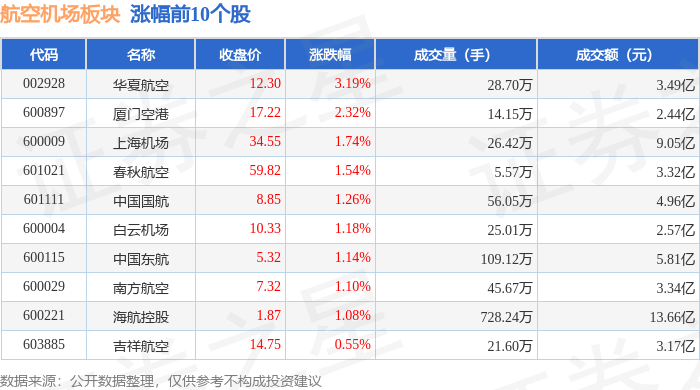
Core Viewpoint - The aviation and airport sector experienced a rise of 1.24% on November 13, with Huaxia Airlines leading the gains, while the overall market indices also showed positive performance [1]. Group 1: Market Performance - The Shanghai Composite Index closed at 4029.5, up 0.73%, and the Shenzhen Component Index closed at 13476.52, up 1.78% [1]. - Key stocks in the aviation and airport sector showed varying degrees of increase, with Huaxia Airlines rising by 3.19% to a closing price of 12.30 [1]. Group 2: Stock Performance - The following stocks in the aviation and airport sector had notable performances: - Huaxia Airlines: 12.30, +3.19%, volume 287,000 [1] - Xiamen Airport: 17.22, +2.32%, volume 141,500 [1] - Shanghai Airport: 34.55, +1.74%, volume 264,200 [1] - Spring Airlines: 59.82, +1.54%, volume 55,700 [1] - China National Aviation: 8.85, +1.26%, volume 560,500 [1] - Baiyun Airport: 10.33, +1.18%, volume 250,100 [1] - China Eastern Airlines: 5.32, +1.14%, volume 1,091,200 [1] - Southern Airlines: 7.32, +1.10%, volume 456,700 [1] - HNA Holding: 1.87, +1.08%, volume 7,282,400 [1] - Juneyao Airlines: 14.75, +0.55%, volume 216,000 [1]. Group 3: Capital Flow - The aviation and airport sector saw a net outflow of 46.93 million yuan from institutional investors and a net outflow of 104 million yuan from speculative funds, while retail investors contributed a net inflow of 151 million yuan [2]. - Detailed capital flow for specific stocks indicated that: - China Eastern Airlines had a net inflow of 62.69 million yuan from institutional investors [3]. - HNA Holding experienced a net outflow of 31.68 million yuan from speculative funds [3]. - Retail investors showed a net inflow of 22.73 million yuan into Juneyao Airlines [3].


2026年交通运输行业投资策略报告:反内卷、历史新高船龄和供求共振-20251113
Western Securities· 2025-11-13 06:06
Group 1: Express Delivery Industry - The express delivery sector is expected to benefit from anti-involution policies, with prices starting to rise since July 2025 due to government measures against low-price and disorderly competition [13][15][20] - In September 2025, major express companies reported a year-on-year increase in single ticket prices, indicating the initial success of the anti-involution policies [24][21] - The express delivery volume is projected to maintain good growth, with a compound annual growth rate of 11.6% from 2023 to 2028 [34][32] Group 2: Oil Transportation Industry - The average age of VLCC (Very Large Crude Carrier) ships reached a historical high of 13 years in August 2025, indicating a need for capacity renewal [52][51] - There is a significant gap between the number of new orders and the required capacity updates, with only 112 VLCCs expected to be delivered by 2029 against a potential scrapping of 319 older vessels [58][56] - Global oil production and consumption are expected to grow in the coming years, which may positively impact oil transportation demand [43][42] Group 3: Aviation Industry - The aviation sector is anticipated to enter a supply-demand resonance cycle, with a projected low growth rate in aircraft supply over the next eight years [71][73] - Most airlines are expected to see good growth in passenger numbers in 2025, with overall load factors remaining high [80][84] - Government policies aimed at promoting consumption and addressing competition in the aviation sector are expected to boost demand in 2026 [90][92]
航空业竞争惨烈 华夏航空业绩却创新高 CEO吴龙江:应该乐观,公司七成乘客是头回坐飞机
Mei Ri Jing Ji Xin Wen· 2025-11-12 15:11
Core Viewpoint - Huaxia Airlines adopts a unique strategy by focusing on connecting remote small cities rather than pursuing popular routes or joining airline alliances, positioning itself as the only independent regional airline in the A-share market [2][3]. Group 1: Business Strategy - The company has a clear strategy to focus on underserved regions, with 70% of its passengers being first-time flyers, indicating a strong potential market for growth [2][9]. - Huaxia Airlines has experienced a significant turnaround, with a 102.17% year-on-year increase in net profit attributable to shareholders in the first three quarters of the year [2][3]. - The airline's focus on regional routes is complemented by government policies aimed at supporting air travel in remote areas, which helps to enhance accessibility [5][10]. Group 2: Market Dynamics - The demand for air travel is increasing not only in major cities but also in smaller cities, leading to more connections between small cities [4][5]. - The company has strategically avoided competing in saturated markets, instead opting to meet the needs of underserved areas, which presents less competition and a more stable demand [6][10]. Group 3: Operational Challenges - The cost of acquiring customers is high due to the need for extensive marketing efforts in rural areas, and operational costs are elevated because of the small size of regional aircraft [9][10]. - Government subsidies play a crucial role in sustaining the airline's operations, allowing it to maintain lower ticket prices while developing a reliable service that encourages habitual air travel among new passengers [10][11]. Group 4: Future Outlook - The airline is evolving its strategy from merely connecting regions to creating a more integrated travel ecosystem, enhancing the overall travel experience for customers [19][20]. - Huaxia Airlines aims to innovate and expand its partnerships to improve operational efficiency and profitability, while also addressing the changing consumer preferences in the tourism market [22][23].