华润置地

Search documents
飞阅楼市第210期丨本土“三驾马车”领跑青岛楼市
Sou Hu Cai Jing· 2026-01-26 15:26
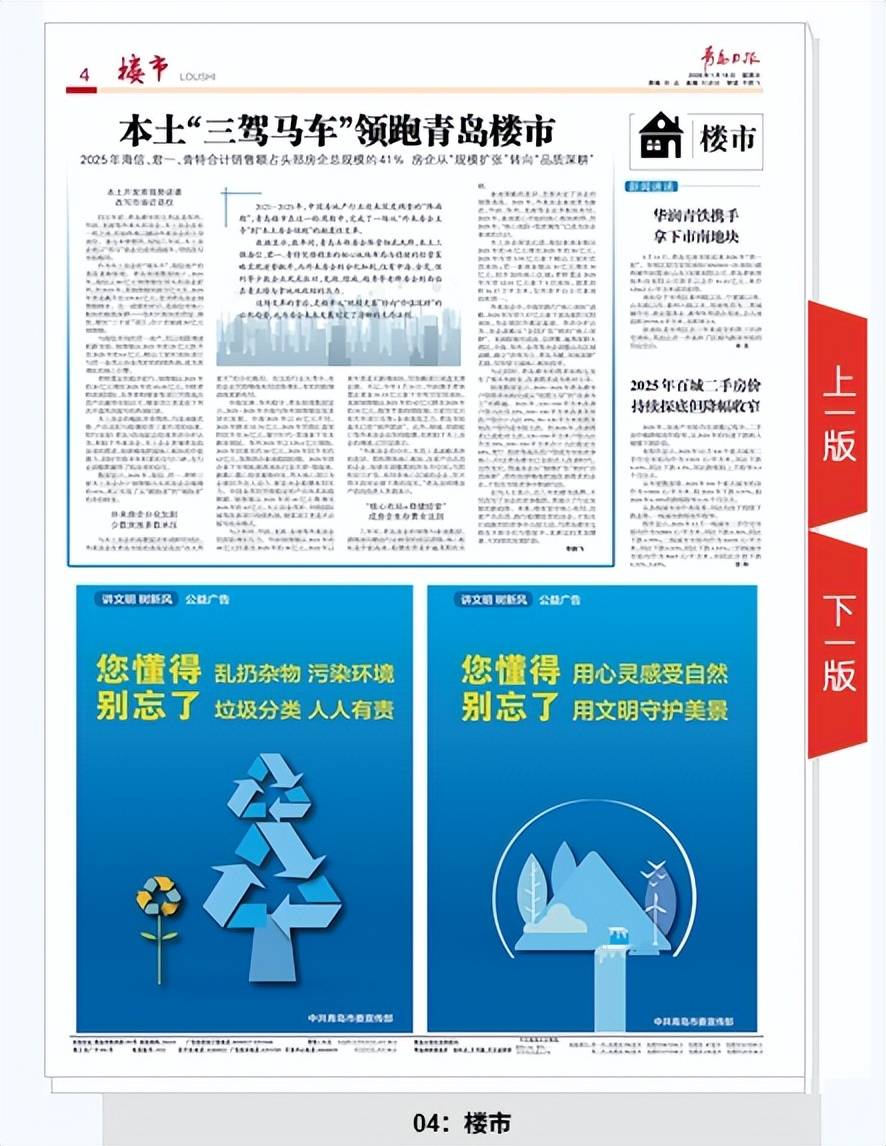
文/青岛日报李鹏飞 2021-2025年,中国房地产行业迎来深度调整的"阵痛期",青岛楼市在这一轮周期中,完成了一场从"外来房企主导"到"本土房企领跑"的颠覆性变革。 数据显示,数年间,青岛头部房企阵营彻底洗牌,本土三强海信、君一、青特凭借精准的核心板块布局与稳健的经营策略实现逆势飙升,而外来房企则分化 加剧,仅有中海、金茂、保利等少数企业风采依旧,龙湖、绿城、越秀等老牌房企则面临在青业绩与拿地双收缩的压力。 这场变革的背后,是楼市从"规模竞赛"转向"价值深耕"的必然趋势,也为房企未来发展划定了清晰的生存法则。 本土开发商强势逆袭 改写市场话语权 四五年前,青岛楼市的主角还是保利、华润、龙湖等外来头部房企,本土房企虽有一席之地,但始终难以撼动外来房企的主导地位。谁也未曾想到,短短几 年间,本土房企竟以"黑马"姿态完成弯道超车,彻底改写市场格局。 作为本土房企的"领头羊",海信地产的表现堪称惊艳。青岛锐理数据统计,2021年,海信以80亿元销售额位居头部房企前列,到2023年,其销售额突破百亿 大关,2025年更是飙升至139.81亿元,登顶青岛房企销售额榜首。这一成绩的背后,是海信对核心板块的极致深耕——张村 ...

合肥房产市场2025年总结:以价换量,市区新房二手房卖超8万套
Sou Hu Cai Jing· 2026-01-26 13:12
一、全年合肥新房与二手房销量 很多人说现在市场行情差,说合肥房子卖不掉,事实是这样的么?答案估计是NO! 根据安徽省住房和城乡建设厅数据显示,2025年合肥(不包含4县1市)成交20472套新房、58981套二手 房,全年新房与二手房合计成交量79,363套近8万套,日均卖218套。如果加上肥西、肥东与北城销量, 估计超9万套没问题。 2025年合肥市区二手房全年累计成交 58881 套。数据显示,各月成交呈现 "年中高位、年末回升" 态 势,其中 3 月以 6230 套创年度最高,1 月为全年最低 3459 套,6 月 5739 套、12 月 5398 套等月份也保 持高位运行。整体市场全年波动明显,政策调整及传统旺季推动成交量保持活跃,形成 "春高夏稳冬回 升" 的季度特征,尤其 12 月 5398 套的成绩显示年底购买力支撑强劲。 合肥市区新房2025年累计销售20472套,各月成交波动明显,11 月以 2582 套创年度最高,6 月仅 768 套 为全年最低,呈现年中淡季、年末旺季特征。1-4 月成交逐步增长,4 月达 2500 套;5 月回落至 1513 套,6 月进入低谷。下半年 9 月、11 月 ...
2026海南土地首秀!这个城市宅地供应“两连跳”,盛宴开启!
Sou Hu Cai Jing· 2026-01-26 08:16
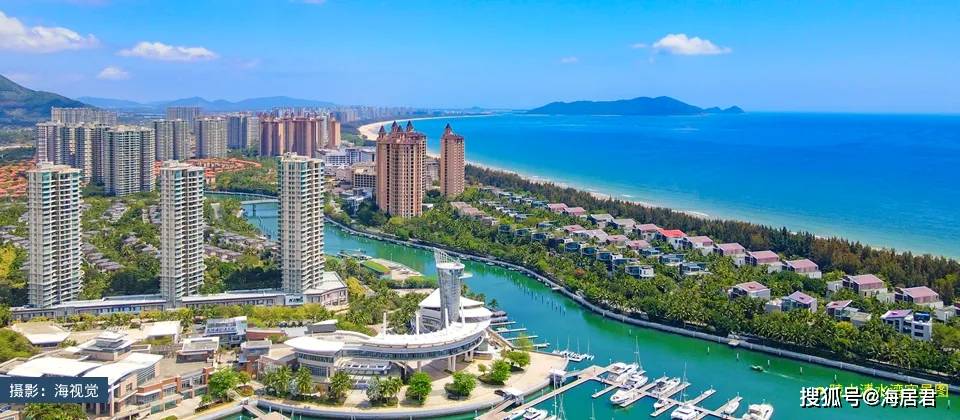
Core Viewpoint - Hainan's Lingshui County has become the first city to announce its 2026 state-owned land supply plan, indicating a shift in land supply dynamics in the region [2] Land Supply Plan Summary - In 2026, Lingshui plans to supply 49 plots of state-owned land, totaling approximately 146.63 hectares (about 2,199.48 acres), which is an increase of 9 plots compared to 2025, but the total area has decreased by approximately 452.65 acres, a reduction of about 17.1% [2][3] - The breakdown of land use includes: - Residential land: 48.92 hectares (about 733.79 acres) - Public management and service land: 241.05 acres - Industrial and storage land: 653.48 acres - Transportation land: 379.64 acres - Commercial service land: 108.52 acres - Public facilities land: 66.44 acres - Green space and open space: 6.17 acres - Special land: 10.38 acres [2][3] Residential Land Supply Insights - The residential land supply for 2026 mainly consists of two categories: market-oriented commodity housing (385.62 acres) and land for urban renewal projects (348.16 acres), with no plans for affordable housing land for the third consecutive year [4][11] - The residential land is concentrated in popular areas of Lingshui's real estate market, including: - Yelin Town: 6 plots, approximately 348.17 acres - Li'an Town: 4 plots, approximately 287.31 acres - Guangpo Town: 2 plots, approximately 49 acres - Yingzhou Town: 1 plot, approximately 49.31 acres [4][6] Market Demand and Sales Performance - Lingshui's real estate market has shown strong demand, with housing sales area increasing for six consecutive years, breaking the trend of the national real estate market adjustment [6][7] - In 2025, the housing sales area in Lingshui grew by approximately 30% year-on-year, reaching over 90,000 square meters, marking a significant recovery in the local market [7][11] - Major real estate companies, including Country Garden and Lingshui Development Group, have established key projects in Lingshui, contributing to the market's stability and growth [7][8] Future Outlook - Despite the lack of affordable housing land supply, there are sufficient ongoing and planned affordable housing projects, which are expected to support the market [11] - The acceleration of residential land supply is anticipated to lead to the introduction of high-quality projects in the coming years, potentially setting new benchmarks in the Lingshui market [11]
越秀证券每日晨报-20260126
越秀证券· 2026-01-26 02:54
每日晨报│2026 年 1 月 26 日 -主要市场指数表现 | | 收市价 | 上个交易日升 | YTD 升跌 | | --- | --- | --- | --- | | 恒生指数 | 26,749 | +0.45% | +4.37% | | 恒生科技指数 | 5,798 | +0.62% | +5.11% | | 国企指数 | 9,160 | +0.51% | +2.77% | | 沪深 300 | 4,702 | -0.45% | +1.57% | | 上证综合指数 | 4,136 | +0.33% | +4.22% | | 深证成份指数 | 14,439 | +0.79% | +6.76% | | 中小板指 | 8,883 | +0.69% | +7.50% | | 道琼斯指数 | 49,098 | -0.58% | +2.15% | | 标普 500 指数 | 6,915 | +0.03% | +1.02% | | 纳斯达克指数 | 23,501 | +0.28% | +1.12% | | 伦敦富时指数 | 10,143 | -0.07% | +2.14% | | CAC40 指数 | 8,143 ...
周期论剑|地产链,逻辑再梳理
2026-01-26 02:50
Summary of Conference Call Industry Overview - The conference focused on the real estate chain logic and investment opportunities within the real estate sector, highlighting the recent strong performance of real estate-related stocks [1][2]. Key Points and Arguments Market Sentiment - The speaker emphasized a positive outlook for the market, predicting a potential rise to 4200 points before the Spring Festival, indicating a strong market sentiment despite regulatory interventions [2][3]. - The speaker noted that while 300 stocks appeared constrained, the majority of stocks performed well, suggesting a broader market strength [2][3]. Real Estate Sector Insights - The real estate sector has seen significant declines, with residential investment as a percentage of GDP dropping to 4.5%, and real estate investment growth decreasing by nearly 60% [6]. - Sales area has fallen by approximately 50% from peak levels, and housing prices have decreased by 30% to 40% [6]. - The speaker highlighted the critical role of stabilizing the real estate market for national economic stability and internal demand growth, especially in the face of external uncertainties [6][7]. Investment Opportunities - The speaker identified three key investment directions: 1. Quality real estate companies with a price-to-book (PB) ratio below one, indicating deep discounts [9]. 2. Companies in the real estate supply chain, particularly in construction materials, chemicals, and appliances, which have seen improved competitive dynamics due to market consolidation [10]. 3. Urban renewal projects that will drive demand for construction materials and related services [10]. Regulatory Environment - The speaker discussed the regulatory environment, suggesting that early interventions by regulators could lead to a more stable market and longer-term growth [4][5]. Additional Insights - The real estate and related sectors currently represent only 8.1% of the total A-share market capitalization, while consumer goods account for 9.4% despite contributing 43% to GDP [8]. - The speaker noted that the current low expectations and stock valuations create a favorable environment for potential recovery in the real estate sector [8]. Transportation Sector Insights - The transportation sector, particularly aviation and oil shipping, is expected to see increased demand during the upcoming Spring Festival, with passenger traffic projected to reach 9.5 billion, a 5% increase from the previous year [12][13]. - The oil shipping market has seen a significant rise in freight rates, with expectations for continued profitability in Q1 2026 [14]. Chemical Sector Insights - The chemical sector is closely tied to the real estate chain, with optimism regarding demand recovery for products like MDI, PVC, and soda ash due to improving internal demand [17][18]. - Key companies in the chemical sector, such as Wanhua Chemical and Boryung Chemical, are highlighted for their competitive advantages and growth potential [19][21]. Metal Sector Insights - The metal sector remains bullish, with expectations for continued price increases driven by supply disruptions and strong demand from sectors like AI and renewable energy [26][29]. - Industrial metals, particularly copper and aluminum, are seen as strategic resources with strong long-term demand prospects [29][30]. Energy Sector Insights - Oil prices are expected to remain stable around $60-$65 per barrel, with limited downside risk due to production cost considerations [34][35]. - The speaker noted that geopolitical factors could temporarily influence prices, but the overall supply-demand balance suggests a bearish outlook for the next 1-2 years [35][36]. Coal Sector Insights - The coal market is experiencing fluctuations due to seasonal demand, with expectations for price pressures in the spring as new projects commence [42][43]. - The speaker indicated that without significant fiscal stimulus, coal prices may face downward pressure in the upcoming quarters [42][43].
科顺股份20260123
2026-01-26 02:49
Summary of Key Points from the Conference Call of Keshun Co., Ltd. Company Overview - **Company**: Keshun Co., Ltd. (科顺股份) - **Industry**: Waterproofing materials and construction materials Core Insights and Arguments - **Price Increase Strategy**: Keshun plans to raise prices of its phenolic waterproof products by 5%-10% to counteract a 5-6% increase in raw material costs, expecting a 2% increase in gross margin by 2026 [2][6] - **Revenue Growth Projections**: The company anticipates a 10% revenue growth in 2026, amounting to approximately 600 million yuan. The civil construction sector (C-end retail) is expected to grow by 30% (around 300 million yuan), while overseas business is projected to grow by 50% (around 200 million yuan) [2][12] - **Tile Adhesive Business**: Keshun's tile adhesive revenue is expected to reach nearly 500 million yuan in 2025, with a growth rate of 20%-30% anticipated for 2026. The company sees significant growth potential in the tile adhesive market over the next 3-5 years [2][17] - **Overseas Market Strategy**: The company plans to adopt a light asset operation model for its overseas business, establishing small factories in Malaysia, Central Asia, and the Middle East through joint ventures and leasing existing facilities [2][22] Financial Performance and Projections - **2025 Financials**: Keshun's overseas revenue is projected to be around 450 million yuan, with a gross margin of 32%-33% and a net profit margin of 7%-8% (excluding impairments) [2][24] - **Credit Impairment Management**: The company aims to limit credit impairment to within 100 million yuan in 2026, with a focus on preparing for potential bad debts in 2025 [4][28] - **Cash Flow Expectations**: Keshun expects positive operating cash flow in 2025, similar to the 300 million yuan range seen in 2024 [4][29] Market Dynamics and Competitive Landscape - **Market Demand for Tile Adhesives**: The tile adhesive market is expected to continue growing, with a market size of approximately 60-70 billion yuan. The industry is fragmented, with leading companies like Deko and Yuhong having sales of 2-4 billion yuan each [19][20] - **Price Competition**: There is a small price difference among leading brands, while significant differences exist between leading brands and smaller companies. Keshun plans to expand its market share through channel collaboration and acquisitions of local small manufacturers [20] Challenges and Risks - **Customer Acceptance of Price Increases**: Some customers, particularly in the public construction sector, may resist price increases due to reduced business volume and intense competition [8][9] - **Implementation of Price Increases**: The company has successfully implemented price increases for its roll products, with a gradual realization of price adjustments expected to improve margins over time [10][11] Future Growth and Investment Plans - **Investment in New Materials**: Keshun is exploring high-end new materials in sectors like semiconductors and robotics to diversify its business and enhance resilience against market cycles [4][30] - **Convertible Bond Strategy**: The company aims to complete the conversion of all convertible bonds by 2026, targeting a market capitalization of around 10 billion yuan and a share price of approximately 9 yuan [4][32] - **Long-term Revenue Goals**: Keshun aims to return to a revenue scale of 10 billion yuan within 3-5 years, contingent on industry stabilization and recovery [34] Conclusion Keshun Co., Ltd. is strategically positioning itself for growth through price adjustments, expansion into overseas markets, and diversification into new materials. The company is focused on improving its financial health while navigating challenges in customer acceptance and market competition.

地产板块的性价比出现-未来可能的催化是什么
2026-01-26 02:49
Summary of Conference Call on Real Estate Sector Industry Overview - The real estate sector has shown signs of improvement since early 2026, ranking 18th among 31 Shenwan industries, indicating a positive shift in market sentiment and liquidity [1][4] - Despite a 45% increase in the Shenzhen Foreign Real Estate Index, it still underperformed compared to the Shanghai Composite Index, suggesting potential for catch-up in undervalued segments [1][5] Key Insights and Arguments - **Market Performance**: The new housing market remains weak, with transaction volumes significantly down year-on-year, and a projected overall decline in transaction area for the year, although the rate of decline may slow [1][6] - **Policy Dependency**: The recovery of the new housing market is heavily reliant on policy support, such as easing measures in first-tier cities and adjustments to the Loan Prime Rate (LPR) [1][7] - **Inventory Levels**: The inventory of unsold new homes in 70 cities is at a historical high, with varying de-stocking cycles across cities, indicating significant pressure on overall inventory [1][8] - **Land Market Trends**: The land market has seen a decline in transaction area and revenue, exacerbating supply-demand imbalances and limiting new housing supply [1][9] Additional Important Points - **Second-Hand Housing Market**: The second-hand housing market has also experienced a decline in transaction volume, with expectations of price stability but potential for slight decreases due to increased listings and stagnant purchasing power [1][10] - **Policy Impact**: Current policies are insufficient for a substantial turnaround in the real estate market, with only minor measures being implemented [1][11][12] - **Investor Sentiment**: There are mixed expectations among investors regarding the real estate sector, with some anticipating a recovery in 2026 while others remain cautious due to poor new housing data [1][13] - **Investment Opportunities**: Companies like Beike and developers such as Binhai Group and China Merchants Shekou are highlighted as potential beneficiaries of demand-side policies [1][14] - **Risks**: Ongoing declines in new housing sales and construction data pose risks to the sector, although the current market position still offers a favorable risk-reward ratio for investments [1][15]
环球房产周报:两部门发文支持城市更新行动,70城房价出炉,2026年北京供地计划公布……
Huan Qiu Wang· 2026-01-26 02:31
Policy News - The Ministry of Natural Resources and the Ministry of Housing and Urban-Rural Development issued measures to support urban renewal, emphasizing a sustainable model involving government guidance, market operations, and public participation [1] - The Minister of Housing and Urban-Rural Development, Ni Hong, stated that the focus this year will be on stabilizing the real estate market and implementing precise policies to support reasonable financing needs of real estate companies and housing demands of residents [1] - Shanghai's 15th Five-Year Plan suggests a dual approach of renting and purchasing to meet diverse housing needs, increasing the supply of affordable housing, and promoting high-quality real estate development [2] Market News - The January Loan Prime Rate (LPR) remains unchanged at 3.0% for the one-year term and 3.5% for the five-year term, effective until the next announcement [7] - In December 2025, the average sales price of new residential properties in first-tier cities decreased by 0.3% month-on-month, with Shanghai seeing a 0.2% increase while Beijing, Guangzhou, and Shenzhen experienced declines [8] - National real estate development investment in 2025 was 82,788 billion yuan, a year-on-year decrease of 17.2%, with residential investment down by 16.3% [9] Company News - Vanke's proposal to extend the repayment of an 11 billion yuan bond was approved, allowing for a 40% immediate repayment and a 60% extension for one year, which will alleviate short-term repayment pressure [13] - China Resources Land plans to issue a public bond of up to 2 billion yuan, with a three-year term and no credit enhancement measures [14] - The Flower Year Group announced the suspension of five domestic bonds due to the approval of an extension plan by bondholders, with the resumption date to be determined [14]
深度调整 动态筑底 2025年房地产行业数据解读
Zhong Guo Jing Ji Wang· 2026-01-26 00:14
Core Viewpoint - The real estate industry in China is undergoing a deep adjustment, with significant declines in investment, sales area, and sales revenue in 2025, indicating a challenging market environment [1][3][9]. Investment and Sales Data - In 2025, national real estate development investment reached 82,788 billion yuan, a year-on-year decrease of 17.2% [1]. - The sales area of new commercial housing was 88,101 million square meters, down 8.7% year-on-year, while the sales revenue was 83,937 billion yuan, reflecting a 12.6% decline [1][9]. - The construction area for real estate developers was 659,890 million square meters, a decrease of 10.0% year-on-year, with residential construction down 10.3% [3]. Construction Activity - New construction area was 58,770 million square meters, down 20.4%, with residential new construction area at 42,984 million square meters, a decline of 19.8% [4]. - The completion area was 60,348 million square meters, down 18.1%, with residential completions at 42,830 million square meters, a decrease of 20.2% [4]. Market Dynamics - The market is still in a "de-inventory" phase due to declining new home sales and significantly reduced land transactions over the past two years [5]. - Some central and state-owned enterprises are maintaining orderly construction activities, and there is still demand for well-located properties, which is boosting market confidence [6]. Financial Policies and Support - Local governments are enhancing "guarantee delivery" efforts, with recent financial policies aimed at stabilizing financing for projects on the "white list," which will support the delivery of homes [7]. Leading Companies - In 2025, ten real estate companies achieved sales exceeding 100 billion yuan, with four surpassing 200 billion yuan. These include major players like Poly Development, China Overseas Land & Investment, and Vanke [9]. - The top ten companies by investment are primarily state-owned enterprises, with significant investments from China Overseas, China Resources, Poly Development, and China Merchants Shekou, indicating a strategic positioning during market adjustments [9]. Market Trends - December 2025 showed signs of improvement, with new commercial housing sales area increasing by 39.87% month-on-month and sales revenue rising by 44.07% [10]. - The average price of new residential properties in first-tier cities saw a slight decrease, with Shanghai experiencing a minor increase, while other cities like Beijing and Guangzhou reported declines [10][11]. - The second-hand housing market is also seeing a shift, with increased transactions in second-hand homes as buyers seek more affordable options [12].





广发策略:从不买就跑输到买了就跑输——再看南下定价权
智通财经网· 2026-01-25 23:38
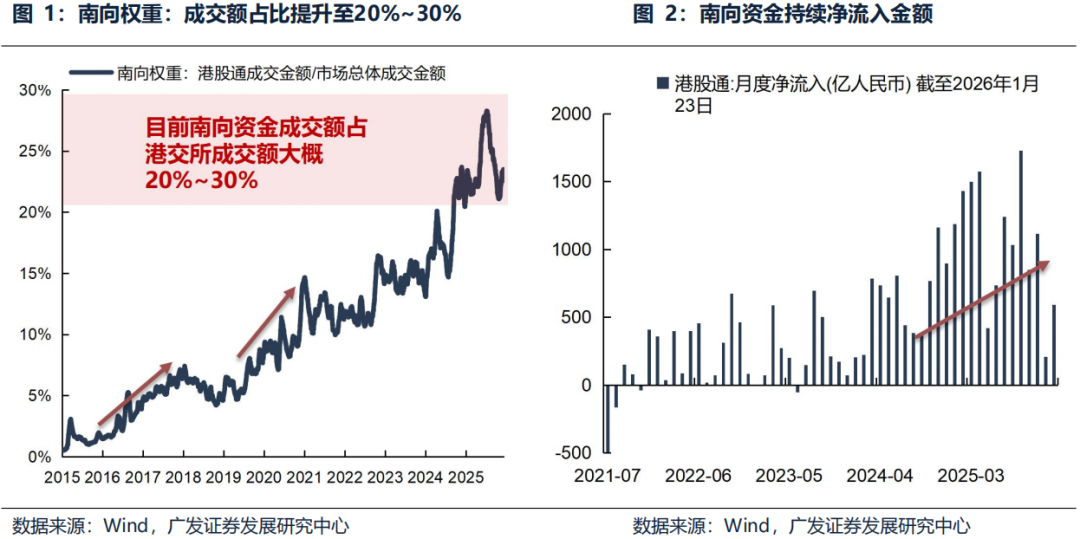
Group 1 - Since September 2024, the proportion of southbound capital transactions has rapidly increased to 20%-30%, nearly doubling compared to before 2024 [2][5] - In 2025, both active and passive foreign capital have become synchronous indicators of the Hong Kong stock market, showing no leading characteristics [2][5] - During sharp declines or corrections in the Hong Kong stock market, southbound capital tends to buy against the trend [2][5] Group 2 - Each round of pricing power competition typically begins with the optimization of the Stock Connect policy or the influx of incremental capital, which usually flows into dividend and scarce assets [5] - Net outflows of southbound capital often occur in response to adverse industry policies or external macroeconomic environments, particularly in sectors where foreign capital pricing power is increasing, such as software services, hardware equipment, consumer services, and discretionary retail [5][12] - Industries less likely to experience significant net outflows include those favored by long-term capital, such as banking, telecommunications, and public utilities, unless there are clear adverse policies affecting the sector [5][12] Group 3 - The proportion of medium to long-term capital in the current round of southbound capital inflow into Hong Kong stocks has increased, with insurance capital making 41 stakes, 35 of which are in H-shares, marking the highest record in the past decade [8] - Key industries for increased holdings include discretionary retail, finance (banking, insurance), innovative pharmaceuticals, software services, and hardware equipment [8] Group 4 - Current industries with pricing power for southbound capital and Chinese capital include semiconductors and dividend stocks, while industries lacking pricing power include internet, hardware equipment, software services, home appliances, and media [11][12] - Active management public funds have low pricing power in the Hong Kong stock market, focusing heavily on AI-related CSP giants, electronics, and innovative pharmaceuticals [16]