房地产市场筑底

Search documents
房地产行业第12周周报(2026年3月14日-2026年3月20日):新房成交同比由正转负,二手房成交同比降幅收窄,上海商业用房购房最低首付比例降至30%-20260323
Bank of China Securities· 2026-03-23 14:08
Investment Rating - The report rates the real estate industry as "Outperform" compared to the market [1]. Core Insights - New home sales have turned negative year-on-year, while the decline in second-hand home sales has narrowed. The minimum down payment ratio for commercial properties in Shanghai has been reduced to 30% [1]. - The inventory of new homes has increased both month-on-month and year-on-year, and the de-stocking cycle has also lengthened [1]. Summary by Sections New Home Market Tracking - In the 12th week, new home sales in 47 cities amounted to 312.6 million square meters, with a month-on-month increase of 0.6% but a year-on-year decrease of 15.2%. The year-on-year growth rate has decreased by 21.0 percentage points compared to the previous week [5]. - The sales volume in first, second, third, and fourth-tier cities showed varied month-on-month growth rates of -0.1%, 26.5%, -17.3%, respectively, with year-on-year growth rates of -17.7%, -8.6%, -20.3% [5][15]. Second-Hand Home Market Tracking - The second-hand home sales area in 23 cities reached 270.7 million square meters, with a month-on-month increase of 9.6% and a year-on-year decrease of 6.7%, which is a narrowing of the decline by 6.5 percentage points compared to the previous week [5]. - The sales volume in first, second, third, and fourth-tier cities showed month-on-month growth rates of 8.1%, 11.5%, 8.2%, respectively, with year-on-year growth rates of -2.5%, -12.4%, -0.2% [5][11]. Inventory and De-stocking Cycle - As of the end of the 12th week, the new home inventory in 13 cities was 79.95 million square meters, with a month-on-month growth rate of 0.1% and a year-on-year growth rate of 1.0%. The de-stocking cycle is 26.0 months, which is an increase of 0.2 months month-on-month and an increase of 6.5 months year-on-year [5][33]. - The de-stocking cycle for first, second, third, and fourth-tier cities is 21.3, 24.0, and 65.0 months, respectively [5][25]. Land Market Tracking - The total land transaction area in 100 cities was 11.639 million square meters, a month-on-month decrease of 16.1% but a year-on-year increase of 45.2%. The total transaction price was 20.04 billion yuan, a month-on-month decrease of 13.5% but a year-on-year increase of 59.7% [5][11]. - The average land price was 1,722 yuan per square meter, with a month-on-month increase of 3.1% and a year-on-year increase of 10.0% [5][11]. Policy Insights - Starting from March 16, Shanghai adjusted the minimum down payment ratio for commercial properties to 30%, following a national policy adjustment [5]. - The report suggests that there are multiple opportunities for phase returns in the real estate sector throughout 2026, with a focus on market sentiment, transaction performance, and policy developments [5]. Investment Recommendations - The report recommends focusing on three main lines: 1. Companies with stable fundamentals and high market share in first and second-tier cities, such as China Resources Land and China Merchants Shekou [5]. 2. Smaller companies that have made significant breakthroughs in sales and land acquisition, such as Poly Real Estate [5]. 3. Commercial real estate companies exploring new consumption scenarios, such as China Resources Vientiane Life and Swire Properties [5].





中国宏观经济月度分析报告202601:烽火科技纠缠,时间藏一陬-20260212
中采咨询· 2026-02-12 05:56
Economic Indicators - The manufacturing PMI for January 2026 is 49.3%, a decrease of 0.8 percentage points from the previous month, indicating a slowdown in manufacturing activity[4] - The CPI growth rate for January 2026 is 0.2%, primarily due to the high base effect from the previous year's Spring Festival[6] - The PPI for January 2026 is -1.4%, with a narrowing decline of 0.5 percentage points, reflecting improved internal structure and demand driven by technology[6] Trade and Investment - In December 2025, China's total imports and exports amounted to $601.42 billion, with exports increasing by 6.6% and imports rising by 5.7% year-on-year[20] - The M1 growth rate in December 2025 fell to 3.8%, while M2 grew by 8.5%, leading to an expanding M1-M2 gap of -4.7%[34] - The real estate market shows signs of recovery, with new home prices averaging 17,114 RMB per square meter, a month-on-month increase of 0.18%[48] Sector Performance - The service sector's business activity index has stabilized around 49.5% for three consecutive months, supported by financial activities and holiday-related consumption[4] - The consumer goods sector experienced a decline of 2.2 percentage points, primarily due to a drop in clothing orders[27] - The equipment sector shows resilience, with significant demand for computers and automation equipment, indicating a positive trend in industrial investment[28]
百强房企1月销售总额为1905.2亿元;金科股份将及时向深交所申请撤销退市风险警示|房产早参
Mei Ri Jing Ji Xin Wen· 2026-02-01 23:05
Group 1: Real Estate Market Performance - In January 2026, the total sales of the top 100 real estate companies amounted to 190.52 billion yuan, representing a year-on-year decline of 18.9%, with a sales area of 6.548 million square meters [1] - The average price of second-hand residential properties in 100 cities was 12,905 yuan per square meter, with a month-on-month decline of 0.85%, while new residential properties saw an average price of 17,114 yuan per square meter, increasing by 0.18% month-on-month [2] - The real estate market is transitioning from a phase of "accelerated decline" to "slow bottoming," indicated by the recovery in core city transactions and a decrease in listings [2] Group 2: Land Sales and Government Actions - Wuxi has listed seven residential land parcels for sale with a total area of 607 acres and a starting price of 6.24 billion yuan, reflecting the local government's commitment to stabilize the market and optimize structure [3] - The government is implementing strict qualification requirements for land sales to ensure market stability and safeguard public welfare [3] Group 3: Company-Specific Developments - Jinke Co., Ltd. announced that its net profit for the fiscal year 2025 is projected to be between 30 billion and 35 billion yuan, with net assets estimated at 5 billion to 7 billion yuan [4] - The company plans to apply for the removal of the delisting risk warning from the Shenzhen Stock Exchange, marking a significant case of debt restructuring in the real estate sector [4] - Jinke Co., Ltd. aims to leverage this restructuring as an opportunity to accelerate strategic transformation and improve operational efficiency [4]

70城房价最新数据出炉:上海新房继续领跑,二手房环比下降
Sou Hu Cai Jing· 2026-01-29 22:44
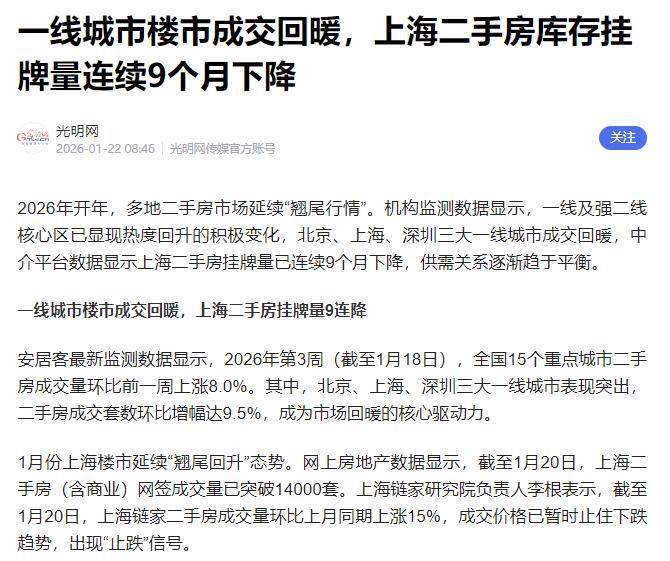
Core Insights - The real estate market is showing signs of recovery, with several cities experiencing increased transaction volumes and a decrease in the number of listings, indicating a shift in market sentiment [3][5][7] Group 1: Market Trends - In January 2026, the second-hand housing market in Shanghai saw transactions exceed 14,000 units, a nearly 30% month-on-month increase, while other cities like Beijing, Shenzhen, and Chengdu also reported a warming trend in transactions [3] - The number of listings in 26 key cities decreased, with 21 cities showing a month-on-month decline; Shanghai's listings dropped from 120,000 to under 90,000, a reduction of over 30,000 units in three months [3] - The sentiment among homeowners is shifting, with some choosing to withdraw listings due to unmet price expectations, while others are adopting a wait-and-see approach due to favorable policy changes [5] Group 2: Policy and Economic Environment - The policy environment is improving, with various cities optimizing purchase restrictions, reducing transaction taxes, and increasing housing loan limits, which are stimulating demand [7][9] - Tax policy adjustments have lowered transaction costs, with the capital gains tax for properties sold within two years reduced from 5.3% to 3%, potentially saving over 60,000 yuan on a 3 million yuan property sale [9] - The credit environment remains loose, with first-time home loan rates at historical lows and improved loan approval efficiency, providing liquidity support for the market [11] Group 3: Market Dynamics - The rental market is becoming more integrated with the sales market, with policies ensuring renters' rights and promoting long-term rental options, contributing to a healthier housing system [13] - The land market is showing positive changes, with increased competition for prime land parcels; the average premium rate for land auctions in Beijing reached 6.8% in January [15] - Demand structure is improving, with a higher proportion of transactions for larger units (over 120 square meters) and buyers focusing on project quality and amenities [15] Group 4: Future Outlook - Long-term, properties in cities with population inflows, such as those in the Yangtze River Delta and Pearl River Delta, are expected to retain value due to strong housing demand [21] - The real estate development model is shifting towards stable and healthy growth, reducing the likelihood of extreme market fluctuations [21] - The industry is undergoing a transformation towards green buildings and smart homes, with increased investment in technology to enhance product quality, which will drive future market dynamics [23]

从国家统计局发布的房产数据看房地产现状
Sou Hu Cai Jing· 2026-01-28 09:36
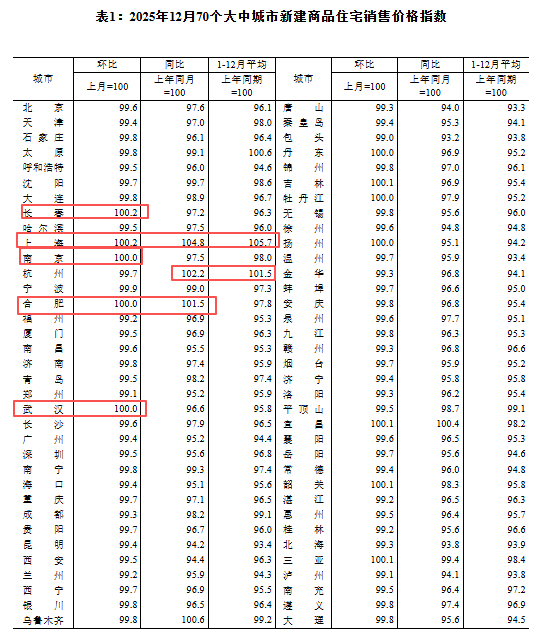
Group 1: New Housing Price Index - The new housing price index for December 2025 shows that only 11 out of 70 major cities maintained stable or slightly increased prices compared to the previous month, with Shanghai experiencing a significant year-on-year increase of 105.7% [2] - Shanghai and Hangzhou are the only cities with year-on-year increases for the entire year of 2024, with Shanghai's increase remaining at 104.6% compared to 2024 [2] - The data reflects the overall market conditions rather than individual project trends, indicating that market data is reliable [2] Group 2: Second-Hand Housing Price Index - The second-hand housing price index indicates a decline across all cities, both month-on-month and year-on-year, regardless of the time frame [4] - The overall trend shows that second-hand housing prices are decreasing, reflecting true market demand and pricing, contrasting with the new housing market [4] Group 3: Real Estate Investment - In 2025, national real estate development investment reached 82,788 billion, a decrease of 17.2% from the previous year, with residential investment at 63,514 billion, down 16.3% [7] - The 2024 data shows a national real estate development investment of 100,280 billion, down 10.6%, with residential investment at 76,040 billion, down 10.5% [8] - Monthly data indicates that both real estate and residential investment growth rates are lower than those in 2024 [9] Group 4: New Housing Sales - In 2025, the sales area of new commercial housing was 88,101 million square meters, a decrease of 8.7%, with residential sales area down 9.2% [13] - The sales revenue for new commercial housing in 2025 was 83,937 billion, down 12.6%, with residential sales revenue down 13.0% [13] - The overall decline in sales area and revenue is less severe compared to 2024, indicating a potential stabilization [14] Group 5: Market Outlook - The real estate market is still in a bottoming phase, maintaining low-level fluctuations without clear signs of reversal [24] - Economic indicators suggest potential stagflation, with global economic growth slowing and inflationary pressures persisting [24] - Real estate may serve as a hedge against inflation and economic uncertainty, similar to precious metals, under certain conditions [25]
深度调整 动态筑底 2025年房地产行业数据解读
Zhong Guo Jing Ji Wang· 2026-01-26 00:14
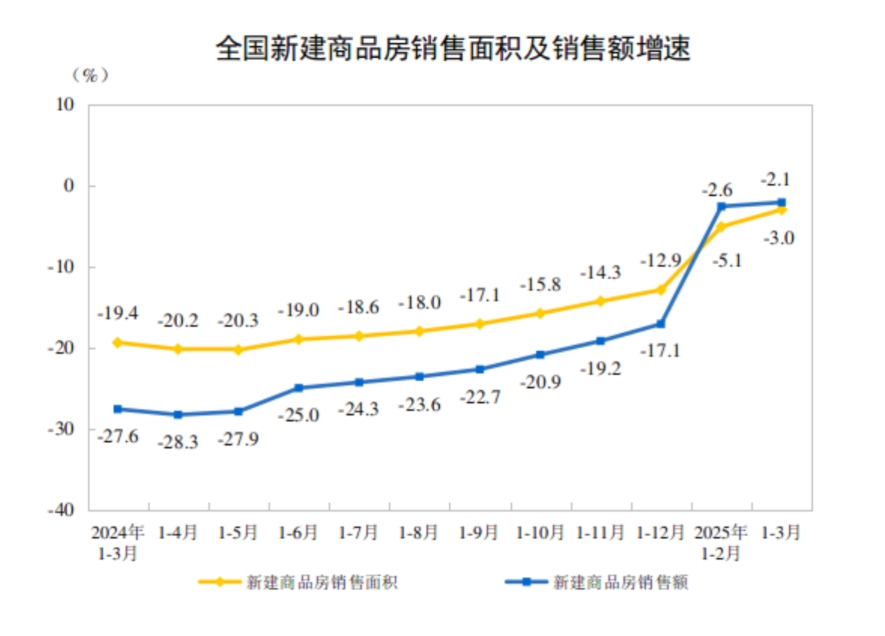
Core Viewpoint - The real estate industry in China is undergoing a deep adjustment, with significant declines in investment, sales area, and sales revenue in 2025, indicating a challenging market environment [1][3][9]. Investment and Sales Data - In 2025, national real estate development investment reached 82,788 billion yuan, a year-on-year decrease of 17.2% [1]. - The sales area of new commercial housing was 88,101 million square meters, down 8.7% year-on-year, while the sales revenue was 83,937 billion yuan, reflecting a 12.6% decline [1][9]. - The construction area for real estate developers was 659,890 million square meters, a decrease of 10.0% year-on-year, with residential construction down 10.3% [3]. Construction Activity - New construction area was 58,770 million square meters, down 20.4%, with residential new construction area at 42,984 million square meters, a decline of 19.8% [4]. - The completion area was 60,348 million square meters, down 18.1%, with residential completions at 42,830 million square meters, a decrease of 20.2% [4]. Market Dynamics - The market is still in a "de-inventory" phase due to declining new home sales and significantly reduced land transactions over the past two years [5]. - Some central and state-owned enterprises are maintaining orderly construction activities, and there is still demand for well-located properties, which is boosting market confidence [6]. Financial Policies and Support - Local governments are enhancing "guarantee delivery" efforts, with recent financial policies aimed at stabilizing financing for projects on the "white list," which will support the delivery of homes [7]. Leading Companies - In 2025, ten real estate companies achieved sales exceeding 100 billion yuan, with four surpassing 200 billion yuan. These include major players like Poly Development, China Overseas Land & Investment, and Vanke [9]. - The top ten companies by investment are primarily state-owned enterprises, with significant investments from China Overseas, China Resources, Poly Development, and China Merchants Shekou, indicating a strategic positioning during market adjustments [9]. Market Trends - December 2025 showed signs of improvement, with new commercial housing sales area increasing by 39.87% month-on-month and sales revenue rising by 44.07% [10]. - The average price of new residential properties in first-tier cities saw a slight decrease, with Shanghai experiencing a minor increase, while other cities like Beijing and Guangzhou reported declines [10][11]. - The second-hand housing market is also seeing a shift, with increased transactions in second-hand homes as buyers seek more affordable options [12].



地产周速达:二手房周成交同比转正
HUAXI Securities· 2026-01-24 13:41
1. Report Industry Investment Rating - No information provided in the content 2. Core Viewpoints of the Report - The second - hand housing market has seen a significant increase in activity, with the year - on - year growth rate of transaction volume turning positive after 14 consecutive weeks of negative growth. Meanwhile, the new housing market continues to bottom out [1][2] - There are significant differences in the performance of the real estate market in first - tier, second - tier and third - tier cities, both in terms of transaction volume and price [3][4][5] 3. Summary by Relevant Catalogs 3.1 Weekly Market Performance - **Second - hand housing market**: The transaction scale of the second - hand housing market has reached a recent high. This week, the transaction area of second - hand housing in 15 cities was 2.56 million square meters, a 12% week - on - week increase, and the year - on - year growth was 10%, ending the 14 - week decline [1] - **New housing market**: The new housing market continued to bottom out, and the transaction volume declined slightly again. This week, the transaction area of new housing in 38 cities was 1.86 million square meters, a 7% week - on - week decrease, and a 38% year - on - year decrease. The new housing transaction has had 17 consecutive weeks of year - on - year negative growth [2] 3.2 Performance in First - tier Cities - **Second - hand housing market**: Second - hand housing in first - tier cities has increased for two consecutive weeks, and the year - on - year increase has also turned positive. The combined transaction of second - hand housing in Beijing, Shanghai and Shenzhen increased by 10% week - on - week, and the overall year - on - year growth was 10%. Among them, Shenzhen had a year - on - year increase of 30%, Beijing 10% and Shanghai 3% [3] - **New housing market**: The new housing market in first - tier cities has slowly recovered from a low level, but the year - on - year decline is still significant. This week, the transaction increased by 5% week - on - week, but the current transaction scale is only 41% of the weekly high in 2025. The year - on - year decline was 29%, with Shanghai and Guangzhou showing relatively more resistance to decline, while Beijing and Shenzhen faced greater adjustment pressure [4] 3.3 Performance in Second and Third - tier Cities - **Second - tier cities**: The performance of second - hand housing in second - tier cities is better than that of new housing, and the year - on - year growth rate of second - hand housing has turned positive. The second - hand housing transaction increased by 16% week - on - week, with a year - on - year growth of 4%. The new housing transaction decreased by 12% week - on - week, and the year - on - year decline widened to 39% [5] - **Third - tier cities**: The second - hand housing transaction in third - tier cities has exceeded the high point of last year, and the post - holiday market activity exceeded expectations. The second - hand housing transaction increased by 8% week - on - week, with a year - on - year high - growth of 30%. The new housing market was weak, with a 9% week - on - week decline, and the year - on - year decline widened to 45% [5] 3.4 Housing Price Observation - According to the data of the National Bureau of Statistics, the month - on - month decline of second - hand housing prices in first - tier cities has narrowed, while the year - on - year decline of housing prices in all tiers of cities has generally widened. In December, the month - on - month decline of new commercial housing prices in 70 cities was 0.4%, and the month - on - month decline of second - hand housing prices was 0.7%. Among them, the month - on - month decline of first - tier cities was 0.9%, narrowing by 0.2 percentage points compared with the previous month. The year - on - year decline of second - hand housing prices in all tiers of cities has expanded [6] - Among first - tier cities, except for Beijing, the month - on - month decline of second - hand housing prices in other cities has narrowed. The year - on - year decline of all four cities has expanded, with Beijing having the largest adjustment range [7]
2025年新建商品房销售8.39万亿
3 6 Ke· 2026-01-19 03:23
Core Viewpoint - The real estate market in China is experiencing a downward trend in both sales volume and prices, with signs of potential stabilization in major cities as policy measures are introduced to stimulate demand [1][5][8]. Group 1: Sales and Price Trends - In 2025, the sales area of new commercial housing reached 88,101 million square meters, a decrease of 8.7% compared to the previous year [1][2]. - The sales revenue from new commercial housing was 83,937 billion yuan, down 12.6% year-on-year [1][2]. - In December, the sales prices of new residential properties in first-tier cities fell by 1.7% year-on-year, with second and third-tier cities seeing declines of 2.5% and 3.7% respectively [1][5]. Group 2: Inventory and Construction - Real estate development investment in 2025 was 82,788 billion yuan, a decline of 17.2%, with residential investment down 16.3% to 63,514 billion yuan [2][4]. - The new construction area for residential properties in 2025 was 42,984 million square meters, a decrease of 19.8%, indicating a continued reduction in available new housing [4]. - By the end of 2025, the inventory of unsold commercial housing was 76,632 million square meters, an increase of 1.6% year-on-year, but down from the peak earlier in the year [4]. Group 3: Market Signals and Policy Impact - There are signs of stabilization in the first-tier market, with a slight reduction in the rate of price decline for new residential properties [5][7]. - Recent policy measures, including lower loan rates and tax incentives, have begun to reduce barriers to home buying, leading to increased user engagement in the market [8]. - The number of users initiating online consultations has increased, particularly among families with multiple children and new residents, indicating a shift from passive browsing to active inquiry [8].
房地产市场关键信号!多机构预测2026年将迎来底部企稳
2 1 Shi Ji Jing Ji Bao Dao· 2026-01-08 04:40
Core Viewpoint - The Chinese real estate industry is expected to stabilize at the bottom in 2026, supported by policy initiatives and improved supply-demand relationships [1][3]. Group 1: Market Overview - The real estate market is experiencing a decline in transaction volume, with estimated sales in 2025 returning to levels seen in 2009, with a total transaction area of approximately 8.9 billion square meters and a transaction value of about 8.4 trillion yuan [3]. - The real estate sector remains a crucial pillar of economic development, as indicated by its contribution to GDP and housing sales figures [3]. - The annual transaction volume for new and second-hand homes is projected to stabilize between 8-9 billion square meters over the next 10-20 years, transitioning to a market dominated by existing transactions [3]. Group 2: Sales and Pricing Trends - In 2025, new home sales are expected to slightly decline, with Shanghai and Chengdu leading in transaction area and value, while the average price of new homes remains stable compared to the previous year [4]. - The second-hand housing market in 30 key cities is projected to reach a record high of approximately 2.14 billion square meters in transaction area [4]. - The land market shows significant differentiation, with major transactions concentrated in 60 core cities, particularly in Chongqing and Shanghai, where land transaction area and value have increased significantly [4]. Group 3: Inventory and Market Signals - Inventory pressure in the housing market is expected to ease, with short-term inventory growth halting and long-term inventory stabilizing [5]. - Effective inventory of commercial housing is estimated at around 5 billion square meters, which is considered a healthy level relative to annual sales [5]. - Signs of a reversal in the second-hand housing market are emerging, with declining new listings and rental yields exceeding 3% in some core city areas [6]. Group 4: Determinants for Market Stability - Four key factors are identified as necessary for confirming the bottoming of the housing market: policy certainty, price certainty, product certainty, and supply certainty [6].
2025年中国房企业绩分析报告
克而瑞地产研究· 2026-01-05 12:34
Core Insights - The real estate market in China continues to stabilize, with 10 companies achieving over 100 billion yuan in sales for the year [4] - 24 companies reported year-on-year growth in performance, with some experiencing significant recovery [4] - Central and state-owned enterprises performed well overall, with 42% of them reporting performance growth [4] - Focus on quality housing and urban renewal has become a new priority, necessitating companies to enhance their internal capabilities [4] Sales Rankings - The top three companies by sales amount are: 1. Greentown China: 251.9 billion yuan 2. China Overseas Land & Investment: 239.2 billion yuan 3. Poly Developments: 232.8 billion yuan [3] - The top three companies by sales area are: 1. Greentown China: 12.08 million square meters 2. Poly Developments: 11.26 million square meters 3. China Overseas Land & Investment: 10.44 million square meters [3] Performance Overview - The overall market is characterized by a bottoming-out trend, with a total of 10 companies achieving over 100 billion yuan in sales [4] - A total of 24 companies saw their performance improve year-on-year, indicating a recovery in the sector [4] - Central and state-owned enterprises showed a strong performance, with 42% reporting growth [4] Strategic Focus - The emphasis on good housing and urban renewal is becoming increasingly important, prompting real estate companies to focus on improving their internal operations [4]