西部证券

Search documents
证券业人事大变局:年内54家券商“换帅”,年轻面孔走上台前
Jing Ji Guan Cha Wang· 2025-12-19 08:25
除了并购热潮、业绩集体高增的关键词之外,2025年证券业一个不容忽视的关键词是:"换帅"。 12月15日,互联网券商龙头东方财富发布换届选举暨高管聘任公告,董事长其实继续掌舵,原财务总监、董秘黄建海接任总经理一职,卸任总经理的郑立坤 将专注于子公司东方财富证券的管理工作。 12月15日,国联民生证券完成第六届董事会换届,新高管团队正式亮相,顾伟任董事长,葛小波任总裁。在完成合并之前,葛小波为国联证券的董事长,顾 伟则是国联证券大股东无锡市国联发展(集团)有限公司的总裁。 据经济观察报不完全统计,2025年至今,已有54家券商"换帅",占151家券商总数的三分之一还多。其中,29家券商的董事长出现变更,25家券商迎来了新 任总经理或总裁。从人事更迭的原因来看,既涵盖头部券商高管们到龄退休后年轻派"接棒",也有地方国资入股、券商合并潮下股东变更带来的高管入驻。 除了已经落定的高管变更,还有正在等待官宣的重磅调整。 12月8日,东方证券董事长龚德雄辞去董事长等职务,其原定任期至2027年11月21日,因工作调动提前辞任。在新任董事长上任前,副董事长鲁伟铭代为履 行董事长、法定代表人等职责。 此外, 由于华泰证券第六 ...


日本央行加息25个基点,利率水平达30年最高,机构:“黑色星期一”不会重演
Sou Hu Cai Jing· 2025-12-19 07:58
Core Viewpoint - The Bank of Japan has raised its policy interest rate from 0.5% to 0.75%, marking the highest level in 30 years, which has implications for currency and equity markets [1][3]. Group 1: Interest Rate Changes - This marks the seventh interest rate hike in Japan since 2000 and the fourth since the normalization of monetary policy in March 2024 [3]. - Following the announcement, the Japanese yen weakened against the US dollar, indicating that the market has absorbed the impact of the rate hike [1]. Group 2: Market Reactions - The Nikkei 225 index rose over 1.5% during the session, while the yield on Japan's 10-year government bonds increased by 3.5 basis points to 2%, the highest since May 2006 [1]. - The Shanghai Composite Index showed stability post-announcement, with the index up 0.59% at midday [4]. Group 3: Economic Implications - Economic expert Pan Helin suggests that the rate hike will cause short-term market shocks due to the reversal of yen carry trades, which could lead to a temporary sell-off of US Treasuries [5]. - Western Securities anticipates structural adjustments in major asset classes, with the yen benefiting significantly from the interest rate hike and the narrowing of the US-Japan interest rate differential [5][6]. Group 4: Long-term Outlook - Citic Securities believes that the global market turmoil following last summer's rate hike was primarily driven by recession fears and not solely by the reversal of carry trades, suggesting that a repeat of last year's market crash is unlikely [6]. - The ongoing interest rate hikes may exacerbate fiscal sustainability pressures due to Japan's substantial government debt [6].

近八成券商多次分红 券商打响“季度分红赛
2 1 Shi Ji Jing Ji Bao Dao· 2025-12-19 07:35
Core Viewpoint - The Chinese securities industry is undergoing a significant transformation towards more frequent and substantial dividend distributions, moving from annual to multiple distributions per year, reflecting a shift in focus from financing to shareholder returns [2][3][10]. Group 1: Dividend Frequency and Trends - In 2025, 35 securities firms have implemented or planned to distribute dividends two times or more, accounting for 79.55% of all listed securities firms, indicating a shift towards a "multiple dividends, timely sharing" norm [4][7]. - The practice of mid-term dividends (including interim and third-quarter dividends) has become a new standard, with 29 firms implementing mid-term dividends in 2025, a significant increase from previous years [3][4]. - The introduction of third-quarter dividends marks a notable change, with 8 firms planning such distributions in 2025, compared to only 9 firms in the same period of 2024 [3][6]. Group 2: Dividend Amount and Quality - The "quality" of dividends, measured by the actual cash distributed per share, has become a key indicator of a firm's commitment to shareholder returns, with leading firms setting high benchmarks [5][6]. - In 2025, major firms like CITIC Securities have distributed dividends exceeding 40 billion yuan, with CITIC Securities leading at 84.48 billion yuan [7][8]. - The competition among leading firms has intensified, with CITIC Securities paying 29 yuan per hand (100 shares), followed by CITIC Jiantou at 16.5 yuan, and Huatai Securities and Guotai Junan at 15 yuan each [6][7]. Group 3: Regulatory and Market Influences - The increase in dividend frequency and amounts is driven by regulatory encouragement and an improved market environment, with policies promoting multiple dividends and requiring reasonable shareholder return plans [7][10]. - The new "National Nine Articles" and regulations on strengthening the supervision of listed securities firms have prompted firms to internalize dividend distribution as a necessary responsibility rather than an optional practice [7][10]. Group 4: Diversification of Shareholder Return Tools - In addition to cash dividends, share buybacks are becoming a key tool for firms to return value to shareholders, enhancing earnings per share (EPS) and net asset value per share [8][9]. - As of December 18, 2025, several firms have implemented share buybacks, with Guotai Junan leading with over 1.2 billion yuan in buybacks, indicating a trend towards a combined approach of cash dividends and buybacks [8][9]. Group 5: Long-term Shareholder Engagement - Firms are increasingly focusing on establishing long-term, stable, and predictable dividend policies to enhance investor confidence and attract long-term capital [9][10]. - Some leading firms have begun to disclose long-term shareholder return plans, committing to distribute at least 50% of their distributable profits in cash from 2025 to 2027, which helps stabilize market expectations [9][10].


一文读懂|日本历次加息后全球股市表现如何?
Zheng Quan Shi Bao Wang· 2025-12-19 05:05
(原标题:一文读懂|日本历次加息后全球股市表现如何?) 日本央行最新宣布加息25个基点至0.75%,利率水平创30年来新高。全球股市影响几何? 日本历次加息情况 据证券时报·数据宝统计,进入2000年以来,日本已加息六次,分别是: 六:2025年1月24日,从0.25%上调至0.5%。 日本加息对全球资产会产生较大影响。根据银河证券研报,2024年7月31日,日央行鹰派加息,引发日 元快速升值,投资者为偿还日元债务,被迫抛售其持有的日本股票,形成"股汇双杀",日经指数下行, 受流动性抽离以及恐慌情绪传导,欧美股市普遍大幅下跌,以日元为融资货币的全球套息交易泡沫破 裂。 机构观点看这里 对于日本本次加息的影响,西部证券表示,大类资产将迎来结构性调整。日元将显著受益,加息预期的 抬升配合美联储同步降息,将加速日美利差收窄,触发套息交易平仓,对持续贬值的日元汇率构成强劲 支撑。日债的短端收益率预计将迅速上行,长端收益率小幅走高;然而,持续的加息周期将进一步加剧 日本政府巨额债务带来的财政可持续性压力。日股方面,短期市场可能出现震荡,但中期将呈现结构性 分化。 中信证券则认为,去年夏季日本加息后的全球市场动荡主要是由 ...
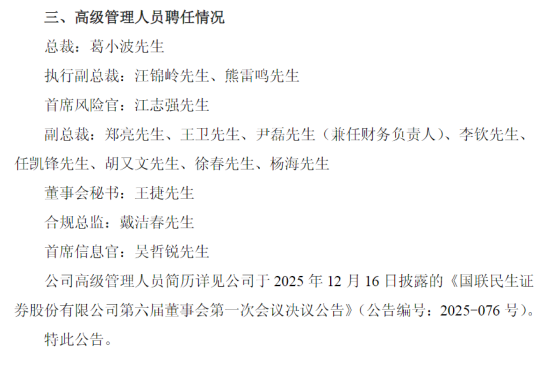
密集换届!5家券商公布董事会、高管阵容,哪些新力量入列?
Xin Lang Cai Jing· 2025-12-19 04:32
Core Insights - The recent board and executive team reshuffles among several securities firms, including Guolian Minsheng Securities, Western Securities, Dongfang Caifu, Guoyuan Securities, and Changjiang Securities, reflect significant changes in leadership and strategic direction within the industry [1][5][7]. Group 1: Board Reshuffles - Guolian Minsheng Securities completed its board reshuffle on December 15, 2025, with Gu Wei elected as chairman and a focus on risk control and strategic committees [2]. - Western Securities' board was restructured on November 17, 2025, with Xu Chaohui as chairman, emphasizing strategic and risk control committees [2]. - Dongfang Caifu's board reshuffle on December 15, 2025, saw Qi Shi as chairman and a significant organizational restructuring to support its "AI + Finance" strategy [3]. - Guoyuan Securities' board was restructured on December 15, 2025, with Shen Hefeng as chairman, focusing on audit and compensation committees [3]. - Changjiang Securities completed its board reshuffle on December 9, 2025, with Liu Zhengbin as chairman, integrating more representatives from Hubei state-owned assets [4]. Group 2: Executive Appointments - Guolian Minsheng Securities appointed Ge Xiaobo as president and established a comprehensive executive team, including roles for risk management and compliance [10]. - Western Securities promoted several internal candidates to key executive positions, ensuring continuity and alignment with its recent acquisition of Guorong Securities [15]. - Dongfang Caifu's new management structure includes Huang Jianhai as general manager, focusing on a flatter organizational structure to enhance agility [12][13]. - Changjiang Securities retained key executives while integrating new management from state-owned backgrounds to strengthen governance [14]. Group 3: Strategic Focus and Industry Trends - The reshuffles indicate a trend towards internal promotions, ensuring continuity in strategic execution and aligning with the high professionalism required in the securities industry [6]. - The adjustments are closely tied to organizational reforms, with firms like Western Securities and Dongfang Caifu optimizing their structures to enhance operational efficiency [6]. - The changes reflect a broader industry trend towards adapting to market transformations, with firms focusing on mergers, local economic development, and financial technology integration [6].




突然,跳水!刚刚,日本两大重磅来袭!
券商中国· 2025-12-19 03:53
Group 1 - The Bank of Japan raised the benchmark interest rate from 0.5% to 0.75%, marking a 30-year high and the first rate hike in 11 months since January 2025 [1][4] - The Japanese government plans to increase income tax rates by 1 percentage point for all income brackets starting January 2027, with the additional revenue aimed at meeting defense needs [1][4] - The market had already priced in the interest rate hike, and the Bank of Japan's decision was made with a unanimous 9-0 vote [2][4] Group 2 - Analysts predict that the terminal interest rate for the Bank of Japan may be around 1%-1.5%, with potential rate hikes in 2026 [4] - The Japanese Finance Minister indicated that the next fiscal year's budget will consider fiscal sustainability, aiming to reduce the debt-to-GDP ratio to boost market confidence [4] - The anticipated tax changes are expected to result in a revenue decrease of 650 billion yen, higher than the previous estimate of 400 billion yen [4] Group 3 - The liquidity impact from the interest rate hike is expected to be less severe than in the past due to the closure of active "carry trade" positions [6] - Concerns about the "AI bubble" in the U.S. stock market may amplify the effects of Japan's rate hike on global liquidity [6][7] - Despite potential liquidity shocks, the long-term trend of global monetary easing is expected to continue, with a favorable outlook for A-shares and strategic positioning in gold [7]

把握回调加仓机会?高“光”159363获资金爆买!机构称AI算力供不应求,光模块“卖铲人”逻辑持续强化
Xin Lang Cai Jing· 2025-12-18 11:44
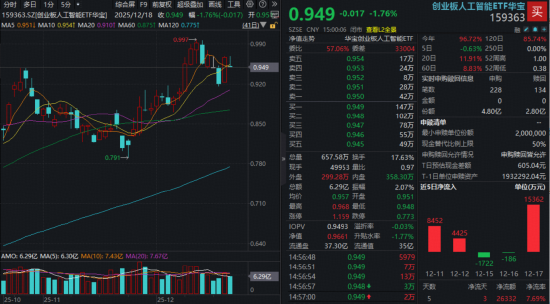
Core Viewpoint - The AI industry chain experienced a slight pullback after a surge, with mixed performance in optical module CPOs, while the A-share AI sector faced concerns over an "AI bubble" influenced by overseas market dynamics [3][9]. Market Performance - On December 18, the A-share AI sector saw a decline, with the ChiNext AI index dropping by 1.74%. Notable gainers included Changxin Bochuang, Liante Technology, and Jinxin Nuo, each rising over 2%, while Xinyi Sheng fell by 4.62% and Zhongji Xuchuang dropped over 3% [1][7]. - The largest and most liquid ChiNext AI ETF (159363) failed to turn positive in the morning and fell by 1.76% in the afternoon, with a trading volume of 629 million yuan. Despite this, there was a net inflow of funds, with a single-day net subscription of 200 million units, and a cumulative increase of over 260 million yuan in the previous five days [1][7]. Investment Opportunities - Institutions believe that the investment in AI computing power remains in a high growth phase, with a supply-demand imbalance in various segments of the AI computing chain. West Securities recommends focusing on opportunities arising from this supply-demand tension [3][9]. - Looking ahead to 2026, the evolution of large model capabilities and continuous penetration of applications are expected to sustain high investment in computing power. The discussion around CAPEX and short-term returns is prevalent, indicating ongoing high demand in the AI computing chain [3][10]. Sector Analysis - Industrial analysis suggests that the optical module and supporting supply chain may experience a divergence in expectations. The introduction of 1.6T optical modules is anticipated to drive significant demand in the coming year, with leading companies expected to maintain high growth [10]. - The ChiNext AI index has doubled in cumulative growth this year, significantly outperforming other AI-themed indices, indicating strong investment potential in the optical module-centric computing chain [10]. ETF Insights - The ChiNext AI ETF (159363) is the first ETF tracking the ChiNext AI index, with a current scale exceeding 3.6 billion yuan and an average daily trading volume of over 600 million yuan in the past month, ranking first among seven ETFs tracking the index [10].
近八成券商多次分红!券商打响“季度分红赛”
2 1 Shi Ji Jing Ji Bao Dao· 2025-12-18 11:17
Core Viewpoint - The Chinese securities industry is experiencing a significant shift towards frequent dividend distributions, with many firms adopting a practice of multiple dividends per year, reflecting a deeper transformation from a focus on financing to prioritizing shareholder returns [1][3][10]. Group 1: Dividend Frequency and Trends - In 2025, 35 securities firms have distributed dividends two times or more, accounting for 79.55% of the total listed firms, indicating a shift to a normalized practice of multiple dividends [1][4]. - The trend of mid-term dividends (including interim and quarterly reports) has become the new norm, with a notable increase in firms participating in this practice from just one in 2023 to a significant number in 2025 [3][4]. - The introduction of quarterly dividends marks a significant change, with 8 firms announcing plans for quarterly dividends in 2025, compared to only 9 in the previous year [3][4]. Group 2: Dividend Amount and Quality - The "quality" of dividends, measured by the actual cash distributed per share, has increased, with leading firms like CITIC Securities distributing 29 yuan per hand (100 shares), setting a high benchmark [6][7]. - Major firms such as Guotai Junan, Huatai Securities, and others have also significantly increased their dividend payouts, with several firms exceeding 40 billion yuan in total dividends for the year [6][7]. Group 3: Regulatory Influence and Market Environment - The shift towards more frequent dividends is driven by regulatory encouragement and an improved market environment, with policies like the new "National Nine Articles" promoting multiple dividends [7][8]. - The regulatory framework has transformed dividend distribution from a flexible option to a rigid responsibility, compelling firms to enhance their shareholder return strategies [7][8]. Group 4: Diversification of Return Mechanisms - In addition to cash dividends, share buybacks are becoming a key tool for firms to manage capital structure and return value to shareholders, with Guotai Junan leading the industry in buyback amounts [8][9]. - A combination of cash dividends and share buybacks is being increasingly adopted, providing firms with flexible capital management options and offering investors diverse value realization paths [8][9]. Group 5: Long-term Shareholder Engagement - Enhancing investor satisfaction is viewed as a systematic project that requires improving governance, optimizing return tools, and ensuring transparency in decision-making [9][10]. - Some leading firms are proactively disclosing long-term shareholder return plans, which helps stabilize market expectations and attract long-term investors [9][10].
AI细分产品需求有望爆发,这家公司已成为了芯片及半导体封测厂商的重要客户
摩尔投研精选· 2025-12-18 10:50
Group 1 - The Bank of Japan is expected to raise interest rates by 25 basis points on the 19th of this month, with limited impact on global liquidity due to previous rate hikes since March last year [1] - The most dangerous phase of liquidity shock has passed, as the futures market has already closed the most active "carry trade" positions, and the Federal Reserve's expansionary policy is stabilizing market liquidity expectations [1] - Concerns about the "AI bubble" in the US stock market and the overall vulnerability of the market may lead to a liquidity shock triggered by the yen's interest rate hike [1][2] Group 2 - The technology sector in the US stock market may experience adjustments that could prompt the Federal Reserve to resume quantitative easing, leading to a quick recovery in capital markets [2] - The outlook for major asset allocation remains positive for gold and RMB assets, driven by China's expanding export surplus and the potential for the Federal Reserve to restart interest rate cuts, which will support the long-term appreciation of the RMB [2] Group 3 - The optical fiber and cable industry is showing signs of recovery, with prices entering an upward channel, as retail prices for scattered fibers have rebounded by approximately 15%-20% [3] - The demand for high-value products such as multimode and ultra-low loss fibers is surging due to the explosion of AI computing power, leading manufacturers to shift capacity towards high-end products [3][4] - The growth in overseas demand is driving a strong "volume and price increase" trend in exports, with export values for optical rods, fibers, and cables expected to grow by over 50% year-on-year by October 2025 [3] Group 4 - Domestic manufacturers are maintaining restraint in expanding core optical rod capacity due to previous years of capacity clearing and management, which will limit short-term supply amid rapidly increasing demand [4] - The mismatch between supply and demand in the context of sustained demand growth will support continued price increases in the optical fiber industry [4]

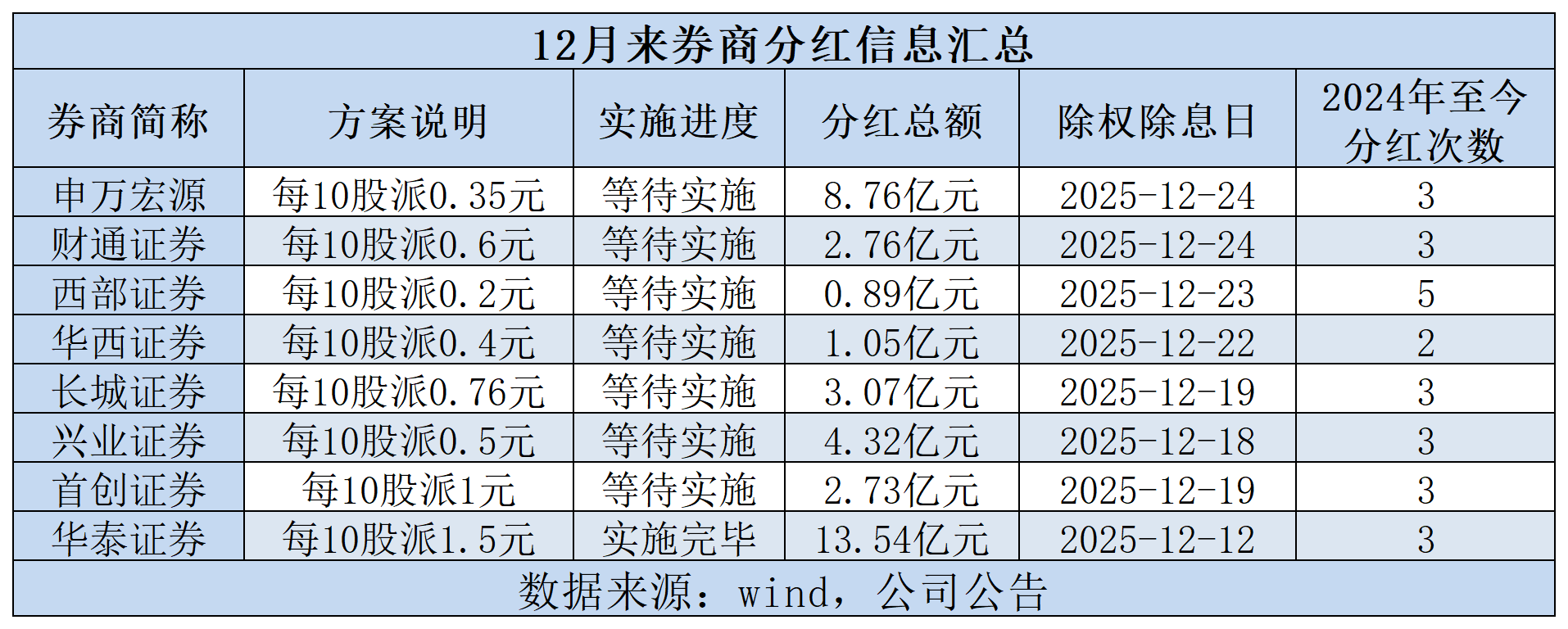
申万宏源等四家券商密集发布分红公告,首创证券分红比例超30%年内股价却跌超10%
Xin Lang Zheng Quan· 2025-12-18 07:34
炒股就看金麒麟分析师研报,权威,专业,及时,全面,助您挖掘潜力主题机会! 从股价表现看,年初至今,8家券商中5家实现上涨,3家下跌,分化显著。华泰证券以37.88%的涨幅遥遥领先,长城证券、兴业证券、华西证券涨幅均超 15%。西部证券5次分红,但股价仍然微跌。更值得注意的是,首创证券以11.57%的跌幅表现最弱,呈现"高分红、低股价"的反差现象。 申万宏源证券研究认为,在"稳中求进、提质增效"的政策基调下,证券行业有望迎来监管红利释放期。当前头部券商可以通过并购重组实现优势互补,中小 券商则有望通过差异化、特色化经营实现突破,行业格局正逐步向"头部引领、特色发展"演进。尽管板块估值仍处于历史低位,但随着政策集成效应显现及 自身质效提升,券商基本面与估值错配的局面有望得到改善。 新浪声明:此消息系转载自新浪合作媒体,新浪网登载此文出于传递更多信息之目的,并不意味着赞同其观点或证实其描述。文章内容仅供参考,不构成投 资建议。投资者据此操作,风险自担。 在分红力度上,各公司呈现差异化布局。华泰证券以"每10股派1.5元"、总额13.54亿元领先其他券商,展现出头部机构的盈利厚度与回馈能力。申万宏源总 额虽达8.76 ...