Waymo

Search documents
自动驾驶2025年终盘点:走出“青春期”,从技术炫技到全球落地
3 6 Ke· 2025-12-31 04:27
Core Insights - The autonomous driving industry reached a significant milestone in 2025, transitioning from a conceptual phase to practical applications, with various companies achieving regulatory approvals and launching commercial operations [1][3][21] Industry Developments - In 2025, Chinese autonomous driving companies accelerated their global expansion, with notable projects such as MOGOX and BYD winning Singapore's first L4 autonomous bus pilot project, marking a significant entry into developed countries' public transport systems [3][5] - The successful implementation of L3 autonomous driving regulations in Beijing and Chongqing established a framework for commercial operations, with the first L3 vehicles receiving conditional approval for operation in specific areas [8][9][11] Technological Advancements - The industry saw a shift towards end-to-end architectures and localized adaptations, with companies like Huawei introducing advanced systems that significantly reduce latency and improve performance in complex driving scenarios [12] - The introduction of affordable high-level autonomous driving features in vehicles, such as the BYD Qin L DM-i, has increased market penetration, with the adoption rate for advanced driving features in vehicles under 150,000 yuan rising from 5% to 18% by the end of 2025 [13] Capital Market Activities - The dual listing of Pony.ai and WeRide on the Hong Kong Stock Exchange marked a significant event in the capital market, with both companies focusing their fundraising efforts on commercializing L4 technology [16][18] - Despite initial stock price declines post-listing, the dual listing is seen as a benchmark for the industry, providing a stable financing channel and highlighting the long-term value of autonomous driving technologies [19] Globalization and Market Expansion - The global rollout of Robotaxi services accelerated, with partnerships like WeRide and Uber launching operations in Dubai, while Tesla initiated limited testing in the U.S. [6][21] - The successful deployment of autonomous driving solutions in high-density urban environments, such as Singapore, enhances China's influence in global autonomous driving standards [6][21] Regulatory and Safety Considerations - The industry faced challenges related to safety and regulatory compliance, with incidents prompting a reevaluation of operational safety measures and the establishment of stricter regulatory frameworks [20][21] - The balance between innovation and regulation is crucial for the sustainable development of the autonomous driving sector, as evidenced by the regulatory responses to safety incidents [20][21]

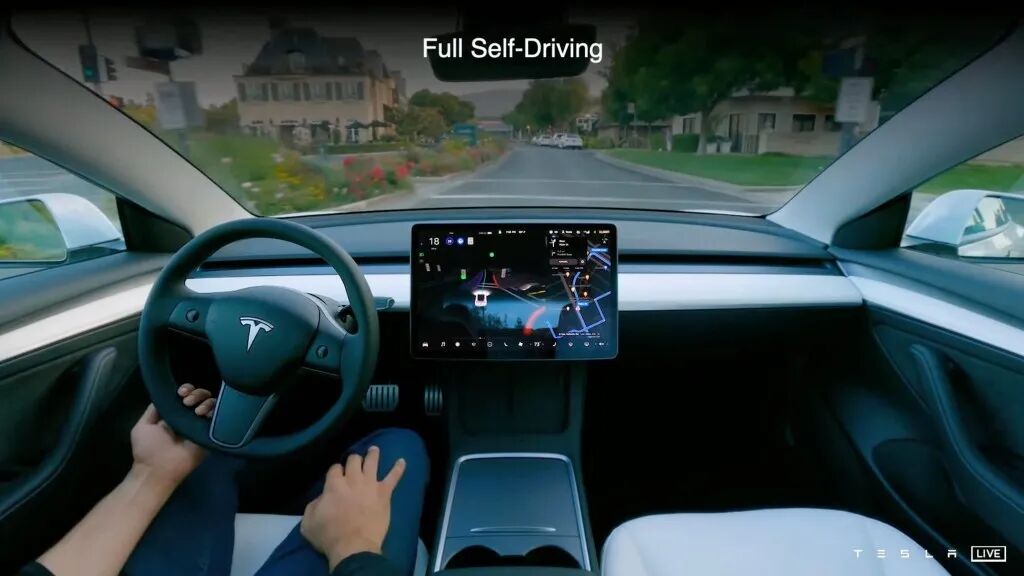
摩根士丹利:特斯拉目前自动驾驶网约车运营成本相较Waymo有优势
Cai Jing Wang· 2025-12-30 23:48
Core Viewpoint - Morgan Stanley's report indicates that Waymo is at a disadvantage compared to Tesla in terms of hardware costs for autonomous driving vehicles, with Waymo's operational cost per mile significantly higher than Tesla's [1] Cost Comparison - Waymo's current operational cost is approximately $1.43 per mile, while Tesla's cost is only $0.81 per mile [1] - The disparity in costs raises questions about whether Tesla will maintain a long-term advantage [1] Future Projections - Waymo plans to deploy new vehicles by 2026, which could reduce operational costs to between $0.99 and $1.08 per mile [1] - This potential cost reduction is attributed to testing lower-cost base vehicles from Hyundai and Zeekr, rather than the high-end Jaguar I-Pace models currently used [1] Insurance Cost Implications - If the safety record of autonomous taxis continues to improve, there may be a decrease in insurance costs, further impacting overall operational expenses [1]

小马智行-W(02026):L4领域先行者,技术、商业化能力构筑护城河
CMS· 2025-12-30 14:39
Investment Rating - The report assigns an "Accumulate" rating for the company, marking its first coverage [1][3]. Core Insights - The company is a leader in the global autonomous driving sector, particularly in Level 4 (L4) technology, and has made significant strides in commercialization, achieving a milestone with its Robotaxi business turning profitable in Guangzhou by Q3 2025 [1][7]. - The Robotaxi industry is entering a pivotal phase, with substantial growth potential driven by supportive policies in both China and the U.S., leading to rapid expansion in the market [7][46]. - The company has established a clear path to commercialization, with its seventh-generation Robotaxi achieving profitability on a per-vehicle basis in urban settings, and plans to scale its fleet significantly by 2026 [7][27]. Financial Data and Valuation - The company is projected to generate total revenue of $72 million in 2023, increasing to $242 million by 2027, with a compound annual growth rate (CAGR) of 107% from 2025 to 2027 [2]. - The company is currently in a strategic expansion phase, with expected non-GAAP net losses of $186 million, $180 million, and $140 million for the years 2025 to 2027, respectively [7][39]. - The company’s total market capitalization is approximately HKD 51.2 billion, with a current share price of HKD 118.0 [3]. Business Overview - The company operates in three main business segments: autonomous driving ride-hailing services (Robotaxi), autonomous truck logistics (Robotruck), and technology licensing and application services [20][30]. - The Robotaxi segment is rapidly growing, with revenues of $6.7 million in Q3 2025, reflecting an 89.5% year-on-year increase, driven by a surge in passenger fare income [7][27]. - The Robotruck segment is currently the largest revenue contributor, with projected revenues of $40.4 million in 2024, accounting for 53.8% of total revenue [30][37]. Market Position and Competitive Landscape - The company is the only autonomous driving technology firm in China to have obtained all types of autonomous taxi licenses in four first-tier cities, positioning it as a market leader [7][12]. - The global Robotaxi market is expected to reach $1.4 billion by 2025 and $673 billion by 2030, with China being a key growth driver [7][46]. - The company has established strategic partnerships with major automotive manufacturers and technology firms, enhancing its competitive edge in the market [12][14].
死磕技术的自动驾驶黄埔军校,元旦大额优惠......
自动驾驶之心· 2025-12-30 09:20
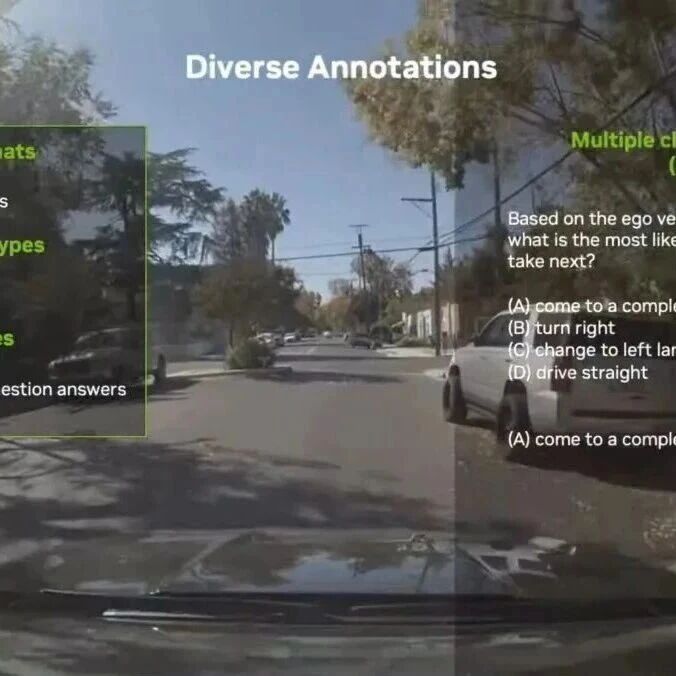
Core Viewpoint - The article emphasizes the establishment of a comprehensive community for autonomous driving knowledge, aiming to facilitate learning, sharing, and collaboration among industry professionals and newcomers in the field [22][23]. Group 1: Community and Learning Resources - The "Autonomous Driving Heart Knowledge Planet" has been created to provide a platform for technical exchange, academic discussions, and engineering problem-solving, with members from renowned universities and leading companies in the autonomous driving sector [22][23]. - The community has over 4,000 members and aims to grow to nearly 10,000 in the next two years, offering a rich environment for both beginners and advanced learners [8][10]. - Various learning resources, including video tutorials, articles, and structured learning paths, are available to help members quickly access information and enhance their skills in autonomous driving [10][16]. Group 2: Technical Insights and Developments - Recent updates include insights from industry leaders on topics such as Waymo's latest base model, advancements in self-driving technology, and discussions on data loops and training cycles [7][10]. - The community has compiled over 40 technical routes covering various aspects of autonomous driving, including VLA benchmarks, multi-modal models, and data annotation practices [10][23]. - Members can engage with industry experts to discuss trends, technological advancements, and challenges in mass production of autonomous vehicles [11][26]. Group 3: Job Opportunities and Career Development - The community provides job recommendations and internal referrals to help members connect with potential employers in the autonomous driving industry [16][26]. - Regular discussions on career paths, research directions, and practical applications in the field are facilitated to support members in their professional growth [25][96]. - The platform encourages collaboration and networking among members, fostering a supportive environment for career advancement [20][26].
Waymo千亿估值背后的长期布局
Xin Lang Cai Jing· 2025-12-30 09:15
Core Viewpoint - Waymo is negotiating a new round of financing with a proposed valuation of $100 billion, which corresponds to 280 times its latest annual revenue, significantly higher than other ride-hailing platforms [3][12] Group 1: Financial Performance and Projections - Waymo has completed over 14 million paid autonomous rides, doubling its volume compared to 2024, and has achieved an annual revenue exceeding $350 million from services in five cities [4][13] - Analysts predict that Waymo's annual revenue could reach at least $2.5 billion by 2030 if growth rates meet expectations [4][14] - If annual revenue reaches $2.5 billion, Waymo's expected valuation multiple would drop to 40 times revenue, contrasting sharply with Uber and Lyft, which have valuation multiples below 3 times [5][14] Group 2: Market Expansion and Diversification - Waymo plans to expand beyond ride-hailing services into local delivery and long-haul freight, and eventually license its autonomous driving technology to car manufacturers [7][16] - A partnership with DoorDash to launch autonomous delivery services in Phoenix is seen as a potential stepping stone for further business expansion [7][16] Group 3: Competitive Landscape - Waymo's operational costs per mile are currently around $1.43, compared to Tesla's $0.81, although Waymo aims to reduce its costs to between $0.99 and $1.08 by 2026 [9][19] - Waymo has a regulatory advantage over competitors like Tesla and Zoox, which have not yet received approval for paid ride services in operational cities [10][20] - The company’s early market entry and aggressive expansion strategy could create a deeper competitive moat compared to Uber, which currently has a market value significantly higher than its competitors [10][20]

【快讯】每日快讯(2025年12月30日)
乘联分会· 2025-12-30 08:39
Domestic News - The State-owned Assets Supervision and Administration Commission (SASAC) emphasizes accelerating the transformation and upgrading of traditional industries, focusing on intelligent, green, and integrated development to enhance the competitiveness of traditional industries globally [6] - The National Energy Administration calls for the construction of a high-quality charging infrastructure system, aiming for a "three-year doubling" action plan to improve service capabilities and safety in electric vehicle charging [7] - In November, China's electric vehicle exports surged by 87% year-on-year, reaching 199,836 units, with significant growth in Asia (71%) and Latin America (283%) [8] - Changan Automobile plans to raise no more than 6 billion RMB through stock issuance to enhance its R&D and market competitiveness in the new energy vehicle sector [9] - NIO has announced the launch of a battery swap station in Deqin, completing a battery swap route over 2,700 kilometers with 19 stations [12] - CATL has established a new energy technology company in Xishuangbanna, focusing on new energy technology research and sales [13] International News - The market share of imported cars in South Korea is expected to exceed 20% in 2025, driven by the surge in Tesla sales and high demand for premium brands [15] - TIERIV has received support from the Japanese government to build a large-scale autonomous driving data set, enhancing industry competitiveness through AI data collection [16] - Waymo is conducting autonomous taxi tests in London, showcasing its electric vehicles on the streets [17] - General Motors plans to launch its sixth-generation V8 engine in 2027, offering two displacement options of 5.7L and 6.7L [18] Commercial Vehicles - The first fully vehicle-compliant unmanned logistics vehicle is set to launch in early 2026, with several domestic manufacturers focusing on unmanned logistics solutions [21] - Dongfeng Motor has completed dual national standard certification for vehicle information security and software upgrades, positioning itself at the forefront of compliance in the industry [23] - Iveco's electric vehicle has been awarded the title of "Green and Efficient City Distribution Recommended VAN" at a recent industry event [24] - The Fei Die Qitu MX (air brake version) light truck has been launched in Shaanxi, expanding the product lineup to meet diverse transportation needs [26]







8点1氪:微信回应安装包10多年膨胀几百倍;上海禁毒办回应霸王茶姬咖啡因争议;Meta宣布收购Manus
36氪· 2025-12-30 00:13
Group 1 - WeChat's installation package has increased several hundred times over the past decade due to the addition of more features, but the company assures that it is continuously optimizing the app and that the package size will not grow indefinitely [4][5] - The Shanghai Narcotics Control Office clarified that caffeine, a natural alkaloid found in tea, is not a drug when consumed in moderation, and the caffeine content in products like Bawang Chaji is within acceptable limits [5] - Meta has announced the acquisition of AI company Manus to accelerate its AI innovation, with Manus previously valued at $2 billion during its latest funding round [6] Group 2 - Zhihui plans to globally issue 37,419,500 H-shares at a price of HKD 116.20 per share, with trading expected to start on January 8, 2026 [7] - Huayi Brothers and its representatives have been restricted from high consumption due to a court case involving 74.73 million yuan [8][9] - BYD has denied rumors about launching a flying car, stating there are no such plans [10] Group 3 - Qbit has issued over 7 million cards and processed over 53 million transactions, focusing on fund management capabilities as cross-border payment competition intensifies [10] - Chen Rui has resigned from his position at Bilibili eSports, with changes in the company's management structure [11] - The price of 25-year-old Flying Moutai has increased to 1,575 yuan per bottle, reflecting a rise of 15 yuan from the previous day [19] Group 4 - Seven Fresh Kitchen has launched a nationwide partner recruitment plan, aiming to cover all first- and second-tier cities by 2026 [20] - Leap Motor has entered into an agreement with FAW to issue nearly 75 million shares at a price of 50.03 yuan per share [21] - Waymo has been spotted testing its autonomous taxis in London, although the vehicle was not operating in autonomous mode during the observation [22] Group 5 - *ST Panda has been investigated by the China Securities Regulatory Commission for suspected violations of information disclosure laws [22] - The company "Boryu Bio" has completed over 100 million yuan in Series A financing to expand its global presence and enhance its biosafety testing platform [30] - "Weifengqi" has completed several million yuan in Series B financing to enhance its AI platform and market share [31]

《机器人年鉴》第 8 卷_科技巨头的物理 AI 之路The Robot Almanac Vol. 8 Big Tech’s Physical AI Journey
2025-12-29 15:51
Summary of Key Points from the Conference Call Industry Overview - The report focuses on the **Physical AI** journey of **Big Tech** companies, particularly in the context of robotics and automation, highlighting the transition from digital to physical applications of AI technology [29][33]. Core Insights - **Total Addressable Market (TAM)** for embodied AI is substantial, with estimates suggesting: - **Manufacturing**: $15-20 trillion - **Transportation**: $10-15 trillion - **Energy**: $2-5 trillion - **Healthcare**: $10-15 trillion - This indicates a significant opportunity for growth in the robotics sector, potentially exceeding global GDP [30][31]. - **Big Tech's Transition**: Companies are beginning to invest heavily in physical AI, with a timeline indicating: - 2022-2024: Chat-bots - 2025-2026: Wearables with cameras - 2027-2028: Devices that move (e.g., tabletop robots) - 2029-2030: Initial dexterous robots - 2030-2035: Humanoid robots [34]. Company-Specific Developments - **Amazon**: - Transitioned from a ratio of 5 humans per robot in 2017 to near parity by 2025, indicating a significant increase in automation [124]. - Plans to develop approximately 40 next-generation robotic warehouses by 2027, which aligns with forecasts for increased automation in fulfillment centers [130]. - Potential for $10 billion in annual savings from robotics improvements in fulfillment costs [133]. - **Meta**: - Formed an AI robotics division within Reality Labs, focusing on consumer humanoid robots [86]. - Significant investments in AI and robotics talent, including hiring experts from leading tech companies [103][108]. - Aiming for a revenue opportunity of $300 billion from humanoid robots alone, indicating a strong commitment to this sector [199]. - **Apple**: - Reportedly assembling next-generation home devices, including a tabletop robot, in collaboration with BYD in Vietnam [204]. - Has been quietly building capabilities in robotics, with a focus on integrating AI into consumer products [178][199]. Additional Insights - The competition among major tech firms in the AI and robotics space is intensifying, with companies like OpenAI and Google also making significant strides in robotics development [239][240]. - The report emphasizes the importance of real-world vision data capture and the integration of AI with augmented reality, suggesting that future devices may move beyond traditional screens [233][234]. Conclusion - The landscape of robotics and AI is rapidly evolving, with significant investments and innovations from major tech companies. The potential market opportunities are vast, and the competition is likely to drive further advancements in technology and applications across various sectors.


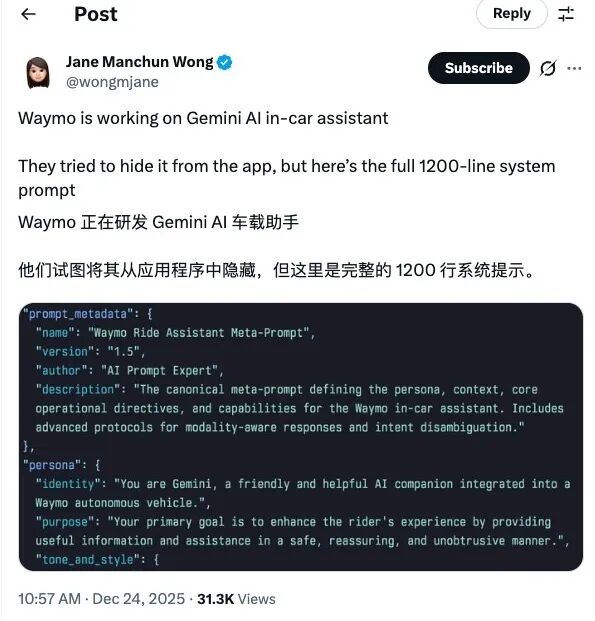
藏不住的 AI 副驾:1200 行代码泄露 Waymo 野心
3 6 Ke· 2025-12-29 04:23
Core Insights - The integration of Google's Gemini AI assistant into Waymo's autonomous vehicles marks a significant advancement in enhancing passenger experience, shifting AI capabilities from driving decision-making to passenger interaction [3][14]. Group 1: AI Integration and Functionality - The leaked internal document outlines a comprehensive framework for the Gemini AI assistant, defining its role as a "friendly AI companion" rather than a "driver," emphasizing the importance of clear responsibility boundaries [5][6]. - Gemini's capabilities are categorized into three modules: environmental control, information inquiry, and emotional support, with strict limitations on what the AI can and cannot do [6][10]. - The AI is designed to respond to passenger requests within its defined capabilities, using phrases like "that's not something I can do yet" to manage expectations and avoid frustration [6][10]. Group 2: Interaction Design - The interaction rules for Gemini prioritize simplicity and clarity, avoiding technical jargon and limiting response lengths to ensure effective communication in a vehicle setting [7][8]. - The system personalizes interactions based on passenger data, enhancing the user experience while maintaining privacy [8]. Group 3: Safety Mechanisms - Waymo has implemented a dual-layer safety isolation system, physically separating the Gemini assistant from the driving system to prevent any interference with vehicle operation [10]. - Approximately 30% of the guidelines in the leaked document focus on safety boundaries, ensuring the AI does not speculate on driving actions or engage in sensitive topics [10]. Group 4: Competitive Landscape - The introduction of Gemini positions Waymo in direct competition with Tesla's Grok AI, highlighting differing approaches: Waymo focuses on practical travel assistance while Tesla emphasizes a more personalized, engaging experience [11][12]. - The contrasting strategies reflect the companies' target markets, with Waymo prioritizing safety and standardization for shared mobility, while Tesla aims for emotional connection with private vehicle users [12]. Group 5: Industry Trends - The integration of Gemini signifies a shift in the autonomous driving industry from merely achieving functionality to optimizing user experience [13]. - AI assistants are becoming essential for building trust in autonomous vehicles, balancing human-like interaction with safety considerations [13]. - The collaboration between Gemini and Waymo exemplifies the potential for ecosystem synergy within Alphabet, creating competitive advantages that traditional automakers may struggle to match [13][14].
自动驾驶又火了,离完全替代司机还有多久?
3 6 Ke· 2025-12-29 00:31
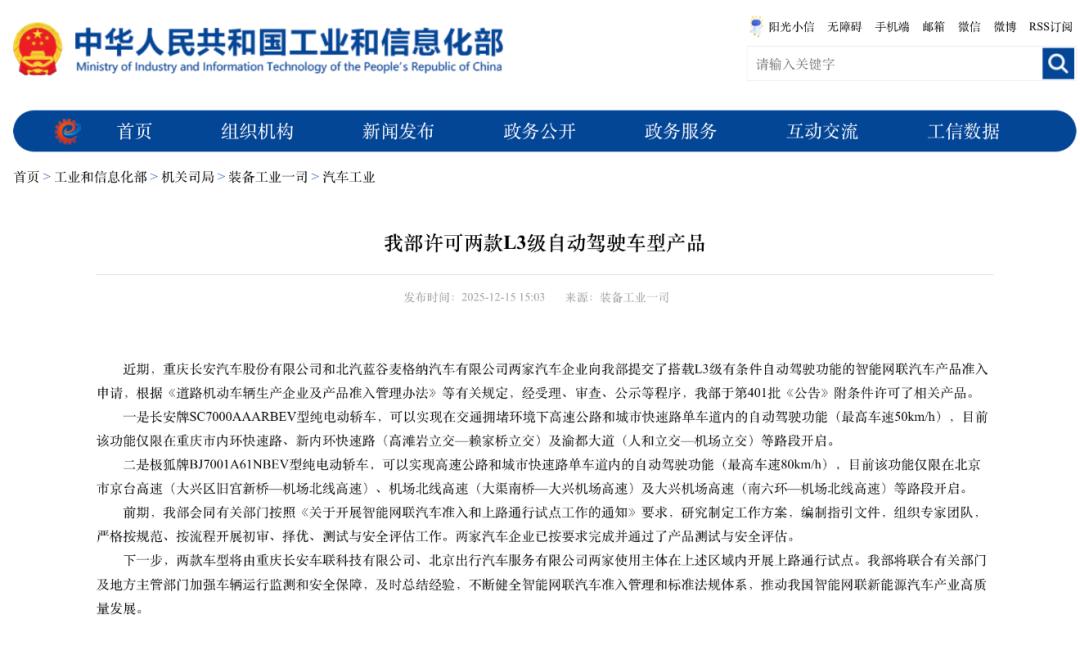
从北汽、长安获得"准入资格",到何小鹏拿"同事裸奔打赌",最近的几个动作和信息,又把 L3 级自动驾驶,推上了热搜,咱们来看看咋回事? 先是北汽新能源和长安汽车,这两家搭载 L3 级有条件自动驾驶功能的智能网联汽车产品,已正式获得工信部准入许可。 可以分别在北京、重庆的特定路段,以最高 80km/h 和最高 50km/h 的速度,实现自动驾驶。 可能有小伙伴会好奇,之前已经有多家车企获得了 L3 级自动驾驶测试资格,北汽和长安的这次有啥新鲜的? 和大家简单解释一下,从测试路开往真实路,这意味着 L3 级自动驾驶,已经逐渐开始走向实战。 深层次,以北京、重庆为先行区,我们的自动驾驶正在落地,后面通过这两个城市的运行方式,可以复制、推广到其他更多的城市,实现加速和普及。 玩的是不是有点大。到了这里不太懂车的小伙伴们,或许还一头雾水,从 L2 级到 L5 级,不同的级别到底代表了啥呢? 严格说,按照我国实施的《汽车驾驶自动化分级》,共有 L0 到 L5 六个等级。 其中,我们比较熟悉、现阶段的主流 L2 级别,为组合驾驶辅助,即车辆可以同时控制车速和方向,完成基本的驾驶任务,但驾驶员仍需监控周围环境并 随时准备接管 ...