
老百姓

Search documents
“亏得没办法了”!去年全国关闭药店约3.9万家
Mei Ri Jing Ji Xin Wen· 2025-09-04 06:12
Industry Overview - The chain pharmacy industry in China has experienced rapid growth over the past 15 years, with the number of pharmacies increasing from 381,400 in 2009 to over 680,000 by the end of 2024, resulting in a market size exceeding 153.1 billion yuan [1][3] - The average number of pharmacies per 10,000 people in China is 4.6, significantly higher than in Japan and the United States [1] Current Challenges - The industry is showing signs of deceleration, with approximately 39,000 retail pharmacies closing in 2024, marking the first negative growth phase for the number of pharmacies [2][3] - In the first quarter of 2025, the net decrease in pharmacies was about 3,000 [3] - Major pharmacy chains, such as 老百姓, have indicated a pause in expansion plans, with a net increase of only 108 stores in the first half of the year, including a reduction of 197 direct-operated stores [3] Market Dynamics - The rapid expansion of pharmacies was driven by a capital influx, leading to a bubble in the number of pharmacies, with many opening not for business but for resale [5][11] - The current market sentiment has shifted from expansion to survival, with discussions now focused on how to maintain operations rather than growth [6][12] - The density of pharmacies in China is significantly higher than the international norm, suggesting that at least one-third of the current pharmacies may need to close [6][11] Financial Performance - The profit margins for pharmacies have drastically declined, with some companies reporting net profit margins as low as 1% to 3% [12][13] - The financial strain is exacerbated by competition from online platforms, which often sell products below cost, forcing brick-and-mortar stores to subsidize losses from online sales [9][10] Future Outlook - The industry is expected to continue facing challenges, with estimates suggesting that the number of pharmacies could decrease to around 400,000 over the next three to five years [11][13] - The current operational strategies are focused on cost-cutting and efficiency rather than expansion, indicating a structural shift in the industry [16]

淬炼初心本色,把老百姓身边的大事小情解决好
Ren Min Ri Bao· 2025-09-04 02:38
Core Viewpoint - The article emphasizes the implementation of the central government's eight-point regulations, highlighting the importance of addressing the needs of the people and enhancing the relationship between the party and the public [1] Group 1: Community Development - The newly constructed road in Yingshou Village, Fushun County, Liaoning Province, facilitates the transportation of apples, allowing farmers to sell their products on the same day [1] - The initiative for the "wealth road" construction originated from a field survey conducted by the village party secretary assistant, who identified the transportation challenges faced by fruit farmers [1] - A total of 450,000 yuan in special funds from the county transportation bureau was allocated for the construction of the 1,600-meter road [1] Group 2: Engagement and Feedback - Fushun City has adopted an open education approach, encouraging young cadres to conduct in-depth research in the fields, resulting in the collection of 593 opinions [1] - The feedback led to the formulation of 118 specific measures aimed at addressing the identified issues, transforming the problem list into a response that benefits the public [1]

三位药店人讲述:从疯狂开店到加速关门,药店数量将再减少三分之一
Mei Ri Jing Ji Xin Wen· 2025-09-04 02:11
Core Insights - The rapid growth of China's chain pharmacy industry over the past 15 years is now showing signs of slowdown, with a notable decline in the number of retail pharmacies for the first time in history [1][2][10] - The industry is transitioning from a phase of aggressive expansion to one of contraction, with many companies halting their growth plans and closing stores [1][2][3][10] Industry Overview - As of the end of 2024, the total number of pharmacies in China exceeded 680,000, with a density of 4.6 pharmacies per 10,000 people, significantly higher than in Japan and the United States [1] - In 2024, approximately 39,000 retail pharmacies closed, marking the first negative growth phase for the industry [1][2] - The first quarter of 2025 saw a net decrease of about 3,000 pharmacies [1][2] Company Strategies - Companies like 老百姓 (Lao Bai Xing) have indicated a shift in strategy, focusing on franchise store openings while reducing direct store numbers [1] - The management of 老百姓 plans to open 1,000 new stores in 2025, primarily through franchising, with a focus on converting existing stores to franchises [1] Market Dynamics - The industry previously experienced a bubble due to high acquisition costs driven by capital influx, leading to unsustainable growth [2][3] - The current market environment has shifted, with companies no longer pursuing aggressive expansion due to the realization that scale alone is insufficient for success [2][3][10] Financial Performance - The profit margins for leading companies have significantly declined, with some reporting net profit margins as low as 1% to 3% [8] - The financial strain is exacerbated by competition from online platforms, which often sell products at prices below cost, impacting the profitability of physical stores [6][7] Future Outlook - Industry experts predict that the number of pharmacies may decrease to around 400,000 over the next three to five years, as many continue to close due to unsustainable business models [7][8] - The industry is expected to enter a new phase of structural growth, moving away from the previous model of broad-based expansion [10]
深度中报观察丨三位药店人讲述:从疯狂开店到加速关门,药店数量将再减少三分之一
Mei Ri Jing Ji Xin Wen· 2025-09-04 02:06
Industry Overview - The chain pharmacy industry in China has experienced rapid growth over the past 15 years, with the number of pharmacies increasing from 381,400 in 2009 to over 680,000 by the end of 2024, resulting in a market size exceeding 153.1 billion yuan [1] - The average number of pharmacies per 10,000 people in China is 4.6, significantly higher than in Japan and the United States [1] Current Challenges - The industry is showing signs of deceleration, with approximately 39,000 retail pharmacies closing in 2024, marking the first negative growth phase for the number of pharmacies [2][6] - In the first quarter of 2025, there was a net decrease of about 3,000 pharmacies [2] - Major pharmacy chains, such as 老百姓 (603883.SH), have indicated a pause in expansion plans, with a net increase of only 108 stores in the first half of the year, including a reduction of 197 direct stores [2] Market Dynamics - The rapid expansion of pharmacies was driven by capital inflow, leading to a bubble in the number of pharmacies, with many opening not for selling drugs but for selling the pharmacies themselves [6][12] - The current market sentiment has shifted from expansion to survival, with discussions among industry leaders now focused on how to stay afloat rather than how to grow [7][13] Financial Performance - The profit margins for many listed pharmacy companies have drastically declined, with net profit margins reported between 1% and 3% [13] - The average gross margin for pharmacies is around 20%, but after accounting for various costs, the actual profitability is significantly lower [10][11] Future Outlook - The industry is expected to see a continued decline in the number of pharmacies, with estimates suggesting a reduction to around 400,000 pharmacies over the next three to five years [12] - The current structural changes in the industry indicate a shift from broad-based growth to a more sustainable model, focusing on efficiency rather than sheer scale [17]
上市连锁药店半年业绩出炉
Guo Ji Jin Rong Bao· 2025-09-03 16:25
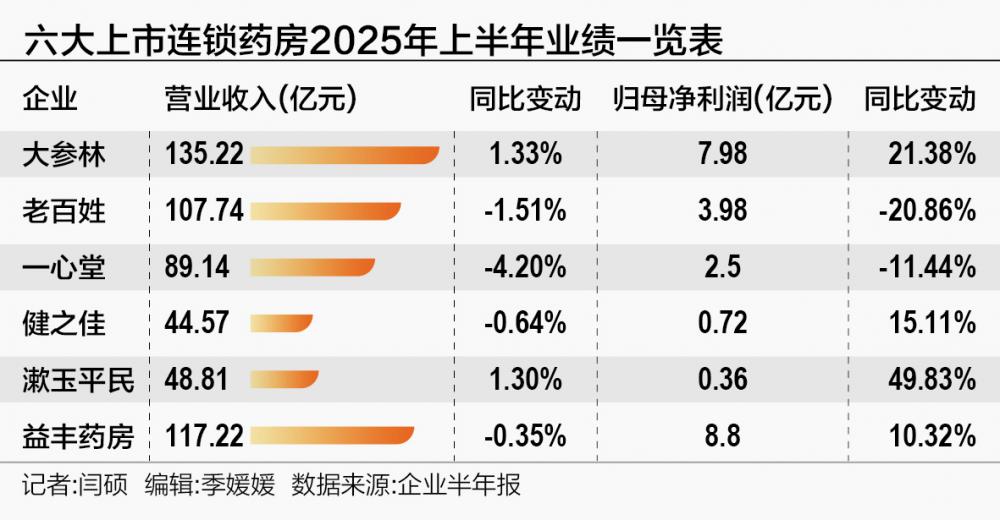
Core Insights - The retail pharmacy industry is experiencing a significant transformation, with a shift from expansion to rapid contraction due to competition from online platforms like JD.com and Meituan [1][6][11] Industry Overview - In the first half of 2025, the retail pharmacy sector faced severe challenges, with four out of seven major chain pharmacies reporting revenue declines, while three maintained growth [1][3] - The overall growth of the retail pharmacy industry is slowing down, with a notable divergence in profitability among companies [4][5] Financial Performance - Major players include: - Dazhonglin: Revenue of 135.22 billion yuan, up 1.3%, net profit of 7.98 billion yuan, up 21.4% [3][4] - Yifeng Pharmacy: Revenue of 117.22 billion yuan, down 0.35%, net profit of 8.8 billion yuan, up 10.32% [3][4] - Laobaixing: Revenue of 107.74 billion yuan, down 1.51%, net profit of 3.98 billion yuan, down 20.86% [3][4] - Yixin Hall: Revenue of 89.14 billion yuan, down 4.20%, net profit of 2.50 billion yuan, down 11.44% [3][4] - Huaren Health: Revenue of 25.04 billion yuan, up 15.52%, net profit of 1.04 billion yuan, up 42.17% [3][4] Store Expansion and Market Dynamics - The industry is witnessing a trend of store closures, with major chains like Laobaixing, Yifeng, and Yixin Hall reducing their store counts significantly [6][11] - Approximately 3,000 pharmacies closed in the first quarter of 2025, indicating a significant market reshuffle [6] Competitive Pressures - The rise of online platforms has intensified competition, leading to price disparities in non-prescription drugs and health products, which has negatively impacted the average transaction value and gross margins of physical pharmacies [6][7] Regulatory and Cost Challenges - Recent policy changes, including healthcare reforms and procurement expansions, have severely impacted traditional profit models of pharmacies [7] - Rising operational costs, including rent and labor, along with expenses related to digital transformation, are increasing the financial burden on retail pharmacies [7] Strategic Responses - In response to online competition, pharmacies are diversifying their business models beyond just selling medications, venturing into health management and beauty products [9][10] - Initiatives include providing personalized medication guidance, health management services, and expanding into non-pharmaceutical product sales [10] Future Outlook - The retail pharmacy industry is expected to face more challenges and opportunities in the second half of 2025, with ongoing impacts from procurement policies and healthcare reforms [11]




发现没有?今年反常的很,老百姓不再关心房价涨跌、国际形势如何
Sou Hu Cai Jing· 2025-09-03 16:01
Group 1 - The public's interest in housing prices has diminished, shifting focus towards personal living conditions and quality of life [5][6][13] - The real estate market has stabilized due to years of regulatory measures, leading homeowners to prioritize living quality over speculation [5][6] - Young individuals are increasingly focusing on skill enhancement and income generation rather than worrying about unattainable housing prices [6][8] Group 2 - The complexity of international affairs has led to a sense of helplessness among the public, causing them to prioritize local issues over global events [8][13] - Employment and income stability have become primary concerns for individuals amid economic restructuring and technological advancements [8][10] - Health, aging, and education are emerging as significant areas of focus for families, reflecting a shift towards practical life needs [10][11][13]

医药零售半年报:转型深水区承压前行 从“规模”向“质量”转身
2 1 Shi Ji Jing Ji Bao Dao· 2025-09-02 23:08
Core Viewpoint - The pharmaceutical retail industry is undergoing a structural transformation, moving from extensive growth driven by scale expansion to a focus on quality optimization and efficiency improvement in 2025 [1][5]. Group 1: Performance Overview - In the first half of 2025, six major listed pharmacy chains showed a polarized performance, with Dazhenglin and Shuyupingmin achieving both revenue and net profit growth, while Laobaixing and Yixintang experienced declines [1][3]. - Dazhenglin reported the highest revenue among the chains at 13.522 billion yuan, a year-on-year increase of 1.33%, and a net profit of 798 million yuan, up 21.38% [2][3]. - Shuyupingmin's revenue and net profit were 4.881 billion yuan and 36.25 million yuan, respectively, reflecting increases of 1.30% and 49.83% [3]. - Laobaixing and Yixintang saw revenue declines of 1.51% and 4.20%, with net profits dropping by 20.86% and 11.44% respectively [4][3]. Group 2: Store Expansion Trends - Dazhenglin continued to expand its store count, adding 280 stores, although this growth rate has significantly slowed compared to previous years [1][7]. - Yixintang and Jianzhijia experienced net decreases in store numbers, with Yixintang losing 126 stores and Jianzhijia losing 22 [7]. - The overall trend indicates a shift from rapid expansion to focusing on the efficiency of existing stores, with many chains emphasizing the importance of franchise models for growth [7][8]. Group 3: Strategic Shifts and Innovations - The industry is moving towards diversification and specialization, with companies like Yixintang planning to develop 30% specialized pharmacies and 70% multi-category stores [8][9]. - Shuyupingmin is focusing on high-potential product categories and optimizing its product range while exploring various store formats [9]. - The implementation of O2O (Online to Offline) strategies is gaining traction, with significant sales contributions from O2O channels across multiple chains [10][11]. Group 4: Digital Transformation and AI Integration - Companies are increasingly adopting digital transformation strategies, with AI becoming a focal point for enhancing operational efficiency and customer service [11][12]. - Laobaixing has initiated AI development as a key strategic project, deploying various AI assistants to improve business operations [11][12]. - Dazhenglin has integrated AI tools to provide intelligent customer service and data analysis, enhancing its operational capabilities [12][13].
医药板块中报总结及投资展望
2025-09-02 14:41
Summary of Key Points from the Conference Call Records Industry Overview - The pharmaceutical sector shows a clear performance divergence, with innovative drug companies outperforming generic drug companies. The focus should be on multi-antibody therapies, dual antibodies, and treatments for unmet clinical needs in chronic diseases, such as ADC dual antibodies and small molecule therapies [1][4] - The medical device sector benefits from favorable policies, with a recovery in bidding processes and reduced channel inventory pressure. Leading companies are expected to gain market share, and the infrastructure sector is anticipated to reach a turning point [1][5] - The distribution sector's revenue remains flat, but the net profit excluding non-recurring items has decreased year-on-year. Gross margins have slightly declined, and accounts receivable turnover days have increased, indicating significant collection pressure [1][6] - The formulation sector shows stable overall performance, with net profit growth benefiting from innovative formulation products entering overseas markets. R&D expenses are growing faster than revenue, indicating increased investment in innovation [1][7] - Biotech companies are experiencing rapid revenue growth, driven by the overseas expansion of core products and unique indications. R&D and sales expense ratios are declining, reflecting improved commercial capabilities [1][9] Key Insights on Sub-sectors Innovative Drugs - Innovative drugs represent one of the largest investment opportunities in 2025, particularly in areas with potential for multi-antibodies and dual antibodies, as well as innovative therapies for cancer [4] Medical Devices - The medical device sector is seeing significant policy support, with a notable recovery in bidding trends and reduced inventory pressure for manufacturers. This is expected to drive performance improvements in the infrastructure sector [5][22] Distribution Sector - The distribution sector's performance is under pressure, with a notable decline in net profit. However, leading companies like Guokong, China Resources, and Shanghai Pharmaceuticals are performing relatively well [6] Formulation Companies - Formulation companies are showing steady performance, with a 20% growth in net profit driven by innovative products. Companies with high barriers to entry and rapid transformation are demonstrating stronger profitability [7] Biotech Companies - From 2019 to 2024, the cumulative revenue of 22 representative biotech companies in China grew from 7.7 billion to 66.8 billion, with a compound annual growth rate (CAGR) of 54%. In the first half of 2025, total revenue reached 38.9 billion, reflecting nearly 30% growth [9][10] Performance Trends - The medical device sector's revenue declined by approximately 5% in the first half of 2025, with profits down 24%. This decline is attributed to the impact of centralized procurement and cost control measures [20] - The biotech sector's core products are experiencing significant growth due to overseas sales and unique therapeutic advantages, with some products seeing revenue increases of over 50% [11] - The traditional Chinese medicine sector is under short-term pressure, but several companies are advancing innovative pipelines that may drive future growth [3][27] Future Outlook - The medical device sector is expected to see a turning point in the second half of 2025, with improved bidding data and a recovery in demand anticipated [22] - The distribution sector is likely to stabilize, with leading companies expected to gain market share as the industry undergoes consolidation [40][41] - The overall outlook for the pharmaceutical sector remains positive, with expectations for continued growth driven by innovation and market expansion [12][41] Additional Considerations - The impact of regulatory changes, such as the drug traceability code policy, is expected to enhance compliance within the industry [39] - The performance of the vaccine sector has been under pressure, with many companies transitioning from profit to loss due to market saturation and pricing pressures [17][18] - The blood products sector is experiencing steady revenue but faces challenges due to price declines in key products [19] This summary encapsulates the key insights and performance trends across various sectors within the pharmaceutical and medical device industries, highlighting both opportunities and challenges ahead.
医药商业行业跟踪报告:2025H1:实体药店整体业绩承压,出清和降本增效效果初显
Wanlian Securities· 2025-09-02 09:31
Investment Rating - The industry is rated as "stronger than the market," indicating an expected index increase of over 10% relative to the broader market in the next six months [28]. Core Insights - In the first half of 2025, the overall performance of the physical pharmacy industry is under pressure due to declining consumer purchasing power, intensified competition, stricter management of personal medical insurance accounts, and the impact of drug procurement policies. However, the industry is experiencing a cleansing and cost-reduction effect, leading to improved development quality [1][2]. Summary by Sections 1. Market Performance - From the beginning of 2025 to August 31, 2025, the pharmaceutical and biological sector achieved a 25.50% increase, outperforming the CSI 300 index by 11.22 percentage points, ranking 9th among 31 sectors. Most sub-sectors within the pharmaceutical sector showed positive growth, with the physical pharmacy index rising by 4.86% [2][8][10]. 2. Performance Review - In the first half of 2025, the physical pharmacy sector's overall revenue grew by 0.10% year-on-year, while net profit attributable to shareholders increased by 0.88%. The growth rate has slowed due to various factors, including declining consumer purchasing power and increased competition [20][22]. 3. Investment Recommendations - The report suggests that optimizing store operations and reducing costs are key to enhancing market competitiveness for pharmacies. The outpatient market for prescription drugs in China has significant growth potential compared to Japan and the U.S. The aging population is expected to further expand this market. Large chain pharmacies are positioned to benefit from regulatory changes and increased operational efficiency through digitalization and smart technologies. The report recommends focusing on leading companies that excel in store optimization, cost reduction, supply chain optimization, and product structure optimization [2][26].
老百姓9月1日获融资买入2785.60万元,融资余额6.24亿元
Xin Lang Zheng Quan· 2025-09-02 01:57
Group 1 - The core viewpoint of the articles highlights the financial performance and stock trading activities of Lao Bai Xing, indicating a decline in revenue and net profit for the first half of 2025, alongside notable trading metrics on September 1 [1][2]. Group 2 - As of September 1, Lao Bai Xing's stock price decreased by 0.78%, with a trading volume of 274 million yuan [1]. - The financing buy-in amount on September 1 was 27.86 million yuan, while the financing repayment was 34.08 million yuan, resulting in a net financing outflow of 6.22 million yuan [1]. - The total margin financing and securities lending balance for Lao Bai Xing reached 626 million yuan, with the financing balance accounting for 4.60% of the circulating market value, indicating a high level compared to the past year [1]. - On the same day, Lao Bai Xing repaid 3,600 shares in securities lending and sold 1,000 shares, with the selling amount calculated at 17,900 yuan [1]. - The company operates a retail chain business focused on pharmaceuticals and health-related products, with its main revenue sources being Western and Chinese medicines [1]. - As of June 30, 2025, the number of shareholders for Lao Bai Xing was 43,600, a decrease of 9.16% from the previous period [2]. - For the first half of 2025, Lao Bai Xing reported a revenue of 10.774 billion yuan, a year-on-year decrease of 1.51%, and a net profit attributable to shareholders of 398 million yuan, down 20.86% year-on-year [2]. - The company has distributed a total of 2.069 billion yuan in dividends since its A-share listing, with 991 million yuan distributed in the last three years [2]. - Among the top ten circulating shareholders, Hong Kong Central Clearing Limited held 15.08 million shares, a decrease of 3.09 million shares from the previous period [2].