
创想三维

Search documents
3D打印iPhone时刻 拓竹的真问题
2 1 Shi Ji Jing Ji Bao Dao· 2026-01-23 08:48
Core Insights - The consumer-grade 3D printing industry is approaching a pivotal moment, likened to an "iPhone moment," with significant growth and interest from consumers and investors alike [2][10] - The A-share 3D printing index has seen an impressive year-to-date increase of 82.11%, with nearly 70% of companies reporting profit growth in the first three quarters [2] - Competition is intensifying, with established players like Bambu Lab facing challenges from new entrants and capital influx, indicating a shift from a single-player dominance to a more competitive landscape [3][4] Market Dynamics - Major capital players such as DJI, Meituan, and Hillhouse Capital are entering the 3D printing space, while established companies like Creality are pursuing IPOs to capitalize on market opportunities [3][5] - Since 2025, there have been 72 investment events in the 3D printing sector, with 52 companies receiving funding, primarily in the domestic market [5] - The competition is not just about hardware specifications but also involves capital battles and ecosystem strategies [3][4] Company Performance - Creality's revenue grew from 1.346 billion to 2.288 billion yuan from 2022 to 2024, but net profit growth has slowed, with a projected decline of 31% in 2024 [7][8] - Bambu Lab is projected to achieve revenues between 5.5 billion and 6 billion yuan in 2024, maintaining its position as an industry leader [11] - Snapmaker's recent crowdfunding success, raising over $20 million for its Snapmaker U1 printer, highlights the potential for disruptive products in the market [6] Ecosystem Development - Bambu Lab's Maker World community is a key component of its competitive advantage, boasting nearly 10 million active users and over a million 3D models [11][13] - Competitors are also focusing on ecosystem development, with companies like Elegoo and Creality investing in community platforms to enhance user engagement and content creation [14] - The rise of AI technologies is expected to lower barriers to entry in 3D modeling, facilitating a shift towards a more democratized creation process [14] Competitive Landscape - The competition is evolving into a battle for ecosystem dominance, with companies needing to build robust communities to retain user loyalty [13][14] - The entry of large players like DJI is accelerating industry consolidation and intensifying competition, making the market landscape more complex [15]

消费级3D打印的iPhone时刻来了,A股概念股大涨,52家企业新获投资
21世纪经济报道· 2026-01-23 08:10
Core Viewpoint - The consumer-grade 3D printing industry is approaching a pivotal moment, often referred to as the "iPhone moment," characterized by rapid growth and increased consumer engagement [1][11]. Market Performance - The A-share 3D printing index has seen a nearly 90% increase year-to-date as of January 23, 2025, with almost all stocks in the sector rising and about 70% of companies reporting positive net profit growth [3][4]. Competitive Landscape - The market is witnessing intense competition, with major players like DJI, Meituan, and Hillhouse Capital entering the space, while established companies like Creality are pursuing IPOs [5][10]. - Bambu Lab, a pioneer in consumer-grade printers, faces significant competition from both established and new entrants, indicating a shift from a single-player dominance to a multi-competitor environment [5][11]. Investment Trends - Since 2025, there have been 72 investment events in the 3D printing sector, with 52 companies receiving funding, primarily concentrated in the domestic market [7][8]. - Notable investments include DJI's multi-million dollar investment in Elegoo, highlighting the potential for growth in consumer-grade 3D printing technology [7][8]. Financial Performance of Key Players - Creality's revenue is projected to grow from 13.46 billion to 22.88 billion from 2022 to 2024, but its net profit is expected to decline by 31% in 2024, indicating a challenging competitive environment [10]. - Bambu Lab's revenue is estimated to be between 55 billion and 60 billion in 2024, with a net profit close to 20 billion, maintaining a leading market share [13]. Ecosystem Development - Bambu Lab's Maker World community has become a central part of its ecosystem strategy, boasting nearly 10 million active users and over one million 3D models, which enhances user engagement and lowers operational barriers [14][16]. - The industry is experiencing a shift towards ecosystem competition, with companies like Elegoo and Snapmaker also focusing on building robust content ecosystems to attract users [16][18]. Future Outlook - The global consumer-grade 3D printing market is expected to grow from $1.5 billion in 2020 to $4.1 billion in 2024, with a compound annual growth rate of approximately 28% [13]. - The entry of AI technologies is anticipated to lower barriers for content creation, facilitating a transition to a "everyone can create" era in 3D printing [18].

拓竹“战群狼” 百亿3D打印赛道大战
2 1 Shi Ji Jing Ji Bao Dao· 2026-01-23 08:07
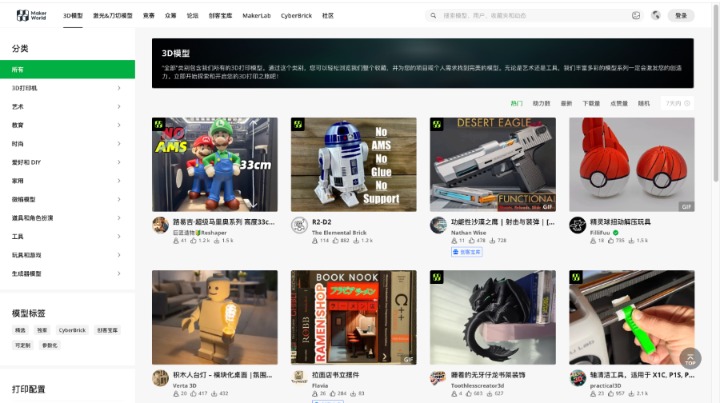
Core Viewpoint - The consumer-grade 3D printing industry is approaching a pivotal moment, often referred to as the "iPhone moment," indicating significant growth and transformation in the market [1]. Market Performance - The A-share 3D printing index has seen an impressive year-to-date increase of 82.11%, with nearly 70% of companies reporting positive net profit growth in the first three quarters [2]. - The global consumer-grade 3D printing market is projected to grow from $1.5 billion in 2020 to $4.1 billion by 2024, with an annual compound growth rate of approximately 28% [11]. Competitive Landscape - The competitive environment is intensifying, with major players like DJI, Meituan, and Hillhouse Capital entering the market, while established companies like Creality are pursuing IPOs [3][6]. - Bambu Lab, once a dominant player, is now facing significant competition, with multiple companies vying for market share and investment [3][4]. Investment Trends - Since 2025, there have been 72 investment events in the 3D printing sector, with 52 companies receiving funding, primarily concentrated in the domestic market [6]. - Notable investments include DJI's multi-million dollar investment in Elegoo, highlighting the potential for growth in consumer-grade 3D printing technology [6]. Company Developments - Elegoo, a key player in the market, has achieved a compound annual growth rate of over 40% in the past three years, with projected revenues of 1.6 billion yuan in 2024 and 2.5 billion yuan in 2025 [7]. - Snapmaker has also gained attention, raising over $20 million on Kickstarter for its innovative 3D printer, which boasts significant efficiency improvements [7][8]. Ecosystem and Community - Bambu Lab's success is attributed not only to hardware performance but also to its robust community and content ecosystem, exemplified by its Maker World platform, which has nearly 10 million active users [12][13]. - The shift towards a closed ecosystem has sparked debates within the industry regarding the balance between open-source and proprietary models [15]. Future Outlook - The entry of large players like DJI is expected to accelerate industry consolidation and competition, making the landscape more complex and dynamic [17]. - The ongoing development of AI technologies is anticipated to lower barriers to entry in 3D modeling, facilitating a broader participation in the 3D printing ecosystem [16].
深圳AI硬件创业火了,投资人争抢大疆系
Di Yi Cai Jing Zi Xun· 2026-01-21 10:21
Core Insights - The competition among tech giants and unicorns in the AI hardware sector is intensifying, with OpenAI planning to launch a series of small devices in the second half of the year, while Apple and ByteDance are also entering the AI hardware market [2][4]. Group 1: Investment Trends - There is a growing interest in AI hardware, with many investors shifting focus from software to hardware, particularly in Shenzhen, which is becoming a hub for AI hardware startups [11][12]. - Investment in AI hardware projects is becoming highly competitive, with some early-stage projects achieving valuations exceeding $100 million, driven by market enthusiasm [8][9]. - The investment landscape has changed significantly, with early-stage projects now receiving valuations that previously were only seen at later development stages [9][10]. Group 2: Entrepreneurial Landscape - Teams with backgrounds in major hardware companies like DJI are highly sought after by investors, as they are perceived to have a deeper understanding of the industry and a higher likelihood of success [6][7]. - Many successful startups in the AI hardware space are founded by former employees of established companies, indicating a trend of talent migration from large firms to startups [7][8]. - The emergence of AI hardware startups is being fueled by a wave of entrepreneurs who previously worked in hardware giants, leading to a competitive environment for funding [7][8]. Group 3: Product Development and Market Demand - AI hardware products are diversifying, with categories such as AI toys and companion devices gaining traction, and many components being sourced locally in Shenzhen [13][15]. - The integration of AI into traditional hardware is creating new market opportunities, as companies explore how AI can enhance user interaction and product functionality [18][19]. - There is a notable increase in the production and sales of AI-enabled products, with companies reporting significant growth in demand for AI toys and related hardware [15][18]. Group 4: Future Outlook - The future of AI hardware remains uncertain, with ongoing discussions about what the next popular forms of AI hardware will be, including potential developments in wearable technology [18][19]. - Some investors express concerns about the overuse of the AI concept in marketing, suggesting that not all products labeled as "smart" or "AI-enabled" deliver real value [19]. - The market for embodied intelligence is expected to stabilize or decline as initial investment phases conclude and companies begin to demonstrate their commercial viability [19].


奥比中光:公司已率先实现芯片级高精度三维扫描技术的代表性商业化产品方案落地
Zheng Quan Ri Bao Wang· 2026-01-20 13:14
Core Viewpoint - The company has established a strategic partnership with a leading global consumer-grade 3D printing and scanning firm, enabling it to provide core underlying technology for several benchmark products in the industry [1] Group 1: Strategic Partnership - The collaboration with the global leader in consumer-grade 3D printing and scanning has led to the development of multiple industry benchmark products, including 3D printers and 3D scanners [1] - The company has provided AI lidar technology for consumer-grade 3D printers and integrated its self-developed multi-core heterogeneous 3D reconstruction chips into several high-precision handheld 3D scanners [1] Group 2: Product Offerings - The high-precision handheld 3D scanners, such as CR-ScanOtter, CR-ScanRaptor, OtterLite, and RaptorPro, meet the end customers' demands for high precision and low cost in various fields like 3D printing, industrial reverse engineering, cultural relic restoration, and game scene production [1] - The company has achieved the commercial launch of representative chip-level high-precision 3D scanning technology products globally, with several products becoming benchmarks in digital twin and 3D digitization scenarios [1] Group 3: Future Development - The company possesses a leading advantage in technology routes and performance in the 3D scanning field and plans to continue developing industrial-grade precision 3D scanner products [1] - The ongoing development aims to meet the portable, high-precision, and low-cost demands of various industries for 3D scanning equipment [1]

奥比中光接待34家机构调研,包括睿远基金(香港)、东方证券(香港)、Bernstein、中信建投证券等
Jin Rong Jie· 2026-01-20 12:04
Core Viewpoint - The company, Obi Technology Group, focuses on the development of 3D visual perception technology and aims to enhance the understanding of the world through AI vision in various applications [1][2]. Group 1: Company Overview - Obi Technology Group was established on January 18, 2013, primarily engaged in technology promotion and application services [3]. - As of September 30, 2025, the company had 29,224 shareholders, an increase of 9,189 from the previous count, with an average holding value of 1.3725 million yuan and an average shareholding of 13,700 shares [3]. Group 2: Market Position and Financials - The latest stock price of Obi Technology Group is 99.99 yuan, down by 2.47 yuan or 2.41% from the previous trading day, with a total market capitalization of 40.11 billion yuan [1]. - The rolling price-to-earnings ratio for the electronic components industry is 88.37, with a median of 64.86 [1]. Group 3: Technological Development - The company has built a "full-stack technology R&D capability + full-field technology route layout" for its 3D visual perception technology system, integrating multiple complex disciplines such as optics, mechanics, electronics, chip design, algorithms, SDK, and firmware development [2]. - Since 2015, the company has been expanding its technology and business in various types of robotics, covering applications in humanoid robots, commercial services, elderly rehabilitation, home care, logistics, and agricultural intelligence [2]. Group 4: Product Applications - Obi Technology Group has formed a strategic partnership with a leading global consumer 3D printing and scanning company, providing core underlying technology for several benchmark products, including consumer-grade 3D printers equipped with AI lidar and high-precision handheld 3D scanners [2]. - The company has successfully commercialized chip-level high-precision 3D scanning technology, establishing several benchmark products in digital twin and 3D digitization scenarios, thus gaining a significant first-mover advantage in the industry [2].

TikTok Shop在欧洲四国推出本地托管模式;创想三维携手阿里云优化3D打印云服务丨36氪出海·要闻回顾
36氪· 2026-01-18 14:09
Group 1 - TikTok Shop launched a local hosting model in four European countries, allowing merchants to stock goods in local warehouses while TikTok handles storage, sales, delivery, and returns [5] - Temu introduced a local seller program in the UAE to enhance delivery efficiency and diversify product offerings, enabling local businesses to sell on its platform [5] - WeChat mini-programs are projected to exceed 5 billion uses by 2025, with significant growth in cross-border transactions, particularly in Malaysia, New Zealand, and the UK [6] Group 2 - ZhiYuan Robotics opened its first overseas robot experience center in Malaysia, aligning with the country's "Industry 4.0" strategy [6] - Creality launched a new sub-brand SPARKX at CES, integrating with Alibaba Cloud to enhance 3D printing services and improve user experience [7] - Xpeng Motors plans to establish a localized supply chain team in Europe and ASEAN by 2026 to enhance operational efficiency and support local production [8] Group 3 - CATL opened the largest overseas new energy after-sales service center in Riyadh, providing comprehensive lifecycle services for various products [9] - VortexInfo showcased an autonomous road cleaning robot at the Abu Dhabi Sustainability Week, focusing on smart city applications [10] - Gongye Technology secured hundreds of millions in financing to accelerate the development of overseas sales channels [10] Group 4 - Kickstarter reported that eight out of the top ten popular projects in 2025 were from Chinese brands, raising nearly $140 million [13] - China's exports of industrial robots exceeded imports in 2025, establishing the country as a net exporter of industrial robots [14] - The trade of AI-related products in China is expected to grow significantly, with a notable increase in exports of high-end components and electrical equipment [14]

新消费&轻工周报:AI+消费迈入物理世界,新型烟草出口格局生变利好龙头-20260118
SINOLINK SECURITIES· 2026-01-18 12:12
Investment Rating - The report does not explicitly state an investment rating for the industry Core Insights - The report highlights various sectors including trendy toys, new tobacco, home furnishings, paper packaging, personal care, AI glasses, Xiaomi Group, pet food, and AI+3D printing, indicating a mixed outlook across these industries with some showing growth potential while others face challenges Trendy Toys - The collaboration between Honor and Pop Mart to launch the first trendy toy smartphone is expected to differentiate products in a competitive market, targeting younger consumers [8] - Despite a decline in overall online GMV for trendy toys, leading companies like Miniso and Bluku are experiencing significant growth, with Miniso's blind box category growing by 315% [10] New Tobacco - The cancellation of VAT export rebates for e-cigarettes is expected to pressure profits in the short term, but may benefit companies like Smoore in the long run as they can capture market share from smaller competitors [11] - The HNB market is anticipated to expand significantly with the upcoming launch of IQOS in the US [12] Home Furnishings - The domestic real estate market remains weak, with significant declines in new and second-hand home transactions [13] - Export figures show a decline for Chinese furniture, while Vietnam's furniture exports are growing, indicating a shift in regional competitiveness [14] Paper Packaging - The report notes fluctuations in paper prices, with a general decline in prices for various paper types, but anticipates a recovery in demand as packaging needs stabilize [15] - The overall retail growth in food, beverages, and daily necessities is expected to support the packaging sector's recovery [16] Personal Care and AI Glasses - The personal care sector shows mixed performance, with some brands experiencing growth while others decline [17] - Meta's plans to significantly increase the production capacity of AI glasses signal a positive outlook for the sector, potentially boosting demand across the supply chain [18] Xiaomi Group - Xiaomi continues to lead in the smartphone market, with expectations to integrate self-developed chips and AI models into their products by 2026 [19] - The company aims to enhance its brand positioning and profitability through technological advancements and strategic product launches [20] Pet Food - The pet food market is projected to grow, with a focus on new product introductions and market expansion strategies [23] - Recent data indicates a decline in GMV for pet food on major e-commerce platforms, highlighting competitive pressures [24] AI+3D Printing - The consumer-grade 3D printing market is expected to grow, driven by new product launches and community engagement initiatives [33] - Companies are focusing on lowering entry barriers and enhancing user experience to penetrate the market further [36]



中国公司全球化周报|TikTok Shop在欧洲四国推出本地托管模式/创想三维携手阿里云优化3D打印云服务
3 6 Ke· 2026-01-18 05:49
Group 1: Events and Forums - The "Dubai Business Forum - China" will take place in Shenzhen on May 14, 2026, focusing on economic collaboration and investment opportunities between China and Dubai [2] Group 2: Company Developments - TikTok Shop has launched a local hosting model in four European countries, allowing merchants to stock goods in local warehouses while TikTok handles logistics [3] - Temu has introduced a local seller program in the UAE to enhance delivery efficiency and expand product offerings [3] - WeChat mini-programs are projected to surpass 5 billion uses by 2025, with significant growth in cross-border transactions [4] - ZhiYuan Robotics has opened its first overseas robot experience center in Malaysia, aligning with the country's "Industry 4.0" strategy [4] - Creality has launched a new sub-brand SPARKX at CES, integrating with Alibaba Cloud for enhanced 3D printing services [5] - Xpeng Motors plans to establish a localized supply chain team in Europe and ASEAN by 2026 to improve operational efficiency [6][7] - WeRide has deployed over 1,000 Robotaxis globally, with operations in Guangzhou, Beijing, and Abu Dhabi [7] - BYD has achieved a record high in exporting new energy buses, leading the industry for three consecutive years [7] - CATL has launched the largest overseas service center for new energy in Riyadh, providing comprehensive lifecycle services [8] - VortexInfo showcased an autonomous road cleaning robot at the Abu Dhabi Sustainability Week, focusing on smart city applications [8] Group 3: Investment and Financing - Gongye Technology has secured hundreds of millions in financing to enhance overseas sales channels [9] - Bay Measurement has completed over 100 million A+ round financing to strengthen its overseas business layout [9] - Huaxuan Sensor has completed a new round of strategic financing to accelerate global market expansion [9] - OMOWAY has raised tens of millions in Pre-A and Pre-A+ rounds to support the production and development of self-balancing electric motorcycles [10] - Haiwei Co. has received a 300 million yuan strategic investment to support lightweight component manufacturing [10] Group 4: Policies and Market Trends - Kickstarter's 2025 data shows that Chinese brands dominate the top ten popular projects, raising nearly $140 million [11] - China's high-tech product exports grew by 13.2% in 2025, with industrial robots becoming a net export product for the country [12] - The trade of AI-related products in China is expected to grow significantly, aligning with global trends [12]





从创想三维看消费级 3D 打印机行业前景:造物平权,奇点将至
Changjiang Securities· 2026-01-15 13:27
Investment Rating - The report suggests a positive outlook for the consumer-grade 3D printing industry, indicating a potential investment opportunity in the AI and consumer sectors, as well as in the supply chain and materials segments [4][10]. Core Insights - The consumer-grade 3D printing industry is expected to experience significant growth driven by product upgrades, decreasing prices of machines and materials, and the empowerment of creative communities and AI models, which lower the cost of product selection and modeling for consumers [4][10]. - The penetration rate for consumer-grade 3D printers is projected to be only 3.9% in 2024, indicating substantial room for growth [4][10]. - The industry is anticipated to reach a "singularity moment" due to the resonance of supply and demand factors, making it crucial to seize investment opportunities in high-growth sectors [4][10]. Summary by Sections Company Overview - The report highlights Chuangxiang Sanwei as a leading global provider of consumer-grade 3D printing products and services, with 3D printers contributing approximately 70% of the company's revenue in 2024, and a market share of 27.9% in cumulative shipments from 2020 to 2024 [7][19]. - The company is expected to achieve a revenue of 2.288 billion yuan in 2024, representing a year-on-year growth of 21.5%, with a net profit of 89 million yuan [7][19]. Growth Potential - The consumer-grade 3D printing sector is showing rapid growth, with a 29.6% year-on-year increase in the export of 3D printers from China in the first 11 months of 2025, totaling 4.48 million units and 9.866 billion yuan in export value [8][41]. - The supply side benefits from product upgrades and price reductions, while the demand side is fueled by the rise of trendy toy culture and a large creative community, suggesting a high growth ceiling for the industry [8][41]. Competitive Factors - The competitive landscape is characterized by a few strong players, with market shares for major companies in 2024 being 29% for Tuo Zhu Technology, 17% for Chuangxiang Sanwei, and others [9]. - Key competitive factors include product capabilities, ecosystem development, and consumer reach, with a focus on product differentiation in terms of printing size, speed, and multi-color functionality [9]. Investment Recommendations - The report emphasizes the importance of capitalizing on the AI and consumer high-growth sectors, as well as potential investment opportunities in the supply chain and materials segments [10].