银华

Search documents
大消息,“逆周期调节”,来了
3 6 Ke· 2025-12-01 23:59
Core Viewpoint - The regulatory body is implementing a counter-cyclical adjustment mechanism for fund product approvals to better protect investor interests, emphasizing a cautious approach towards new equity fund approvals amid high valuation benchmarks [1][2][7]. Fund Approval and Market Conditions - Regulatory scrutiny on new equity funds has increased, requiring that the performance benchmark index's rolling valuation over the last five years be below the 90th percentile and the last three months below the 80th percentile [2][3]. - Despite a bullish A-share market, fund companies are exercising restraint in launching new equity funds, with many setting initial fundraising caps at 2 billion to 3 billion yuan [1][4]. Fund Product Trends - Recent approvals have favored funds in sectors with relatively low valuations, such as healthcare, food, and consumer electronics, indicating a strategic focus on value [3][4]. - The approval of 16 hard technology products in mid-November reflects the regulatory body's timely response to market fluctuations, showcasing the effectiveness of the counter-cyclical adjustment mechanism [3][7]. Scale Management and Investor Experience - Fund companies are actively controlling the scale of new products, with many setting fundraising limits between 2 billion and 3 billion yuan, contrasting with the past trend of large-scale fund launches [4][5]. - Over 100 equity funds have announced restrictions on large subscriptions, with a focus on protecting existing investors and maintaining stable fund operations [5][6]. Regulatory Changes and Industry Transformation - The regulatory framework is shifting from a focus on scale to quality, with new performance evaluation metrics emphasizing long-term investment returns and investor experience [6][7]. - The implementation of counter-cyclical adjustment mechanisms is expected to enhance the capital market's resource allocation and support long-term investment strategies [7].
基金发行,大爆发
3 6 Ke· 2025-12-01 02:12
Group 1 - The core viewpoint of the article highlights a significant increase in the number of new funds issued in the first 11 months of the year, with a total of 1,375 new funds and a fundraising scale exceeding 1.06 trillion yuan, indicating a structural shift towards equity funds which now account for over half of the total [1][2][4] Group 2 - In the first 11 months, the number of newly established funds reached 1,376, with total issuance of 10,624.56 billion units, reflecting a year-on-year increase of 34.38% in quantity and 2.72% in scale [2] - Equity funds (including stock and mixed funds) and bond funds have become the main drivers of issuance, with 768 stock funds raising 390.44 billion units (36.71%) and 257 mixed funds raising 147.07 billion units (13.84%), together accounting for 50.55% of the total [2] - The structure of new fund issuance has changed significantly compared to the previous year, with equity funds now making up more than half of the total, while bond funds have seen a decline in fundraising scale by over 40% [2] - FOF products have experienced explosive growth, with 69 products established this year, raising a total of 73.55 billion units, which is 5.53 times that of the same period last year [2] Group 3 - In November, 136 new funds were established, with a total issuance of 945.67 billion units, maintaining a relatively fast pace despite market fluctuations [4] - Equity funds continued to be the main contributors in November, raising 546.69 billion units (57.81%), while bond funds raised 216.66 billion units, marking a new low for the year [4] - The issuance of FOF products remained strong, with 11 products raising a total of 169.75 billion units in November [4] Group 4 - Among individual products, stable types have attracted more capital, with the top 10 products in terms of issuance being FOF or bond funds [3] - Notable individual fund issuances include the E Fund Industry Preferred Fund raising 31.62 billion units, and other funds like the E Fund Technology Pioneer and China Universal Xin Yue Fund also achieving significant fundraising [5][6] - In the FOF category, several products exceeded 13 billion units in fundraising, indicating strong investor interest [6]
基金发行,大爆发!
Zhong Guo Ji Jin Bao· 2025-11-30 11:21
Core Insights - The new fund issuance market in the first 11 months of the year has shown significant growth in quantity, with over 1,375 new funds launched, a year-on-year increase of nearly 35%, while the total fundraising amount reached over 1.06 trillion yuan, slightly up from the previous year [1][2] - Equity funds have surged, surpassing bond funds in fundraising scale, accounting for over half of the total issuance [1][2] Fund Issuance Overview - As of November 28, 2023, a total of 1,376 new funds were established, with total issuance reaching 1,062.46 billion units, marking a 34.38% increase in the number of funds and a 2.72% increase in fundraising compared to the same period last year [2] - Equity funds (including stock and mixed funds) and bond funds have been the main drivers of issuance, with 768 stock funds raising 390.04 billion units (36.71%) and 257 mixed funds raising 147.07 billion units (13.84%), together accounting for 50.55% of the total [2] - The structure of new fund issuance has shifted significantly compared to last year, with equity funds now making up over half of the total, a substantial increase from 21.47% for stock funds and 5.92% for mixed funds last year [2] November Fund Issuance - In November, 136 new funds were established, with a total issuance of 94.57 billion units, indicating a steady pace despite market fluctuations [4] - Equity funds continued to dominate, raising 54.67 billion units (57.81%), while bond funds raised 21.67 billion units, marking a new low for the year [4] - FOF products maintained strong performance, with 11 new products raising a total of 16.98 billion units, following a record high in October [4] Popular Products - Among individual products, stable funds attracted significant interest, with the top 10 largest issuances being FOF or bond funds [3] - Notable fund issuances included the E Fund Industry Preferred with 3.16 billion units, and the Fuguo Xinghe and Penghua Qihang Quantitative Stock with 3 billion and 2.98 billion units respectively, all completed within a single day [5] - In the FOF category, E Fund Ruiyi Ying'an raised over 5.8 billion units, with several other products exceeding 1.3 billion units [6]
【ETF观察】11月26日跨境ETF净流出2.95亿元
Sou Hu Cai Jing· 2025-11-26 22:33
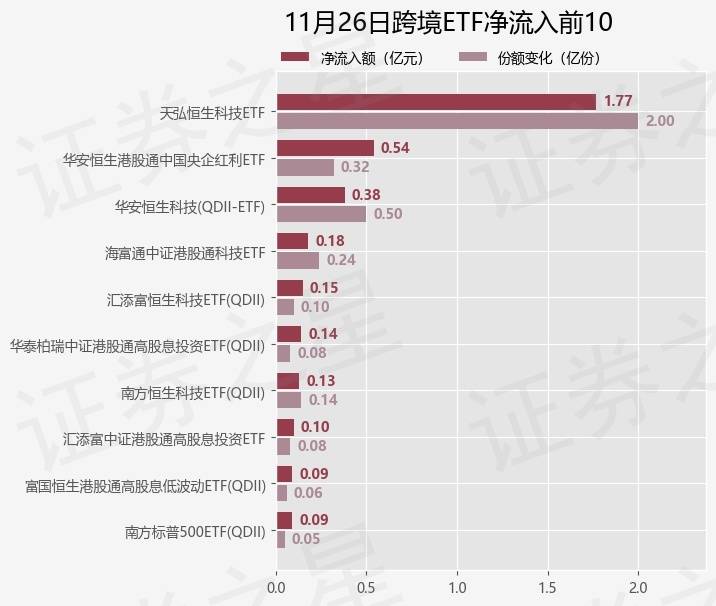
Summary of Key Points Core Viewpoint - On November 26, the total net outflow of cross-border ETFs reached 295 million yuan, while the cumulative net inflow over the past five trading days was 13.727 billion yuan, indicating a mixed sentiment in the market with four days of net inflow during this period [1]. Fund Flow Analysis - A total of 38 cross-border ETFs experienced net inflows on November 26, with the Tianhong Hang Seng Technology ETF (520920) leading the inflow, increasing by 200 million shares and a net inflow of 177 million yuan [1][3]. - Conversely, 21 cross-border ETFs saw net outflows, with the Huatai-PineBridge Southern East Ying Hang Seng Technology (QDII-ETF) (513130) recording the highest outflow, decreasing by 285 million shares and a net outflow of 212 million yuan [1][4]. Detailed Fund Performance - The top 10 cross-border ETFs by net outflow on November 26 included: - Huatai-PineBridge Southern East Ying Hang Seng Technology (QDII-ETF) with a net outflow of 212 million yuan and a share decrease of 285 million [4][5]. - GF Securities CSI Hong Kong Stock Connect Non-Bank ETF with a net outflow of 159 million yuan and a share decrease of 95 million [4][5]. - Other notable outflows included the Huatai-PineBridge CSI Hong Kong Stock Connect 50 ETF and the China Southern Hang Seng ETF, both showing significant reductions in shares and net outflows [4][5].

天府证券ETF日报-20251121
天府证券· 2025-11-21 09:13
Report Summary 1. Market Overview - On November 21, 2025, the Shanghai Composite Index dropped 2.45% to 3834.89 points, the Shenzhen Component Index fell 3.41% to 12538.07 points, and the ChiNext Index declined 4.02% to 2920.08 points. The total trading volume of A-shares in the two markets was 19839 billion yuan. The top sectors with the largest declines were Comprehensive (-5.50%), Non-ferrous Metals (-5.26%), and Power Equipment (-5.17%) [2][6]. 2. Stock ETFs - The top trading volume stock ETFs on that day were E Fund ChiNext ETF (down 4.03%, premium rate -3.93%), Huatai-PineBridge CSI 300 ETF (down 2.40%, premium rate -2.41%), and China AMC CSI A500 ETF (down 2.78%, premium rate -2.77%) [3][7]. - The top ten trading volume stock ETFs are presented in detail in Chart 1, including their codes, names, prices, price changes, tracking indices, premium rates, trading volumes, and latest share references [8]. 3. Bond ETFs - The top trading volume bond ETFs were HFT CSI Short-term Financing Bond ETF (down 0.00%, premium rate 0.00%), Bosera CSI Convertible and Exchangeable Bond ETF (down 0.77%, premium rate -0.88%), and BOC Shanghai Stock Exchange AAA Sci-Tech Innovation Bond ETF (up 0.02%, premium rate -0.21%) [4][9]. - Details of the top five trading volume bond ETFs, including codes, names, prices, price changes, premium rates, and trading volumes, are shown in Chart 2 [10]. 4. Gold ETFs - Gold AU9999 dropped 0.59% and Shanghai Gold fell 0.88% on that day. The top trading volume gold ETFs were HuaAn Gold ETF (down 0.84%, premium rate -0.72%), Bosera Gold ETF (down 0.79%, premium rate -0.68%), and E Fund Gold ETF (down 0.75%, premium rate -0.66%) [12]. - The top five trading volume gold ETFs are presented in Chart 3, including their codes, names, prices, price changes, trading volumes, IOPV, and premium rates [13]. 5. Commodity Futures ETFs - On that day, China AMC Feed Soybean Meal Futures ETF dropped 0.25% with a premium rate of 2.10%, CCB Yisheng Zhengzhou Commodity Exchange Energy and Chemical Futures ETF fell 0.75% with a premium rate of -0.76%, and Dacheng Non-ferrous Metals Futures ETF declined 0.61% with a premium rate of -0.93% [13]. - Details of commodity futures ETFs, including codes, names, prices, price changes, trading volumes, IOPV, premium rates, tracking indices, and tracking index price changes, are shown in Chart 4 [14]. 6. Cross-border ETFs - The previous trading day, the Dow Jones Industrial Average dropped 0.84%, the Nasdaq Composite fell 2.15%, and the S&P 500 declined 1.56%, while the German DAX rose 0.50%. On November 21, the Hang Seng Index dropped 2.38% and the Hang Seng China Enterprises Index fell 2.45%. The top trading volume cross-border ETFs were Huatai-PineBridge Hang Seng Tech ETF (down 1.91%, premium rate -2.39%), E Fund CSI Hong Kong Securities Investment Theme ETF (down 3.74%, premium rate -3.60%), and China AMC Hang Seng Tech ETF (down 1.87%, premium rate -2.12%) [15]. - The top five trading volume cross-border ETFs are presented in Chart 5, including their codes, names, trading volumes, price changes, and premium rates [16]. 7. Money Market ETFs - The top trading volume money market ETFs on that day were Silver HuaRiLi ETF, HuaBaoTianYi ETF, and CCB TianYi Money Market ETF [17]. - The top three trading volume money market ETFs are shown in Chart 6, including their codes, names, and trading volumes [19]. Core View The report provides a comprehensive overview of the performance of different types of ETFs on November 21, 2025, including stock, bond, gold, commodity futures, cross-border, and money market ETFs, along with the overall market situation of A-shares. Report Industry Investment Rating No industry investment rating information is provided in the report.
麦高视野:ETF观察日志(2025-11-20)
Mai Gao Zheng Quan· 2025-11-21 06:01
- The report introduces the **RSI (Relative Strength Index)** as a quantitative factor. The construction idea is to measure the relative strength of price movements over a specific period to identify overbought or oversold market conditions. The formula is: $ RSI = 100 - \frac{100}{1 + RS} $, where $ RS $ is the ratio of the average gain to the average loss over a 12-day period. An RSI > 70 indicates an overbought market, while RSI < 30 indicates an oversold market[2] - Another quantitative factor mentioned is **Net Purchase (NETBUY)**, which measures the net inflow or outflow of funds for ETFs. The formula is: $ NETBUY(T) = NAV(T) - NAV(T-1) \times (1 + R(T)) $, where $ NAV(T) $ is the net asset value on day $ T $, $ NAV(T-1) $ is the net asset value on the previous day, and $ R(T) $ is the return on day $ T $[2] - The report also tracks **Institutional Holdings** as a factor, which is derived from the latest annual or semi-annual reports of ETFs, excluding holdings by linked funds. This factor provides an estimate of institutional participation in the ETF[3] - The report includes **T+0 Trading** as a feature for certain ETFs, indicating whether same-day buy-and-sell transactions are allowed[2] - The report provides a detailed breakdown of ETF performance across various indices, including **broad-based indices** (e.g., CSI 300, CSI 500, CSI 1000) and **thematic indices** (e.g., semiconductor, renewable energy, artificial intelligence). Performance metrics include RSI, net purchase, and institutional holdings[4] - The **RSI values** for ETFs tracking broad-based indices range from 35.83 to 52.12, with thematic ETFs showing a wider range, such as 30.25 for robotics and 63.73 for banking[4] - **Net purchase values** vary significantly, with some ETFs showing large outflows (e.g., -10.82 billion for Nasdaq 100 ETFs) and others showing inflows (e.g., 10.01 billion for Hang Seng Technology ETFs)[4] - **Institutional holdings** also vary widely, with some ETFs having over 90% institutional participation (e.g., CSI 800 ETFs) and others below 20% (e.g., certain thematic ETFs like robotics)[4]
麦高视野:ETF观察日志(2025-11-19)
Mai Gao Zheng Quan· 2025-11-20 05:45
- The report includes the construction of the RSI (Relative Strength Index) factor, which is calculated using the formula: $ RSI = 100 - 100 / (1 + RS) $, where RS represents the ratio of average gains to average losses over a 12-day period. RSI values above 70 indicate an overbought market, while values below 30 suggest an oversold market [2] - The report also introduces the calculation of net subscription (NETBUY), defined as $ NETBUY(T) = NAV(T) - NAV(T-1) * (1 + R(T)) $, where NETBUY(T) represents the net subscription amount, NAV(T) is the ETF's net asset value on day T, and R(T) is the return on day T [2] - The report tracks various ETFs categorized into "Broad-based" and "Thematic" indices, such as CSI 300, CSI 500, and industry-specific indices like non-bank financials, dividends, and China internet sectors. It provides daily performance metrics, including RSI values, net subscription amounts, and institutional holding percentages [2][4][7] - The RSI factor is evaluated as a useful indicator for identifying market conditions, such as overbought or oversold states, aiding in short-term trading decisions [2] - The net subscription metric is assessed as a valuable measure for understanding fund flows and investor sentiment towards specific ETFs [2] - RSI values for various ETFs range from 11.05 to 77.25, reflecting diverse market conditions across different indices and sectors [4][7] - Net subscription values vary significantly, with some ETFs showing positive inflows while others exhibit outflows, indicating mixed investor sentiment across different funds [4][7]
11/17财经夜宵:得知基金净值排名及选基策略,赶紧告知大家
Sou Hu Cai Jing· 2025-11-17 16:32
Core Insights - The article provides an overview of the latest net asset value (NAV) rankings of various funds, highlighting the top-performing and bottom-performing funds in the market [2][4]. Fund Performance Summary Top 10 Funds by NAV Growth - The top 10 funds with the highest NAV growth as of November 17, 2025, include: 1. 东方阿尔法瑞享混合发起C: NAV 1.1144, growth 6.24% 2. 东方阿尔法瑞享混合发起A: NAV 1.1144, growth 6.22% 3. 泰信发展主题混合: NAV 2.0350, growth 4.90% 4. 泰信现代服务业混合: NAV 2.2980, growth 4.64% 5. 圆信永丰高端制造C: NAV 3.0301, growth 4.59% 6. 圆信永丰高端制造A: NAV 3.0304, growth 4.59% 7. 国寿安保低碳经济混合A: NAV 1.1454, growth 4.26% 8. 国寿安保低碳经济混合C: NAV 1.1336, growth 4.26% 9. 创金合信全球医药生物股票发起(QDII)A: NAV 1.6867, growth 4.20% 10. 创金合信全球医药生物股票发起(QDII)C: NAV 1.6721, growth 4.20% [2]. Bottom 10 Funds by NAV Decline - The bottom 10 funds with the largest NAV declines as of November 17, 2025, include: 1. 同泰大健康主题混合C: NAV 0.4961, decline -3.58% 2. 同泰大健康主题混合A: NAV 0.5053, decline -3.57% 3. 国投瑞银白银期货(LOF)C: NAV 1.3605, decline -3.56% 4. 国投瑞银白银期货(LOF)A: NAV 1.3718, decline -3.56% 5. 景顺长城医疗产业股票C: NAV 1.3737, decline -3.32% 6. 景顺长城医疗产业股票A: NAV 1.3777, decline -3.32% 7. 华富健康文娱灵活配置混合C: NAV 1.1653, decline -3.24% 8. 华富健康文娱灵活配置混合A: NAV 1.1750, decline -3.24% 9. 银华成长智选混合A: NAV 1.0716, decline -3.13% 10. 银华成长智选混合C: NAV 1.0694, decline -3.13% [4]. Market Analysis - The Shanghai Composite Index showed a downward trend, while the ChiNext Index experienced fluctuations, closing slightly lower. The total trading volume reached 1.93 trillion, with a market breadth of 2,584 gainers to 2,726 losers [6]. - The leading sectors included software services with gains exceeding 2%, while the lagging sectors were pharmaceuticals, insurance, healthcare, banking, construction materials, and securities [6]. Fund Strategy Insights - The top-performing fund, 泰信发展主题混合, is focused on the new energy sector, with a significant portion of its holdings in lithium mining companies, indicating a strong performance relative to the market [7]. - Conversely, the poorly performing fund, 同泰大健康主题混合C, is concentrated in the pharmaceutical sector, which has faced significant declines in its top holdings [7].

盘前资讯|本周以来5只ETF净流入额超20亿元
Sou Hu Cai Jing· 2025-11-13 00:44
Group 1 - As of November 12, five ETFs in the market have seen net inflows exceeding 2 billion yuan, including Yinhua Rili A, Huaan Gold ETF, Huaxia Shanghai Stock Exchange Sci-Tech Innovation Board 50 ETF, E Fund ChiNext ETF, and E Fund CSI 300 Non-Bank ETF [1] - Recently, the trading of Sci-Tech bond theme ETFs has been active, with four of the top ten ETFs by single-day trading volume on November 12 being Sci-Tech bond theme ETFs, namely Guotai Sci-Tech Bond ETF (551800), CMB Sci-Tech Bond ETF (551900), Huatai-PB Sci-Tech Bond ETF (551520), and Southern Sci-Tech Bond ETF (159700) [1] - The Shanghai Securities Exchange International Investor Conference opened in Shanghai on November 12, where the Vice Chairman of the China Securities Regulatory Commission, Li Ming, stated that the door to China's capital market will continue to open wider, emphasizing a market-oriented, legal, and international approach to steadily expand high-level institutional openness [1]
四大利好共振,港股科技或迎来关注良机?
Xin Lang Ji Jin· 2025-11-06 07:42
Group 1 - The core viewpoint is that the Hong Kong technology sector is currently in a phase of consolidation after a strong rise earlier in the year, and investors are looking for future momentum driven by liquidity improvement, industry catalysts, valuation advantages, and earnings expectations [1][4][9] Group 2 - The Federal Reserve's interest rate cuts are expected to improve liquidity in the Chinese stock market, which historically leads to upward trends in both A-shares and Hong Kong stocks [4] - AI capital expenditure is significantly increasing, with major cloud providers shifting their investments towards AI infrastructure, indicating a new growth cycle for AI [4][5] - The valuation of the Hang Seng Technology Index is currently attractive, with a price-to-earnings ratio of 24.65, which is below its historical average and significantly lower than that of the US Nasdaq [5][6] Group 3 - Earnings growth is anticipated to be a major driver for the market, with forecasts suggesting a double-digit growth rate for major Hong Kong indices, particularly a 42.6% growth for the Hang Seng Technology Index in 2026 [6][9] - The Hang Seng Hong Kong Stock Connect Technology Index is positioned as a key tool for capturing investment opportunities in the AI era, reflecting the overall development of the Hong Kong technology sector [9][10] Group 4 - The index includes leading companies across various sectors such as software services, semiconductors, and consumer electronics, which are actively transforming in the AI landscape [10][13] - The top five constituents of the index represent significant players in the AI industry, contributing to the core of the domestic AI supply chain [13]