
顺丰

Search documents
西部证券晨会纪要-20250811
Western Securities· 2025-08-11 02:25
Group 1: Company Overview - Gu Ming (01364.HK) has a strong core competitiveness in delivering fresh fruits and milk to lower-tier cities with a two-day shelf life, benefiting from significant cost advantages [1][6] - The company has a leading quarterly repurchase rate supported by a robust supply chain and high-quality research and development [1][7] - The store count in the top eight key provinces accounts for nearly 80% under the regional densification strategy [1][7] Group 2: Industry Insights - The tea beverage industry is characterized by a long-term growth trajectory, with brands possessing comprehensive capabilities expected to dominate the market [6][7] - The head effect intensifies, leading to rapid expansion of second and third-tier brands, while local long-tail brands will follow suit [6] Group 3: Financial Projections - Gu Ming's projected revenues for 2025, 2026, and 2027 are 116 billion, 140 billion, and 169 billion respectively, with corresponding net profits of 21 billion, 26 billion, and 32 billion [8] - The company is expected to achieve a PE ratio of 26X, 21X, and 17X for the years 2025, 2026, and 2027, indicating strong growth potential [8] Group 4: Competitive Advantages - The company maximizes supply chain efficiency and offers products with a high quality-to-price ratio, which enhances customer loyalty and repurchase rates [7][8] - The regional densification strategy allows for a significant market share in key provinces, while the coffee segment is expected to increase per-store revenue [8] Group 5: Market Position - Ju Chen Co., Ltd. (688123.SH) is positioned as a global leader in EEPROM, with a strong foothold in the smartphone camera market and a growing presence in automotive-grade EEPROM products [11][12] - The company is expected to see revenue growth from its DDR5 SPD products, with projected revenues of 13.09 billion, 17.95 billion, and 24.03 billion for 2025, 2026, and 2027 respectively [11][12] Group 6: Industry Trends - The macroeconomic environment shows signs of stabilization, with CPI remaining flat and core CPI rebounding, indicating potential for price recovery in the second half of the year [15][17] - The electrical equipment sector, represented by Hua Ming Equipment (002270.SZ), is experiencing stable growth in core business and significant export growth, with projected net profits of 7.38 billion, 8.44 billion, and 9.43 billion for 2025, 2026, and 2027 [19][21]


中国铁塔在港发布中期业绩 上半年收入盈利双增长
Zhong Guo Xin Wen Wang· 2025-08-08 06:59
Core Insights - China Tower Corporation reported a revenue of 39.794 billion RMB for the first half of 2020, representing a year-on-year increase of 4.8%, and a profit of 2.978 billion RMB, up 16.9% [1] - The company's business model is structured around "one body and two wings," with the main focus on tower and indoor distributed antenna systems, while the two wings include energy services and cross-industry site applications [1] Revenue Breakdown - The tower business generated 36.371 billion RMB, a year-on-year increase of 1.6%, while indoor distribution revenue reached 1.720 billion RMB, growing by 37.2% [1] - The "two wings" business, although contributing the least to total revenue, saw a significant growth of 87.3%, indicating the fastest growth rate among the segments [1][2] Market Dynamics - The growth rate of the tower business slowed due to the pandemic, with delays in rental start dates and construction in certain residential areas [1] - The average number of tenants per tower increased from 1.62 at the end of 2019 to 1.64 by mid-2020, reflecting a slight growth despite the overall slowdown [2] Future Outlook - The company anticipates a recovery in business as the pandemic eases, with expectations for a significant increase in 5G revenue in the second half of the year due to rising demand for 5G construction and deeper 4G network coverage [1] - The energy service segment has established over 12,500 battery swap stations in major cities, catering to over 5 million workers in the delivery and logistics sectors [2] Industry Collaboration - China Tower supports the collaborative construction of 5G base stations among telecom operators, believing that shared infrastructure will be more efficient than individual efforts [3] - The partnership between China Mobile and China Broadcasting, utilizing the 700MHz frequency band, is expected to attract new tenants, although specific numbers are not yet available [3]

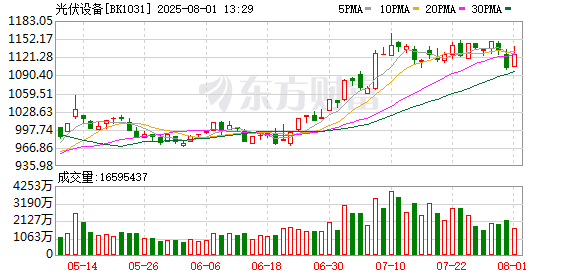
光伏设备板块大涨 三大利好突袭
Zhong Guo Zheng Quan Bao· 2025-08-01 05:28
Group 1: Pharmaceutical Sector - The pharmaceutical sector showed strong performance on the first trading day of August, with traditional Chinese medicine stocks experiencing significant gains, including companies like Weikang Pharmaceutical and Xintian Pharmaceutical reaching their daily price limits [2] - Various sub-sectors within pharmaceuticals, such as animal vaccines, pharmaceutical e-commerce, innovative drugs, chemical preparations, raw materials, and CRO, also saw increases [2] Group 2: Solar Energy Sector - Solar energy stocks rebounded, with significant gains in the solar equipment sector, including companies like Jiejia Weichuang and Haiyou New Materials [5] - Jiejia Weichuang announced a mid-year profit forecast, expecting a net profit of 1.7 billion to 1.96 billion yuan for the first half of 2025, representing a year-on-year growth of 38.65% to 59.85% [5] - The increase in silicon wafer prices continued, with average prices rising approximately 0.1 yuan per piece, driven by increased raw material costs and higher downstream orders [6] Group 3: Logistics Sector - The logistics sector experienced an uptick, with companies like Huapengfei, Shentong Express, and Yunda Holdings showing significant stock price increases [9] - Shentong Express has seen a cumulative increase of over 52% since its rebound on July 10 [9] - The logistics industry is undergoing consolidation, with Shentong Express announcing a cash acquisition of Zhejiang Dan Niao Logistics for 362 million yuan [9] - The introduction of unmanned logistics vehicles is entering a phase of large-scale commercial use, with major players like SF Express and Zhongtong expected to introduce thousands of unmanned vehicles this year [10]


百年商埠再跃升:武汉现代商贸流通试点“期中卷”里的进阶密码
2 1 Shi Ji Jing Ji Bao Dao· 2025-07-11 14:19
Core Insights - Wuhan has made significant progress in its pilot construction of the modern commercial circulation system, with 36 pilot projects and 29 reserve projects established, and a total of 795.33 million yuan in subsidies disbursed, leveraging an investment of 468 million yuan from enterprises [1][3][11] - The pilot projects include innovative logistics solutions such as the first cross-river drone delivery route in China, which can complete a 20-kilometer delivery in 15 minutes, and the establishment of a large-scale temperature-controlled food processing facility [1][5] - The city is focusing on digitalization and smart technology to enhance the efficiency of the commercial circulation system, with major companies like SF Express and Jiuzhoutong exploring AI and robotics in logistics [6][7] Funding and Project Management - The funding strategy involves a rigorous selection process to ensure quality projects are chosen, with a maximum support amount of 10 million yuan for projects under 100 million yuan and 20 million yuan for those above [3] - A pre-funding system has been established to facilitate early investment, allowing up to 80% of the proposed subsidy to be disbursed once a project reaches 30% of its planned investment [3][4] - The funding has demonstrated a leverage effect, with a ratio of 1:5.88, indicating that for every yuan of subsidy, 5.88 yuan of enterprise investment has been mobilized [3] Technological Innovations - The integration of digital and smart technologies is a key focus, with projects like the SF Express drone delivery system and Jiuzhoutong's AI-driven logistics robots enhancing operational efficiency [5][6][7] - The establishment of a comprehensive recycling network for used appliances, including a digital management system for the entire recycling process, is also a significant innovation [10] Economic Impact and Future Directions - The pilot projects are expected to stimulate consumption growth, with a reported retail sales growth rate of 8.3% in early 2025, maintaining Wuhan's leading position among major cities [11] - Wuhan aims to further optimize its commercial space layout and enhance the cultivation of enterprise capabilities, while also focusing on digital commerce innovation [10][11] - The city is positioning itself as a key node in the national commercial circulation landscape, aiming to connect various regions and enhance its influence in the supply chain [1][11]
花湖国际机场货运航班量跃居全国前四 2025上半年国际货邮吞吐量增252%
Chang Jiang Shang Bao· 2025-07-09 22:53
Core Insights - Ezhou Huahu International Airport has become China's first approved professional cargo hub airport, with significant growth in international cargo throughput and flight operations [1][4] - The airport's international cargo volume is projected to reach 220,000 tons in the first half of 2025, a 252% increase compared to the same period in 2024 [1] - The airport has established a comprehensive international cargo route network, with 103 total routes, including 45 international routes, connecting to 15 Asian countries, 10 European countries, 4 American countries, and 1 African country [2][3] Cargo Operations - The newly launched "Ezhou-Mumbai" route is the fifth direct cargo route to India, enhancing the airport's connectivity and expected to provide nearly 5,000 tons of annual air cargo capacity [2] - In the first half of 2025, the airport's international cargo flight frequency increased by 4.3 times, with an average of 3 additional flights per new route [3] - The airport's cargo operations have positioned it as the fourth busiest airport in China for cargo flights, with 90% of the total cargo volume for 2024 achieved in just the first half of 2025 [4] Strategic Importance - Ezhou Huahu International Airport is a key component of China's "14th Five-Year Plan" and aims to become a free trade air port, facilitating Hubei's economic development [4] - The airport's strategic location allows it to cover 90% of China's major economic areas within a 1.5-hour flight [4] - The airport's efficient customs processes, including a 15-minute clearance time for cargo flights, enhance its operational efficiency [4] Industry Impact - The airport's rapid growth has attracted logistics giants like SF Express and DHL to increase their flight operations [3] - The establishment of the Ezhou Cross-Border E-Commerce Industrial Park has drawn 46 companies, leveraging the airport's logistics advantages to create a cross-border trade ecosystem [6] - The airport supports the fast delivery of perishable goods, exemplified by the quick transport of Norwegian salmon and Thai durians to Chinese consumers [5]
深圳机场执行充电宝查验新规,不合规产品可暂存7天
Nan Fang Du Shi Bao· 2025-06-28 02:18
Core Points - Shenzhen Bao'an International Airport has implemented new regulations regarding the carrying of power banks starting June 28, as mandated by the Civil Aviation Administration of China [1] - Non-compliant power banks, including those without a clear 3C mark or those that have been recalled, are prohibited from being taken on domestic flights [1] - The airport will provide a free storage service for non-compliant power banks for up to 7 days, with specific procedures for retrieval [1][2] Summary by Category - **Regulations** - Travelers are banned from carrying power banks that do not meet compliance standards, including those lacking a 3C mark or those that have been recalled [1] - Power banks with a clear energy rating and no damage can be carried if they do not exceed 100Wh without airline approval; those between 100Wh and 160Wh require airline approval [2] - **Storage Services** - Shenzhen Airport offers a 7-day free storage service for non-compliant power banks, located at the check-in island B tail counter [1] - Travelers must present a receipt to retrieve their stored power banks within the specified time frame, or they will be treated as abandoned [1] - **Recall Procedures** - Travelers with recalled power banks from specific brands can follow the established process to return them at designated counters [1][2] - The airport advises travelers to consult courier services in advance, as local courier companies currently do not accept power bank deliveries [1] - **Safety Measures** - Abandoned power banks will be collected by airport security and sent to a qualified hazardous waste treatment center for proper disposal [2] - The regulations specifically target power banks, while other battery-containing products will continue to be checked under existing standards [2]


信达国际港股晨报快-20250626
Xin Da Guo Ji Kong Gu· 2025-06-26 02:33
每日港股評析 港股早晨快訊 2025 年 6 月 26 日星期四 2012-01- 17 市場回顧 中港股市短期展望 恒指受制 24,700 點:中美在 5 月中旬於瑞士日內瓦經貿會談後發布聯合 聲明,雙方降低加徵關稅,互相保留加徵 10%關稅,美國對中國進口貨 品關稅將由 145%降至 30%,中國對美國進口貨品將由 125%降至 10%, 為期 90 日。中美 6 月倫敦談判達框架協議,後續關注 90 日對等關稅寬 限期過後能否取得長期協議。以伊停火,惟其後雙方是否遵循協議,仍有 待觀察。中美貿談續缺乏進展,內地現階段加推經濟刺激方案的意願不大, 企業盈利改善有限,北水於高位流入速度放緩。恒指阻力料見於 24,700 點,相當於未來 12 個月預測市盈率 11 倍。 短期看好板塊 今日市場焦點 ➢ 美國首季 GDP、核心 PCE 指數; 宏觀焦點 ➢ 財政部:根據形勢變化 及時推出增量儲備政策; 港滙觸7.85弱方 金管局今晨承接94.2億港元沽盤; 鮑威爾:未來貿易協議或允許聯儲局考慮減息; 歐盟警告:即使特朗普實施基準關稅,仍將進行報復; 企業消息 ➢ 據報比亞迪(1211)部分產能取消夜班及減產 暫 ...
刘强东的底牌藏不住了
虎嗅APP· 2025-05-28 23:55
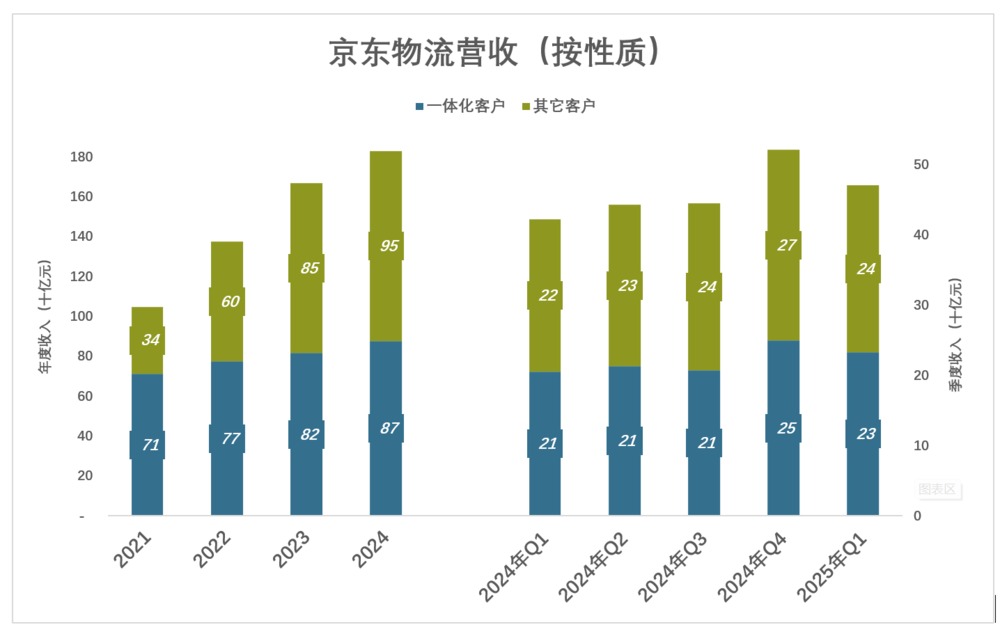
Core Viewpoint - JD Logistics has shown significant revenue growth and improved profitability, driven by external customer expansion and enhanced service offerings, particularly through its integrated supply chain solutions [3][4][21]. Revenue Growth - In 2024, JD Logistics reported revenue of 182.84 billion, a year-on-year increase of 9.7%, with net profit reaching 7.09 billion, up 507% [3]. - For Q1 2025, revenue was 46.97 billion, reflecting an 11.5% year-on-year growth, while net profit was 610 million, up 89.5% [3]. Customer Base and Service Offerings - The company has shifted its focus from internal group clients to external customers, with external revenue growing significantly over the years [12][14]. - By 2023, revenue from external customers exceeded 100 billion, accounting for 70% of total revenue, although this percentage plateaued thereafter [12][14]. - The integrated supply chain service, while a key offering, has seen its revenue share decrease as external customer revenue increases [11][21]. Profitability Factors - JD Logistics has improved its gross profit margin, with gross profit rising from 1.1 billion in 2018 to over 10 billion in 2024, reflecting a gross margin increase from 2.9% to over 10% [22][29]. - The reduction in outsourcing costs has contributed to this margin improvement, with outsourced costs decreasing from 38.5% of revenue in 2021 to 34.6% in 2024 [25][29]. Operational Efficiency - The company has maintained a stable total expense ratio around 7%, with seasonal fluctuations, indicating effective cost control [31]. - JD Logistics has invested heavily in building its logistics network, including acquisitions and self-built infrastructure, enhancing its operational capabilities [35][36]. Financial Health - JD Logistics transitioned from a cost center to a profit center post-independence, contributing significantly to JD Group's overall profitability [41][42]. - The operating cash flow has consistently exceeded 100 billion since 2020, indicating a strong financial position and reduced debt burden [39][41].

刘强东的底牌藏不住了
Hu Xiu· 2025-05-28 22:57
Core Viewpoint - JD Logistics has shown significant revenue growth and profitability improvements, driven by external customer expansion and enhanced service offerings, particularly through its integrated supply chain solutions [1][2][3]. Revenue and Profitability - In 2024, JD Logistics reported revenue of 182.84 billion, a year-on-year increase of 9.7%, and a net profit of 7.09 billion, reflecting a remarkable year-on-year growth of 507% [1]. - For Q1 2025, the revenue was 46.97 billion, up 11.5% year-on-year, with a net profit of 610 million, marking an 89.5% increase [2]. Customer Base and Service Offerings - The company has focused on expanding its external customer base, with a notable shift in revenue sources. By 2023, revenue from external customers reached 116.56 billion, accounting for 70% of total revenue [12][14]. - The integrated supply chain service, while a key product, has seen its revenue share decrease as more external customers opt for other service options [11][9]. Cost Management and Profit Margins - JD Logistics has improved its gross profit margins significantly, with the gross profit margin reaching 10.2% in 2024, up from 2.9% in 2018 [22][24]. - The reduction in outsourcing costs has also contributed to the improved profit margins, with outsourcing costs as a percentage of revenue decreasing from 38.5% in 2021 to 34.6% in 2024 [25]. Financial Health and Cash Flow - The company has transitioned from a cost center to a profit center since its independence in 2017, contributing one-sixth of JD Group's profits in 2024 [49][50]. - Operating cash flow exceeded 20 billion in 2024, indicating a strong financial position and reduced debt burden [48]. Logistics Infrastructure and Strategy - JD Logistics has invested heavily in building a robust logistics infrastructure, including over 1,600 warehouses and 20,000 delivery stations, enhancing its last-mile delivery capabilities [43][41]. - The company has also focused on improving its transportation capabilities through acquisitions and partnerships, significantly increasing its fleet size and operational efficiency [40][38].
畅谈Robotaxi和机器人配送小车
2025-05-27 15:28
Summary of Key Points from the Conference Call Company Overview - The document discusses the company Xiaoma Zhixing, which is set to go public in November 2024 with an IPO valuation of approximately $4.2 billion, lower than the pre-IPO valuation of $9 billion. Post-IPO, the stock price rebounded, indicating market interest in the company [1][5]. Industry Insights - Xiaoma Zhixing's revenue is expected to be predominantly from its Robotaxi business, projected to account for 80% of total revenue by 2028. Currently, the main revenue source is technology licensing, including sales of domain controllers and autonomous driving technology to companies like Meituan and Cainiao [1][5]. - The company showcased its seventh-generation Robotaxi, which has reduced operational costs by 70% and is collaborating with local automakers like BAIC and GAC to lower vehicle prices [1][6]. Financial Projections - The average Gross Merchandise Value (GMV) per Robotaxi is currently around several hundred thousand RMB annually, with expectations to exceed 200,000 RMB in the future. The company anticipates achieving group-level breakeven between 2028 and 2029, with single-vehicle breakeven expected by late 2025 to early 2026. By 2030, gross margins are projected to exceed 50%, with net margins reaching over 20% [3][20]. Technological Advancements - Xiaoma Zhixing possesses L4 level autonomous driving technology, which is a significant competitive advantage. The company collaborates with platforms like Gaode, Tencent, and Lichi to secure customer acquisition channels [1][7]. - The document outlines the complexity of autonomous driving applications, categorizing them into four scenarios: closed cargo, closed passenger, open cargo, and open passenger, with the latter being the most challenging [4]. Competitive Landscape - Key competitors include WeRide, Waymo, and various domestic and international automakers such as XPeng, Xiaomi, Huawei, and Tesla. While these competitors have technical capabilities, they are still catching up to L4 level autonomous driving technology [8]. Market Dynamics - The autonomous driving ecosystem is heavily reliant on technology, partnerships with ride-hailing platforms, and collaborations with automakers. Team stability is also crucial for maintaining operational efficiency and technological advancement [9]. Future Outlook - The document highlights the potential for autonomous delivery systems, particularly in low-density areas abroad and high-density areas domestically, indicating a growing market for such technologies [22]. - The differences between Robotaxi and autonomous delivery vehicles are noted, with Robotaxi companies providing both technical and hardware support, while delivery vehicles are easier to commercialize due to simpler operational scenarios [23]. Valuation Methods - Various valuation methods are discussed, including Price-to-Sales (PS), Price-to-Earnings (PE), and Discounted Cash Flow (DCF) approaches, with conservative estimates suggesting significant future valuation potential [21]. Conclusion - Xiaoma Zhixing is positioned to capitalize on the growing demand for autonomous driving solutions, with a strong focus on technology development and strategic partnerships, while navigating a competitive landscape that includes both domestic and international players.
