
中国卫星

Search documents
权益类基金2025年四季报透视:短期业绩出现分化
Zheng Quan Ri Bao· 2026-01-16 16:46
Core Insights - The public fund reports for Q4 2025 are being disclosed, showing a divergence in performance among equity funds, with several fund managers optimistic about investment directions such as AI infrastructure and commercial aerospace [1][2]. Group 1: Market Performance - The equity market experienced a volatile adjustment in Q4 2025, with 33 out of 56 disclosed equity funds reporting net value growth, while others faced varying degrees of decline [2]. - Notable funds like Qianhai Kaiyuan Hong Kong-Shenzhen Enjoy Life and Qianhai Kaiyuan Ocean Mixed achieved over 30% net value growth in Q4 2025, with significant increases in fund shares [2]. - The Qianhai Kaiyuan Hong Kong-Shenzhen Enjoy Life fund focused on global AI infrastructure, adjusting its holdings to emphasize optical communication and liquid cooling sectors [2]. Group 2: Sector Focus - Funds such as Ping An CSI Satellite Industry Index and Tongtai New Energy reported net value growth rates above 20% in Q4 2025, focusing on satellite manufacturing and controllable nuclear fusion sectors [3]. - Despite some funds experiencing net value declines of up to 15% in Q4 2025, most funds still achieved net value growth over the entire year [3]. Group 3: Investment Strategies - Fund managers are optimistic about the technology sector for 2026, with AI being highlighted as a key investment direction due to its ongoing nonlinear technological advancements [4]. - The investment strategy suggested by fund managers includes a focus on "hard" technologies over "soft" ones, with an emphasis on sectors like optical communication and liquid cooling, which are expected to yield higher excess returns [4]. - The commercial aerospace sector is anticipated to transition from exploration to growth, with increased launch frequencies and a focus on reusable rockets and satellite payloads [4]. Group 4: Long-term Outlook - Fund managers believe that adjustments in holdings are based on long-term industry trends, with potential for significant recovery in fund net values following favorable policy releases or industry advancements [5]. - The volatility of equity funds is more pronounced compared to fixed-income products, emphasizing the importance of clear investment frameworks and in-depth industry research by fund managers [5].
火箭回收,卫星量产:中国商业航天的“降本增效”之战
材料汇· 2026-01-16 15:41
Group 1: Launch Vehicles - The main types of launch vehicles include solid rockets, liquid rockets, and hybrid rockets, classified by their propulsion systems [4][5][6] - Launch vehicles can also be categorized by payload capacity: small (less than 2 tons), medium (2-20 tons), large (20-100 tons), and heavy (over 100 tons) [5][6] - The structure of a launch vehicle generally consists of three main parts: the airframe, propulsion system, and control system [6] Group 2: Cost Reduction in Commercial Rockets - The hardware costs of first and second stage rockets are significant, with engines accounting for over 50% of total costs in some cases, indicating that reusability could be a key to cost reduction [19][21] - SpaceX's Falcon 9 rocket has demonstrated substantial cost savings through reusability, with the total cost for a new rocket at $50 million, while reused rockets can significantly lower costs per launch [25][24] - The cost structure of Falcon 9 shows that hardware costs dominate, making up approximately 60% of the total launch cost, while operational costs can be reduced through effective reuse strategies [21][24] Group 3: Development of China's Space Industry - China's launch frequency has rapidly increased, with the number of launches rising from 39 in 2018 to 68 in 2024, positioning China as a leader in global launch activities [32][34] - In 2024, the China Aerospace Science and Technology Corporation conducted 51 launches, accounting for 75% of the total, while private companies contributed 12 launches, indicating a growing role for the private sector [41][42] - The proportion of commercial launches in China has surged, with 43 commercial launches in 2024, representing 63.2% of total launches, a significant increase from previous years [45] Group 4: SpaceX Starlink Program - The Starlink project aims to deploy 42,000 satellites in low Earth orbit to provide global high-speed internet services and support future Mars missions [47][48] - Starlink has undergone multiple iterations, with advancements in satellite technology, including the introduction of inter-satellite laser links and improved ground terminals [59][60] - The deployment of Starlink satellites is structured in phases, with the first phase involving 1,584 satellites for initial coverage, followed by additional satellites to complete global coverage [54][57]


“进入行星大气极端流动与传热基础科学问题”重大研究计划启动
Xin Lang Cai Jing· 2026-01-16 12:56
Core Insights - The National Natural Science Foundation has launched a major research plan focusing on extreme flow and heat transfer issues in planetary atmospheres during entry processes [1] - The plan aims to reveal the mechanisms of multi-process coupling in high-speed complex flows and to overcome key technological bottlenecks in high-temperature non-equilibrium flows and thermal protection [1] - The initiative emphasizes a problem-oriented, interdisciplinary, and collaborative innovation approach, targeting core areas such as multi-process coupling mechanisms, material responses in strong radiation heat transfer environments, and non-equilibrium physicochemical reaction mechanisms in ultra-high temperature planetary atmospheres [1] Group 1 - The plan will support various levels of projects, including "key support projects" and "nurturing projects," through a competitive selection process across the country [1] - A collaborative innovation network across institutions and disciplines has been established to achieve the scientific goals of the plan [1] - The implementation of the plan will leverage national strengths to promote theoretical innovation and technological breakthroughs, aiming to form a controllable technical system in areas such as extreme high-speed flow and strong radiation heat transfer [1] Group 2 - Over 400 academicians, experts, and scholars from more than 70 universities, research institutes, and aerospace industrial sectors, including the Chinese Academy of Sciences and major aerospace groups, gathered to witness this significant moment for deep space exploration [2]
本周沪深两市成交额超17万亿元,创历史单周新高
Zhong Guo Jin Rong Xin Xi Wang· 2026-01-16 10:07
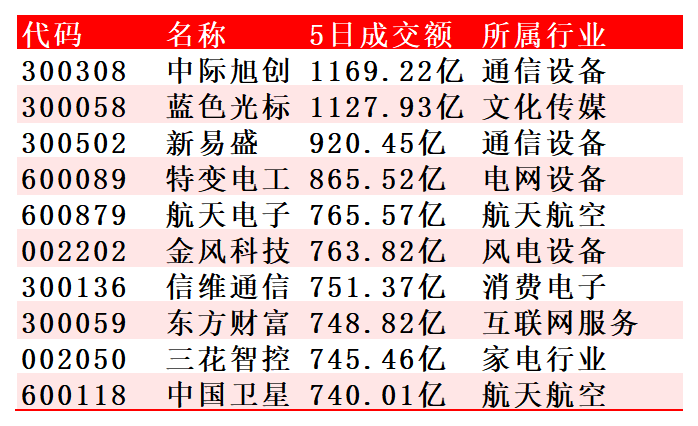
Group 1 - The A-share market experienced active trading this week, with total trading volume exceeding 17 trillion yuan, reaching 17.1 trillion yuan, setting a record for the highest weekly trading volume in history [1] - The average daily trading volume for the week was approximately 3.42 trillion yuan, marking the first time the average daily trading volume surpassed 3 trillion yuan [1] - The previous record for weekly trading volume was 14.8 trillion yuan, recorded during the week of August 25 to 29, 2025, with an average daily trading volume that did not exceed 3 trillion yuan [1] Group 2 - The stock with the highest trading volume this week was Zhongji Xuchuang, with a total trading volume of 116.922 billion yuan [2] - BlueFocus Media followed closely with a trading volume of 112.793 billion yuan, both stocks exceeding 100 billion yuan in trading volume for the week [2] - Other notable stocks in the top ten by trading volume included Aerospace Electronics, Goldwind Technology, China Satellite, and Xinwei Communication, all related to the commercial aerospace theme [1][2]



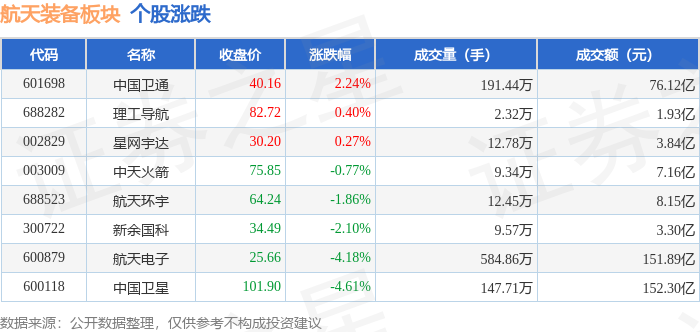
航天装备板块1月16日跌1.47%,中国卫星领跌,主力资金净流出28.11亿元
Zheng Xing Xing Ye Ri Bao· 2026-01-16 09:00
Core Viewpoint - The aerospace equipment sector experienced a decline of 1.47% on January 16, with China Satellite leading the drop, while the Shanghai Composite Index fell by 0.26% and the Shenzhen Component Index decreased by 0.18% [1] Group 1: Market Performance - The aerospace equipment sector's main stocks showed mixed performance, with China Satellite closing at 101.90, down 4.61%, and China Telecom rising by 2.24% to 40.16 [1] - The total net outflow of main funds in the aerospace equipment sector was 2.811 billion yuan, while retail investors saw a net inflow of 1.939 billion yuan [1] Group 2: Individual Stock Analysis - China Satellite had a significant net outflow of 1.729 billion yuan, accounting for 11.35% of its trading volume, while retail investors contributed a net inflow of 502 million yuan [2] - New Yu Guoke experienced a net outflow of 402 million yuan from main funds, with retail investors providing a net inflow of 446.85 million yuan, indicating strong retail interest [2] - The stock of Aerospace Electronics saw a net outflow of 570 million yuan from main funds, while retail investors contributed a net inflow of 438 million yuan [2]

“未来产业”主题系列报告(二):商业航天:跨越“卡门线”
Western Securities· 2026-01-16 08:07
Core Conclusions - The "singularity" of commercial aerospace is approaching, with a transition from "single satellite testing" to "constellation networking" underway. China's satellite deployment completion is currently around 1%, indicating significant room for growth in the coming years as rocket recovery and reusability technologies are mastered [1][9][10] - Commercial aerospace is a high-growth and scarce sector, with the successful launch of the "Zhuque-3" rocket, which has a capacity of 21.3 tons (non-recoverable), setting a strong foundation for mass satellite launches. The cost of commercial rocket launches in China is expected to decrease rapidly, further enhancing market potential [2][17][18] - The commercial aerospace sector is likely to evolve into a mainline market, with the second wave of market growth not being the endpoint. The satellite industry index has increased nearly 105% in a short period, indicating strong investor interest and potential for further growth as rocket recovery technologies mature [3][27][28] Group 1: The Singularity of Commercial Aerospace - Global commercial aerospace is at a critical stage, moving towards "constellation networking" with strict timelines set by the International Telecommunication Union (ITU) for satellite frequency and orbital resource applications [1][9] - China's satellite constellation construction is lagging, with significant room for improvement in launch frequency and completion rates. The largest constellation, SpaceX's Starlink, has a completion rate of approximately 18.9%, while China's major constellations are at about 1% [10][11] Group 2: High-Growth Potential - The bottleneck in China's commercial aerospace development is insufficient rocket capacity, leading to high satellite launch costs. However, the successful launch of the "Zhuque-3" rocket marks a significant breakthrough, with a theoretical capacity to launch multiple satellites simultaneously [17][18] - The market space for satellite launches is substantial, with an estimated annual demand for approximately 4,000 satellites based on the lifespan of existing constellations [2][17] Group 3: Transition to Mainline Market - The commercial aerospace sector is expected to transition from a thematic market to a mainline market as rocket recovery technologies mature. The current market dynamics suggest that the sector is in the middle of a long-term upward trend [3][27][31] - The performance of leading companies in the sector indicates that while there has been significant growth, there is still potential for further increases compared to other sectors like low-altitude economy and new energy vehicles [3][27] Group 4: Focus on Rocket Manufacturing and Satellite Services - The commercial aerospace market is expected to follow a clear sequence of development, with rocket manufacturing leading the charge, followed by satellite payloads and platforms. The downstream application and service market still lack clear business models, indicating room for growth [4][33][34] - As satellite launches increase, the need for operational and service capabilities will become critical, making satellite operations and services a key area of focus for future investment [4][33][34] Group 5: Industry Chain and Related Stocks - A comprehensive industry chain map for commercial aerospace has been developed, highlighting key players and stocks for investor reference. This includes segments such as rocket manufacturing, satellite payloads, platforms, testing, and operations [41][42]
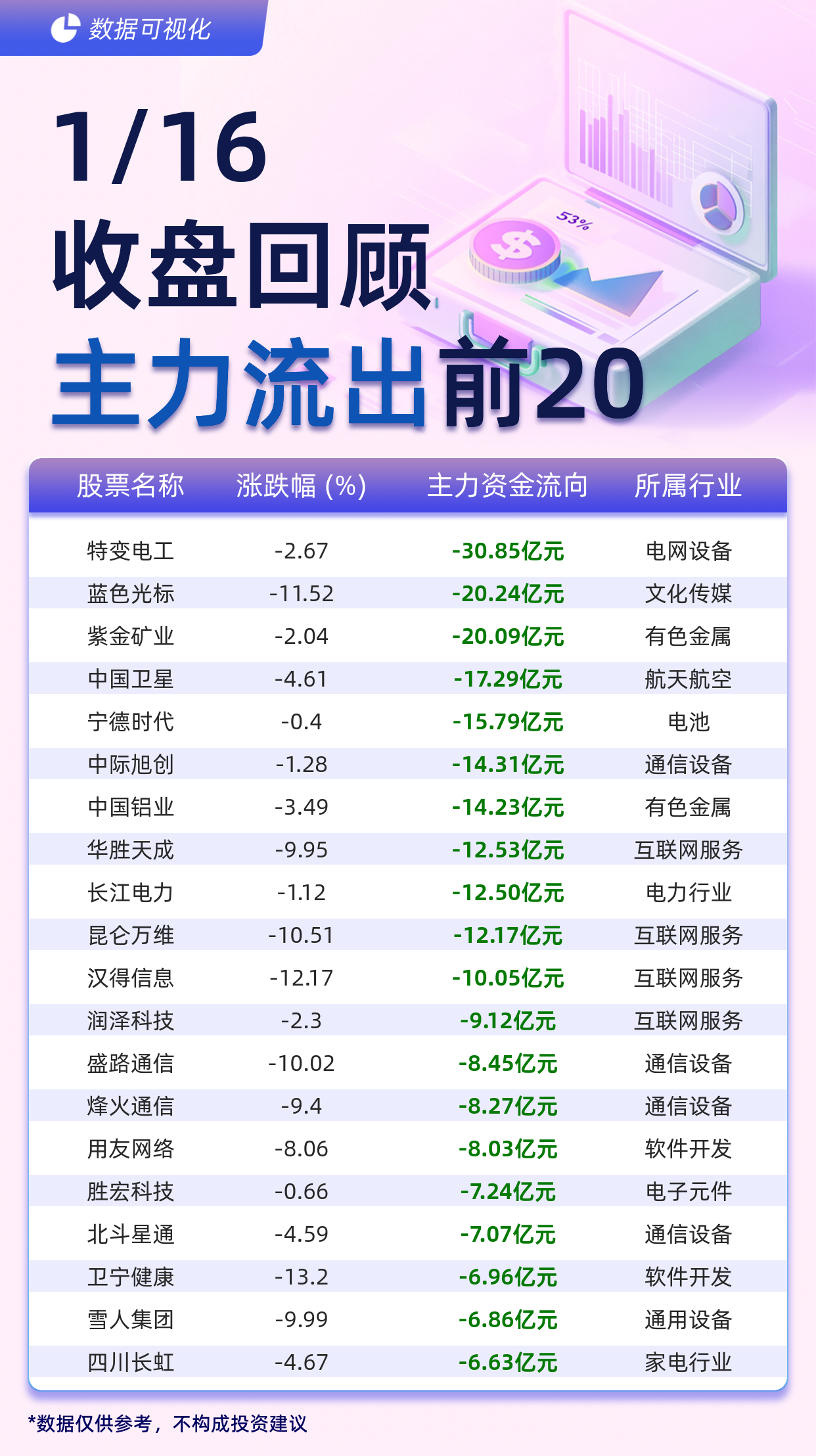
主力个股资金流出前20:特变电工流出30.85亿元、蓝色光标流出20.24亿元
Jin Rong Jie· 2026-01-16 07:40
Core Viewpoint - The data indicates significant outflows of capital from various stocks, with notable declines in share prices across multiple sectors, suggesting a bearish sentiment in the market. Group 1: Stock Performance and Capital Outflow - The top stock with the highest capital outflow is TBEA Co., Ltd. (特变电工), with an outflow of 3.085 billion yuan and a price drop of 2.67% [1][2] - BlueFocus Communication Group (蓝色光标) experienced a capital outflow of 2.024 billion yuan, with a significant price decline of 11.52% [1][2] - Zijin Mining Group (紫金矿业) saw an outflow of 2.009 billion yuan and a price decrease of 2.04% [1][2] - China Satellite Communications (中国卫星) had a capital outflow of 1.729 billion yuan, with a price drop of 4.61% [1][2] - Contemporary Amperex Technology Co., Ltd. (宁德时代) experienced an outflow of 1.579 billion yuan and a minor price decline of 0.4% [1][2] Group 2: Sector Analysis - The electric equipment sector, represented by TBEA Co., Ltd., shows a significant capital outflow, indicating potential challenges in this industry [2] - The cultural communication sector, represented by BlueFocus, is facing substantial capital withdrawal, reflecting investor concerns [2] - The non-ferrous metals sector, including companies like Zijin Mining and China Aluminum (中国铝业), is also experiencing notable outflows, suggesting a broader trend affecting commodity-related stocks [2][3] - The software development sector, represented by companies like Yonyou Network (用友网络) and Weining Health (卫宁健康), is witnessing significant capital outflows, indicating potential vulnerabilities in this area [3]



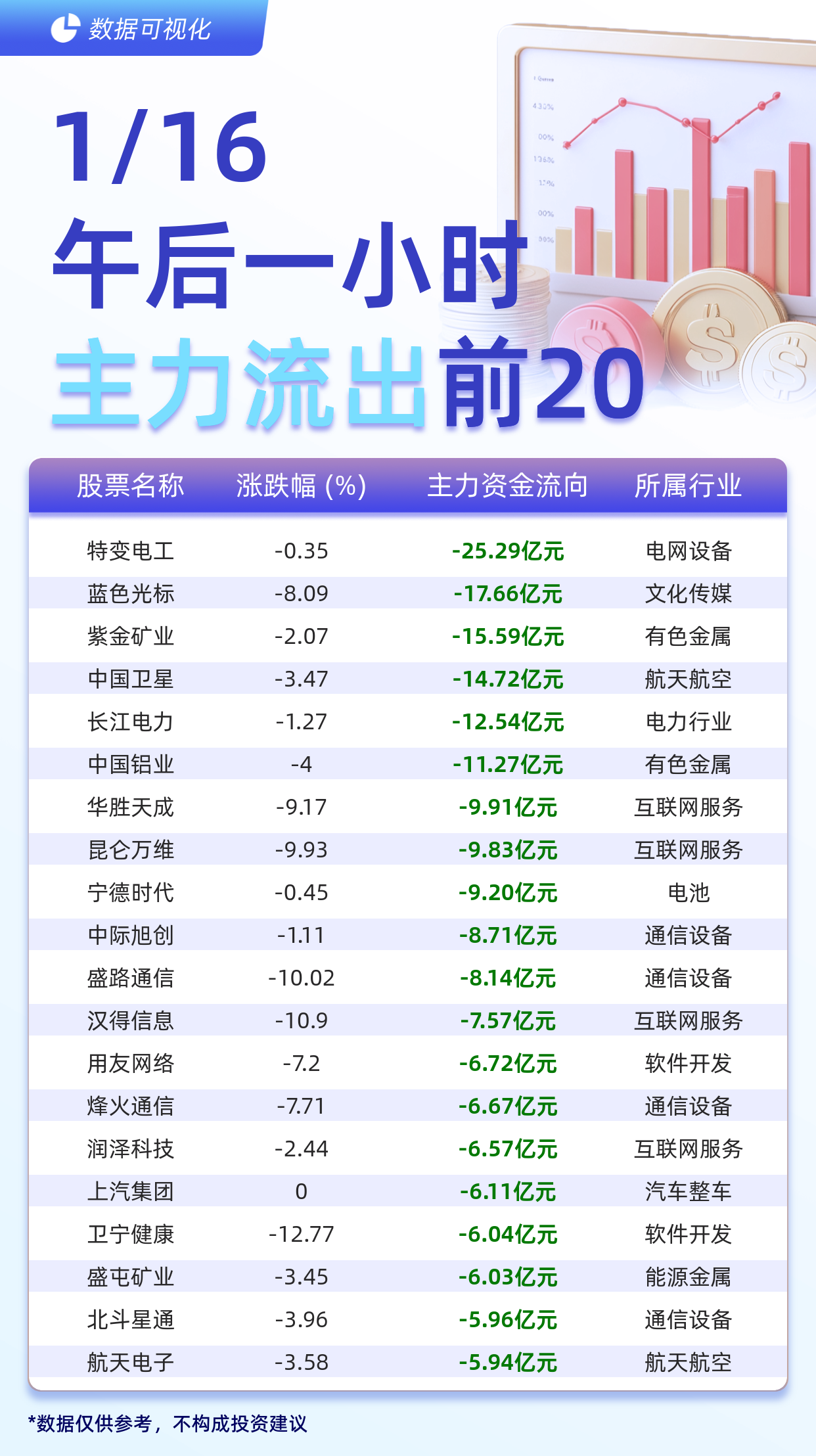
主力个股资金流出前20:特变电工流出25.29亿元、蓝色光标流出17.66亿元
Jin Rong Jie· 2026-01-16 06:38
Core Viewpoint - The data indicates significant outflows of capital from various stocks, with notable amounts leaving the market, suggesting a potential shift in investor sentiment and market dynamics [1][2][3] Group 1: Major Stocks with Capital Outflows - The stock with the highest capital outflow is TBEA Co., Ltd. (特变电工), experiencing a net outflow of 2.529 billion yuan, with a decline of 0.35% [2] - BlueFocus Communication Group Co., Ltd. (蓝色光标) follows with a capital outflow of 1.766 billion yuan and a drop of 8.09% [2] - Zijin Mining Group Co., Ltd. (紫金矿业) saw an outflow of 1.559 billion yuan, with a decrease of 2.07% [2] - China Satellite Communications Co., Ltd. (中国卫星) had a capital outflow of 1.472 billion yuan, down by 3.47% [2] - Yangtze Power Co., Ltd. (长江电力) experienced a 1.27% decline with an outflow of 1.254 billion yuan [2] Group 2: Sector Analysis - The electric power sector, represented by Yangtze Power, shows a capital outflow of 1.254 billion yuan, indicating potential concerns within the industry [2] - The non-ferrous metals sector, including companies like Zijin Mining and China Aluminum Corporation (中国铝业), is also facing significant outflows, with 1.559 billion yuan and 1.127 billion yuan respectively [2][3] - The internet services sector, represented by companies such as Huasheng Tiancheng (华胜天成) and Kunlun Wanwei (昆仑万维), shows substantial declines of 9.17% and 9.93% respectively, with outflows of 0.991 billion yuan and 0.983 billion yuan [2][3] Group 3: Additional Notable Stocks - Other companies with significant capital outflows include: - Ningde Times (宁德时代) with an outflow of 0.920 billion yuan and a decline of 0.45% [2] - Zhongji Xuchuang (中际旭创) with an outflow of 0.871 billion yuan and a decrease of 1.11% [2] - Han's Laser Technology Industry Group Co., Ltd. (汉得信息) with a capital outflow of 0.757 billion yuan and a drop of 10.9% [3]


招商证券:国家战略与产业趋势共振 看好商业航天2026年投资机会
智通财经网· 2026-01-16 06:16
Core Viewpoint - The Chinese commercial aerospace industry is identified as a strategic emerging industry that resonates with national strategy and industrial trends, expected to see significant catalysts in 2026, including reusable rocket technology validation and IPO progress for commercial aerospace companies [1] Industry Status - The industry has developed a complete supply chain consisting of "satellites, rockets, and launch sites" over the past decade, with a current core issue being severe "insufficient capacity" in rocket launch capabilities, which is a bottleneck for scaling the industry [1] - In 2025, there will be a total of 323 orbital rocket launches globally, with the U.S. conducting 193 (SpaceX 165) and China 92 (Long March series 69), indicating a competitive landscape where the U.S. is currently leading [1] - The U.S. has deployed 3,724 satellites compared to China's 372, with the U.S. commercial launch market accounting for 82% of total capacity, approximately ten times that of China [1] Rocket Segment - The key to enhancing commercial aerospace capacity lies in reusable rocket technology, which transforms rocket hardware from "single-use" to "reusable assets," significantly reducing launch costs and increasing launch frequency and total payload [2] - SpaceX's Falcon 9 has achieved 32 reuse records by 2025, while China is expected to begin its first reusable rocket validation in 2026 [2] - The launch cost of Falcon 9 is approximately 18,000 yuan/kg, compared to 85,000 yuan/kg for Ariane 5, indicating a cost reduction of about 4-5 times due to reusable technology [2] Satellite Segment - As of now, SpaceX has launched 10,955 satellites with a long-term plan for about 42,000, while China's StarNet has launched 174 with a plan for 13,000 [3] - China has submitted an application for frequency and orbital resources for an additional 203,000 satellites to the ITU, marking the largest international frequency application action by China [3] - The current satellite deployment by China is just beginning, and with breakthroughs in reusable rocket technology, the satellite network in China is expected to experience significant growth [3] Investment Logic - Short-term: The supply chain for rocket capacity is expected to benefit from the current capacity shortage, with a focus on high-value components such as engines and structural parts [4] - Suggested investment opportunities include companies involved in 3D printing technology, high-barrier rocket materials, and high-quality structural components [4] - Long-term: The breakthrough in reusable technology is anticipated to shift the business model of rocket manufacturers from research and development to launch operations, enhancing profitability and operational efficiency [5] - The demand for satellites is expected to grow rapidly, with satellite companies being identified as having long-term inflationary attributes [6]

商业航天系列研究(一):国家战略与产业趋势共振,看好商业航天2026年投资机会
CMS· 2026-01-16 05:33
Investment Rating - The report maintains a positive outlook on the commercial aerospace industry, particularly focusing on the investment opportunities in the rocket supply chain due to existing supply gaps and the long-term potential of rocket manufacturers and satellite industry chains with commercial model advantages [1]. Core Insights - The Chinese commercial aerospace industry is identified as a strategic emerging industry that resonates with national strategies and industrial trends, expected to witness significant developments in 2026, including reusable rocket technology validation and IPO progress of commercial aerospace companies [1]. - The current core bottleneck in the industry is the insufficient launch capacity, which is crucial for the scaled development of the sector. The report highlights that in 2025, the global launch capacity is dominated by the US, with a significant gap compared to China [5][6]. - The report emphasizes the importance of reusable rocket technology, which can transform rockets from disposable assets to reusable ones, significantly reducing launch costs and increasing launch frequency and payload capacity [5][6]. Industry Overview - The commercial aerospace industry in China has developed a complete industrial chain consisting of satellites, rockets, and launch sites, gradually extending to measurement and control and applications [5]. - As of 2025, the US has conducted 193 rocket launches, while China has conducted 92, indicating a competitive landscape where the US currently leads [5]. - The report notes that the US has deployed 3,724 satellites compared to China's 372, highlighting the disparity in satellite deployment capabilities [5]. Investment Logic - Short-term opportunities are identified in the rocket supply chain due to the current launch capacity constraints, with specific recommendations for companies involved in high-value components and materials [6]. - Long-term prospects are focused on the transformation of rocket manufacturers' business models towards launch operations and the anticipated growth in satellite demand once the launch capacity bottleneck is resolved [6].