
雀巢

Search documents
健康营养・价值共鸣・产品组合聚焦 —— 食饮企业竞争护城河三大支柱
科尔尼管理咨询· 2025-11-04 09:40
Core Insights - The three core pillars for food and beverage companies to build competitive advantages are health nutrition, value resonance, and product portfolio focus. However, only by quickly responding to changes in consumer expectations can these advantages translate into sustained growth [1] Consumer Behavior Gap - There is a significant gap between consumer claims and actual purchasing behavior. While 68% of consumers express support for brand values, quality and price remain the primary decision factors in actual purchases. This discrepancy highlights a deep-seated contradiction where consumers are aware of health and value-driven diets but still exhibit strong behavioral inertia [4][3] Health Nutrition as a Foundation - Health nutrition has become a non-negotiable requirement. Reducing sugar, salt, and fat is now merely the entry ticket for market competition. The real challenge lies in achieving nutritional upgrades without sacrificing taste. Leading companies are adopting a dual strategy of maintaining classic product flavors while introducing healthier versions [7][6] Value Resonance for Differentiation - Brand differentiation and the ability to command a premium price stem from the resonance between brand values and consumer values. Emotional connections with consumers are key to establishing commercial advantages, attracting new customers, and enhancing loyalty [10][11] Product Portfolio Focus - Simplifying formulations and product lines is essential for reinforcing consumer trust and reducing costs. A streamlined product portfolio allows companies to optimize resource allocation and focus on areas where they have a competitive edge, thus enhancing operational efficiency [15][16] Continuous Restructuring - Continuous innovation and restructuring are crucial as consumer expectations evolve. Nutritional formula upgrades are necessary to solidify market positions and protect brand assets. Companies must act decisively to capture early signals of changing consumer demands [18][17]



贝伦贝格:上调雀巢评级至“买入”
Ge Long Hui A P P· 2025-11-03 06:51
Group 1 - Berenberg has raised Nestlé's target price from 83.10 Swiss Francs to 92.00 Swiss Francs [1] - The rating for Nestlé has been upgraded to "Buy" [1]

The Vanguard FTSE Developed Markets ETF (VEA) Offers Broader Diversification Than the SPDR Portfolio Developed World ex-US ETF (SPDW)
The Motley Fool· 2025-11-03 00:21
Core Insights - Both the SPDR Portfolio Developed World ex-US ETF (SPDW) and the Vanguard FTSE Developed Markets ETF (VEA) provide investors with exposure to developed international equities, excluding the U.S. [1] Cost & Size Comparison - Both SPDW and VEA have an expense ratio of 0.03% [2][3] - As of October 28, 2025, SPDW has a 1-year return of 21.4% while VEA has a return of 21.2% [2] - VEA offers a slightly higher dividend yield of 2.7% compared to SPDW's 2.6% [3] - Assets Under Management (AUM) for SPDW is $32.0 billion, while VEA has a significantly larger AUM of $250.8 billion [2] Performance & Risk Comparison - Over the past five years, SPDW experienced a maximum drawdown of -30.20%, while VEA had a drawdown of -29.71% [4] - A $1,000 investment in SPDW would have grown to $1,546 over five years, compared to $1,555 for VEA [4] Portfolio Composition - VEA holds approximately 3,873 stocks and is diversified across sectors such as Financial Services (24%), Industrials (19%), and Technology (11%) [5] - SPDW covers 2,405 holdings with a similar sector allocation: Financial Services at 23%, Industrials at 19%, and Technology at 10% [6] - VEA's larger asset base and stock count may appeal to investors seeking maximum diversification [6] Long-term Performance - Over the past decade, VEA has achieved a total return of 115.6%, while SPDW has a total return of 114.4% [9] - In comparison, the Vanguard 500 Index Fund ETF has delivered a total return of 291% over the same period, highlighting the relative underperformance of both international ETFs [10]

iShares Core MSCI EAFE ETF (IEFA) Offers Broader Market Coverage at Lower Costs Than iShares MSCI Emerging Markets ETF (EEM)
The Motley Fool· 2025-11-02 16:02
Core Insights - The iShares Core MSCI EAFE ETF (IEFA) and the iShares MSCI Emerging Markets ETF (EEM) offer different approaches to global equity exposure, with IEFA focusing on developed markets outside the U.S. and Canada, while EEM targets emerging economies [1] Cost & Size Comparison - IEFA has a significantly lower expense ratio of 0.07% compared to EEM's 0.72% [2] - As of October 27, 2025, IEFA's one-year return is 19.2%, while EEM's is 22.9% [2] - IEFA has a higher dividend yield of 2.9% compared to EEM's 2.1% [3] - Both ETFs have similar beta values, with EEM at 1.06 and IEFA at 1.07, indicating comparable volatility [2] - Assets under management (AUM) for IEFA stand at $159.2 billion, while EEM has $21.2 billion [2] Performance & Risk Analysis - Over the past five years, EEM experienced a maximum drawdown of -39.82%, while IEFA's maximum drawdown was -30.41% [4] - A $1,000 investment in IEFA would have grown to $1,537 over five years, compared to $1,244 for EEM [4] Portfolio Composition - IEFA holds 2,611 stocks, with significant allocations in financial services (22%), industrials (20%), and healthcare (10%) [5] - Major holdings in IEFA include ASML Holding NV, SAP, and Nestlé [5] - EEM consists of 1,198 holdings, with a heavier focus on technology (25%) and financial services (23%) [5] - Top allocations in EEM include Taiwan Semiconductor Manufacturing, Tencent Holdings, and Alibaba Group Holding [6] Investment Preference - IEFA is favored due to its lower expense ratio, higher dividend yield, and better historical performance compared to EEM [7][9] - EEM's top five holdings constitute over 25% of its portfolio, indicating a lack of diversification, with Taiwan Semiconductor Manufacturing alone accounting for 12% [8]

全球思想领袖将出席2025年斯经济与投资峰会
Shang Wu Bu Wang Zhan· 2025-11-01 16:20
Group 1 - The 2025 Sri Lanka Economic and Investment Summit will gather international and regional experts to discuss reform, economic resilience, and investment-driven growth [1] - The summit is organized by the Ceylon Chamber of Commerce and will take place in Colombo from December 2 to 3 [1] - Keynote speakers include Kenneth Shen from EDOTCO Group, Gevorg Sargsyan from the World Bank, and Alex Patelis, former chief economic advisor to the Greek Prime Minister, among others [2][3] Group 2 - The summit will feature discussions on sustainable development, green logistics, and inclusive finance, with insights from various industry leaders [2] - Sponsors of the summit include Nestlé, Standard Chartered Bank, Unilever, VISA, and South Asia Gateway Terminal [3]
10家知名企业大规模裁员,涉及零售、科技行业
财富FORTUNE· 2025-11-01 13:10
Core Insights - The current job market is experiencing significant challenges, with many companies adopting a "hiring freeze" while also not laying off employees, leading to a stagnation in job creation [2] - Rising operational costs, including new tariffs and shifts in consumer spending, are cited as reasons for this trend, alongside broader corporate restructuring efforts [2] - The shift towards investment in artificial intelligence is seen as a factor that may lead to job losses, as companies prioritize infrastructure over hiring [2] Employment Market Dynamics - Federal employees face increased uncertainty due to job cuts and government shutdowns, impacting overall worker sentiment in the job market [3] - The government has paused official hiring data releases during the shutdown, but a survey indicated a surprising loss of 32,000 private sector jobs in September [4] Company-Specific Layoffs - Amazon announced a reduction of approximately 14,000 corporate positions, nearly 4% of its total workforce, as it shifts focus towards AI investments [5] - UPS has cut around 34,000 jobs as part of its business turnaround efforts, exceeding earlier predictions of 20,000 layoffs [6] - Target plans to eliminate about 1,800 corporate positions, representing 8% of its global corporate workforce, to streamline operations [7] - Nestlé is set to cut 16,000 jobs globally over the next two years as part of a cost-cutting initiative amid rising commodity costs [8] - Lufthansa Group plans to reduce 4,000 jobs by 2030, primarily in administrative roles, despite strong demand for air travel [9] - Novo Nordisk announced a layoff of 9,000 employees, about 11% of its workforce, as part of a broader restructuring effort [10] - ConocoPhillips plans to cut up to 25% of its workforce, affecting approximately 2,600 to 3,250 employees by the end of 2025 [11] - Intel is reducing thousands of jobs as it seeks to revitalize its business, with a target of reducing its core workforce to 75,000 by year-end [12][13] - Microsoft initiated layoffs affecting 15,000 employees, marking its largest job cuts in over two years, as it undergoes organizational changes [14][15] - Procter & Gamble plans to cut up to 7,000 jobs, about 6% of its global workforce, as part of a restructuring amid tariff pressures [16]



2025年中国无糖茶行业研究报告——从高速增长迈向结构优化与品牌分化
Sou Hu Cai Jing· 2025-11-01 01:17
Core Insights - The Chinese sugar-free tea industry has transitioned from rapid growth to structural optimization and brand differentiation, becoming a vibrant segment in the soft drink market [1][2] - The market size of sugar-free beverages in China is projected to grow from 2.26 billion yuan in 2015 to 57.05 billion yuan in 2024, with a compound annual growth rate (CAGR) of 43.2% [1][18] - In 2025, sugar-free tea sales are expected to experience a decline for the first time, primarily due to market saturation in first- and second-tier cities, product homogenization, and competition from alternative beverages [1][19] Industry Overview - Sugar-free tea is defined as ready-to-drink tea with a sugar content not exceeding 0.5 grams per 100 grams or 100 milliliters, categorized into green tea, black tea, oolong tea, and others [12][19] - The overall tea beverage market is also growing steadily, with a market size increase from 114.4 billion yuan in 2018 to 154.5 billion yuan in 2024, reflecting a CAGR of 5.2% [1][42] Market Dynamics - In 2025, jasmine tea leads in market share, followed closely by oolong tea, while pu-erh and green tea maintain stable shares [2][20] - The consumer demographic is predominantly under 30 years old, accounting for 70.8% of the market, with health concerns being the primary purchasing motivation [2][32] - Offline channels dominate with an 81.5% share, with convenience stores being the core consumption scene, while online channels are rapidly growing [2][34] Competitive Landscape - The market is characterized by a "one strong, many strong" competition pattern, with Dongfang Shuye leading with a 75% market share, followed by Suntory and Kang Shifu [2][19] - The industry concentration is increasing, with the top five companies (CR5) in the ready-to-drink tea market reaching 79.6% in the first half of 2025 [2][19] Consumer Trends - Health consciousness is driving the market, with consumers increasingly favoring products that are sugar-free, low-calorie, and additive-free [2][35] - The demand for functional and flavorful beverages is rising, with consumers showing a preference for quality and taste over price competition [2][35] Future Outlook - The industry is expected to continue evolving towards functionalization and flavor diversification, with increasing brand differentiation [2][19] - The growth of the sugar-free tea market will be supported by rising health awareness, technological advancements in taste optimization, and favorable policies promoting low-sugar products [2][39][40]

VYMI: Foreign 4.3% Dividend Yield Made Cheap And Simple
Seeking Alpha· 2025-10-31 20:56
Core Insights - Non-US markets represent 75% of the global economy, 90% of the IMF's expected GDP growth, and 95% of the world population, indicating significant investment opportunities outside the US [1] Group 1: Investment Strategy - The focus is on improving international stock strategies, highlighting the importance of diversifying investments beyond the US [1] - The Expat Portfolio offers resources such as frequent analysis, a watchlist, and market guides to assist investors in navigating foreign markets [2] Group 2: Analyst Background - Tariq Dennison, an experienced RIA, emphasizes the benefits of investing in diverse foreign markets, leveraging his extensive international experience [2] - The Expat Portfolio community provides direct access to expert insights and discussions, enhancing investor confidence in international investments [2]

咖啡豆价格狂飙,中国咖啡总消费量20年暴增33倍,咖农皮卡换宝马
21世纪经济报道· 2025-10-31 13:17
Core Insights - The article highlights the significant transformation in the coffee farming industry in Yunnan, China, particularly in Pu'er City, where coffee farmers have seen substantial increases in income due to rising coffee prices and demand [1][4][5]. Group 1: Market Dynamics - Yunnan is the only region in China located within the coffee "golden growing belt," making it ideal for high-quality coffee production [1]. - The average purchase price of Yunnan coffee beans rose from 23.94 yuan/kg in 2021 to 31.6 yuan/kg in 2022, marking a 32% increase [5]. - By 2024, coffee bean prices continued to surge, with Arabica coffee futures exceeding 430 cents per pound, a 118.57% increase over the previous year [6]. Group 2: Farmer Experiences - Farmers like Pu Fenghui have transitioned from struggling with low prices to thriving, with some reporting annual incomes of over 200,000 yuan [4][6]. - The rise in coffee prices has led many farmers to upgrade their lifestyles, purchasing luxury vehicles and expanding their coffee plantations [4][7]. - The introduction of brands like Xin Coffee by farmers indicates a shift towards direct consumer engagement [6]. Group 3: Quality and Production Challenges - Despite the price increases, Yunnan's coffee production remains a small fraction of the global market, accounting for less than 1.5% of total coffee production [9]. - Issues such as poor management practices and inadequate quality control have historically hindered Yunnan's coffee industry [9][10]. - The region's coffee planting area has decreased by 37% from its peak in 2014, influenced by fluctuating international prices and environmental factors [9]. Group 4: Support and Growth Potential - Major companies like Nestlé and Starbucks have played a crucial role in supporting Yunnan's coffee industry through technology and market access [10][12]. - China's coffee consumption has skyrocketed from 16,700 bags in 2003/2004 to an estimated 576,500 bags in 2023/2024, indicating a massive growth potential [12]. - The per capita coffee consumption in China is only about 0.24 kg, compared to 5.3 kg in the EU and 4.2 kg in the US, suggesting significant room for growth [12][13]. Group 5: Market Position and Future Outlook - China's coffee imports reached 329,100 tons in 2023/2024, with domestic production unable to meet demand, leading to over 80% dependency on imports [13]. - The pricing dynamics have shifted towards a competitive market where local coffee beans are increasingly valued, with prices surpassing those offered by international traders [13]. - Despite the growth, Yunnan coffee still faces challenges in achieving global market prominence due to quality and production scale issues [14].

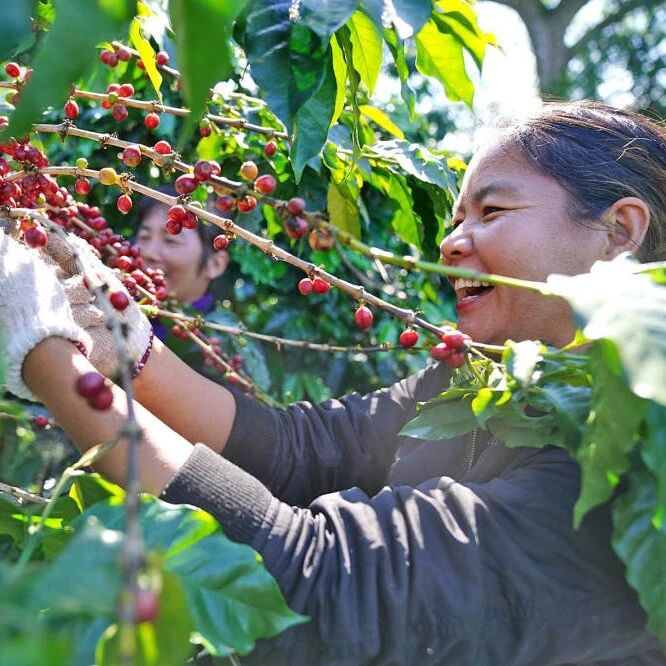
普洱咖农富了:皮卡换奔驰宝马
2 1 Shi Ji Jing Ji Bao Dao· 2025-10-31 11:03
Core Insights - The coffee farmers in Yunnan are experiencing significant improvements in their livelihoods, with many upgrading their vehicles and living standards due to rising coffee prices [1][2][6] - Yunnan is the only region in China located within the coffee "golden growing belt," making it a prime area for high-quality coffee production [1] - The average purchase price of Yunnan coffee beans increased from 23.94 yuan/kg in 2021 to 31.6 yuan/kg in 2022, marking a 32% year-on-year growth [5] Market Dynamics - The coffee market in Yunnan faced challenges from 2019 to early 2021 due to oversupply and low international prices, leading to decreased production and even tree removal by farmers [4] - A turnaround began in October 2021, driven by global coffee supply shortages and increased demand, resulting in a surge in coffee prices to historical highs [5] - By 2024, Arabica coffee futures prices exceeded 430 cents per pound, a 118.57% increase over the previous year, reflecting strong demand from emerging markets like China [5] Production and Quality Challenges - Despite the rising prices, Yunnan's coffee production remains low in the global context, accounting for less than 1.5% of the world's coffee supply [10] - The area under coffee cultivation in Yunnan has decreased by 37% from its peak in 2014, influenced by international price fluctuations and local climatic conditions [10] - Quality issues persist, with Yunnan coffee historically suffering from inconsistent quality, although partnerships with companies like Starbucks have helped improve standards [12][13] Government and Corporate Support - The Yunnan provincial government has implemented various policies to support the coffee industry, including funding for quality improvement and processing [14] - Major companies like Nestlé and Starbucks have played a crucial role in supporting Yunnan's coffee sector through technology transfer and premium pricing strategies [11][12] Domestic Demand and Market Potential - China's coffee consumption has skyrocketed from 16,700 bags in 2003/2004 to an estimated 576,500 bags in 2023/2024, indicating a growth of over 33 times [15] - The per capita coffee consumption in China is approximately 0.24 kg, significantly lower than the EU and US, suggesting substantial growth potential in the domestic market [16] - In 2023/2024, China is expected to import 329,100 tons of coffee beans, with over 80% of its coffee consumption reliant on imports [17] Competitive Landscape - Domestic coffee brands are gaining traction, with companies like Starbucks and Luckin Coffee promoting Yunnan coffee products, leading to higher local prices [19] - The competitive landscape is shifting, with local farmers now engaging in bidding wars for high-quality beans, reducing the influence of traditional buyers like Nestlé and Starbucks [20] Global Market Position - Despite the growth in domestic consumption, China's coffee market remains a minor player globally, with an expected consumption share of only 3.45% by 2025/2026 [21] - Yunnan coffee still faces challenges in terms of quality and market positioning compared to global standards, indicating a need for further development [21][22]