
宝钢股份

Search documents
钢铁行业:行业盈利修复提速,龙头优势凸显
Yin He Zheng Quan· 2025-12-30 13:13
Investment Rating - The report maintains a "Recommend" rating for the steel industry [1] Core Insights - The overall profitability of the steel industry is recovering rapidly, with effective cost control measures leading to significant improvements in profit margins [5][6] - In Q3 2025, the steel sector achieved record profits, with net profit margins increasing quarterly, indicating a sustainable recovery in profitability [7][10] - The recovery in profitability is broadening, with leading companies showing faster recovery rates compared to their peers, highlighting the advantages of scale and cost management [19][24] - Investment recommendations focus on companies with stable high dividends, those with high technical barriers, and upstream resource companies benefiting from improved supply dynamics [27] Summary by Sections 1. Industry Profitability Recovery and Cost Control - The profitability of the steel industry has shown significant improvement, with a total profit of 111.5 billion yuan from January to November 2025, a year-on-year increase of 1,752.2% [5] - The SW steel sector reported a net profit of 20.147 billion yuan in the first three quarters of 2025, marking a turnaround from losses in the previous year [5][6] 2. Record Profits in Q3 2025 - In Q3 2025, the steel sector generated revenue of 480.123 billion yuan, a slight year-on-year increase of 0.07%, while costs decreased by 4.42% [7][8] - The net profit for Q3 2025 reached 8.716 billion yuan, reflecting a 12.16% increase from the previous quarter and a significant recovery from losses in the same period last year [7][10] 3. Broadening Profit Recovery and Leading Companies - Leading steel companies like Baosteel and Shougang have demonstrated strong profit recovery, with Shougang's net profit increasing by 368.13% year-on-year [19][20] - The recovery in profitability is not limited to top firms; several smaller companies have also turned losses into profits, indicating a broad improvement across the sector [24] 4. Investment Recommendations - The report suggests focusing on companies with stable high dividends, such as CITIC Special Steel and Hualing Steel, as well as those with high technical barriers like Fangda Special Steel [27] - Upstream resource companies like Baotou Steel and Hainan Mining are also recommended due to expected improvements in supply dynamics [27]


创新驱动、链式赋能,光大银行上海分行打造绿色金融新样本
Di Yi Cai Jing· 2025-12-30 10:59
Core Viewpoint - Financial institutions play a crucial role in promoting industrial green upgrades and supporting the transformation of the real economy, particularly in the context of China's "dual carbon" goals and comprehensive green transition [1] Group 1: Green Financial Innovations - Everbright Bank's Shanghai branch has made significant breakthroughs in green finance, focusing on green bonds, green loans, and green ABS, aligning with national strategies such as technological innovation and low-carbon transition [2][4] - The branch successfully invested in Baowu Steel's first bond themed around technological innovation and low-carbon transition, amounting to 600 million yuan, with at least 70% of the funds directed towards low-carbon and Belt and Road initiatives [2] - The bank's green ABS investments, including a 620 million yuan investment in a green asset support plan for new energy vehicles, are expected to reduce carbon emissions by approximately 49,600 tons annually [2][3] Group 2: Green Building Initiatives - The bank has invested in a green asset support plan for the Expo City Best Practice Area, which has received LEED ND Platinum certification and aims for "zero carbon" certification by 2025, contributing to significant energy savings and carbon reduction [3] - The investment in the green building project is projected to achieve energy savings of 22.57 tons of standard coal and a carbon reduction of 49.89 tons in 2024 [3] Group 3: Organizational Structure for Green Finance - Everbright Bank's Shanghai branch has established a comprehensive organizational framework for green finance, including a leadership group focused on carbon peak and neutrality, and specialized working groups for green finance business expansion and ESG risk management [4] - The "1+N+X" organizational system promotes collaboration across departments and supports the establishment of green finance specialty branches, enhancing the bank's ability to implement green financial products and services [4] Group 4: Regional Green Financial Layout - The bank focuses on Shanghai's industrial structure, providing targeted support for green transportation, automotive supply chains, and innovative technologies, aligning with the city's goal of becoming a world-class automotive industry center [6][7] - The bank has provided 4.7 million yuan in loans to a private environmental technology company to support its growth in environmental technology research and production capacity [6] Group 5: Green Energy Financial Ecosystem - Everbright Bank is building a comprehensive green energy financial ecosystem, particularly in distributed photovoltaic projects, through innovative financial service models and partnerships with leading companies [8][9] - The bank's collaboration with a leading distributed photovoltaic company has resulted in project financing covering 185 MW of capacity, expected to reduce carbon emissions by approximately 200,000 tons annually [8][9] - The bank aims to integrate financial services with clean energy operational efficiency, establishing a benchmark in the distributed photovoltaic finance sector [9]

下游迭代加速:汽车、包装与家电需求变化重塑机铰式注塑机结构性机会
QYResearch· 2025-12-30 09:59
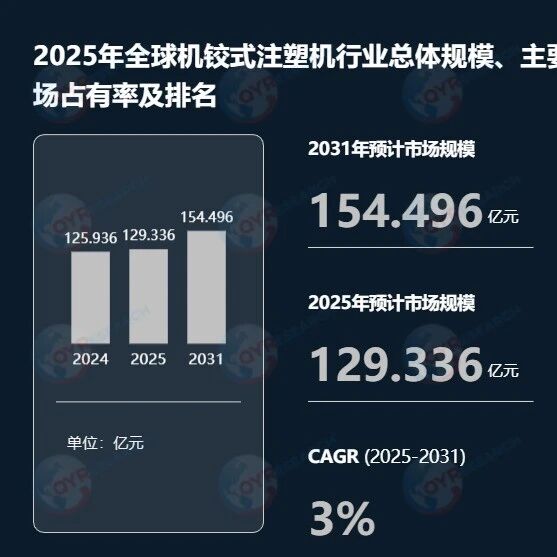
Core Viewpoint - The toggle-type injection molding machine is gaining traction due to its mechanical advantages over traditional hydraulic machines, including energy efficiency, reduced mold deformation, and faster cycle times, making it suitable for high-demand production environments [2][3]. Market Overview - The global market for toggle-type injection molding machines is projected to reach USD 1.902 billion in 2024, with a compound annual growth rate (CAGR) of 3% [3]. - Key manufacturers in the industry include Engel, Supermac Machinery, UBE Machinery Corporation, and others, focusing on various applications across automotive, packaging, medical, and industrial sectors [4]. Supply Chain Dynamics - The upstream supply chain consists of resin materials (e.g., PP, PE, ABS, PC) and essential components like steel, hydraulic oils, and servo motors, with suppliers such as BASF and Baowu Steel [6]. - The downstream applications span across automotive, home appliances, consumer electronics, and medical devices, with major clients including Toyota, Haier, and Foxconn [6]. Driving Factors - The demand for toggle-type injection molding machines is driven by the need for lightweight automotive components, rapid product iterations in consumer electronics, and the push for energy-efficient manufacturing processes [7]. - The transition from traditional hydraulic systems to servo-driven and automated solutions is enhancing production efficiency and stability [7]. Barriers to Entry - High capital expenditure and total cost of ownership (TCO) pressures, along with the need for precise assembly and maintenance capabilities, pose significant challenges for new entrants in the market [8]. - The complexity of the machinery and the requirement for a robust service network make it difficult for newcomers to compete effectively [10]. Industry Development Opportunities - Opportunities for growth are centered around enhancing energy efficiency, integrating automation, and expanding processing capabilities [9]. - The increasing demand for advanced materials and specialized applications in automotive and packaging sectors is expected to drive the adoption of high-end toggle machines [9]. Competitive Landscape - The competitive landscape is characterized by the need for system engineering capabilities, reliability validation, and a strong service network to meet customer expectations [10]. - Established players with a proven track record in quality and service are likely to maintain a competitive edge in the market [10].

普钢板块12月30日跌0.72%,武进不锈领跌,主力资金净流出1.19亿元
Zheng Xing Xing Ye Ri Bao· 2025-12-30 08:56
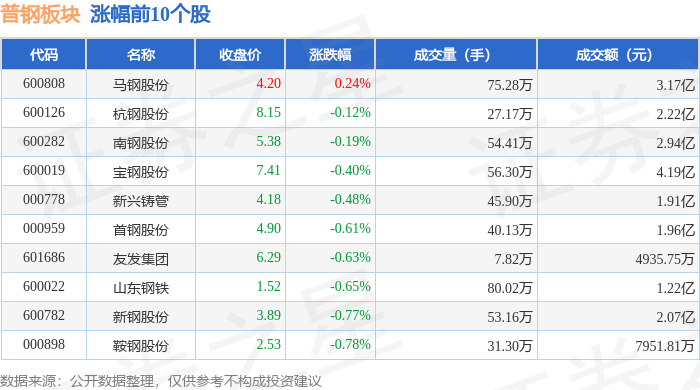
Market Overview - The steel sector experienced a decline of 0.72% on December 30, with Wujin Stainless Steel leading the drop [1] - The Shanghai Composite Index closed at 3965.12, showing no change, while the Shenzhen Component Index rose by 0.49% to 13604.07 [1] Individual Stock Performance - Major steel stocks showed varied performance, with Maanshan Iron & Steel slightly up by 0.24% at a closing price of 4.20, while Wujin Stainless Steel fell significantly by 8.86% to 9.26 [2] - Other notable declines included Angang Steel down by 0.78% to 2.53 and Shougang Corporation down by 0.61% to 4.90 [1][2] Trading Volume and Value - Maanshan Iron & Steel had a trading volume of 752,800 shares with a transaction value of 317 million yuan, while Wujin Stainless Steel had a volume of 339,700 shares and a value of 326 million yuan [1][2] - The overall steel sector saw a net outflow of 119 million yuan from main funds, while retail investors contributed a net inflow of 135 million yuan [2][3] Fund Flow Analysis - Key stocks like Hebei Steel and Baotou Steel saw net inflows from main funds of 16.26 million yuan and 12.10 million yuan respectively, while Wujin Stainless Steel experienced a net outflow of 22.06 million yuan from speculative funds [3] - Retail investors showed a preference for stocks like Baotou Steel, which had a net inflow of 24.11 million yuan, indicating a mixed sentiment in the market [3]


新年钢招及冬储预期 硅铁期货盘面延续震荡反弹
Jin Tou Wang· 2025-12-30 08:01
12月30日,国内期市黑色金属板块涨跌互现。其中,硅铁期货主力合约开盘报5654.00元/吨,今日盘中 高位震荡运行;截至收盘,硅铁主力最高触及5788.00元,下方探低5652.00元,涨幅达1.16%。 上周统计全国136家独立硅铁企业开工率为29.5%,环比上周减少0.8%;日均产量为14065吨,环比上周 减1.30%,减185吨,处近6个月来最低水平。 据日本海关数据统计,2025年11月日本硅铁(>55%)进口总量23409.56吨,环比减少30.40%,同比减少 20.21%。其中11月日本硅铁前三进口国主要来自中国9466.13吨、马来西亚6166.23吨、巴西3032.20吨。 2025年1-11月日本硅铁(>55%)进口总量为314657.30吨,同比减少1.79%。 宝钢1月招标:硅铁2110吨,宝山基地600吨,梅山基地250吨,湛江基地750吨,宝特高金210吨,武钢 75#硅铁300吨。报名截止时间:2025-12-3015:00,报价截止时间:2025-12-3016:00,要求交货期: 2026-01-31。 后市来看,硅铁期货行情将如何运行,相关机构观点汇总如下: 中原期货表 ...
碳市场系列研究报告之六:转型金融助力高碳企业低碳发展
Shenwan Hongyuan Securities· 2025-12-30 05:30
Investment Rating - The report does not explicitly state an investment rating for the industry. Core Insights - Transition finance and green finance form an effective complementary structure, with transition finance targeting high carbon-emitting enterprises for their low-carbon transformation through technological upgrades, while green finance focuses on pure green projects [2][9]. - The international development of transition finance is driven by the EU carbon tax policy, entering a rapid development phase since 2023, with a historical progression through three stages: global consensus (2015-2019), framework establishment (2020-2022), and rapid development (2023-present) [2][14]. - China officially proposed the concept of "low-carbon transition" in 2024, with a series of supportive policies following, including the revision of the "Green Industry Guidance Catalog" to focus on low-carbon transition industries [2][17]. - The 14th Five-Year Plan shifts China's energy management from "dual control of energy consumption" to "dual control of carbon emissions," with an estimated demand for green low-carbon investment reaching 487 trillion yuan over the next 30 years, of which 60% is related to low-carbon transition [2][20]. - Mainstream international transition finance products include Sustainable Linked Loans (SLL), Sustainable Linked Bonds (SLB), and transition bonds, with SLL and SLB directly linking financing costs to sustainability goals [2][25]. Summary by Sections Transition Finance vs Green Finance - Transition finance supports high carbon-emitting projects for low-carbon transformation, while green finance supports energy-saving and emission-reducing projects [9][8]. International Development of Transition Finance - The development of international transition finance has progressed through three stages: consensus (2015-2019), framework establishment (2020-2022), and rapid development (2023-present) [14][10]. China's Transition Finance Development - China's transition bonds include transition bonds and low-carbon transition-linked bonds, with the latter dominating in issuance and financing amounts [3][50]. - The issuance of low-carbon transition-linked bonds reached 104, with a net financing amount of 572 billion yuan, while transition bonds totaled 32 with approximately 207 billion yuan [3][50]. - The main issuers of transition bonds have shifted from state-owned enterprises to local state-owned enterprises, with a corresponding decline in credit ratings from AAA to AA [3][72]. Mainstream Products in Transition Finance - The report identifies three main products in transition finance: transition bonds, SLL, and SLB, with specific characteristics and restrictions on fund usage [25][27]. - Transition bonds are specifically allocated for low-carbon transition projects, while SLL and SLB link financing costs to sustainability targets [25][27]. Advantages and Challenges of Transition Bonds - Despite higher costs, transition bonds offer advantages such as expedited review processes, potential government interest subsidies, and flexible interest rate adjustments linked to ESG goals [3][96][94]. - Transition bonds face challenges including higher issuance costs and a shift in issuer credit ratings, impacting their attractiveness compared to traditional corporate bonds [3][84][89].
全市场唯一钢铁ETF(515210)昨日净流入超4亿元,钢企利润有进一步修复空间
Mei Ri Jing Ji Xin Wen· 2025-12-30 04:03
相关机构表示,发改委和工信部近期相继发声,强调要深入整治"内卷式"竞争,持续实施粗钢产量 调控,钢铁供给端约束预期强化。根据国家统计局数据,25年1-11月,我国粗钢产量8.92亿吨,同比下 降 4.0%;生铁产量 7.74 亿吨,同比下降 2.3%;钢材产量 13.33 亿吨,同比增长 4.0%。未来粗钢产量调 控持续预期下,预计钢铁供给端格局将进一步优化。 根据我的钢铁网及力拓集团,西芒杜铁矿位于几内亚东南部,已探获标准资源量 44.1 亿吨,平均 铁品位超过 65%,初期规划年产能 1.2 亿吨,占 23 年全球铁矿产量的 4.8%。根据宝武集团官方公众 号,2025 年 11 月 11 日,西芒杜铁矿正式投产,预计明后年将持续贡献增量。西芒杜铁矿的投产,不 仅贡献了铁矿石供给增量,且由于宝武集团和中铝等中资企业参与度较高,也有助于提高中国企业在铁 矿上的议价能力,预期铁矿价格中枢将有所下行,进而一定程度上降低钢铁企业成本压力。 粗钢产量调控背景下,未来我国钢铁供需格局将持续改善,叠加铁矿供给的趋于宽松,钢企利润有 进一步修复空间。 钢铁ETF(515210)跟踪的是中证钢铁指数(930606),该指数 ...
研判2025!中国预硬化高速工具钢行业产业链全景、市场规模、竞争格局、发展趋势分析:下游需求爆发,预硬化高速工具钢市场规模稳步增长[图]
Chan Ye Xin Xi Wang· 2025-12-30 01:26
Core Insights - The Chinese pre-hardened high-speed tool steel industry is experiencing growth, with a market size projected to reach 3.1 billion yuan in 2024, reflecting a year-on-year increase of 12.7% [1][7] - This growth is driven by the rapid development of key downstream industries such as automotive manufacturing, aerospace, and mold manufacturing, which significantly increases the demand for high-performance tool steel [1][7] - The "Made in China 2025" initiative and related plans for high-quality manufacturing development are creating a favorable environment for the growth of the pre-hardened high-speed tool steel industry [1][7] - The market size is expected to continue growing, reaching 3.5 billion yuan by 2025 [1][7] Industry Overview - Pre-hardened high-speed tool steel is a type of high-speed tool steel that has undergone special heat treatment to achieve a specific hardness before manufacturing, simplifying processing and reducing deformation risks [3] - The industry supply chain includes upstream resources such as iron ore and strategic metals, midstream production, and downstream applications in automotive, aerospace, mold manufacturing, and energy equipment [4][5] Market Dynamics - The production of iron ore in China has been increasing, from 84.4 million tons in 2019 to 104.2 million tons in 2024, although a slight decline of 3.2% was noted in early 2025 [6] - The automotive sector is a significant application area for pre-hardened high-speed tool steel, with production and sales of automobiles in China rising from 25.7 million units in 2019 to 31.3 million units in 2024, indicating a growing demand for automotive components [6][7] Competitive Landscape - The industry features a diverse competitive landscape, with leading companies like Baosteel and Ansteel holding significant market positions due to their strong R&D capabilities and brand influence [8] - Baosteel, a key player, reported a revenue of 232.4 billion yuan in the first nine months of 2025, with a net profit of 7.96 billion yuan, reflecting a year-on-year profit increase of 35.32% [9] Future Trends - The pre-hardened high-speed tool steel industry is expected to adapt to raw material price fluctuations and international trade uncertainties by enhancing supply chain resilience [10] - The industry is also expanding into new applications beyond traditional sectors, such as renewable energy and high-end medical products, indicating a diversification of market opportunities [10]

大会委员会50+专家公布!60+前沿方向!「海洋关键材料」前沿技术及青年论坛,报告征集中!
DT新材料· 2025-12-29 16:05
Core Viewpoint - The article discusses the upcoming 2026 International Forum on Marine Corrosion and Fouling Prevention and Marine Key Materials, highlighting the importance of marine materials and technologies in response to national initiatives for upgrading traditional marine industries and fostering new productive forces in the marine sector [8]. Group 1: Conference Overview - The forum will take place on April 8, 2026, in Qingdao, featuring various activities including keynote speeches, specialized forums, and a youth forum aimed at encouraging young scientists [8]. - The event is organized by the National Key Laboratory of Marine Key Materials in collaboration with several prestigious institutions, including the Chinese Academy of Sciences and China Shipbuilding Group [11][12]. Group 2: Specialized Forums - The conference will include three specialized forums focusing on: 1. Marine Key Materials: Topics include marine corrosion and fouling materials, new materials for hull drag reduction and noise reduction, and materials for deep-water composite pipes [22]. 2. Corrosion and Protection Technologies: Discussions will cover new mechanisms of marine corrosion, protective technologies, and the application of artificial intelligence in these fields [23]. 3. Erosion and Protection Technologies: This forum will explore wear mechanisms, high-temperature wear studies, and protective technologies for materials under multi-phase flow conditions [23]. Group 3: Youth Forum - The youth forum will adopt a format of 10-minute presentations followed by expert evaluations, aiming to highlight key scientific issues and innovative solutions proposed by young researchers [6][24]. Group 4: Industry Applications - The conference will address the latest demands in traditional and emerging marine industries, including: 1. Shipbuilding: Focus on corrosion protection needs for various ship structures and green ship fuel requirements [21]. 2. Marine Oil and Gas: Discussing protective needs for underwater production facilities and pipelines [21]. 3. Marine Clean Energy: Covering offshore CCUS projects, hydrogen production systems, and offshore wind and solar energy technologies [21]. 4. Deep-Sea Technology: Addressing needs for underwater production devices and deep-sea mining [21]. Group 5: Special Activities - The forum will feature special activities such as product and technology exhibitions, technology matchmaking sessions, and academic poster displays to facilitate collaboration between industry and academia [24].

钢铁行业2026年度投资策略
2025-12-29 15:50
Steel Industry Research Summary Industry Overview - The steel industry is expected to see profitability bottom out in Q3 2024, with overall earnings remaining below historical averages. The profit outlook for 2025 is poor, except for a few months in Q2 and Q3 [1][2] Key Points on Demand - Demand for steel in the real estate sector is expected to continue declining until 2026, although the rate of decline is narrowing. Manufacturing and exports are emerging as new growth drivers, particularly in high-end manufacturing sectors such as machinery, home appliances, and new energy [1][3][4] - The overall steel consumption in the construction chain is stabilizing, with exports and manufacturing becoming critical growth points. Recent export license management policies may lead to some steel returning to the domestic market, affecting supply and inventory levels [1][6] Production and Cost Dynamics - There are discrepancies in growth rates and statistical data across different stages of steel production (pig iron, crude steel, and finished steel), leading to varied market expectations regarding raw material price support [1][5] - Upstream raw material prices (iron ore and coking coal) are severely squeezing the profitability of midstream steel producers. The potential for upstream concessions, such as the commissioning of the Simandou mine, could lower costs [1][7] Policy Impacts - The implementation of anti-involution policies is expected to improve supply-demand fundamentals and stabilize steel prices. The effectiveness of the 50 million ton production cut plan is crucial for market expectations [1][8] - The carbon emissions trading system will create significant differentiation among steel companies, with those holding excess quotas able to profit from selling them, while those lacking quotas will face increased costs [1][11] Environmental and Regulatory Trends - The steel industry is entering a phase of stricter environmental and energy consumption management, with policies expected to be fully implemented by the end of 2025. The year 2026 will be critical for assessing the effectiveness of these measures [1][9][10] Investment Opportunities - In 2026, leading companies like Nanjing Steel, Baosteel, and Hesteel have already seen valuation increases due to their strong performance in product demand and cost management. However, second-tier companies with production capacities of 10-20 million tons, which have historically underperformed, may present significant investment opportunities if they can reduce production costs by 100-200 RMB per ton, potentially doubling their profits [1][12][13]