
洛阳钼业

Search documents
金价大跳水后又狂飙!黄金最新行情:看懂这三点不踩坑还能赚
Sou Hu Cai Jing· 2026-02-06 19:15
Core Viewpoint - The gold market experienced extreme volatility in early February 2026, with prices reaching a historical high of $5626 per ounce before plummeting below $4800, leading to significant losses and buying opportunities for investors [1][3]. Group 1: Market Dynamics - The immediate trigger for the volatility was the nomination of Kevin Walsh as the next Federal Reserve Chairman, who advocates for a significant reduction in the balance sheet, negatively impacting gold prices [3]. - The trading structure amplified the volatility, with increased margin requirements leading to forced liquidations and a chain reaction of sell-offs, resulting in a 30-day volatility rate for gold exceeding 44%, the highest since the 2008 financial crisis [3]. - Despite the fluctuations, global central banks continued to purchase gold, with a reported net purchase of 230 tons in Q4 2025, indicating sustained demand [3]. Group 2: Investor Behavior - The physical gold market reacted swiftly to price changes, with long queues forming for both selling and buying gold in major cities like Beijing and Guangzhou, reflecting a strong interest in physical gold despite price volatility [5]. - Institutional investors displayed a split in outlook, with Deutsche Bank predicting gold could rise to $6000 per ounce, while UBS set targets ranging from $4600 to $7200 per ounce depending on market conditions [6]. - Caution was expressed by some institutions, such as Citigroup, which suggested that gold prices might face structural declines in the latter half of 2026 due to reduced hedging demand [8]. Group 3: Market Data - As of February 5, 2026, gold was priced at $4812 per ounce, down 3.97% from the previous trading day, while domestic prices in China also saw significant declines [11]. - Analysts forecasted that domestic gold prices might fluctuate between 1070 and 1150 yuan per gram in the short term, indicating a period of consolidation [13]. - The trading volume of gold ETFs surged during this period, with significant daily transaction amounts reflecting heightened market activity and investor engagement [8].

资讯日报:美国劳动力数据疲软;白银、加密货币跳水-20260206
Guoxin Securities Hongkong· 2026-02-06 12:45
Market Overview - The Hang Seng Index closed at 26,885, down 0.14% for the day and up 4.90% year-to-date[3] - The S&P 500 index fell by 1.23% to close at 6,883, with a year-to-date decline of 0.69%[3] - The Nasdaq dropped 1.59% to 22,905, marking a year-to-date decrease of 3.02%[3] Sector Performance - The restaurant sector saw significant gains, with Yum China rising over 11% after reporting a Q4 operating profit of $187 million, a 25% year-on-year increase[9] - Automotive stocks showed positive movement, with Xiaomi and NIO both increasing by over 2%[9] - The metals sector faced downward pressure, with Lykins Resources down 6.57% and Minmetals Resources down 6.51%[9] Economic Indicators - U.S. job openings fell to their lowest level since 2020, with a significant increase in layoffs announced by companies, marking the highest level for January since 2009[12] - Initial jobless claims in the U.S. exceeded all economists' forecasts in a Bloomberg survey[12] Cryptocurrency and Precious Metals - Silver prices plummeted nearly 20% due to heavy selling pressure in the precious metals market[12] - Bitcoin dropped below $63,000, erasing all gains since Trump's election victory, influenced by leveraged bets being unwound[12] Technology Sector - Major tech stocks like Microsoft and Amazon experienced declines, with Microsoft down 4.95% and Amazon down 4.42%[12] - AMD's stock fell 17.31% after providing a revenue forecast that, while above market expectations, was below some analysts' high-growth predictions[9]
围剿中国工厂
虎嗅APP· 2026-02-06 10:18
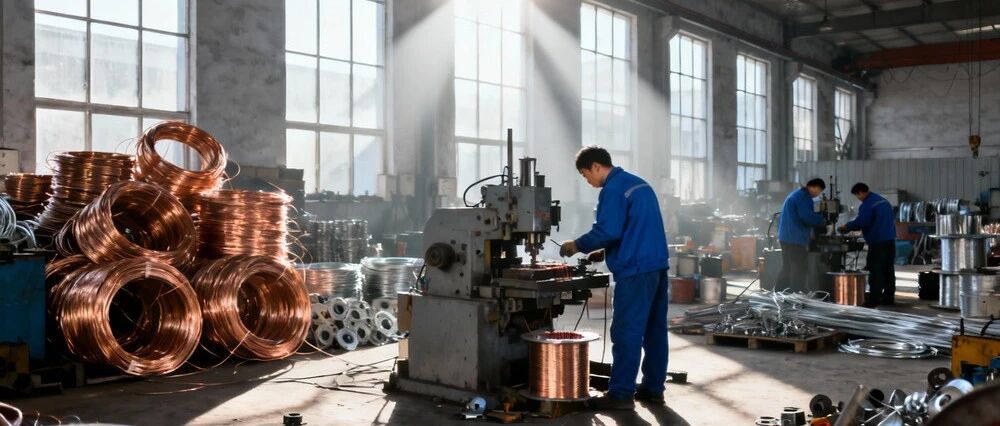
Core Viewpoint - The article discusses the significant pressure faced by Chinese manufacturing due to rising raw material prices, particularly in the context of the booming prices of copper and other industrial metals, which are squeezing profit margins for manufacturers while benefiting upstream resource companies [4][5]. Group 1: Raw Material Price Surge - The price of copper has seen a substantial increase, with a 34.34% rise in 2025, continuing into 2026 [4]. - Other metals such as aluminum, tin, zinc, and lead have also experienced significant price increases, with tin prices rising nearly 40% in 2025 [8]. - Lithium carbonate, essential for electric vehicle batteries, surged from 75,700 yuan per ton in January 2025 to 175,250 yuan per ton by January 2026, marking a 131.4% increase [9]. - Tungsten prices have also skyrocketed, with tungsten concentrate reaching 520,000 yuan per ton and carbide prices increasing from approximately 300,000 yuan per ton to 1,200,000 yuan per ton [9]. Group 2: Impact on Manufacturing Sector - The rising costs of raw materials have led to significant profit pressure on downstream manufacturing sectors, particularly in the home appliance industry, where copper constitutes over 20% of the total cost [12]. - The cost of air conditioning units has increased by 8.45% due to rising copper prices, which reached 105,020 yuan per ton in February 2026, a 42.25% increase from early 2025 [12]. - In the electric vehicle sector, the cost inflation for raw materials alone is estimated at 5,600 yuan per vehicle, primarily driven by lithium price increases [15]. Group 3: Broader Economic Context - Despite being the world's largest manufacturing nation, China's manufacturing sector is facing a dual squeeze from rising upstream costs and competitive pressures from downstream pricing [19][22]. - The profit margin for manufacturing has been declining, with the profit rate dropping to 4.7% in 2025, compared to higher rates in mining and energy sectors [23]. - The article highlights that marketing costs are also rising, with over 63% of surveyed e-commerce businesses spending more than 10% of their sales on paid traffic, further compressing profit margins [20]. Group 4: Strategies for Survival - Chinese manufacturers are exploring three main strategies to cope with these challenges: 1. Expanding business scope by increasing exports of high-value products, with a trade surplus of $1.19 trillion in 2025 [30]. 2. Extending the industrial chain by integrating vertically to reduce dependency on external raw materials [32]. 3. Innovating through technology to replace expensive raw materials, such as the development of sodium-ion batteries as an alternative to lithium-ion [33]. Group 5: Conclusion - The article concludes that the current challenges faced by Chinese manufacturing are indicative of a need for a strategic overhaul, requiring not only corporate efforts but also broader political and economic support to regain control over the industrial chain [28][34].
中国黄金行业展望
Zhong Cheng Xin Guo Ji· 2026-02-06 09:40
Investment Rating - The report rates the overall credit quality of the gold industry as "stable improvement" for the next 12 to 18 months, indicating a positive outlook compared to the previous year's "stable" status [4]. Core Insights - The report highlights that geopolitical risks, weakening dollar credit, and uncertainties in monetary and fiscal policies will significantly influence gold prices, which are expected to rise further in 2026. This will enhance the profitability and cash flow of gold enterprises, although increased debt levels may arise from mergers and acquisitions and inventory demands [4][6]. - The gold industry's overall performance is improving, with rising gold prices leading to increased profits and cash flow for most gold companies, thereby enhancing their debt repayment capabilities and overall credit levels [6][36]. Summary by Sections Analysis Approach - The analysis focuses on the credit fundamentals of the gold industry by examining gold price trends and the factors affecting supply and demand, concluding that gold's financial attributes will have a more significant impact on prices amid economic uncertainties [7]. Industry Fundamentals - Gold prices have surged over 60% since 2025 due to factors like tariff frictions and geopolitical tensions, with expectations for continued upward movement in 2026. The demand for gold as a safe-haven asset is strong, driven by central banks increasing their gold reserves [8][12]. - The report notes that gold supply is relatively stable, with limited increases in mine production and a slowdown in recycled gold supply growth due to high price expectations [16][20]. Financial Performance - The financial performance of gold companies has improved significantly, with total revenues for sample companies increasing by 11.48% and 22.49% year-on-year in 2024 and the first nine months of 2025, respectively [40]. - The net profit for sample companies reached 632.82 billion yuan in the first three quarters of 2025, reflecting a 57.89% increase year-on-year, driven by rising gold prices and production levels [43]. - Operating cash flow has also seen substantial growth, with a 38.30% increase in 2024 and a 38.45% increase in the first nine months of 2025, indicating strong cash generation capabilities [45]. Conclusion - The report concludes that the gold industry is experiencing a favorable environment with rising prices, improved profitability, and enhanced cash flow. However, the ongoing pursuit of mergers and acquisitions may increase financial pressure on companies. The outlook for gold prices remains positive due to geopolitical risks and economic uncertainties [52][53].
申万菱信行业精选近期跌幅仅次于国投白银LOF 有基民表示对基金经理贾成东“一次次失望”
Sou Hu Cai Jing· 2026-02-06 09:26
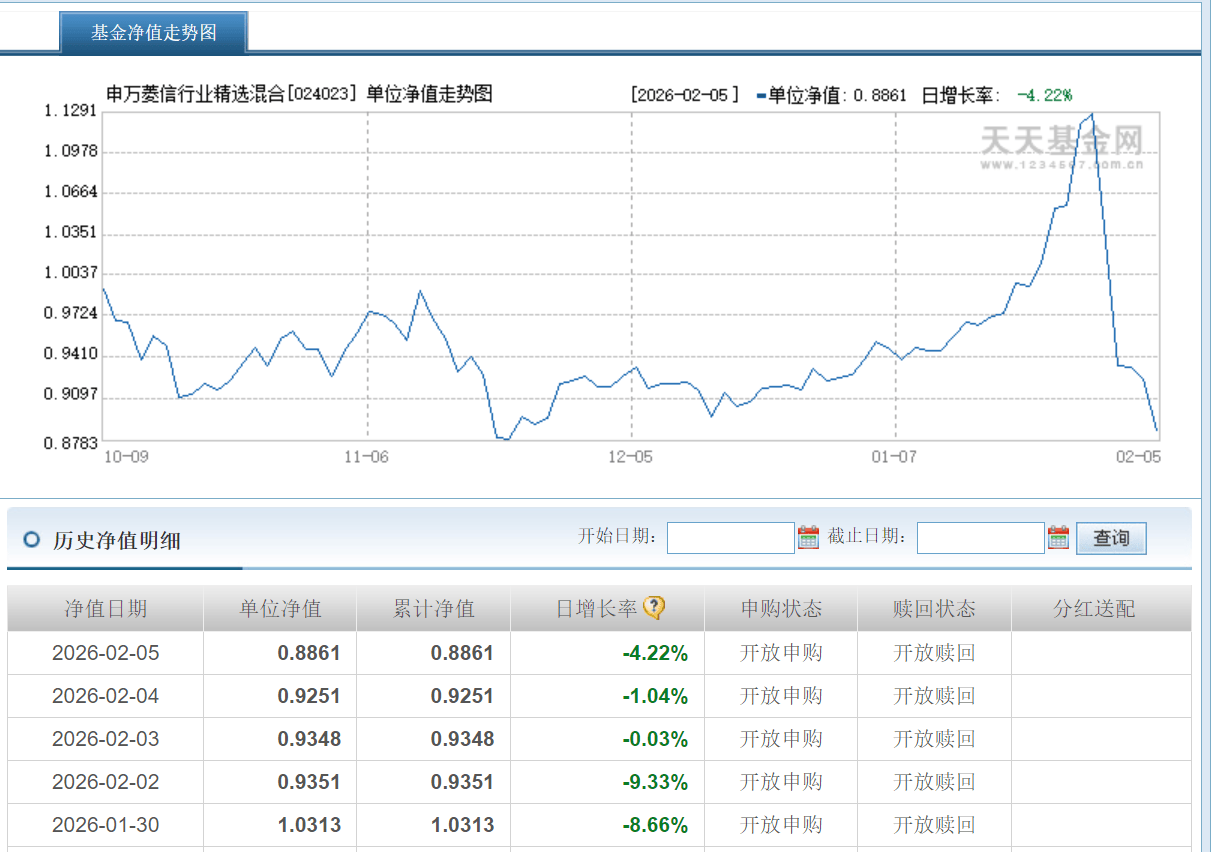
Core Viewpoint - Investors are closely monitoring the actions of renowned fund manager Jia Chengdong after his appointment at Shenwan Hongyuan Fund, as his managed fund has seen a significant decline in net value since the end of January 2026, raising concerns among investors [1][5]. Group 1: Fund Performance - From January 30 to February 5, 2026, the net value of Shenwan Hongyuan Industry Select A fund dropped by 21.52%, ranking second in the market for declines, only behind the Guotou Silver LOF fund [4][5]. - The fund's performance has been disappointing, with a return of -11.39% since its establishment on June 3, 2025, significantly underperforming the benchmark by nearly 27 percentage points [7]. - The fund's assets have shrunk by nearly 43% from its initial size, with a combined scale of less than 700 million yuan by the end of last year [7]. Group 2: Investor Sentiment - Investors have expressed dissatisfaction with Jia Chengdong's management, with complaints about poor performance during both bullish and bearish market conditions [5][6]. - There are suspicions that Jia has increased his holdings in the metals sector this year, despite the fund's overall poor performance [5][6]. Group 3: Fund Manager Background - Jia Chengdong, a veteran in the public fund industry, joined Shenwan Hongyuan Fund at the end of 2024 and has since been a focal point for market attention [5][6]. - His management of the Shenwan Hongyuan Industry Select fund has been marked by a series of poor investment decisions, including high entry points into popular sectors and subsequent losses [6].
华富基金李孝华:稀有金属短期震荡不改长期向好趋势
Zheng Quan Ri Bao Wang· 2026-02-06 07:44
Core Viewpoint - Rare metals are entering a new prosperity cycle driven by global supply chain restructuring and the rapid development of emerging industries, serving as strategic resources for energy transition, high-end manufacturing, and national security [1] Group 1: Market Outlook - Despite recent market volatility, the manager of Huafu Rare Metals ETF remains optimistic about the long-term positive trend for rare metals, believing that short-term fluctuations do not alter this outlook [1] - Rare metals are considered the "blood of the new economy," playing a critical role in high-tech industries despite their relatively small usage, with ongoing value reassessment [1] Group 2: Demand Drivers - Downstream demand remains robust, particularly in sectors such as new energy vehicles, humanoid robots, low-altitude economy, wind power, and industrial motors, leading to strong demand for rare earth magnetic materials [1] - The demand for lithium carbonate in energy storage is growing significantly, with leading companies maintaining full production and overall supply expected to be tight in the first half of the year [1] Group 3: Price Trends and Performance - Benefiting from the gradual price increases of specific rare metal varieties, the overall performance forecast for companies in the CSI Rare Metals Theme Index for Q4 2025 is positive, indicating solid fundamental support [1] - The top ten constituents of the CSI Rare Metals Theme Index include leading companies such as Luoyang Molybdenum (603993), Northern Rare Earth (600111), Tianqi Lithium (002466), and Huayou Cobalt (603799), collectively accounting for approximately 60% of the index weight [2] Group 4: Investment Tools - The Huafu Rare Metals ETF, one of the first products tracking this index in the market, provides investors with a convenient tool to gain exposure to the core strategic metal supply chain, including lithium, rare earths, and cobalt [2]
现货黄金反弹!湖南黄金涨停,有色ETF汇添富(159652)翻红涨1%,盘中资金涌入!近10日“吸金”近3亿元!
Xin Lang Cai Jing· 2026-02-06 06:35
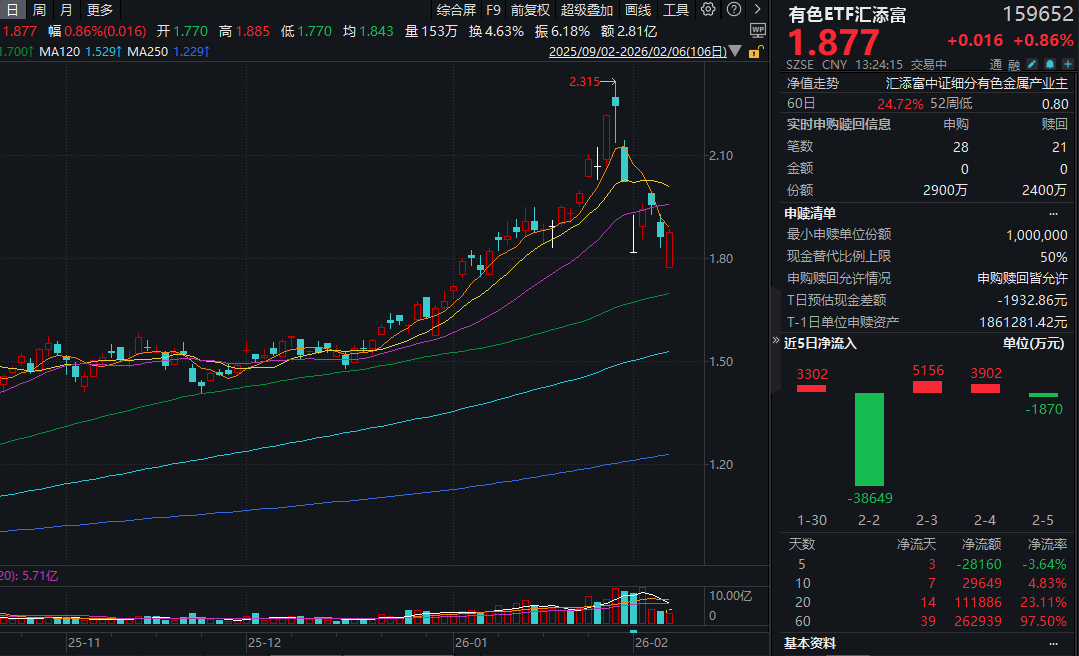
Group 1 - Spot gold and silver experienced a "V-shaped" rebound, with gold increasing by 1% and silver rising over 2% after initial declines of more than 2% and 8% respectively [1] - The non-ferrous sector saw a corresponding rise, with the ETF Huatai-PineBridge (159652) gaining nearly 1% and attracting nearly 10 million yuan in net inflows during the session, totaling close to 300 million yuan over the past 10 days [1] - The China Securities Galaxy believes that the recent price corrections in gold and silver are normal profit-taking actions after reaching historical highs, which may help to release overheated market sentiment [2] Group 2 - In January, the China Logistics and Purchasing Federation reported that the commodity price index rose for the ninth consecutive month, reaching a three-and-a-half-year high, with a month-on-month increase of 6.3% to 125.3 points [3] - Among 50 monitored commodities, 33 saw price increases, with lithium carbonate, refined tin, and refined nickel leading with month-on-month increases of 48.4%, 20.2%, and 19.5% respectively [3] - The non-ferrous metals price index rose significantly by 9.9% month-on-month, driven by factors such as international monetary policy and geopolitical influences [3] Group 3 - Recent pricing logic for non-ferrous metals is shifting from short-term supply and demand to broader macroeconomic factors, benefiting from ongoing fiscal expansion and liquidity in major economies [4] - The copper market is characterized by both supply and demand constraints, with limited new mine production and ongoing supply disruptions, while demand is driven by energy transition and AI industries [4] - The non-ferrous sector is highlighted as having significant investment value due to favorable macroeconomic conditions, with the Huatai-PineBridge ETF (159652) being recommended for its comprehensive exposure to various metal sectors [4][5] Group 4 - The Huatai-PineBridge ETF (159652) has a leading concentration of core strategic commodities such as copper, gold, aluminum, lithium, and rare earths, with a top five stock concentration of 38% [8] - The ETF's index has shown superior performance since 2022, with a cumulative return leading its peers and a lower maximum drawdown, indicating a better investment experience [10] - The index's price increase is driven by earnings rather than valuation expansion, with a current PE ratio of 26.27, down 52% from five years ago, suggesting a favorable valuation [10]

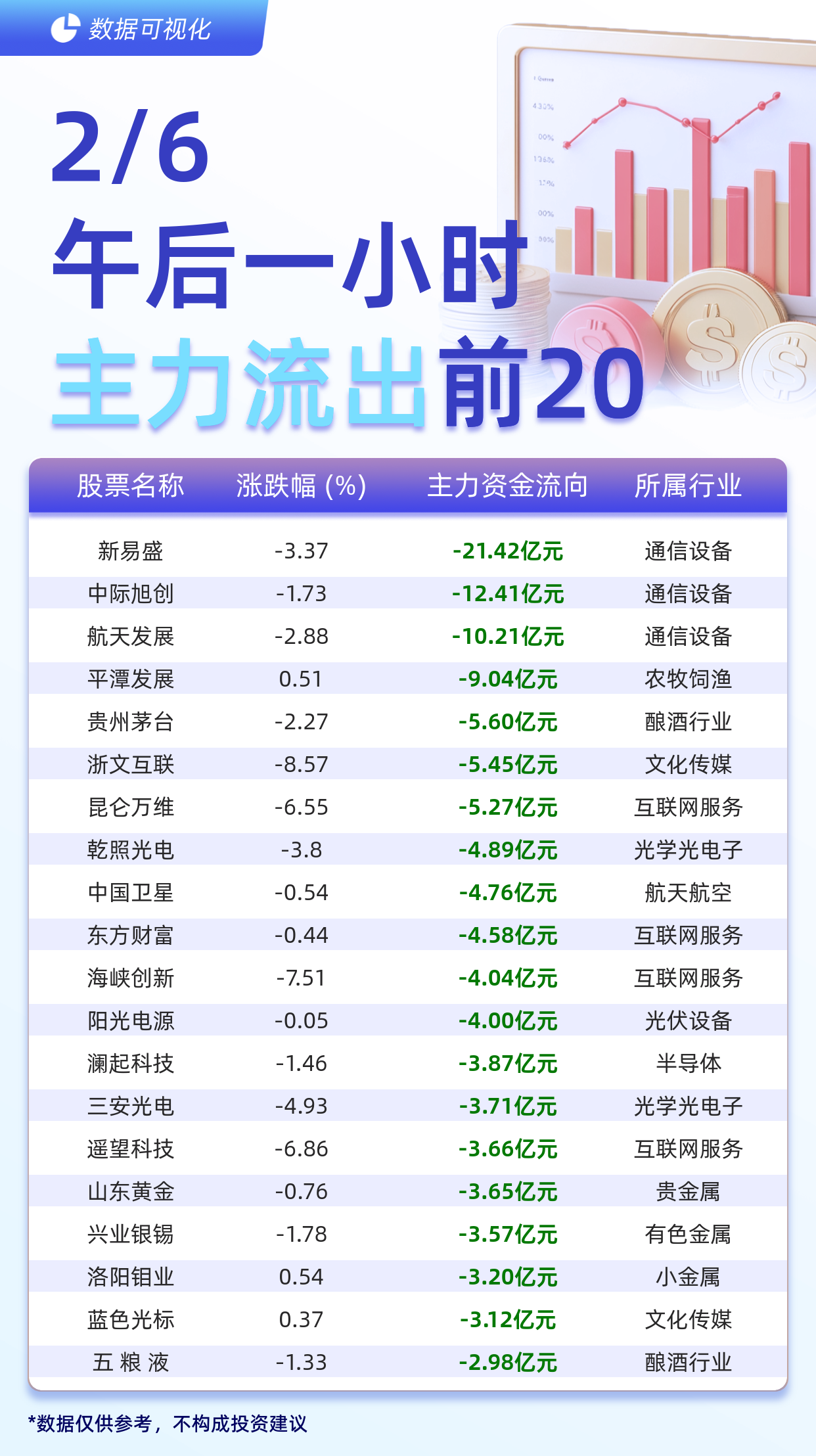
主力个股资金流出前20:新易盛流出21.42亿元、中际旭创流出12.41亿元
Jin Rong Jie· 2026-02-06 06:27
Main Points - The main focus of the news is on the significant outflow of capital from various stocks, highlighting the top 20 stocks with the largest capital outflows as of February 6, with New Yisheng leading at -21.42 billion yuan [1][2][3] Group 1: Stock Performance - New Yisheng experienced a capital outflow of -21.42 billion yuan, indicating a strong sell-off in the communication equipment sector [1][2] - Zhongji Xuchuang saw a capital outflow of -12.41 billion yuan, also within the communication equipment industry [1][2] - Aerospace Development had a capital outflow of -10.21 billion yuan, reflecting investor sentiment in the communication equipment sector [1][2] - Pingtan Development reported a capital outflow of -9.04 billion yuan, indicating challenges in the agriculture and animal husbandry sector [1][2] - Kweichow Moutai faced a capital outflow of -5.60 billion yuan, suggesting potential concerns in the liquor industry [1][2] Group 2: Sector Analysis - The communication equipment sector is notably affected, with three companies (New Yisheng, Zhongji Xuchuang, and Aerospace Development) among the top outflows [1][2] - The liquor industry, represented by Kweichow Moutai, shows a significant outflow, which may indicate market volatility or changing consumer preferences [1][2] - The internet services sector is also impacted, with companies like Kunlun Wanwei and Dongfang Caifu experiencing outflows of -5.27 billion yuan and -4.58 billion yuan respectively [1][2][3] Group 3: Additional Stocks - Other notable stocks with significant outflows include Sunshine Power (-4.00 billion yuan) in the photovoltaic equipment sector and Sanan Optoelectronics (-3.71 billion yuan) in the optical and optoelectronic sector [1][3] - The precious metals sector, represented by Shandong Gold, saw an outflow of -3.65 billion yuan, indicating potential investor caution [1][3] - The cultural media sector, with companies like Zhejiang Wenlian and Blue Focus, also faced outflows of -5.45 billion yuan and -3.12 billion yuan respectively, reflecting market dynamics in this industry [1][3]





有色矿业ETF招商(159690)开盘跌3.81%,重仓股紫金矿业跌5.07%,洛阳钼业跌5.28%
Xin Lang Cai Jing· 2026-02-06 05:55
Group 1 - The core viewpoint of the article highlights a significant decline in the performance of the non-ferrous metal mining ETF, with a drop of 3.81% on February 6, 2023, closing at 2.120 yuan [1] - Major holdings within the non-ferrous mining ETF experienced notable declines, including Zijin Mining down 5.07%, Luoyang Molybdenum down 5.28%, and Northern Rare Earth down 2.71% [1] - The ETF's performance benchmark is the CSI Non-Ferrous Metals Mining Theme Index, managed by China Merchants Fund Management Co., with a return of 120.70% since its inception on June 21, 2023, and a monthly return of 9.84% [1]



安永2025年中国海外投资概览
EY· 2026-02-06 04:10
Investment Rating - The report indicates a positive investment outlook for Chinese overseas investments, with a focus on high-quality growth and strategic cooperation in global markets [5][12]. Core Insights - Chinese enterprises' overseas direct investment (ODI) reached USD 174.4 billion in 2025, marking a year-on-year increase of 7.1%. Non-financial ODI was USD 145.7 billion, up 1.3% [12][25]. - Investment in countries participating in the Belt and Road Initiative (BRI) saw a significant increase, with non-financial ODI amounting to USD 39.7 billion, a growth of 17.6% [25]. - The report highlights a notable recovery in overseas mergers and acquisitions (M&A), with announced transaction amounts reaching USD 43.6 billion, a nearly 40% increase year-on-year [36][39]. - The global economic landscape is characterized by resilience despite challenges, with a projected growth rate of 3.1% for 2026 [5][59]. Summary by Sections 1. Overview of Chinese Overseas Investment in 2025 - The report outlines that China's GDP grew by 5% in 2025, surpassing 140 trillion RMB for the first time [5]. - The overall ODI growth reflects a robust performance amid global economic uncertainties [5][12]. 2. Key Highlights of Chinese Enterprises Going Abroad - Direct investment in BRI countries accounted for 27% of total ODI, an increase of 4 percentage points from the previous year [25]. - New contracts signed in overseas projects reached USD 289.2 billion, up 8.2%, with completed turnover at USD 178.8 billion, a 7.7% increase [51]. 3. Analysis of Overseas M&A - The number of M&A transactions was 429, a slight decrease of 1%, but the value of large transactions (over USD 1 billion) increased significantly [36][39]. - The most active sectors for M&A included consumer goods, TMT (Technology, Media, and Telecommunications), and mining and metals [39][42]. 4. Factors Influencing Overseas Investment in 2026 - The report anticipates continued high-quality outbound investment, driven by China's strategic focus on expanding domestic demand and optimizing investment structures [5][59]. - Geopolitical dynamics and trade relations, particularly with the U.S. and European countries, are expected to shape investment strategies [5][66]. 5. Policy Support for Overseas Investment - The report emphasizes the Chinese government's commitment to enhancing support for enterprises going abroad, including the establishment of a comprehensive service system for overseas operations [17][20].