
中天科技

Search documents
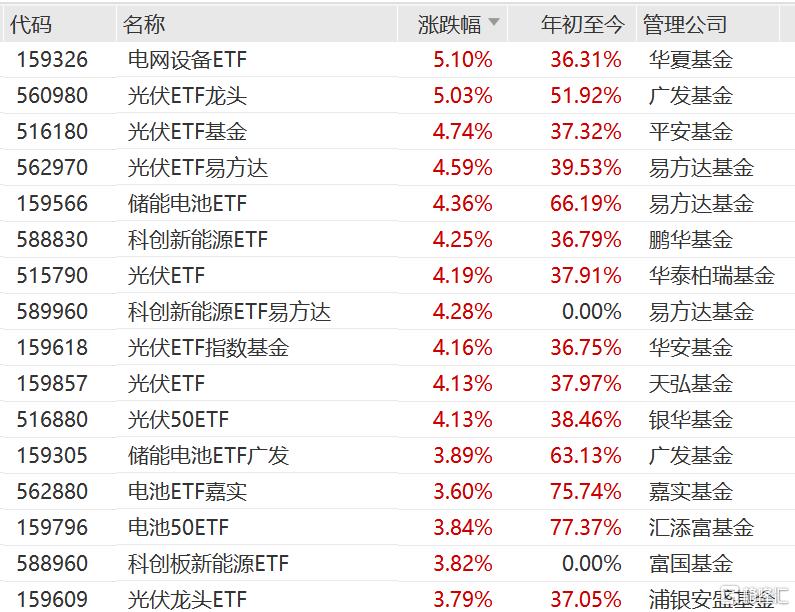
新能源午后拉升,电网设备ETF、光伏ETF龙头涨超5%,储能电池ETF、科创新能源ETF涨超4%
Ge Long Hui A P P· 2025-11-05 05:52
Core Viewpoint - The renewable energy sector is experiencing significant growth, with ETFs related to grid equipment and photovoltaic (PV) technology showing substantial gains, indicating a bullish trend in the market. Group 1: ETF Performance - The Grid Equipment ETF increased by 5.10% and has a year-to-date growth of 36.31% [2] - The leading Photovoltaic ETF rose by 5.03% with a year-to-date increase of 51.92% [2] - The Energy Storage Battery ETF saw a 4.36% rise and a year-to-date growth of 66.19% [2] - Other notable ETFs include the Photovoltaic ETF Fund (4.74% increase, 37.32% YTD) and the Photovoltaic 50 ETF (4.13% increase, 38.46% YTD) [2] Group 2: Industry Insights - The Grid Equipment ETF tracks the CSI Grid Equipment Theme Index, with a high concentration of heavyweights in ultra-high voltage and charging pile sectors, indicating strong market positioning [2][3] - The Energy Storage Battery ETF focuses on the new energy battery index, featuring leading companies like CATL and Gotion High-Tech, reflecting robust demand in the storage sector [3] - The Photovoltaic ETF covers the entire PV industry chain, with a significant focus on core manufacturing, including key players like LONGi Green Energy and Tongwei Co [3] Group 3: Market Trends and Policies - The energy storage sector is witnessing a strong demand-supply dynamic, with leading battery manufacturers operating at full capacity and prices continuing to rise [4] - The photovoltaic industry is undergoing a transformation driven by policy and technology, with the "14th Five-Year Plan" emphasizing green transition and sustainable development [5] - China's photovoltaic installation capacity is expected to grow by approximately 45% in 2024, marking a significant shift in the energy landscape [6]

锚定“十五五” 杭氧股份“空分+气体”双轮助力战略产业再升级
Quan Jing Wang· 2025-11-05 01:45
Core Insights - Hangyang Co., Ltd. has been deeply involved in the CCUS (Carbon Capture, Utilization, and Storage) field for many years, developing scalable CO2 capture and food-grade CO2 production technologies, while also keeping an eye on emerging sectors [1] - The company is strategically positioned to support China's 14th Five-Year Plan, which emphasizes the development of strategic emerging industries, including biomanufacturing and quantum technology [1] - Hangyang is leveraging its dual-engine strategy of "air separation equipment + gas business" to drive technological upgrades and enhance the industrial ecosystem [1][5] CCUS and Hydrogen Energy - The company has established a comprehensive hydrogen energy business, focusing on hydrogen production, purification, storage, and transportation, and has initiated a project in collaboration with Longze Energy and Shanghai Hydrogen Feng to produce high-purity hydrogen for fuel cell vehicles [2] - The project will have a capacity of 2825 Nm³/h for hydrogen production from coke oven gas, contributing to the development of a clean, low-carbon hydrogen energy system [2] Aerospace Industry Engagement - Hangyang has a long-standing relationship with China's aerospace industry, having been a key supplier of liquid oxygen equipment since the 1950s, and continues to provide critical products and technologies for space missions [3] - The company recently won a bid for a large liquid oxygen tank construction project at a launch site, enhancing the storage capacity and efficiency for aerospace operations [3] Nuclear Fusion and Advanced Manufacturing - The nuclear fusion market is projected to grow significantly, with estimates suggesting a market size of approximately $361.56 billion by 2025 and over $647.5 billion by 2035, indicating a strong future for this energy source [3] - Hangyang's recent success in winning a bid for a low-temperature nitrogen system project in the nuclear fusion sector highlights its growing capabilities and recognition in this field [4] Semiconductor and Specialty Gases - The company has expanded its presence in the semiconductor and specialty gases market through acquisitions, enhancing its competitive edge in high-end gas products [4] - Hangyang's helium products are widely used in advanced manufacturing sectors, including semiconductors and aerospace, and it has secured contracts to supply critical gases for major semiconductor projects [4]

超级周期,资金持续流入赛道
3 6 Ke· 2025-11-04 11:24
Core Insights - The main issue facing AI development is not the availability of chips but rather the lack of sufficient electricity to support GPU operations [10][12][28] Group 1: AI and Power Demand - The rapid growth of AI is leading to an increased demand for electricity, particularly in data centers, which is expected to push North America's power demand into a new growth cycle [13][17] - Microsoft CEO Satya Nadella highlighted that the AI industry is currently facing a power shortage rather than a chip surplus [10][12] - OpenAI has urged the U.S. government to significantly increase investments in power infrastructure, suggesting a target of adding 100 GW of power capacity annually [14] Group 2: Market Reactions and Trends - The A-share market has seen a surge in electric grid equipment stocks, driven by the growing demand for power due to AI and controlled nuclear fusion themes [2][7] - The only electric grid equipment ETF (159326) has attracted over 527 million in investments over the past 20 days, reaching a historical high in size [3][25] - The electric grid equipment ETF has seen a year-to-date increase of 29.7%, indicating strong market interest [25] Group 3: Future Projections - The global nuclear fusion market is projected to exceed $40 trillion by 2050, indicating significant future investment opportunities [9] - Data centers are expected to account for 8.1% of total U.S. electricity consumption by 2030, up from 4.2% in 2024 [17] - The U.S. power grid has seen limited growth in capacity, primarily from renewable sources, while traditional power sources are declining [20] Group 4: Technological Innovations - Companies like NVIDIA are pushing for innovations in data center power infrastructure, such as transitioning to 800V direct current systems to improve efficiency [21] - Solid-state transformers (SST) are being highlighted as a solution to meet the increasing power demands of AI data centers [21][22] - Domestic companies are also making strides in the global market, with significant growth in transformer exports from China [23]



超级周期!资金持续流入赛道
Ge Long Hui· 2025-11-04 09:49
Core Insights - The main issue facing AI development is not chip supply but rather the lack of sufficient electricity to support GPU operations, as highlighted by Microsoft CEO Satya Nadella [1][7][11] - The demand for electricity is surging due to the rapid expansion of data centers driven by AI, leading to significant implications for the energy sector [10][12][15] Group 1: Electricity Demand and AI - The AI competition is evolving into an electricity competition, with the explosion of AI computing power driving a new cycle of electricity demand growth in North America [10][12] - OpenAI has urged the U.S. government to significantly increase investments in electricity infrastructure, suggesting a target of adding 100 GW of generation capacity annually [11][12] - Data centers are projected to account for 8.1% of total U.S. electricity consumption by 2030, up from 4.2% in 2024, indicating a substantial increase in demand [15][17] Group 2: Market Trends and Investment Opportunities - The global nuclear fusion market is expected to exceed $40 trillion by 2050, indicating a long-term growth opportunity in energy technology [4][7] - The electric grid investment cycle is currently favorable, with significant growth in transformer exports from China, which increased by 52.73% year-on-year [20] - The only electric grid equipment ETF (159326) has seen a significant inflow of capital, with a recent increase in size exceeding 5.27 billion, reflecting strong investor interest [1][22] Group 3: Technological Innovations - Companies are exploring advanced power supply solutions, such as the 800V direct current architecture proposed by NVIDIA, to enhance efficiency in data centers [18][24] - Solid-state transformers (SST) are being recognized as ideal for high power density applications, potentially reducing peak demand by about 5% [18][19] - Domestic companies are rapidly catching up in the SST supply chain, with firms like Jinpan Technology and Sifang Co. making significant strides in overseas markets [19][20]

超级周期!资金持续流入赛道
格隆汇APP· 2025-11-04 09:11
Core Viewpoint - The main issue in AI development is not the lack of computing power but the insufficient electricity supply to support the growing demand for data centers and AI infrastructure [2][11][14]. Group 1: AI and Electricity Demand - The rapid expansion of AI and data centers is leading to a significant increase in electricity demand, particularly in the United States, where the electricity consumption from data centers is projected to rise from 4.2% in 2024 to as high as 25% by 2030 according to various forecasts [18][21]. - Microsoft CEO Satya Nadella emphasized that the AI industry is facing challenges due to a lack of adequate power infrastructure rather than a shortage of chips [11][12][14]. - OpenAI has called for substantial investments in electricity infrastructure, suggesting a target of adding 100 GW of power capacity annually to meet the demands of AI [15][16]. Group 2: Market Trends and Investment Opportunities - The electric grid equipment sector has seen a surge in interest, with the only electric grid equipment ETF (159326) attracting over 5.27 billion in investments over the past 20 days, reaching a historical high in scale [4][31]. - Companies in the electric grid equipment sector, such as Shenma Electric and Moen Electric, have experienced significant stock price increases, with some stocks hitting their daily limit [10][29]. - The global nuclear fusion market is expected to exceed $40 trillion by 2050, indicating a long-term investment opportunity in energy technologies [10][11]. Group 3: Technological Innovations - Innovations such as the transition to 800V direct current (DC) power systems are being pursued to enhance the efficiency of data center power supply, with companies like NVIDIA leading the charge [22][34]. - Solid-state transformers (SST) are being recognized for their ability to meet the high power density demands of AI data centers, potentially reducing peak demand by about 5% [23][34]. - The ongoing global investment in electric grid infrastructure is expected to create a favorable environment for companies involved in power supply and distribution technologies [26][29].

国金证券:25Q3风电板块盈利继续向上 看好本轮整机盈利弹性释放周期
Zhi Tong Cai Jing· 2025-11-04 08:49
Core Viewpoint - The wind power industry is experiencing improved operational cash flow and strong demand, with expectations for continued growth in the fourth quarter and beyond [1][2][3]. Group 1: Industry Performance - In Q3 2025, the wind power sector achieved a revenue of 66.2 billion yuan, a year-on-year increase of 27% [2]. - The net profit attributable to shareholders reached 1.45 billion yuan, up 4.6% year-on-year, indicating a sustained growth trend in profitability [2]. - The operating cash flow for the sector improved to 3.4 billion yuan, an increase of 700 million yuan compared to the previous year [2][4]. Group 2: Market Demand and Orders - The domestic wind power bidding remained high, with an estimated 300 GW of orders on hand, ensuring robust future demand and stable pricing [3][4]. - The average winning bid price for onshore wind projects from January to October was 1,593 yuan/kW, reflecting a 12% increase compared to 2024 [3][4]. Group 3: Segment Analysis - The profitability in the turbine segment is diversifying, with companies like Goldwind and Yunda benefiting from fewer low-price orders and an increase in offshore wind project deliveries [4]. - Operators' cash flow significantly improved in Q3 due to accelerated national subsidies, which is expected to enhance project investment enthusiasm [4]. - The offshore wind segment is experiencing high demand, with capital expenditures accelerating as companies expand their new bases [4][5]. Group 4: Investment Recommendations - The company recommends focusing on turbine manufacturers benefiting from sustained demand and improved pricing, highlighting Goldwind Technology, Yunda Co., and Mingyang Smart Energy [5]. - Companies in the offshore cable and foundation segments, such as Daikin Heavy Industries and Dongfang Cable, are also recommended due to high demand and overseas order spillover [5]. - The foundry and blade segments are expected to see significant performance elasticity due to tight supply and demand, with recommendations for Jinlei Co. and Times New Materials [5].

三责新材闫永杰: 以硬核陶瓷破局半导体国产化
Zhong Guo Zheng Quan Bao· 2025-11-03 20:30
Core Insights - The company, Sanze New Materials, is rapidly emerging in the advanced ceramics sector, particularly focusing on silicon carbide materials, aiming to break the foreign monopoly in high-end ceramic components [1][3] - The strategic relocation of the company's headquarters from Shanghai to Nantong reflects a shift towards regional industrial collaboration and efficiency [2][3] - Sanze New Materials has established partnerships with local enterprises and government support, enhancing its position within the new materials industry in Nantong [3][4] Company Strategy - The company has transitioned its headquarters to Nantong to overcome operational inefficiencies caused by the separation of its headquarters and manufacturing base [2] - Government support has been crucial, providing land and facilitating connections with local industry leaders, which has been instrumental in the company's growth [2][3] - Sanze New Materials aims to achieve self-sufficiency in key materials through continuous innovation and collaboration within the industrial chain [1][4] Technological Advancements - The company has developed three core technological capabilities: large-size complex shape sintering, precision forming based on 3D printing, and high-purity coating technology for semiconductor equipment [4] - Sanze New Materials has significantly improved the yield rate of complex structural components to 70%, which is notably higher than the industry average [4] - The company is now entering the semiconductor market, with its products achieving performance levels comparable to international counterparts [4][5] Financial Growth - The company's revenue has grown from 30 million yuan in 2020 to an expected 270 million yuan in 2023, indicating strong market demand [5] - Despite a decrease in profit margin from 30% to approximately 15%, the company recognizes the need for continuous innovation to maintain profitability [5][6] - Sanze New Materials is planning to list on the New Third Board and aims for the Beijing Stock Exchange by mid-2026, with funds primarily directed towards semiconductor component production and R&D [5][6] Future Outlook - The company is focused on enhancing its capabilities in high-performance ceramic materials to support national goals in semiconductor technology [6] - Sanze New Materials is committed to addressing technological bottlenecks in critical materials, contributing to the country's self-sufficiency in this sector [6]
以硬核陶瓷破局半导体国产化
Zhong Guo Zheng Quan Bao· 2025-11-03 20:11
Core Viewpoint - The company, Sanze New Materials, is rapidly emerging in the advanced ceramics sector, particularly in silicon carbide materials, aiming to break the foreign monopoly in high-end ceramic components, with a focus on strategic national fields like semiconductors and renewable energy [1][2]. Strategic Migration and Industry Collaboration - The company initially established its headquarters and R&D center in Shanghai, with manufacturing in Nantong, but later moved its headquarters to Nantong to enhance operational efficiency and integrate into the local industrial cluster [2][3]. - Nantong is developing into a new materials industry hub, and Sanze's products are critical for sectors such as chemicals, photovoltaics, lithium batteries, and semiconductors [2][3]. - The local government has played a supportive role in facilitating the company's integration into the regional industrial ecosystem, providing land and policy support [2][3]. Technological Breakthroughs - Sanze New Materials has achieved significant technological advancements, including large-size complex shape sintering, precision forming based on 3D printing, and high-purity coating processes for semiconductor equipment [3]. - The company has improved the yield rate of complex structural components to 70%, significantly higher than the industry average [3]. - Sanze's products are now entering the verification systems of major domestic equipment manufacturers and chip manufacturers, with initial small-scale deliveries already made [3]. Financial Growth and Future Plans - The company's revenue has grown from 30 million in 2020 to an expected 270 million in 2023, although profit margins have decreased from 30% to around 15% due to increased competition [5]. - Sanze is planning to list on the New Third Board and aims for a listing on the Beijing Stock Exchange in the first half of 2026, with funds primarily allocated for semiconductor component production and R&D [4]. Company Culture and Vision - The transition from a scientific to a business mindset emphasizes the importance of product manufacturability and market competitiveness [5]. - The company is focused on self-research and industrialization of high-performance ceramic materials, contributing to national technological advancements in critical material fields [6].
北京硅光芯片企业冲刺港交所!阿里小米联手投资,北航校友创办
Sou Hu Cai Jing· 2025-11-03 12:00
Core Viewpoint - Haiguangxin is officially listed on the Hong Kong Stock Exchange, focusing on optical interconnect products for AI data centers, with a significant portion of its revenue derived from AI-related fields. Company Overview - Established in November 2011, Haiguangxin specializes in optical modules, active optical cables (AOC), and other products, with a product range that includes transmission rates of 100G, 200G, 400G, and 800G, utilizing self-developed silicon photonic chips for large-scale client delivery [4][6]. - Major investors include Alibaba China, Xiaomi, and Zhongtian Technology, holding 4.73%, 2.71%, and 1.31% of shares respectively, while the founder and CEO, Dr. Hu Chaoyang, holds 11.11% [4]. Financial Performance - In 2024, Haiguangxin is expected to be one of the first companies in China to achieve mass production and delivery of 800G optical modules [8]. - The company ranked 10th among global professional optical module providers by revenue in 2024, with a revenue growth rate of 189.6% from 2022 to 2024, and is projected to rank 6th globally and 5th in China, capturing 1.8% of the global market share [10][12]. - Revenue figures from 2022 to 2025 show significant growth, with revenues of 1.03 billion, 1.75 billion, 8.62 billion, and 6.98 billion RMB respectively, although the company has not yet achieved profitability [17][20]. Product Development and Market Position - Haiguangxin's products primarily support AI data centers, with 88.7% of its revenue coming from AI-related sectors [6]. - The company is focused on developing high-speed optical interconnects, including next-generation 3.2T and 6.4T products, and advanced optical interconnect technologies such as near-package optics (NPO) and co-packaged optics (CPO) [16][23]. - The company has established a complete supply chain from upstream silicon photonic wafer fabrication to downstream leading cloud service providers [16]. Research and Development - As of June 30, 2025, Haiguangxin has 101 R&D personnel, accounting for approximately 30% of its total workforce, with a strong focus on automation, chip-fiber coupling algorithms, and silicon photonic integration [28]. - The company has developed its own silicon photonic chips, significantly reducing production costs by 30-40% compared to overseas wafer fabrication, and overall module costs by 20-30% [29]. Customer and Supplier Relationships - Haiguangxin's revenue is heavily reliant on its top five customers, which accounted for 90.9% to 86.1% of total revenue from 2022 to 2025 [31]. - The company operates under JDM, ODM, and self-branded models, allowing it to leverage customer brand recognition while utilizing its design and manufacturing capabilities [33]. Industry Trends - The demand for optical interconnects is rapidly increasing due to the explosive growth in AI computing and large-scale data center deployments, with the market for AI optical modules experiencing significant growth [38]. - The company plans to collaborate with leading GPU manufacturers to develop silicon photonic solutions aimed at reducing data transmission distances and energy consumption, enhancing the competitiveness of its optical interconnect products [38].
国内海上风电市场现状与海缆企业出海欧洲
2025-11-03 02:35
Summary of Offshore Wind Power Industry and Submarine Cable Companies Industry Overview - The domestic offshore wind power market is expected to exceed 10 GW in bidding volume for 2025, but actual progress is lower than anticipated due to the cancellation of national subsidies and reduced local subsidies, leading to insufficient motivation for operators to rush installations [1][2][3] - Military factors significantly impact the development of offshore wind power, with projects in Zhejiang, Fujian, and Hainan facing obstacles, while Liaoning province performs better than expected and Guangdong remains a major contributor [1][3][6] - The offshore wind power gross margin is higher than that of onshore wind power, but market pricing and price reduction pressures may lead to a decline in gross margins, necessitating efficiency improvements and cost reductions by companies [1][15] Key Insights - The expected development of offshore wind power in 2026 is anticipated to be better than during the 14th Five-Year Plan, contingent on resolving military issues in affected provinces [1][4] - The domestic supply chain faces challenges, particularly in construction resources and key equipment capacity, which are bottlenecks that hinder the achievement of the annual target of 20 GW [1][11][12] - The demand for 500 kV AC or DC products is increasing, with leading companies maintaining a gross margin of around 50% due to stable competition [1][19][20] Regional Performance - In 2025, the overall progress of offshore wind power projects has increased compared to 2024, but still falls short of expectations. Notable performances include: - Liaoning province shows rapid development with project bidding expected to commence in 2026 [3][9] - Guangdong province has around 4 GW in bidding volume, maintaining its status as a key contributor [3][9] - Fujian province's projects are largely paused, with minimal progress expected in the short term [8][9] Future Projections - The 14th Five-Year Plan's uncompleted offshore wind power projects will carry over to the 15th Five-Year Plan, with expectations of at least 10 GW achievable annually, contingent on new supportive policies [10][11] - The domestic market's absorption capacity is primarily local, with future trends indicating a shift towards market pricing and gradual price reductions [14] International Market Opportunities - Domestic submarine cable companies, such as Dongfang Cable and Zhongtian Technology, are performing well in the European market, which has seen a significant increase in bidding volume since 2023 [22][23] - The European market presents substantial opportunities for domestic companies, although challenges exist regarding legal, operational, and performance aspects [22][26] - The demand for high-voltage products in Europe remains dominated by local companies, but the potential for domestic companies to capture market share is significant due to local production capacity shortages [28][29] Competitive Landscape - The domestic submarine cable industry is experiencing intensified competition, particularly for high-end products like 500 kV cables, where leading companies face fewer challenges compared to smaller firms [24][25] - The gross margin for similar products sold in Europe is approximately 5% higher than in China, driven by the need for domestic companies to establish their reputation in international markets [29] Conclusion - The offshore wind power industry in China is at a critical juncture, with military and regulatory challenges impacting growth. However, the potential for expansion in both domestic and international markets remains strong, particularly in Europe, where demand is high and local production capacity is insufficient. Companies must navigate these challenges while focusing on efficiency and cost management to maintain competitiveness in a rapidly evolving landscape [1][23][24]