ABB

Search documents
中金 | 线缆深度系列1:如何看机器人的“血管与神经系统”?
中金点睛· 2025-08-19 23:41
Core Viewpoint - The embodied robotics industry is rapidly developing, with leading manufacturers beginning to recognize the importance of cable mechanical performance and lifespan for robot functionality. The cable industry for embodied robots is expected to have high entry barriers and significant market potential, suggesting investment opportunities in domestic cable manufacturers that support this growth [2][3]. Summary by Sections Role of Cables in Robotics - Cables serve as the blood vessels and nervous system of robots, requiring high flexibility and physical performance to meet the demands of robotic movement [6][7]. - Robot cables can be categorized into power cables and signal cables, with power cables transmitting electricity and signal cables transmitting control signals [7]. Differences Between Industrial and Embodied Robot Cables - The industrial robot cable industry is mature, while embodied robot cables are in the early stages (0-1 phase) with no clear industry standards [11]. - Embodied robot cables require better flexibility, faster and more accurate signal transmission, and lightweight integration compared to industrial robot cables [11][12]. Market Drivers and Opportunities - The demand for embodied robot cables is increasing due to policy and industry resonance, with humanoid robots and robotic dogs entering small-scale production [14][15]. - Domestic cable manufacturers are expected to grow alongside leading manufacturers, leveraging local supply chain advantages and cost benefits [15][16]. Barriers to Entry - Short-term barriers include technology and certification, while long-term considerations will focus on cost [3][21]. - The complexity of cable design and production processes creates high technical barriers, requiring expertise across multiple disciplines [21][28]. Market Size and Growth Potential - The global market for robot cables is projected to reach nearly 10 billion yuan in the next five years, with the potential to exceed 100 billion yuan in the long term [18][20]. - The market for embodied robot cables is expected to grow at a CAGR of 51% from 2024 to 2030, driven by increasing demand and technological advancements [19]. Cost Considerations - In the long term, cost reduction will become a core competitive factor in the cable solutions market, with a focus on increasing the localization of raw materials and improving production yields [37].


具身智能重构产业边界——“走马观花”2025世界机器人大会
Zhong Guo Qi Che Bao Wang· 2025-08-19 10:16
Group 1: Industry Overview - The 2025 World Robot Conference showcased over 1,500 exhibits from more than 200 domestic and international robot companies, highlighting the rapid advancements in the robotics industry [3][4] - The Chinese robotics industry experienced a revenue growth of 27.8% in the first half of the year, with industrial and service robot production increasing by 35.6% and 25.5% respectively, maintaining its position as the largest industrial robot application market globally for 12 consecutive years [7] Group 2: Technological Advancements - The development of humanoid robots is still in its early stages, but consumer interest is high, with many expressing a desire to purchase highly intelligent and autonomous robots for household assistance [5][6] - The integration of embodied intelligence with AI is crucial for the advancement of robotics, as it enhances the robots' capabilities in executing tasks and interacting with humans [8] Group 3: Market Dynamics - The humanoid robot market is projected to expand rapidly, with estimates suggesting it could reach 150 billion yuan by 2029, and China's market share is expected to increase from 20% to over 50% [13] - The automotive supply chain is increasingly focusing on embodied intelligence, which is reshaping the underlying logic of value creation for both vehicle and component manufacturers [9][10] Group 4: Challenges and Opportunities - The primary challenge facing the robotics industry is the insufficient level of embodied intelligence, which limits the widespread application of humanoid robots [7] - The industry is experiencing structural issues due to speculative investments and the proliferation of subpar products that do not address real-world problems, necessitating a more rational approach to investment and development [14][15]


大摩:7月四家全球工业机器人巨头在中国总出货量同比增12%
Zhi Tong Cai Jing· 2025-08-18 14:25
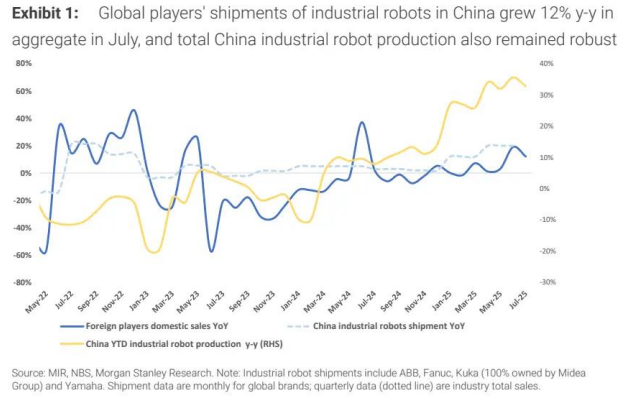
8月17日,摩根士丹利关于中国工业机器人市场发展的研究报告,主要介绍了2025年7月全球主要工业机 器人厂商在中国的出货量增长情况,以及中国工业机器人生产的强劲表现。以下是对这些核心内容的简 要概述: (1)全球主要厂商在中国市场的表现 2025年7月,ABB、发那科、库卡和雅马哈四家全球工业机器人巨头在中国的总出货量同比增长12%, 高于2025年上半年的5%增长率。 根据MIR数据,7月中国工业机器人产量同比增长24%,尽管较2025年上半年的36%增速有所放缓,但 仍保持强劲增长态势。 (2)行业需求分析 中国工业机器人生产的增长主要受到汽车、3C(计算机、通信、消费电子)产品和出口需求的强劲支撑。 发那科的机器人库存保持稳定,订单主要来自电子、PCB(印制电路板)行业的复苏以及汽车OEM(原始 设备制造商)的稳健出货。 (3)市场趋势与展望 报告指出,中国工业机器人市场继续保持增长势头,预计未来随着技术进步和应用领域的拓展,市场需 求将进一步增加。 工业自动化和智能化趋势的推动下,工业机器人在提高生产效率、降低成本以及应对劳动力短缺方面的 作用日益凸显。 备注:本报告的数据和分析主要来源于MIR(Ma ...
中国工业月度报告(2025 年 7 月)-整体需求不错,本土化进程加快IA Monthly (Jul 2025) – Overall Demand Not Bad, and Localization Accelerated
2025-08-18 02:53
Summary of Key Points from the Conference Call Industry Overview - The report focuses on the **Industrial Automation (IA)** sector in **China** and highlights the ongoing trends in demand and market dynamics as of **July 2025** [1][2][13]. Core Insights - **Demand Trends**: - Local IA suppliers experienced a sales growth of **+19% YoY** in July, up from **+18% YoY** in June and **+15% YoY** in May [2][13]. - Inovance's IA order growth improved to over **20% YoY** in July, up from **15% YoY** in June [2][13]. - Key sectors showing solid growth include **logistics, hoisting, battery, auto, woodworking, food & beverage, textile, machine tool, and packaging** [2][13]. - **Overseas Brands Performance**: - Sales growth for leading overseas IA suppliers moderated to **+1% YoY** in July from **+6% YoY** in June [3][13]. - Yaskawa's servo sales growth remained strong at **+25% YoY**, while inverter sales in China dropped to **-11% YoY** [3][13]. - ABB's inverter sales fell to **-6% YoY** from **+10% YoY**, indicating competitive pricing pressures [3][13]. - **Taiwanese Peers**: - Hiwin's sales were weak at **-6% YoY** in July, while Airtac maintained a firm growth of **+7% YoY** [4][13]. - Management expects automation demand to pick up in Q4 as interest rates are cut in the EU and US [4][13]. Macro Indicators - **Manufacturing PMI**: - The Manufacturing PMI declined slightly to **49.3** in July from **49.7** in June, indicating softened confidence in the manufacturing sector [5][67]. - High-end, large, and small companies' PMIs all dropped, while mid-sized companies' PMI recovered to **49.5** [5][67]. - **Business Conditions Index (BCI)**: - The BCI remained at **53.4** in July, down from a peak of **57.7** in April, reflecting cautious investment outlooks among SMEs [67]. - **Export Growth**: - Container export volumes in major ports increased to **+1.9%** in June from **+1.3%** in May, while total exports improved to **+7.2%** in July from **+5.9%** [67]. Sector-Specific Insights - **Servo and Inverter Demand**: - Projected servo demand growth remained at **+12% YoY** in July, while inverter demand fell back to **-2% YoY** [13][18]. - The top downstream applications for servos include **lithium battery, 3C electronics, industrial robots, solar, and machine tools** [24][30]. - **Downstream Demand Trends**: - Demand for servos from top applications slowed to **+15% YoY** in June from **+82% YoY** in May, primarily due to deteriorating solar demand [26][30]. - Inverter demand from top applications improved slightly to **+3% YoY** in June from **+2% YoY** in May, driven by recovery in machine tools and power sectors [26][30]. Conclusion - The IA sector in China is experiencing a divergence in growth between local and overseas suppliers, with local players showing stronger performance amid ongoing macroeconomic challenges. The outlook for the second half of 2025 remains cautiously optimistic, supported by favorable government policies and potential recovery in key sectors.
UTG: An Excellent Utility Fund For The Long Term, But Too Expensive
Seeking Alpha· 2025-08-17 12:10
Group 1 - The primary goal of the "High Income DIY Portfolios" Marketplace service is to provide high income with low risk and capital preservation for DIY investors [1] - The service offers vital information and portfolio/asset allocation strategies aimed at creating stable, long-term passive income with sustainable yields [1] - The portfolios are specifically designed for income investors, including retirees or near-retirees, and include seven different portfolios: 3 buy-and-hold, 3 rotational portfolios, and a 3-bucket NPP model portfolio [1] Group 2 - The portfolio offerings include two high-income portfolios, two dividend growth investing (DGI) portfolios, and a conservative NPP strategy portfolio characterized by low drawdowns and high growth potential [1]

中原证券晨会聚焦-20250815
Zhongyuan Securities· 2025-08-15 02:01
Core Insights - The report highlights the ongoing recovery of the Chinese economy, driven by consumption and investment, with a focus on the capital market's attractiveness and inclusivity [8][9][10] - The semiconductor industry is experiencing growth, with global sales increasing and significant capital expenditure from major cloud companies [21][24] - The new energy vehicle (NEV) sector is rapidly expanding, with China maintaining its leading position in global sales and market share [33][34] Domestic Market Performance - The Shanghai Composite Index closed at 3,666.44, down 0.46%, while the Shenzhen Component Index closed at 11,451.43, down 0.87% [3] - The average price-to-earnings ratios for the Shanghai Composite and ChiNext are at 15.08 and 43.64, respectively, indicating a suitable environment for medium to long-term investments [8][9] Industry Analysis - The chemical industry index rose by 4.51% in July, outperforming the Shanghai Composite Index, with a year-on-year increase of 41.50% [14][15] - The semiconductor sector showed a mixed performance, with integrated circuits up by 2.74% and semiconductor materials down by 0.11% in July [21] - The new energy vehicle market saw sales of 1.26 million units in July, a year-on-year increase of 27.35% [25] Investment Recommendations - The report suggests focusing on sectors such as insurance, robotics, and semiconductors for short-term investment opportunities [8][9][10] - In the chemical sector, attention is drawn to agricultural chemicals, organic silicon, and polyester filament as beneficiaries of anti-involution policies [14][17] - The semiconductor industry is recommended for investment due to its growth potential driven by AI and cloud computing demands [21][24]
小摩看2025 世界机器人大会:人形机器人正迎来爆发前夜?这些明星企业亮了
Zhi Tong Cai Jing· 2025-08-14 14:51
Core Insights - The 2025 World Robot Conference (WRC) held in Beijing highlighted the accelerating commercialization of humanoid robots, marking a significant shift in the robotics industry [1][2]. Industry Highlights - Humanoid robots emerged as the main focus of the conference, attracting attention from various stakeholders including enterprise clients and government officials [2]. - Domestic companies such as Estun, HCFA, Dobot, Siasun, and Keenon are increasing their strategic investments in humanoid robots, viewing the trend as irreversible [2]. - International brands like ABB and Kuka participated but focused more on traditional collaborative and industrial robots [2]. Key Companies - UBTech showcased its Walker S2 robot, capable of 24-hour operation with a sorting speed twice that of the demonstration [3][4]. - Unitree impressed attendees with a boxing demonstration, showcasing its robot's balance and movement control capabilities [5][6]. - Both UBTech and Unitree have demonstrated advanced capabilities, with UBTech planning to deliver 500 units of the Walker S series by 2025, including an order from BYD for 50 units [4]. Technology Maturity - There is a noticeable disparity in technological maturity among companies, with UBTech and Unitree able to perform real-time demonstrations of complex tasks, while many others remain in the prototype stage [7][8]. - Companies like Galbot and Spirit AI are also developing robots for specific applications, indicating a trend towards specialized solutions [9]. Core Components - The performance of robots heavily relies on core components, with Leader Drive showcasing advanced harmonic reducers suitable for humanoid robots [10][11]. - The flexibility of robotic hands is crucial for precise operations, with several manufacturers, including Unitree, presenting their own dexterous hand modules [11]. Global vs. Domestic Development - There is a clear difference in R&D focus between Chinese and global companies, with U.S. firms concentrating on general-purpose robot control technologies, while Chinese players prioritize application breakthroughs in specific scenarios [12]. Industry Outlook - The conference indicated that the technical bottlenecks in humanoid robots are gradually being overcome, with UBTech and Unitree leading in commercialization efforts [13].
走进2025世界机器人大会,景顺长城科技军团孟棋解析“万亿级”市场投资机遇
Zhong Guo Ji Jin Bao· 2025-08-14 13:38
Core Viewpoint - The 2025 World Robot Conference (WRC) showcased significant advancements in robotics, highlighting the industry's rapid evolution and the emergence of investment opportunities in a trillion-dollar market [1][4][14]. Group 1: Event Highlights - The WRC featured over 1,500 exhibits from more than 200 domestic and international robotics companies, with over 100 new products launched, marking a record for domestic robotics exhibitions [1]. - Humanoid robots were a major focus, demonstrating capabilities in various activities such as combat, soccer, and marathon running, showcasing their advanced evolution [1]. - Notable innovations included combat robots with enhanced performance, soccer robots capable of autonomous ball recognition and shooting, and running robots with improved stability for complex movements [1]. Group 2: Application Scenarios - Three primary application scenarios for robotics were identified: 1. Industrial applications focusing on handling and sorting, which are seen as the most feasible for initial deployment in factories [6]. 2. Commercial applications, including robots in supermarkets and pharmacies for item retrieval and entertainment through robot competitions [6]. 3. Consumer-facing applications, particularly robots designed for children and elderly care, highlighting the growing market for personal assistance robots [6]. Group 3: Technological Advancements - Significant advancements were noted in hardware, with reduced costs and improved performance, including specialized components for various operational needs [7]. - The development of "small brain" technology has led to smoother operations in robots, enhancing their balance and agility [8]. - The "big brain" technology, while still developing, has shown progress in environmental recognition and cloud-based control systems, allowing for coordinated operations among multiple robots [8]. Group 4: Market Trends and Investment Opportunities - The robotics sector is experiencing inevitable volatility, but the long-term upward trend is clear, with increasing certainty as the industry matures [9]. - Investment strategies should focus on established hardware sectors and the ongoing technological advancements that will drive future growth [12]. - The overall market is transitioning into a positive cycle, with increasing resilience and opportunities for investment in technology sectors, including robotics [13]. Group 5: Future Outlook - The robotics industry is expected to mature, with a solidifying fundamental base that will reflect positively in the stock market [14]. - Chinese companies are positioned to benefit from industry growth due to their rapid technological advancements and cost advantages [15]. - The focus on high-quality stock selection and long-term investment strategies is essential for navigating the evolving landscape of the robotics sector [16].

走进2025世界机器人大会,景顺长城科技军团孟棋解析“万亿级”市场投资机遇
中国基金报· 2025-08-14 13:33
Core Viewpoint - The 2025 World Robot Conference (WRC) showcased significant advancements in robotics, highlighting the industry's rapid evolution and the emergence of substantial investment opportunities in a trillion-dollar market [1][2][8]. Group 1: Event Highlights - The WRC featured over 1,500 exhibits from more than 200 domestic and international robotics companies, with over 100 new products launched, marking a record for domestic robotics exhibitions [2]. - Humanoid robots were a major attraction, demonstrating capabilities in combat, soccer, and marathon running, showcasing their evolution and versatility [3][4]. Group 2: Application Scenarios - Three primary application scenarios for robotics were identified: 1. Industrial automation focusing on handling and sorting tasks, which are seen as the most readily deployable applications in factories [10]. 2. Commercial applications, including robots that assist in supermarkets and pharmacies, as well as entertainment through robot competitions [11]. 3. Consumer-facing scenarios, particularly those targeting children and the elderly, such as companion robots for learning and rehabilitation [11]. Group 3: Technological Advancements - Significant progress was noted in hardware, with reduced costs and improved performance, including specialized components for various operational needs [13]. - The development of "small brain" technology has enhanced robots' operational fluidity and balance, allowing for more complex movements and interactions [14]. - The "big brain" technology is evolving, enabling robots to perform tasks through cloud-based control, which reduces costs and enhances collaborative operations [14]. Group 4: Market Trends and Investment Strategies - The robotics sector is experiencing inevitable volatility as it matures, with a wave-like market performance observed over the past three years [16]. - Investment strategies should focus on established hardware sectors while also looking for growth in emerging technologies that enhance robots' capabilities [19]. - The overall market is transitioning into a positive cycle, with increasing resilience and clarity in investment opportunities, particularly in technology sectors [21][22]. Group 5: Future Outlook - Chinese companies are well-positioned to benefit from the robotics industry's growth due to their rapid technological advancements and cost optimization [25]. - The focus on high-quality stock selection and long-term investment strategies is essential for navigating the current market landscape [26][28].

电力设备及新能源行业:毛琼佩
Haitong Securities International· 2025-08-14 11:05
Investment Rating - The report suggests a positive outlook for the nuclear power industry, indicating that the entire nuclear power supply chain has entered a performance release window, shifting from thematic trading to fundamental-driven logic [5]. Core Insights - Brookfield projects that global AI infrastructure investment will exceed $7 trillion over the next decade, with approximately $4 trillion allocated for chips, $2 trillion for AI data centers, and $500 billion each for power transmission and other technologies [1][16]. - The U.S. electricity demand forecast has been revised upwards, with expectations of a 15.8% increase by 2029, driven by significant infrastructure investment and the need for enhanced power transmission capabilities [20][21]. - The report highlights a robust recovery in the aerospace and defense sectors, with increased defense spending and modernization needs, suggesting investment opportunities in companies like BAE Systems and Raytheon Technologies [5][6]. Summary by Sections Global Infrastructure and Construction Equipment - Brookfield anticipates over $7 trillion in global AI infrastructure investment in the next decade, with significant allocations for data centers and chip manufacturing [1][16]. Global Electrical and Intelligent Equipment - The U.S. gas turbine price index increased by 1.3% year-on-year as of June 2025, while the production price index for electric and special transformers remained stable [2][26]. - U.S. transformer exports saw a significant increase, with June 2025 figures showing a 48% year-on-year growth [34]. Global Energy Industry - U.S. electricity prices rose by 66.89% week-on-week, while natural gas prices also saw an increase [3]. - The U.S. Department of Energy has selected 11 companies for a pilot program aimed at deploying high-tech nuclear reactors to meet rising electricity demands driven by AI data centers [44][45]. Global New Materials - The report notes a decline in uranium spot prices, with July 2025 figures at $71.10 per pound, down 9.4% month-on-month [4]. Global Defense and Aerospace - The aircraft engine and parts manufacturing price index remained stable, with a year-on-year increase of 1.5% as of June 2025 [4]. - Increased defense spending and the recovery of the aerospace sector present investment opportunities in companies involved in high-performance structural components and aerospace parts manufacturing [5][6].